Product successfully added to your shopping cart
Quantity
Total
There are 0 items in your cart. There is 1 item in your cart.
Total products
Total shipping To be determined
Total

1.6L 8v - M40/M43
Manufacturers
1.6L 8v - M40/M43
Warning: Last items in stock!
New product
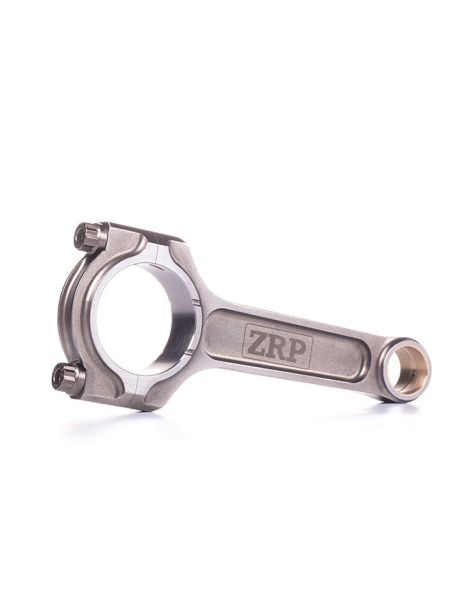
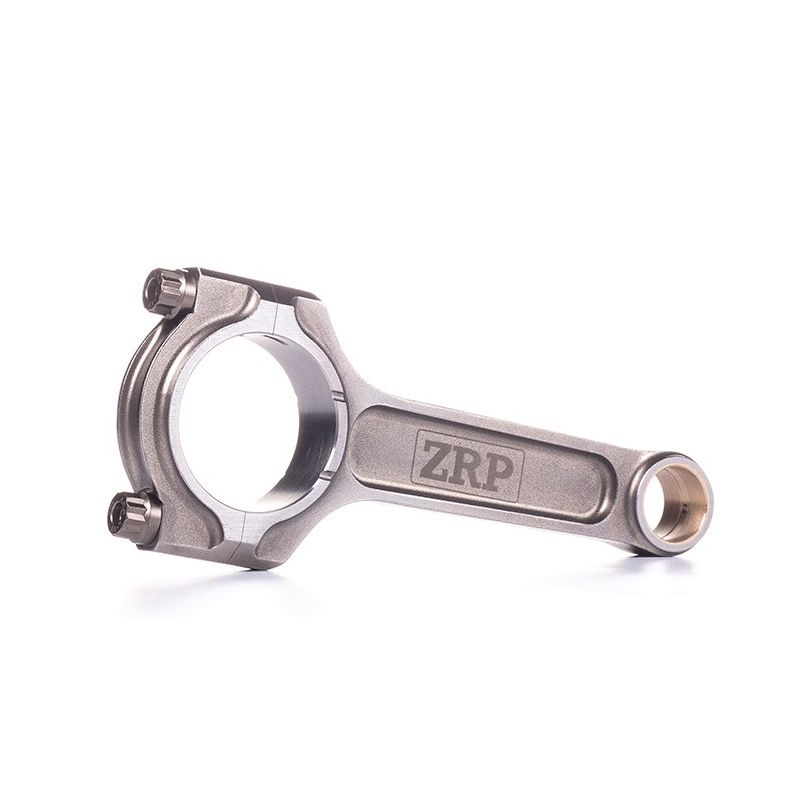
Set of 4 forged 4340 steel connecting rods for BMW 1.6L 8V M40B16 / M43B16.
The M40 is the 1.6-litre inline-four developed by BMW for its entry-level models of the late 1980s. A SOHC 8-valve design (a single belt-driven overhead camshaft), naturally aspirated and fed by electronic fuel injection, it produces around 100 hp from 1,596 cc (84 mm bore, 72 mm stroke). It made its debut on the 316i E30 3 Series in 1987 and replaced the older M10. In the early 1990s BMW gave it a successor, the M43: the same 1.6-litre displacement and SOHC 8-valve architecture, but a redesigned, chain-driven timing system for greater reliability and refinement.
Badged 316i, these two engines powered a large part of the 3 Series: E30 saloons and Touring, E36 saloons, coupés, Touring and Compact, then E46 saloons and coupés up to the mid-2000s, not to mention the 316g natural-gas variant. Output ranges from 99 to 105 hp depending on the version. Known for being sturdy and economical, these 1.6 blocks enjoy a second life in tuning: switching to forged connecting rods and forged pistons secures the bottom end whenever you aim to strengthen the assembly or handle a power increase.
These rods are forged from high-strength 4340 steel, a low-alloy nickel-chromium-molybdenum grade that combines high yield strength with good endurance. The result: a bottom end made reliable as soon as power rises. Moving to forged pistons, raising the rev limit, increasing boost pressure or gaining displacement all take the standard rod outside its range; the ZRP I profile, 498 g for a 140 mm centre-to-centre and a 48 mm big end, carries that load without deflecting.
These rods are sized for modified engines, turbocharged or supercharged, and cover every discipline: rally, drift, drag, circuit and trackdays, hillclimb, time attack. They support Stage 2, Stage 3 and Stage 4+ builds, right up to the competition block. On this 1.6-litre eight-valve four-cylinder they are the essential foundation of a serious build.
| Reference | Brand | Profile | Bolts | Pin diameter | Small-end width | Big-end diameter | Big-end width | Center-to-center | Weight per rod |
|---|---|---|---|---|---|---|---|---|---|
| R-BMW-002-I-4 | ZRP | I | ARP 2000-3/8"-38mm | 48 mm | 21.9 mm | 22 mm | 140 mm | 498 g | |
| R-BMW-002-I-4-L19 | ZRP | I | ARP L19-3/8"-38mm | 48 mm | 21.9 mm | 22 mm | 140 mm | 498 g |
| Rod | Bolts | Tightening torque | Recommended stretch |
|---|---|---|---|
| ZRP (R-BMW-002-I-4) | ARP 2000 | 61 N·m | 0.140 – 0.152 mm |
| ZRP (R-BMW-002-I-4-L19) | ARP L19 | 67.8 N·m | 0.152 – 0.165 mm |
A classic trap is to reuse the manufacturer's original torque figure with ARP fasteners: the two share neither the same steel grade, nor the same thread geometry, nor the same target preload. Applying too low a figure on these rods leaves preload below the force separating the cap: the joint opens intermittently, the seating face degrades, the shell is hammered, clearance grows and the bearing eventually becomes noisy. Applying too high a figure takes the bolt beyond its elastic limit: permanent elongation, vanished preload, a distorted bearing bore and an oval big end, with a shell that no longer bears evenly. The only valid figures for the four ZRP rods of this M40B16 or M43B16 are therefore those in the table below, published by the fastener manufacturer and differentiated between ARP 2000 and ARP L19 in 3/8". Stretch measurement with a dial gauge remains the reference method, assembly is done with ARP lubricant and the kit instructions prevail.
| 4340 is a low-alloy nickel-chromium-molybdenum steel used in aerospace and motorsport. Forged then heat-treated by quenching and tempering, it combines high tensile strength, excellent fatigue life and good ductility. Compared with an original sintered-steel rod, it gains around 19% in yield strength, 8% in tensile strength and 19 to 37% in fatigue life: real margin where sintered steel breaks under heavy load. It is the reference material for any high-performance connecting rod. |
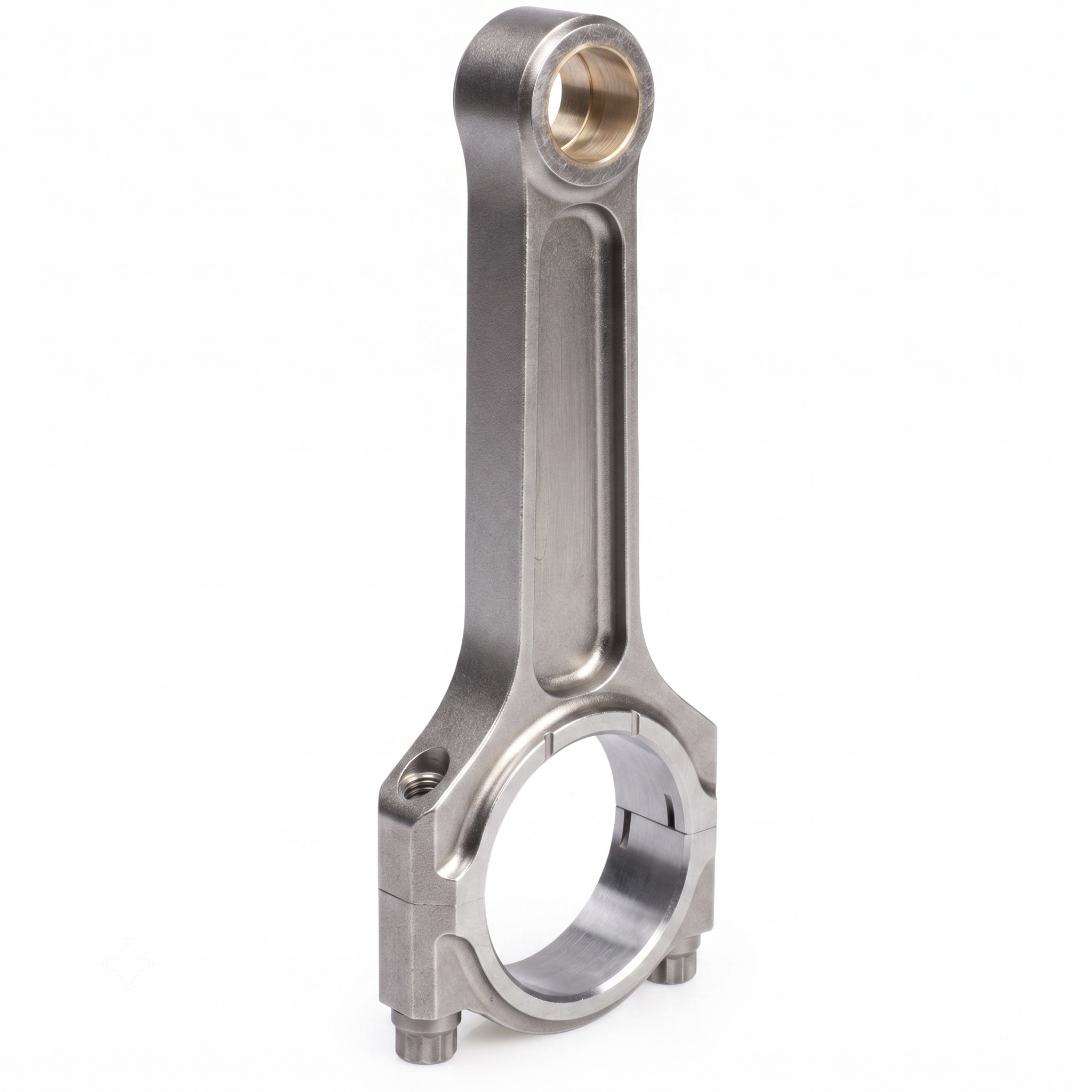 | I-Beam profile. Thin central section and reduced mass: the I-beam rod limits inertia and allows high engine speeds. It is the profile of choice for modern engines, rally builds and high-revving units, drift and time attack in particular. It is the profile chosen for this M40 / M43 kit. |
A rod bolt works in pure tension, cycle after cycle, and it is its metallurgy that decides its service life: alloy grade, cleanliness of the steel, quench and temper carried through the whole section, then rolling of the threads once the part is treated. That last point is decisive, because it work-hardens the thread root, where almost every fatigue failure starts. Add corrosion resistance and dimensional consistency, which give the same preload to every bolt. On this M40B16 / M43B16 two grades are offered in 3/8"-38 mm: choose according to target power and engine speed, then tighten by measured stretch.
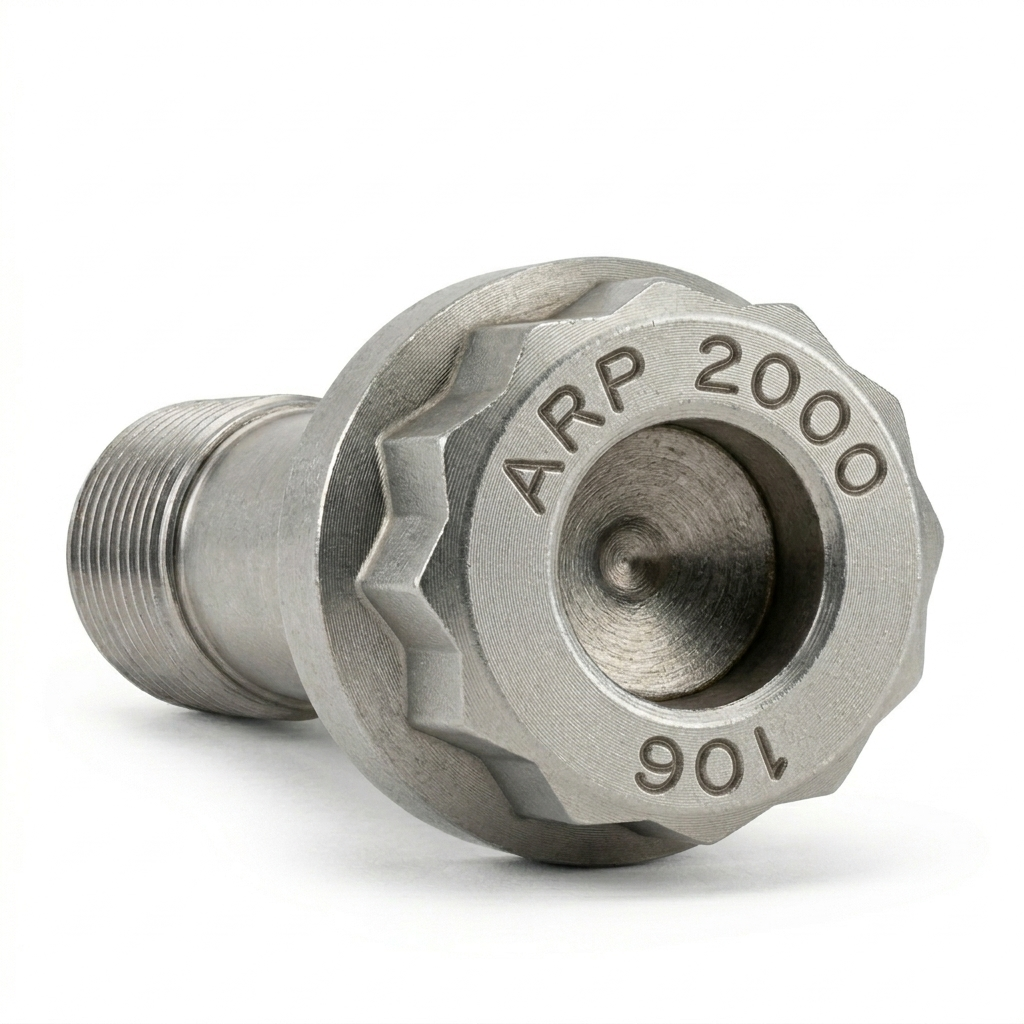 | ARP 2000 (tensile strength around 220,000 psi, ~1,517 MPa) is the high-performance standard. Its thresholds are expressed per cylinder and by bolt diameter: about 200 hp per cylinder in 3/8", at engine speeds up to 8,500 rpm. It is the most versatile choice for circuit, trackday, drift, rally, drag and hillclimb, with an excellent balance of strength and reliability and no particular storage constraints. |
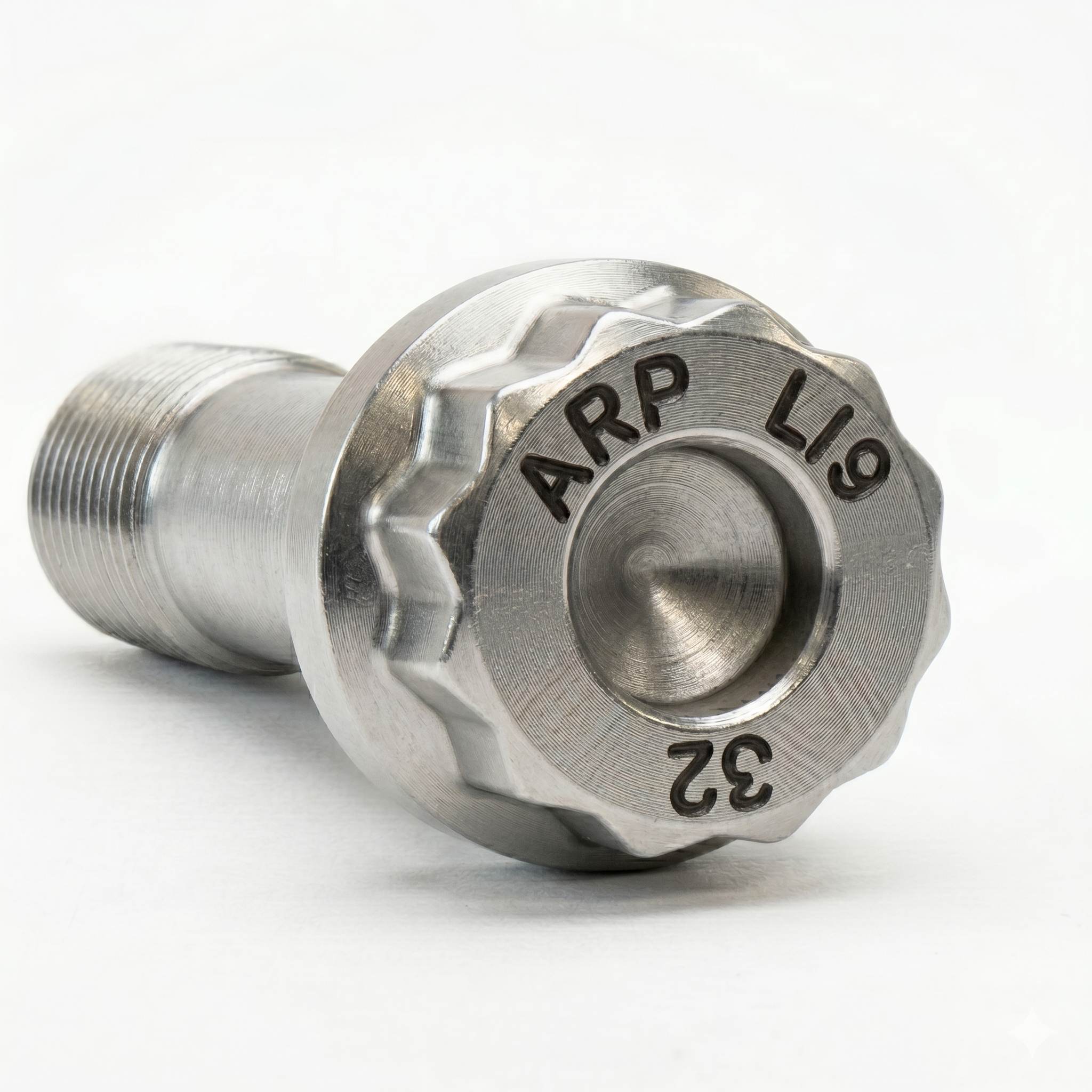 | ARP L19 (tensile strength around 260,000 psi, ~1,793 MPa) is designed for engines pushed to the extreme: high boost pressure, sustained high engine speeds and elevated cylinder pressure. Thresholds rise to about 250 hp per cylinder in 3/8", at engine speeds up to 10,000 rpm. It suits high-power builds in drag, drift, rally and circuit use. Sensitive to corrosion and hydrogen embrittlement, it must be stored and fitted oiled, away from moisture. |
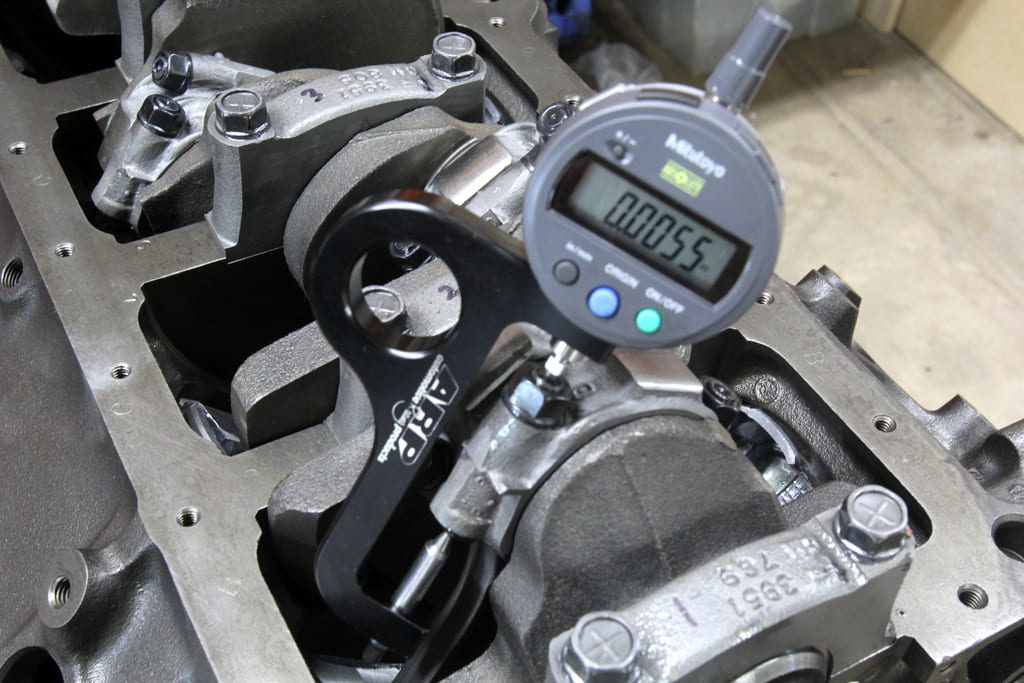 | The most reliable way to fit a rod bolt is to monitor its stretch rather than torque alone. Using a stretch gauge, you measure how far the bolt elongates during tightening and stop at the figure recommended by the manufacturer. This technique ensures even tension from one bolt to the next, essential under high load. Buy the ARP stretch gauge → |
 | ZRP : a Greek brand of high-performance forged connecting rods, made by Drakos Engineering in Athens. Each rod is forged from 4340 steel, precision-machined and balanced to stay reliable at high rpm. Available here in I-Beam profile and supplied with ARP 2000 or ARP L19 bolts, they are designed and inspected in Greece and used in rally, on track and in drift. |
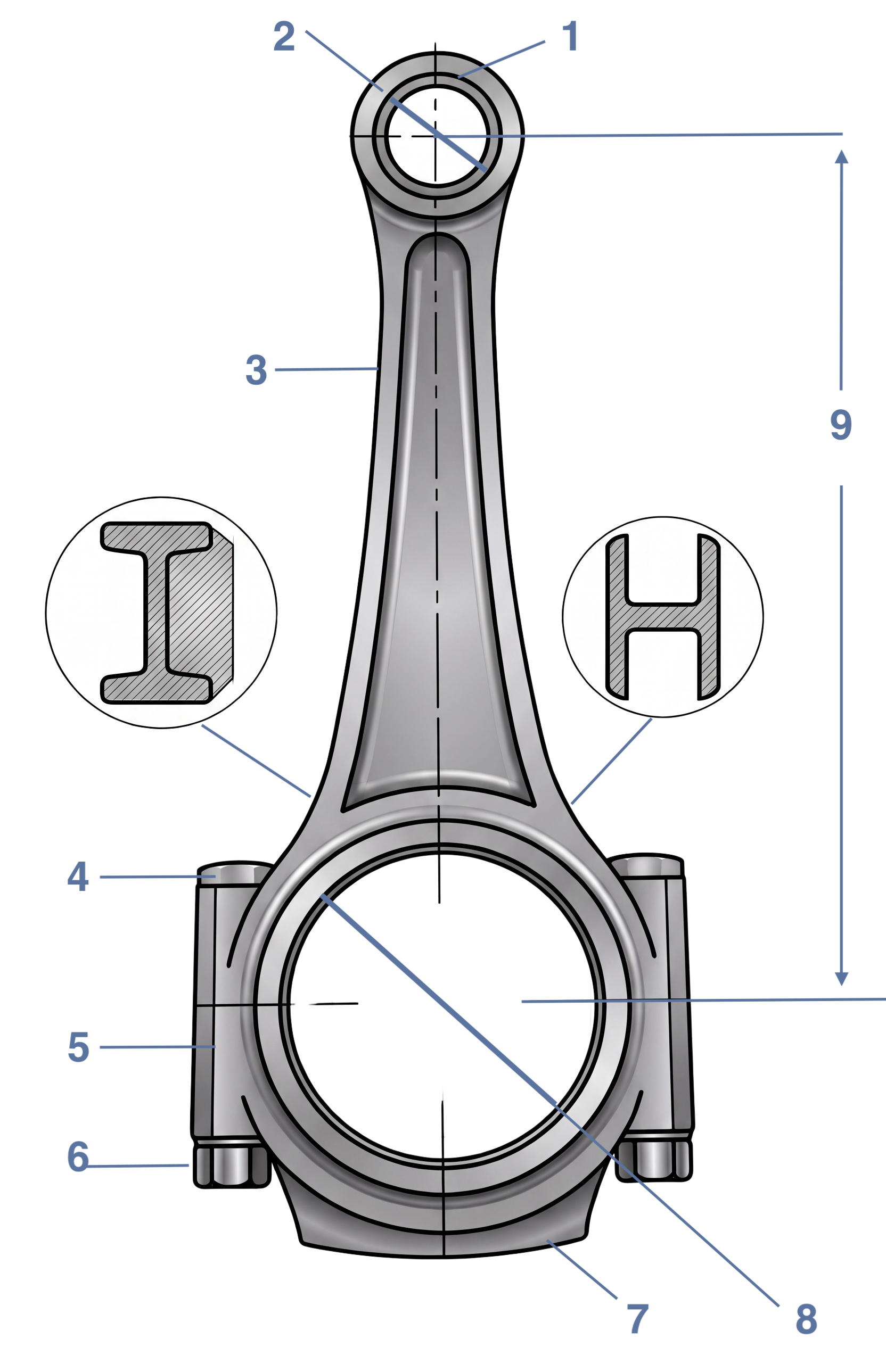 | 1) Small end 2) Small-end diameter 3) Rod beam 4) Rod bolt 5) Big end 6) Rod nut / bolt 7) Rod cap 8) Big-end diameter 9) Center-to-center |
The vehicles in the table below leave the factory with the BMW 1.6L 8V M40B16 M43B16 engine. Confirm the piston pin diameter and the centre-to-centre length of your rods before placing an order.
| Brand | Model (chassis) | Engine code | Power | Years |
|---|---|---|---|---|
| BMW | Série 3 316i (E30) | M40B16 | 99–102 hp | 1987–1991 |
| BMW | Série 3 Touring 316i (E30) | M40B16 | 100–102 hp | 1991–1994 |
| BMW | Série 3 Cabriolet 316i Baur TC (E30) | M40B16 | 99 hp | 1987–1989 |
| BMW | Série 3 316i (E36) | M40B16 | 100 hp | 1991–1993 |
| BMW | Série 3 316i (E36) | M43B16 | 102 hp | 1993–1998 |
| BMW | Série 3 Coupé 316i (E36) | M43B16 | 102 hp | 1993–1998 |
| BMW | Série 3 Touring 316i (E36) | M43B16 | 102 hp | 1997–1999 |
| BMW | Série 3 Compact 316i (E36) | M43B16 | 102 hp | 1994–2000 |
| BMW | Série 3 Compact 316g (E36) | M43B16 | 102 hp | 1996–2000 |
| BMW | Série 3 316i (E46) | M43B16 | 105 hp | 2000–2005 |
| BMW | Série 3 Coupé 316Ci (E46) | M43B16 | 105 hp | 2000–2006 |
OEM reference: M40B16: 11 24 1 727 239 ; M43B16: 11 24 1 437 618 (connecting rod set, fracture-split cap).
When a standard rod breaks, the repair is never limited to the broken part: the rods AND the pistons, almost always damaged in the same incident, have to be replaced, and the crankshaft, the bearings and sometimes the block have to be reworked. The cost of a simple return to the factory configuration then becomes high, for an engine that will have gained nothing.
For an equivalent or even lower budget, a set of 4340 forged rods combined with forged pistons puts the bottom end on another level of reliability, with a clear safety margin and real room to raise power. This has been the route of European engine builders for more than fifteen years, including on small four-cylinders such as this one.
For the same budget: more reliability, more potential and more longevity for the bottom end.