
Product successfully added to your shopping cart
Quantity
Total
There are 0 items in your cart. There is 1 item in your cart.
Total products
Total shipping To be determined
Total

3.9L 12v - F
Manufacturers
3.9L 12v - F
 View larger
 Warning: Last items in stock!
New product
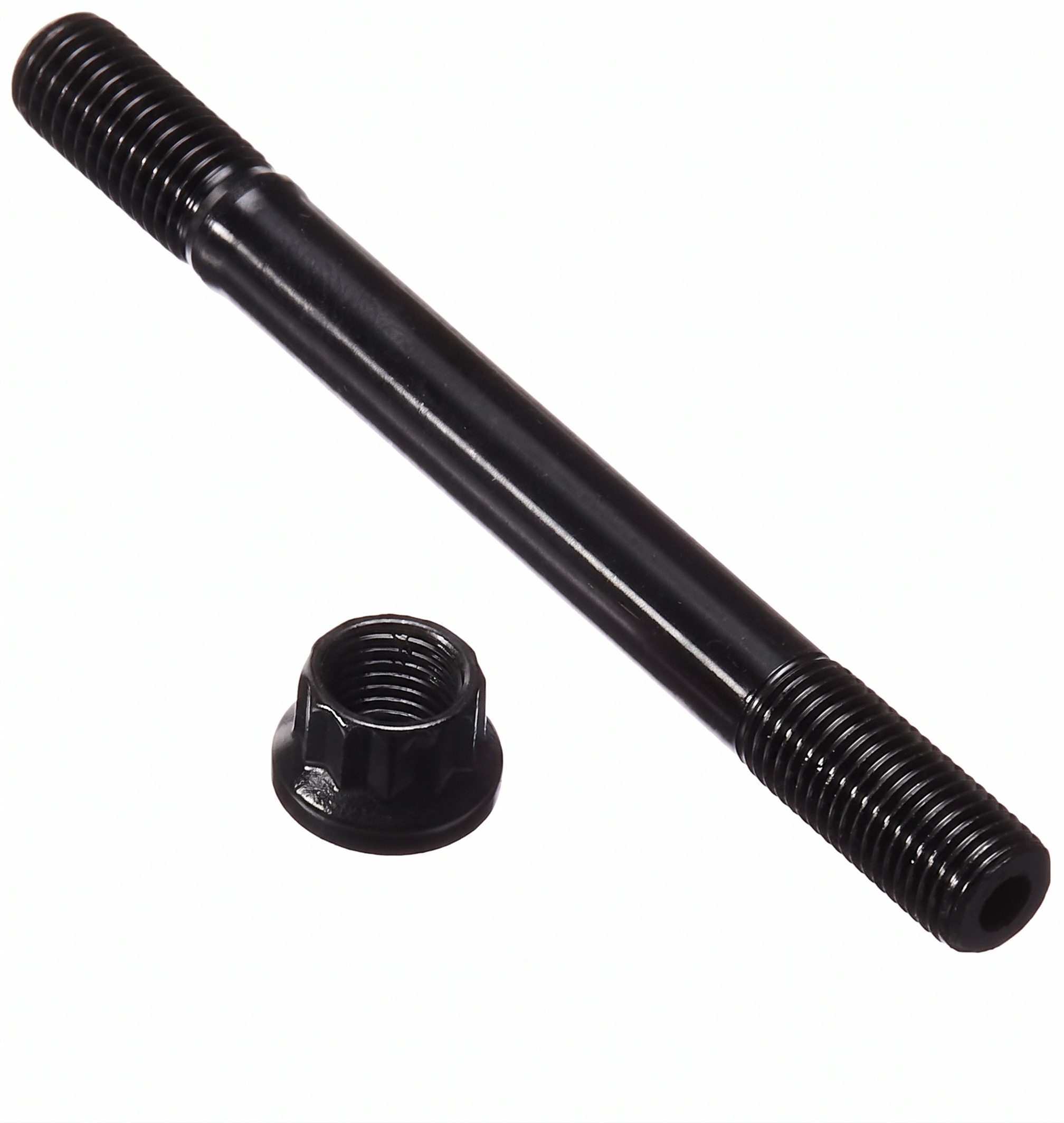
Kit of ARP 8740 cylinder head studs for the Toyota F inline six (Land Cruiser).
The Toyota F is a 3.9-litre inline six-cylinder (3,878 cc in the NGK catalogue), fitted to the Land Cruiser FJ40, FJ43, FJ45 and FJ55. ARP matches this engine to its 203-4001 stud kit, made of 8740 and supplied with hex nuts.
As built, the F cylinder head is secured by the standard fasteners; ARP kit 203-4001 replaces them with studs and nuts.
Cylinder head fasteners work constantly: they hold the head tight against the block, crush the gasket to the right value and hold back the push of the gases at every combustion. If they lose even a little tension, the gasket starts to leak.
ARP kit 203-4001, in 8740, uses a 1/2 in thread. According to the sheet, the studs are first run into the block by hand; the head is then fitted, and threads, nuts and washers take the supplied ARP Ultra-Torque before torque tightening in three equal passes. 8740 is a chrome-molybdenum steel, rated by ARP at 200,000 psi tensile strength. As a reference point, an engine's standard fasteners mostly belong to property classes 10.9 and 12.9, with a minimum tensile strength between 150,800 and 176,900 psi. In 1/2 in, the 8740 studs hold up to 1,100 hp on this six-cylinder engine (calculated estimate).
| Part number | Brand | Grade / material | Nuts | Thread |
| ARP-203-4001 | ARP | 8740 | hex | 1/2 in |
| Part number | Stage 1 | Stage 2 | Stage 3 |
| ARP-203-4001 | 50 Nm | 99 Nm | 149 Nm |
The studs are screwed into the block by hand, without torque. Their instruction sheet allows thread locker if they are to be fixed permanently, on the sole condition that tightening is finished before it sets.
The instruction sheet asks for the block threads to be cleaned before fitting, if needed with the ARP thread chaser.
When a stud reaches into the water jacket, its block-side threads are coated with ARP Thread Sealer; Loctite is only an option for a permanent fit, with the nuts torqued before it sets.
Follow the tightening sequence recommended by the manufacturer and bring to torque in three stages; the stated values assume ARP lubricant on the threads and under the nuts.
The instruction sheet also calls for ARP lubricant on the washers.
The torque figures above come from ARP instruction sheet 203-4001, revision applicable on the day the page went online. The official instruction sheet prevails in case of difference and describes the complete procedure, tightening sequence included. Read the ARP 203-4001 instruction sheet
To obtain the intended preload, ARP assembly grease must be present on the threads and under the nuts: the torque figures in the table are established with it.
| Buy the ARP assembly grease → |
 | Gary Holzapfel, a former aerospace engineer, created ARP (Automotive Racing Products) in the early 1970s to tackle engine failures caused by insufficiently strong fasteners in racing. Today the brand develops and manufactures thousands of parts in California, available in several material grades as needed. |
| Criterion | Original head bolts | Reinforced ARP studs |
 |  | |
| Block threads | Stressed at every tightening | Preserved: studs fitted by hand |
Standard fasteners remain suitable as long as the engine keeps its original combustion pressure. They reach their limits in the following cases:
| Model | Engine code | Power | Years |
| Toyota Land Cruiser 3.9 (FJ40, FJ43, FJ45, FJ55) | F | 125-158 hp | 1960-1975 |
| Toyota Land Cruiser Pick-up 3.9 (FJ45) | F | 137-158 hp | 1965-1974 |
On a tuned F, it is the original fasteners that cap the load on the gasket. 8740 studs of 1/2 in carry it much higher, for a budget out of all proportion to a cylinder head to be skimmed and a gasket to be replaced.