Product successfully added to your shopping cart
Quantity
Total
There are 0 items in your cart. There is 1 item in your cart.
Total products
Total shipping To be determined
Total

1.5L 16v - 1NZ-FE
Manufacturers
1.5L 16v - 1NZ-FE
 View larger
 Warning: Last items in stock!
New product
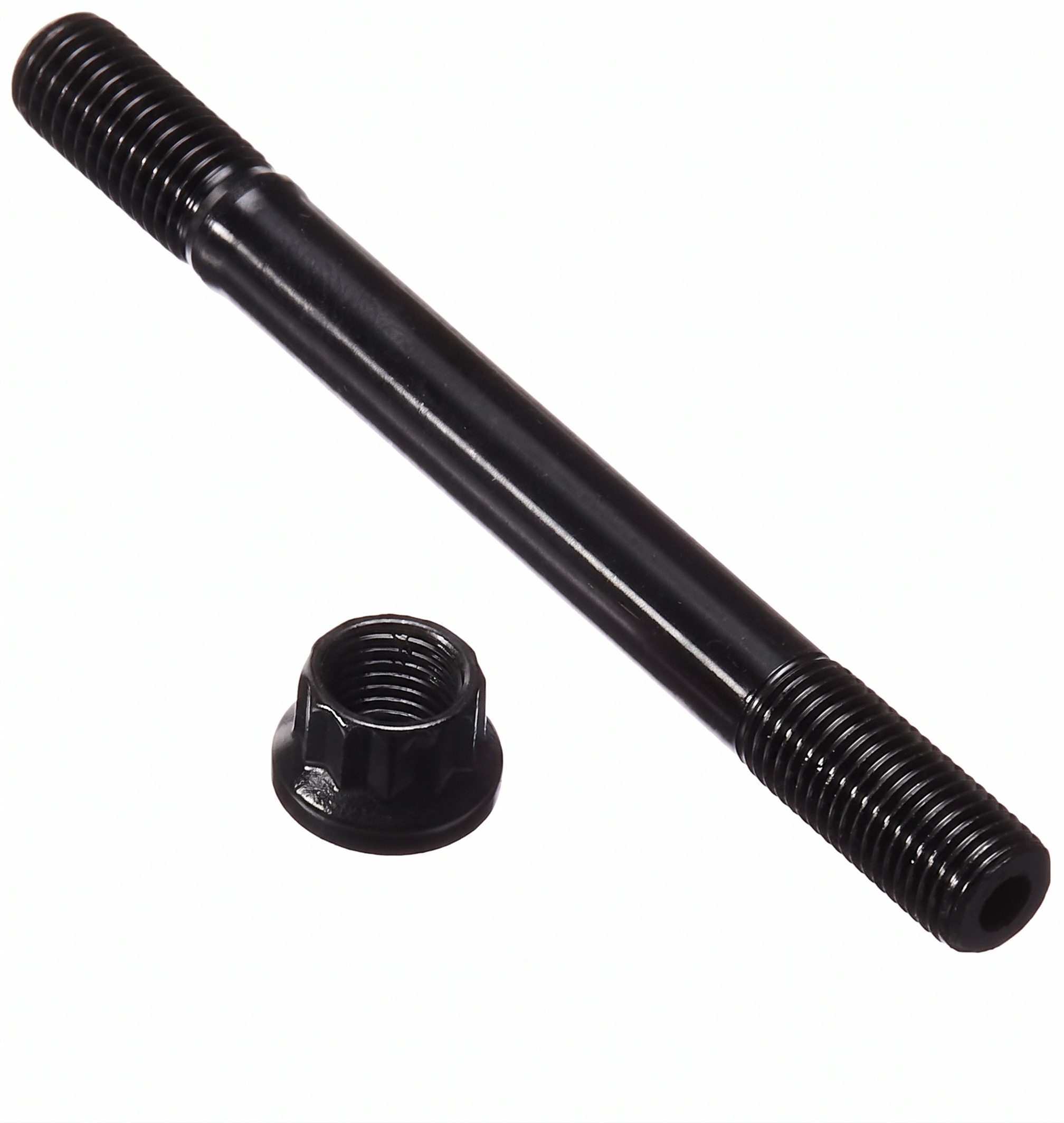
Kit of ARP 8740 cylinder head studs for the Toyota 1NZ-FE four-cylinder (Yaris, Corolla, Auris).
The Toyota 1NZ-FE is a 1.5-litre double overhead camshaft inline four-cylinder (1,497 cc in the NGK catalogue), fitted notably to the Yaris, Echo, Corolla, Auris, Probox and Sienta. ARP matches this engine to its 203-4101 stud kit, made of 8740 with 12-point nuts.
As built, the 1NZ-FE cylinder head is held by its standard fasteners; ARP kit 203-4101 substitutes studs and their nuts.
The job of the head fasteners is to keep the cylinder head locked to the block despite the pressure inside the combustion chambers. They keep the gasket compressed; as soon as their clamping force drops, leaks appear between head and block.
ARP kit 203-4101, in 8740, is the one ARP specifies for this engine. Its sheet has the studs run into the block by hand and the head fitted; threads, nuts and washers then take ARP Ultra-Torque, the nuts are tightened by hand, then to torque in three increasing passes. ARP makes these fasteners in 8740, a chrome-molybdenum steel whose tensile strength reaches 190,000 psi. To put this figure in context, original engine fasteners generally belong to classes 10.9 and 12.9, whose minimum ranges from 150,800 to 176,900 psi. For this kit we do not publish a calculated tightness figure, as its thread is not known. As an estimate only, 8740 studs of M10 diameter correspond to about 500 hp on a four-cylinder engine.
| Part number | Brand | Grade / material | Nuts | Thread |
| ARP-203-4101 | ARP | 8740 | 12-point |
| Part number | Stage 1 | Stage 2 | Stage 3 |
| ARP-203-4101 | 27 Nm | 47 Nm | 75 Nm |
The studs are screwed into the block by hand, without torque. Their instruction sheet allows thread locker if they are to be fixed permanently, on the sole condition that tightening is finished before it sets.
Before fitting, the sheet asks for the clearance between the studs or nuts, the camshafts and the variable timing solenoid to be checked.
If a stud reaches into the water jacket, its block-side threads take ARP thread sealer; Loctite remains allowed for a permanent fit.
Follow the tightening sequence recommended by the manufacturer and bring to torque in three stages; the stated values assume ARP lubricant on the threads and under the nuts.
The washers also receive ARP lubricant, as stated in the instruction sheet.
Source of these values: ARP instruction sheet 203-4101, revision current at the time of publication. The official instruction sheet applies if any discrepancy appears; it covers the entire procedure and the tightening sequence. Read the ARP 203-4101 instruction sheet
The stated tightening torques only make sense with ARP assembly grease, applied to the threads and under the nuts.
| Buy the ARP assembly grease → |
 | ARP (Automotive Racing Products) was born in the early 1970s from the initiative of Gary Holzapfel, an engineer from the aerospace industry, determined to eliminate engine failures caused by weak fasteners in motorsport. The company designs and manufactures thousands of parts in California, in several material grades suited to each use. |
| Criterion | Original head bolts | Reinforced ARP studs |
 |  | |
| Block threads | Stressed at every tightening | Preserved: studs fitted by hand |
On an engine left standard, the original fasteners do their job. Switching to reinforced fasteners becomes worthwhile as soon as:
| Model | Engine code | Power | Years |
| Toyota Yaris / Echo (P1) 1.5 | 1NZ-FE | 105-150 hp | 1999-2005 |
| Toyota Yaris (P9) 1.5 | 1NZ-FE | 107-110 hp | 2005-2014 |
| Toyota Yaris (P13, P15) 1.5 | 1NZ-FE | 107-109 hp | since 2010 |
| Toyota Yaris Verso (P2) 1.5 | 1NZ-FE | 105-110 hp | 2000-2005 |
| Toyota Corolla (E12, E15, E16) 1.5 | 1NZ-FE | 103-110 hp | since 2001 |
| Toyota Auris (E15, E18) 1.5 | 1NZ-FE | 105-110 hp | 2006-2018 |
| Toyota Probox / Succeed (P5, P16) 1.5 | 1NZ-FE | 103-109 hp | since 2002 |
| Toyota Sienta (P8, P17) 1.5 | 1NZ-FE | 103-110 hp | since 2003 |
On a tuned 1NZ-FE, the original fasteners limit the load the gasket can carry. 8740 studs carry it higher, for a cost unrelated to a cylinder head to be skimmed and a gasket to be replaced.