Product successfully added to your shopping cart
Quantity
Total
There are 0 items in your cart. There is 1 item in your cart.
Total products
Total shipping To be determined
Total

5.7L 32v - 3UR-FE
Manufacturers
5.7L 32v - 3UR-FE
 View larger
 Warning: Last items in stock!
New product
Set of 8 forged 4340 steel connecting rods for the Toyota 3UR-FE 5.7 V8.
The 3UR-FE is Toyota's 5.7-litre petrol V8 from the UR family, an aluminium block with dual overhead camshafts, 32 valves and Dual VVT-i variable valve timing. With a displacement of 5663 cc (94 mm bore, 102 mm stroke), this naturally aspirated engine produces roughly 362 to 383 hp depending on the version and market. Introduced in 2007, it powers the brand's large vehicles: Toyota Tundra, Sequoia, Land Cruiser 200 and the Lexus LX 570.
Renowned for its generous torque and longevity, the 3UR-FE is a solid tuning base, whether the goal is raising the compression ratio, adding forced induction (supercharger or turbo) or strengthening an engine meant to tow and run loaded. As soon as cylinder pressure and engine speed rise, the factory rods become the weak link of the reciprocating assembly: replacing them with forged rods is the key step to reliably secure the bottom end of this big V8.
Our 3UR-FE forged rods are machined from wrought 4340 steel, the reference in motorsport. They handle fatigue, bending and pull-out far better than factory rods, while strictly respecting the dimensions of the 3UR-FE crankshaft and pistons. Supplied as a set of 8 and fitted with high-strength 7/16" ARP bolts, they are ready to install.
They suit every tuning programme: forced induction, higher compression ratio, intensive off-road use, drag or simply the reinforced rebuild of a tired engine. Depending on the goal (Stage 1 reliability, Stage 2 moderate boost, Stage 3 high power), the forged rod secures the power increase of this V8 without ever compromising reliability.
| Reference | Brand | Profile | Rod bolts | Ø pin (mm) | Small-end width (mm) | Ø big end (mm) | Big-end width (mm) | Center-to-center (mm) | Weight (g) |
|---|---|---|---|---|---|---|---|---|---|
| 14425-8 | Manley | I-HD | ARP 2000-7/16"-42mm | 22 | 59 | 20,83 | 164,49 | 675 |
| Reference | Brand | Rod bolts | Max torque (no gauge) | Stretch (gauge check) |
|---|---|---|---|---|
| 14425-8 | Manley | ARP 2000-7/16"-42mm | 135,6 N·m | 0,163 – 0,173 mm |
The torque figure applies to tightening carried out without a stretch gauge. For optimal preload, ARP recommends checking bolt-body stretch with a micrometric gauge, a more reliable and repeatable method than torque alone, especially on an eight-cylinder engine where even clamping is decisive.
| 4340 is a low-alloy steel with nickel, chromium and molybdenum. Forging aligns the metal fibres in the direction of load, which eliminates internal porosity and delivers far greater mechanical strength than a factory sintered or cast rod. The result is a tensile strength of around 930 to 1080 MPa with excellent fatigue resistance, essential as soon as the engine gains torque, power or revs. It is the standard for competition rods, able to absorb combustion-pressure peaks without deforming or breaking. Compared with a series sintered-metal rod, this forged 4340 improves by about +19% in yield strength, +8% in tensile strength and +19 to +37% in fatigue resistance, hence a markedly longer endurance under cyclic load. |
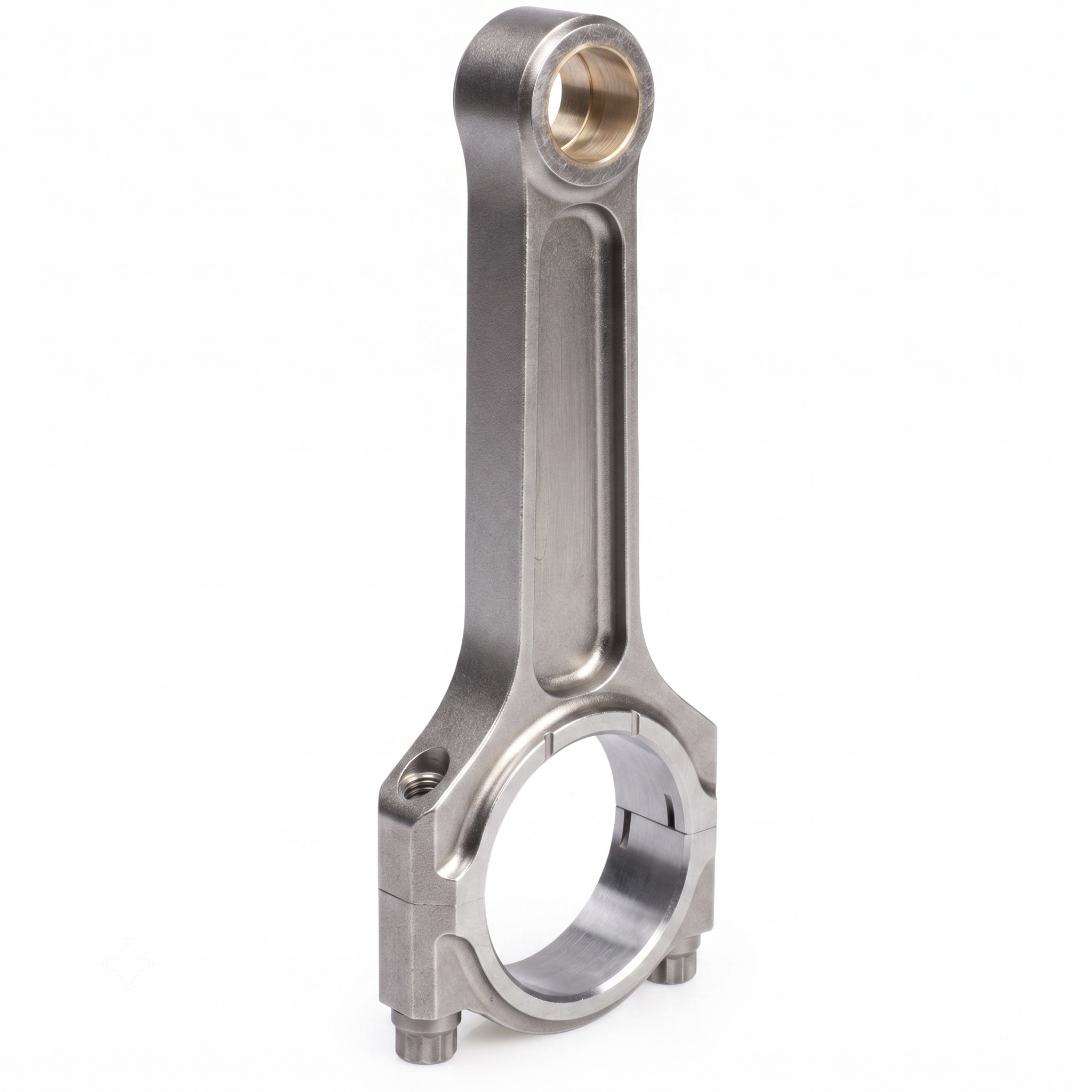 | The I-HD profile (I-Beam Heavy Duty) keeps the I-section, prized for its excellent stiffness-to-weight ratio, and reinforces it to withstand higher loads. This geometry limits reciprocating mass while retaining the strength required against the high torque of a big boosted V8. Our 3UR-FE rods are offered exclusively in the I-HD profile, particularly suited to builds of this 5.7-litre V8. |
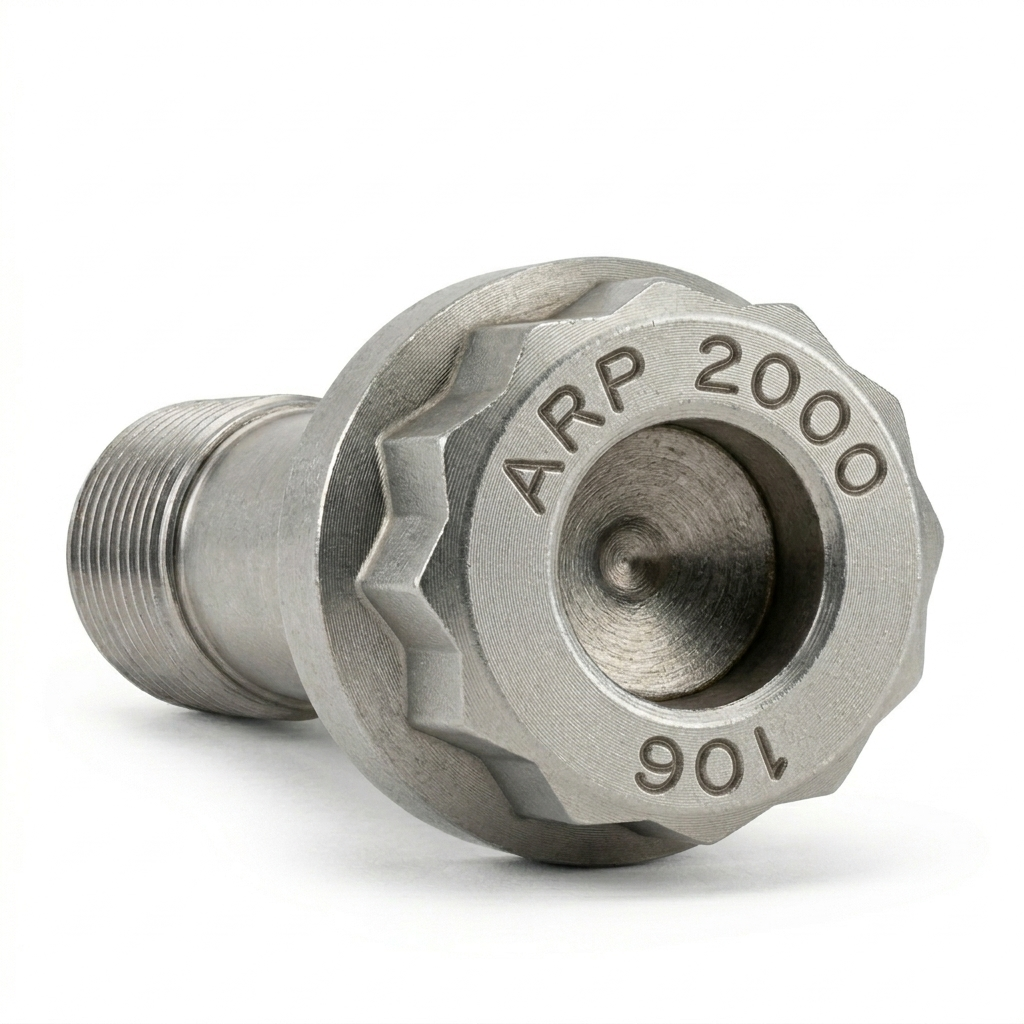 In practice this 7/16" ARP 2000 grade covers the demanding uses of this large V8: high torque, towing and heavy loads, hardcore off-road use, drag racing and track driving, provided the assembly torque and stretch are respected. The same grade also suits drift and rally use, depending on the build level. In practice this 7/16" ARP 2000 grade covers the demanding uses of this large V8: high torque, towing and heavy loads, hardcore off-road use, drag racing and track driving, provided the assembly torque and stretch are respected. The same grade also suits drift and rally use, depending on the build level. | Rod bolts are a critical component: they keep the cap and rod body together on every cycle. Our 3UR-FE rods use ARP 2000 bolts in 7/16" diameter, a generous diameter reserved for heavily loaded rods. ARP 2000 is a high-strength alloy steel offering a tensile strength of about 220,000 psi (around 1517 MPa). This large 7/16" diameter provides superior clamping reserve and stiffness, perfectly suited to the high torque of a big V8, and withstands sustained engine speeds. These bolts bring strength, reliability and versatility, with no particular storage constraint. |
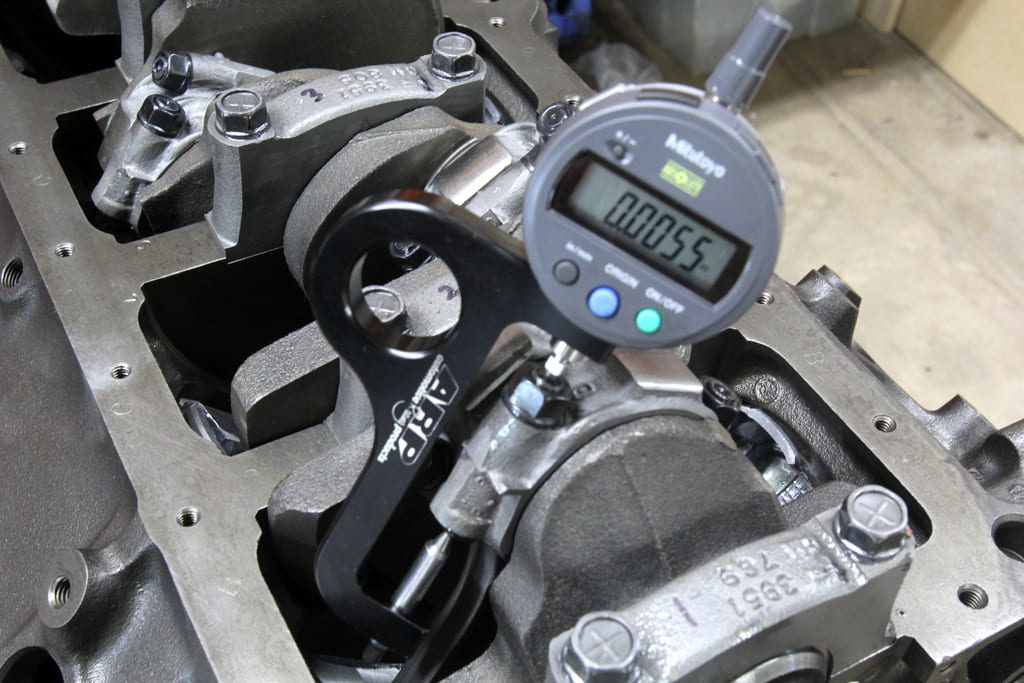
| Torque tightening remains approximate because it depends on thread friction. The most accurate method is to measure bolt-body stretch with a micrometric gauge: you tighten until the specified stretch is reached, here 0.163 to 0.173 mm. This guarantees an even preload across the eight rods and maximum reliability under high load. |
 | Manley Performance is an American manufacturer recognised for decades for its high-performance engine components. Its forged 4340 rods, here in the I-HD profile, are known for their machining quality, weight consistency and endurance under severe use. It is the brand chosen to equip the 3UR-FE. |
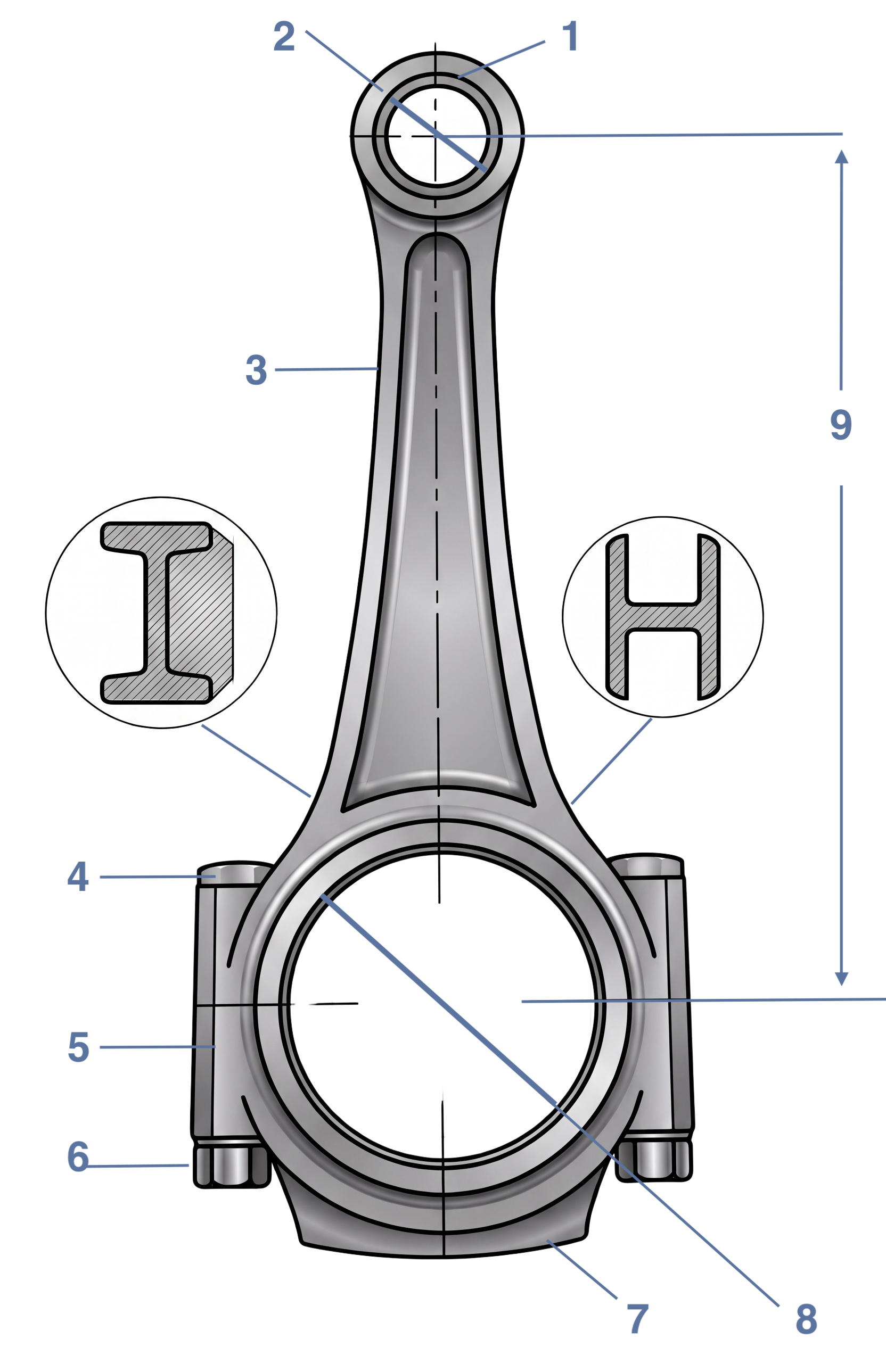 | 1) Small end 2) Small-end diameter 3) Rod beam 4) Rod bolt 5) Big end 6) Rod nut / bolt 7) Rod cap 8) Big-end diameter 9) Center-to-center |
| Brand | Model (chassis) | Engine code | Power | Years |
|---|---|---|---|---|
| Toyota | Tundra (XK50) | 3UR-FE | 381 ch | 2007–2021 |
| Toyota | Sequoia (XK60) | 3UR-FE | 381 ch | 2008–2022 |
| Toyota | Land Cruiser (URJ200) | 3UR-FE | 381 ch | 2008–2021 |
| Lexus | LX 570 (URJ201) | 3UR-FE | 383 ch | 2008–2021 |
On a tuned 3UR-FE, a stock rod that lets go usually destroys the block, crankshaft and pistons. Investing in a forged rod set from the outset costs far less than an engine failure followed by a full rebuild. You permanently strengthen the bottom end, preserve the value of your build and drive with peace of mind, in intensive use as much as day to day.