Product successfully added to your shopping cart
Quantity
Total
There are 0 items in your cart. There is 1 item in your cart.
Total products
Total shipping To be determined
Total

4.2L 32v - BNS / BYH / CAUA
Manufacturers
4.2L 32v - BNS / BYH / CAUA
Warning: Last items in stock!
New product
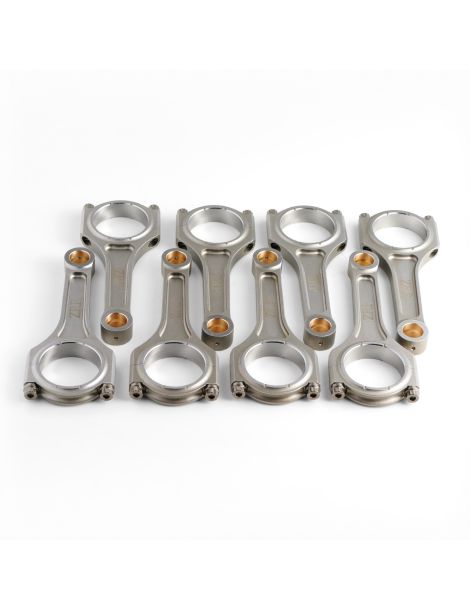
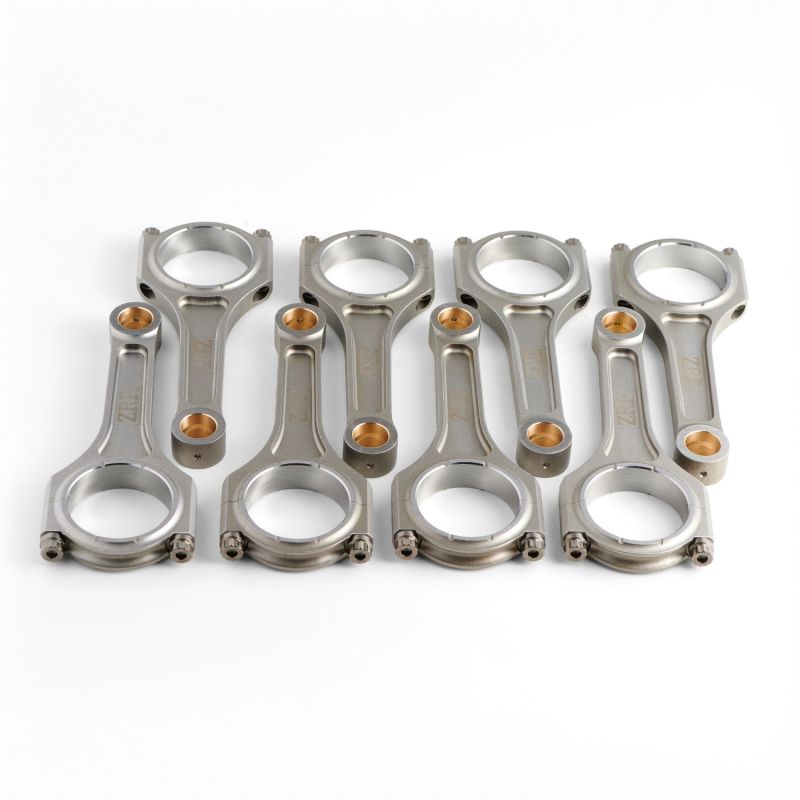
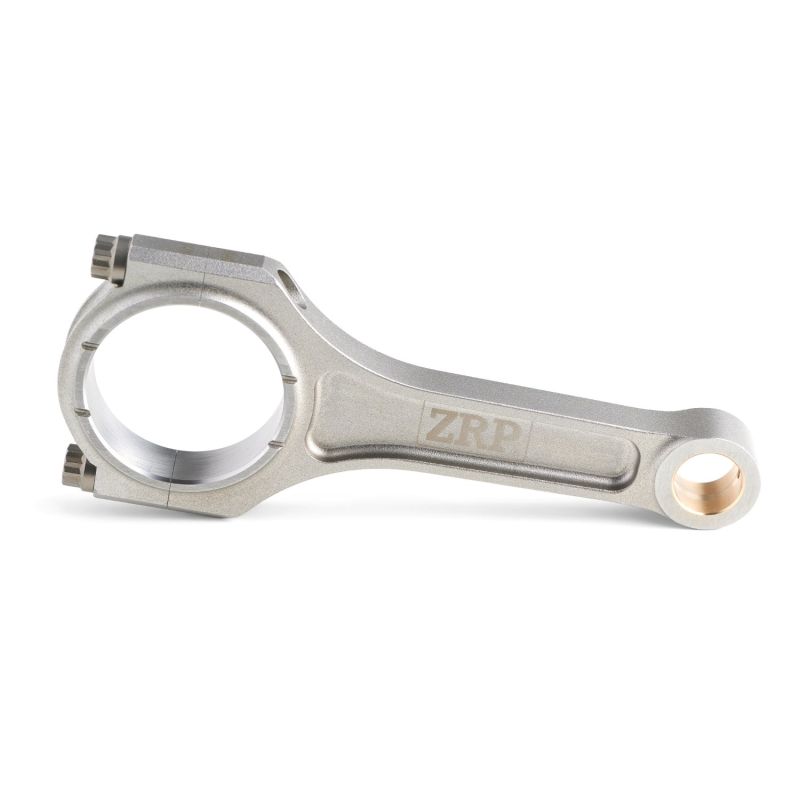
Set of 8 forged 4340 steel connecting rods for Audi 4.2L 32V BNS-BYH-CAUA.
Introduced by Audi in the mid-2000s, this naturally aspirated 4.2 FSI V8 of 4163 cc (84.5 mm bore, 92.8 mm stroke, 32 valves) powers the RS4 quattro B7 (code BNS, 420 hp, 2005-2008), the first-generation R8 Coupé (code BYH, 420 hp, 2007-2010) and the S5 Coupé (code CAUA, 354 hp, 2007-2012). Direct FSI injection and a 90-degree architecture characterise this high-end unit, which already features a forged crankshaft on its most powerful versions.
Under sustained high-performance use (track days, circuit driving, tuning), extended high-rpm operation and increased cylinder pressure put the factory rods, usually made of sintered metal, at risk of failure. NSB Concept offers a set of 8 forged ZRP connecting rods in 4340 steel to secure the bottom end of these Audi V8 engines for tuning or sustained track use.
The fact remains that this V8’s standard sintered-metal rod was calculated for the homologated power and engine speed, with a slim margin. As soon as the operating rev range is raised, forged pistons are fitted or supercharging is added, it becomes the weak point of the short block. On an eight-cylinder engine a single failure is enough to destroy the crankshaft and the crankcase: a complete set of eight forged rods is therefore the first worthwhile expense of a serious build.
Unlike a cast or sintered rod, a forged rod is shaped hot under high pressure: the grain flow follows the outline of the part instead of being interrupted, which markedly raises fatigue strength and resistance to bending as well as compression. On this naturally aspirated V8 the dominant load is not boost pressure but the number of high-rpm cycles: the rod works in tension every time the piston passes top dead centre, and it is that repeated loading that eventually cracks a production part. The ZRP forged rods offered here, made from 4340 steel and supplied as weight-matched sets of eight, are sized for that duty cycle. They suit the sporting use of the RS4 B7, the R8 4.2 and the S5: circuit and track days, hillclimb, rally, time attack and drift, as well as Stage 2 and Stage 3 builds combining forged pistons, freer intake and exhaust, a raised rev limit or even a supercharger conversion.
| Reference | Brand | Profile | Hardware | Pin diameter OEM 20 mm | Small-end width | Big-end diameter OEM n.p. | Big-end width | Center-to-center OEM 154 mm | Weight per rod |
|---|---|---|---|---|---|---|---|---|---|
| R-AUD-012-I | ZRP | I | ARP 2000-3/8"-38mm | 20 | 56.8 | 19.4 | 154 | 507 | |
| R-AUD-012-I-L19 | ZRP | I | ARP L19-3/8"-38mm | 20 | 56.8 | 19.4 | 154 | 507 |
ZRP: Straight, non-tapered pin end.
| Rod | Hardware | Torque | Recommended stretch |
|---|---|---|---|
| ZRP (R-AUD-012-I) | ARP 2000 | 61.0 N·m | 0.140 – 0.152 mm |
| ZRP (R-AUD-012-I-L19) | ARP L19 | 67.8 N·m | 0.152 – 0.165 mm |
On a V8 such as this 4.2 32V, consistency matters as much as the value itself: eight rods tightened unevenly give eight different bearings, and the weakest one sets the limit for the whole engine. A bolt left below the range sees its preload drop under the force pulling the cap away: cyclic lift, a degrading parting face, a hammered then misaligned shell, growing clearance and oil that no longer carries. A bolt taken above the range also loses its tension, but through yielding: permanent elongation, vanished preload, a distorted bearing bore and an oval big end, which removes the shell's even contact. The very same value, the one in the table below, must therefore be applied to all eight rods, distinguishing ARP 2000 fasteners from ARP L19 ones since the manufacturer does not specify the same figures for both. The stretch gauge remains the reference method and the only way to verify that all eight bolts have really received the same tension; ARP assembly lubricant, kit instructions taking priority.
4340 is a low-alloy nickel-chromium-molybdenum steel used in aerospace and in motorsport for its behaviour under alternating load. Hot forging aligns its grain flow with the rod’s load paths, then quenching and tempering set the balance between hardness, toughness and ductility: under overload the part deforms before it gives way instead of snapping like a harder material. Against the standard sintered-metal rod, optimised for mass-production cost, forged 4340 brings around 19 % more yield strength, 8 % more tensile strength and above all 19 to 37 % more fatigue strength, giving a service life under cyclic load several times longer. On a 4,163 cm³ V8 expected to spend long periods at high revs, that fatigue reserve is precisely what you are buying.
| Yield strength: about +19% vs sintered metal |
| Tensile strength: about +8% vs sintered metal |
| Fatigue resistance: +19 to +37% vs sintered metal |
For this engine, NSB Concept exclusively offers the I-beam profile, lighter and particularly suited to naturally aspirated or moderately boosted engines seeking a good balance between stiffness, reduced mass and high-rpm reliability.
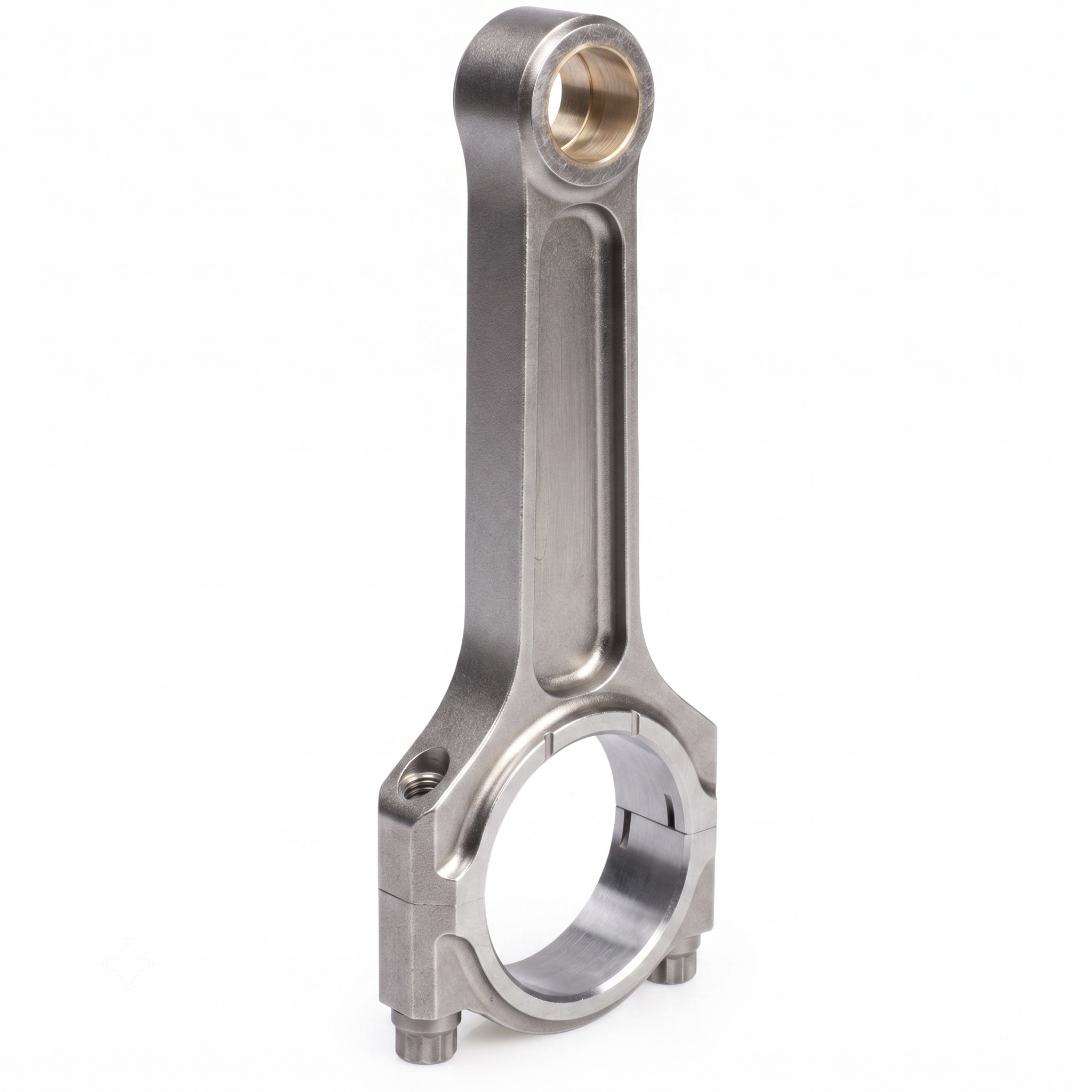 | I-beam profile: the I section, thinner at its centre and thickened at the flanges, offers the best ratio between bending stiffness and reciprocating mass. On a naturally aspirated V8 that draws its output from engine speed, this lighter rotating assembly reduces inertia loads on the big end and on the bearings while keeping the stiffness needed to carry compression loads. It is the profile ZRP selected for this application. |
The choice of rod bolt depends on the target power and engine speed. On this listing, the ZRP rods are offered with a 3/8" bolt diameter in two ARP grades:
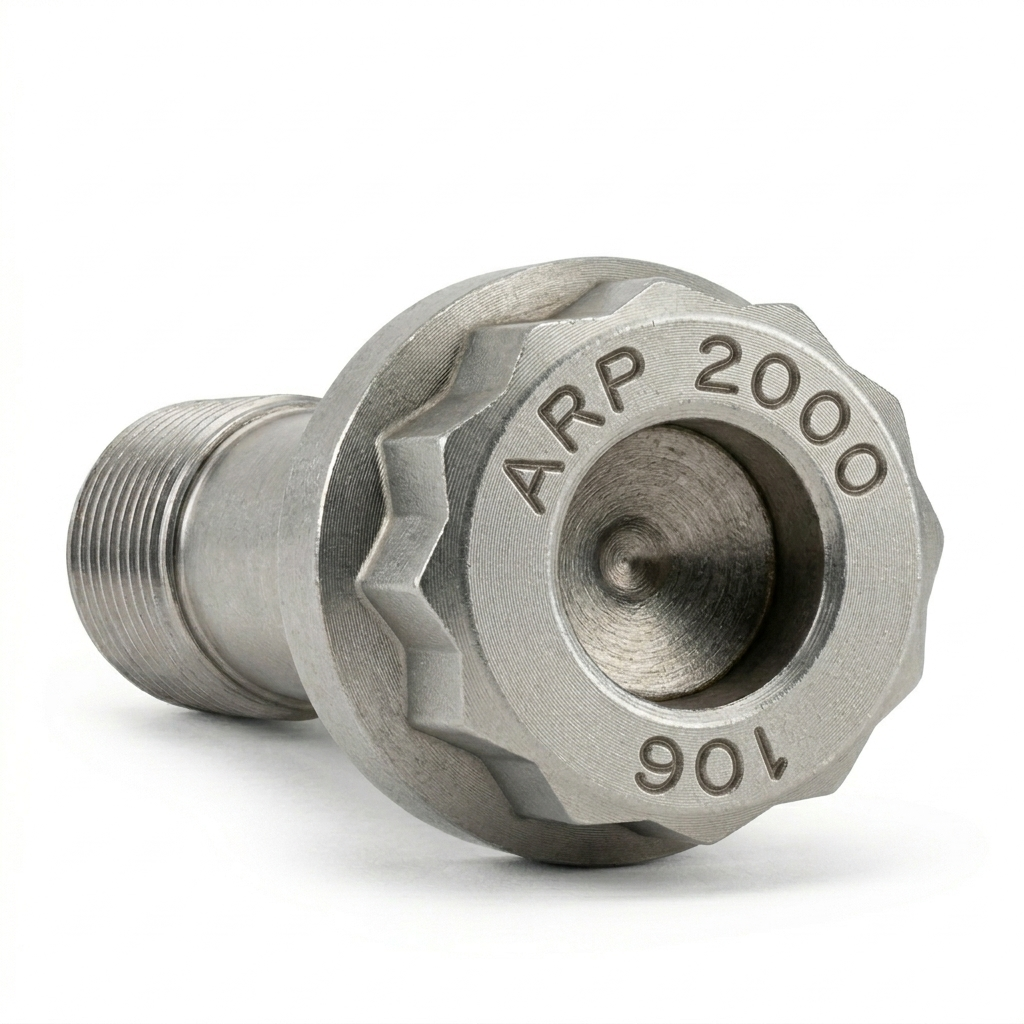 | ARP 2000: tensile strength of about 220,000 psi (1,517 MPa), for use up to 200 hp/cylinder in 3/8" and a maximum speed of 8,500 rpm. High-performance standard, with no particular storage constraint, suited to circuit, track day, drift, rally, drag racing and hillclimb. |
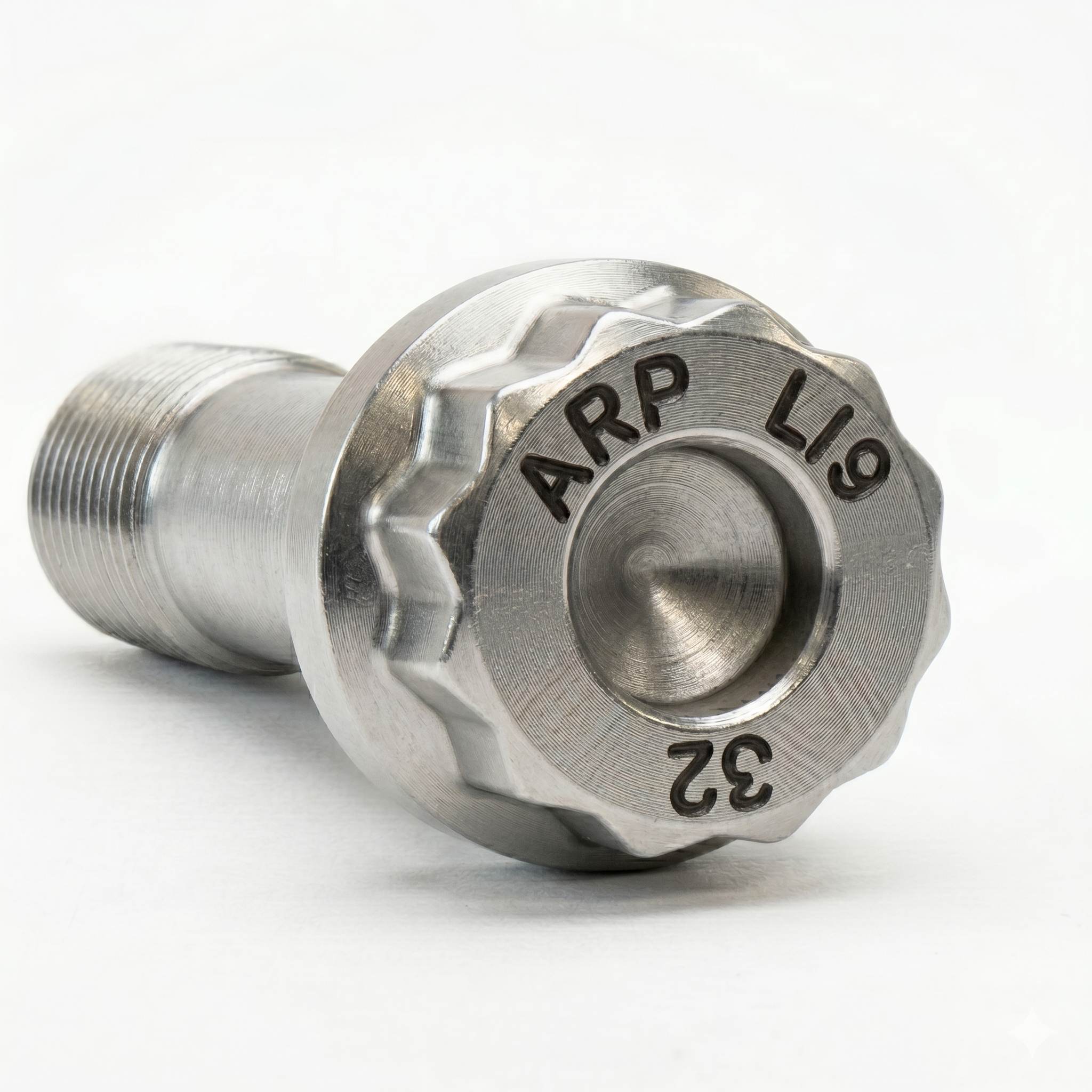 | ARP L19: tensile strength of about 260,000 psi (1,793 MPa), for use up to 250 hp/cylinder in 3/8" and a maximum speed of 10,000 rpm. Designed for engines pushed to the extreme (high boost pressure, sustained high rpm, high cylinder pressure): drag racing, drift, rally and circuit. Sensitive to corrosion and hydrogen embrittlement, it must be stored and fitted oiled. |
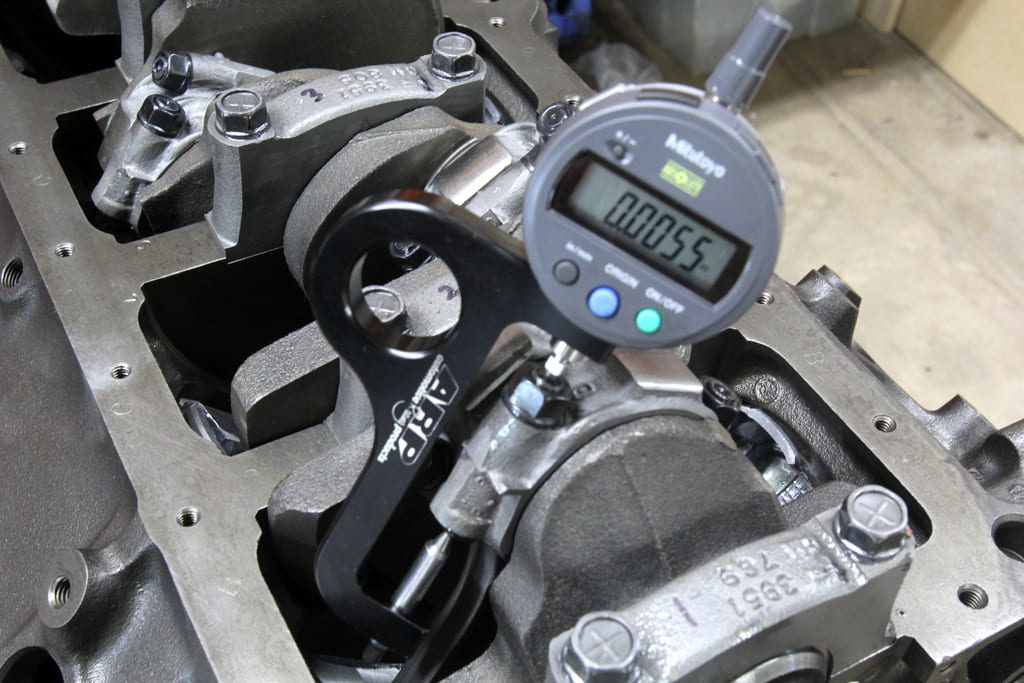
| The stretch method (dial indicator) is more precise than plain torque: it directly measures the actual bolt tension, independent of friction. A dedicated ARP stretch gauge lets you check the value during assembly. |
 | ZRP is a Greek maker of high-performance forged connecting rods, founded in Athens under the direction of Alex Drakos. Every rod is forged from 4340 steel, CNC machined and then balanced to ±1 g so that the set of eight stays consistent and does not spoil the balance of the V8 at high revs. The hardware is ARP, available either as ARP 2000 or as L19 depending on the level of tune. Designed and inspected in Greece, these rods are proven on track, in rally and in drift. |
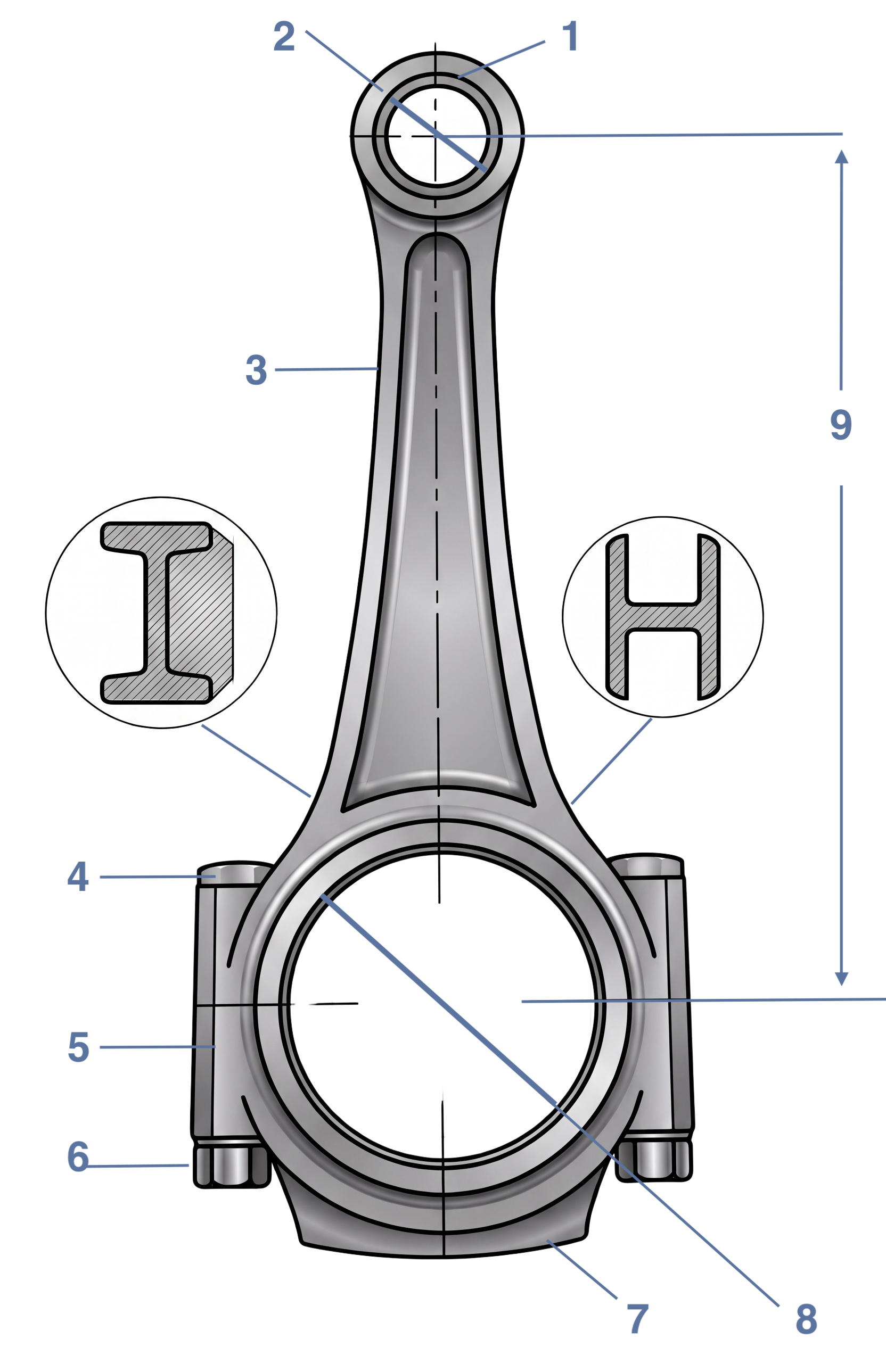 | 1) Small end 2) Small-end diameter 3) Rod beam 4) Rod bolt 5) Big end 6) Rod nut / bolt 7) Rod cap 8) Big-end diameter 9) Center-to-center |
This set of forged connecting rods is compatible with the following Audi engines:
| Brand | Model (chassis) | Engine code | Power | Years |
|---|---|---|---|---|
| Audi | RS4 quattro Sedan / Avant / Cabriolet (B7) | BNS | 420 hp | 2005–2008 |
| Audi | R8 Coupé (Type 42) | BYH | 420 hp | 2007–2010 |
| Audi | S5 Coupé (8T) | CAUA | 354 hp | 2007–2012 |
Importing forged ZRP connecting rods yourself from Greece involves international shipping costs, uncertain lead times and no French-language technical support if you have doubts about fitment or bolt selection. NSB Concept lists these rods directly, with tracked stock, shipping from France and technical support for choosing the profile, the hardware and checking bolt stretch. The complete kit (rods and ARP hardware) is delivered ready to fit, with no extra steps on your part.
Conversely, rebuilding a standard short block after a failure means buying a crankshaft, a set of pistons and sometimes the block again, only to recover exactly the margin that gave way. A set of eight forged rods, fitted with forged pistons, often costs less than that restoration and leaves headroom for what comes next.