Product successfully added to your shopping cart
Quantity
Total
There are 0 items in your cart. There is 1 item in your cart.
Total products
Total shipping To be determined
Total

2.4L 12v - L24/L24E/L24S
Manufacturers
2.4L 12v - L24/L24E/L24S
 View larger
 Warning: Last items in stock!
New product
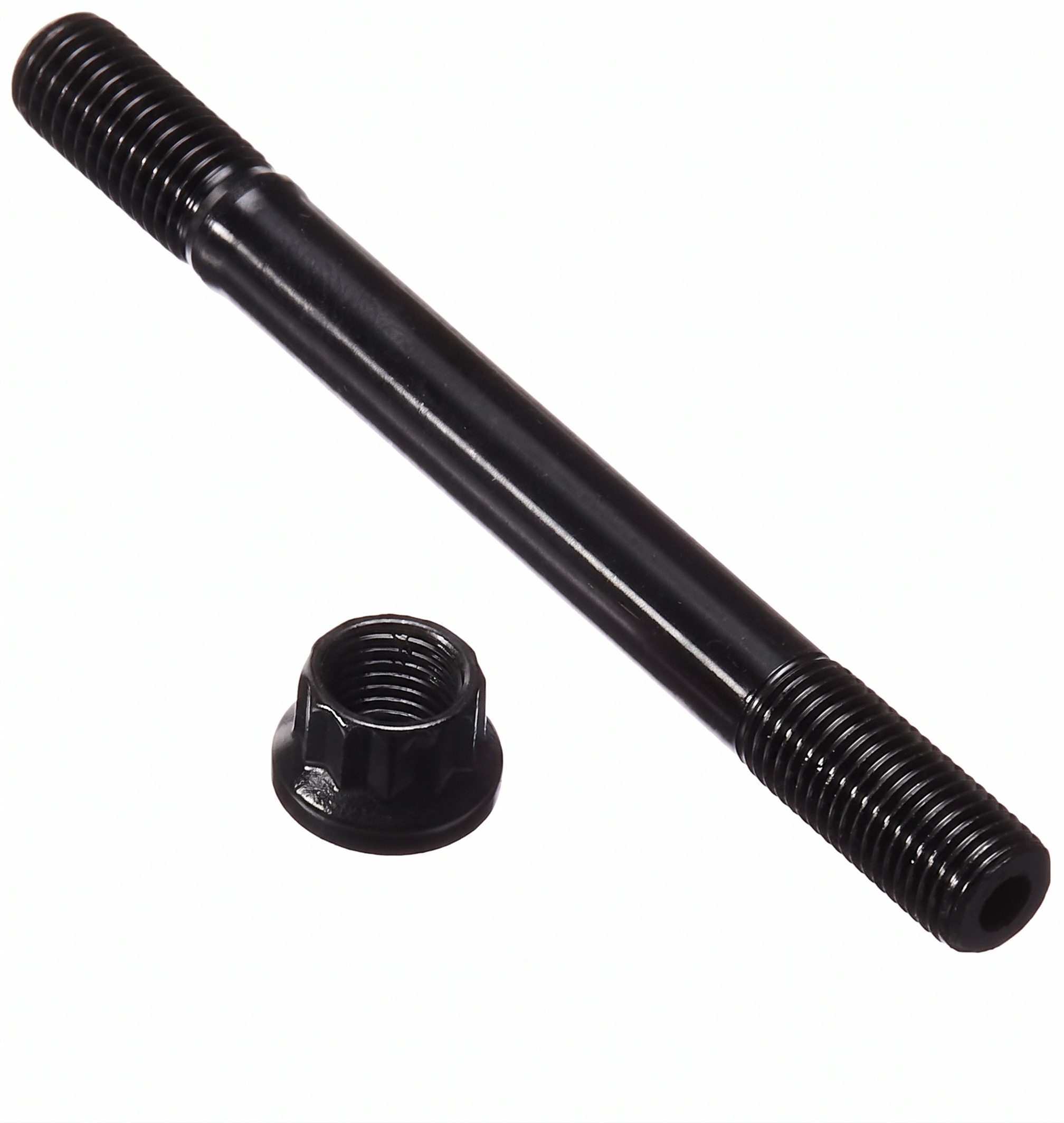
Kit of ARP 8740 cylinder head studs for the Nissan L24, L26 and L28 six-cylinders.
The Nissan L24, L26 and L28 are 2.4, 2.6 and 2.8-litre inline six-cylinders (2,393, 2,565 and 2,753 cc in the NGK catalogue), offered as the L24E, L24S, L28E and L28ET, fitted to the 240Z, 260Z, 280Z and 280ZX, the Skyline, Cedric, Laurel, Bluebird, Leopard and Patrol. ARP matches these six-cylinders to its 202-4206 stud kit, made of 8740 with 12-point nuts.
As built, the cylinder head of these engines is tightened with the standard fasteners; the studs of ARP kit 202-4206 take their place, with their nuts.
Every combustion cycle pushes the cylinder head upwards. The head fasteners resist it by keeping a constant clamping pressure on the gasket; if that pressure drops, the seal is no longer guaranteed.
For ARP kit 202-4206, made of 8740 at 10 mm diameter (pitch not given in the sheet), the procedure runs as follows: studs turned in by hand only, head fitted, then threads, nuts and washers coated with ARP Ultra-Torque, and torque tightening in three equal passes. 8740 is a chrome-molybdenum steel, rated by ARP at 200,000 psi tensile strength. As a reference point, an engine's standard fasteners mostly belong to property classes 10.9 and 12.9, with a minimum tensile strength between 150,800 and 176,900 psi. In 10 mm, the 8740 studs hold up to 700 hp on this six-cylinder engine (calculated estimate).
| Part number | Brand | Grade / material | Nuts | Thread |
| ARP-202-4206 | ARP | 8740 | 12-point | 10 mm |
| Part number | Stage 1 | Stage 2 | Stage 3 |
| ARP-202-4206 | 27 Nm | 54 Nm | 81 Nm |
The studs are screwed into the block by hand, without torque. Their instruction sheet allows thread locker if they are to be fixed permanently, on the sole condition that tightening is finished before it sets.
Before fitting, every thread in the block is cleaned so that it engages properly; where needed, the ARP thread chaser restores them.
If a stud ends in the water jacket, its threads receive ARP Thread Sealer; for a permanent assembly Loctite is allowed, provided the fasteners are tightened before it sets.
Final tightening is done in three successive stages, following the manufacturer's tightening sequence; these torque figures only hold with ARP assembly lubricant on the threads and under the nuts.
The washers also receive ARP lubricant, as stated in the instruction sheet.
Source of these values: ARP instruction sheet 202-4206, revision current at the time of publication. The official instruction sheet applies if any discrepancy appears; it covers the entire procedure and the tightening sequence. Read the ARP 202-4206 instruction sheet
All torque values on this page are given with ARP assembly grease on the threads and under the nuts; another lubricant would make them wrong.
| Buy the ARP assembly grease → |
 | ARP (Automotive Racing Products) was born in the early 1970s from the initiative of Gary Holzapfel, an engineer from the aerospace industry, determined to eliminate engine failures caused by weak fasteners in motorsport. The company designs and manufactures thousands of parts in California, in several material grades suited to each use. |
| Criterion | Original head bolts | Reinforced ARP studs |
 |  | |
| Block threads | Stressed at every tightening | Preserved: studs fitted by hand |
Standard fasteners remain suitable as long as the engine keeps its original combustion pressure. They reach their limits in the following cases:
| Model | Engine code | Power | Years |
| Nissan 240Z (S30) 2.4 | L24 | 150 hp | 1970-1974 |
| Nissan 260Z (S30) 2.6 | L26 | 162-165 hp | 1974-1979 |
| Nissan 280Z (S30) 2.8 | L28E | 151-171 hp | 1974-1978 |
| Nissan 280ZX (HGS130) 2.8 | L28E, L28ET | 140-200 hp | 1978-1984 |
| Nissan Skyline (C110, C210) 2.4 | L24, L24E | 128-131 hp | 1972-1981 |
| Nissan Skyline (R30) 2.4 / 2.8 | L24E, L28E | 128-140 hp | 1981-1987 |
| Nissan Cedric (230, 430) 2.4 / 2.8 | L24, L28, L28E | 131-147 hp | 1971-1983 |
| Nissan Laurel (HLC230, JC31, JC32) 2.4 / 2.8 | L24, L24E, L24S, L28, L28E | 113-140 hp | 1977-1987 |
| Nissan Bluebird (610) / 810 2.4 | L24 | 122 hp | 1976-1981 |
| Nissan Maxima I (G910) 2.4 | L24E | 122 hp | 1980-1984 |
| Nissan Gloria (330) 2.6 | L26 | 140 hp | 1975-1978 |
| Nissan Leopard (F30) 2.8 | L28E | 144 hp | 1981-1984 |
| Datsun 280C (330) 2.8 | L28 | 135-147 hp | 1977-1979 |
| Nissan Patrol III (K160, W160, K260) 2.8 | L28 | 120-121 hp | 1980-1990 |
When an L24, L26 or L28 six-cylinder is tuned, the original fasteners stop keeping up. 8740 studs of 10 mm hold their preload despite higher combustion pressures; their cost stays modest next to a head to be resurfaced or a gasket to be changed.
To get the most out of reinforced fasteners, pair them with a head gasket that withstands the same pressure. Here is the gasket we offer for this engine:
| Reinforced head gasket for L28 and L28E → |