Product successfully added to your shopping cart
Quantity
Total
There are 0 items in your cart. There is 1 item in your cart.
Total products
Total shipping To be determined
Total

1.8L 16v - CA18DET
Manufacturers
1.8L 16v - CA18DET
 View larger
 Warning: Last items in stock!
New product
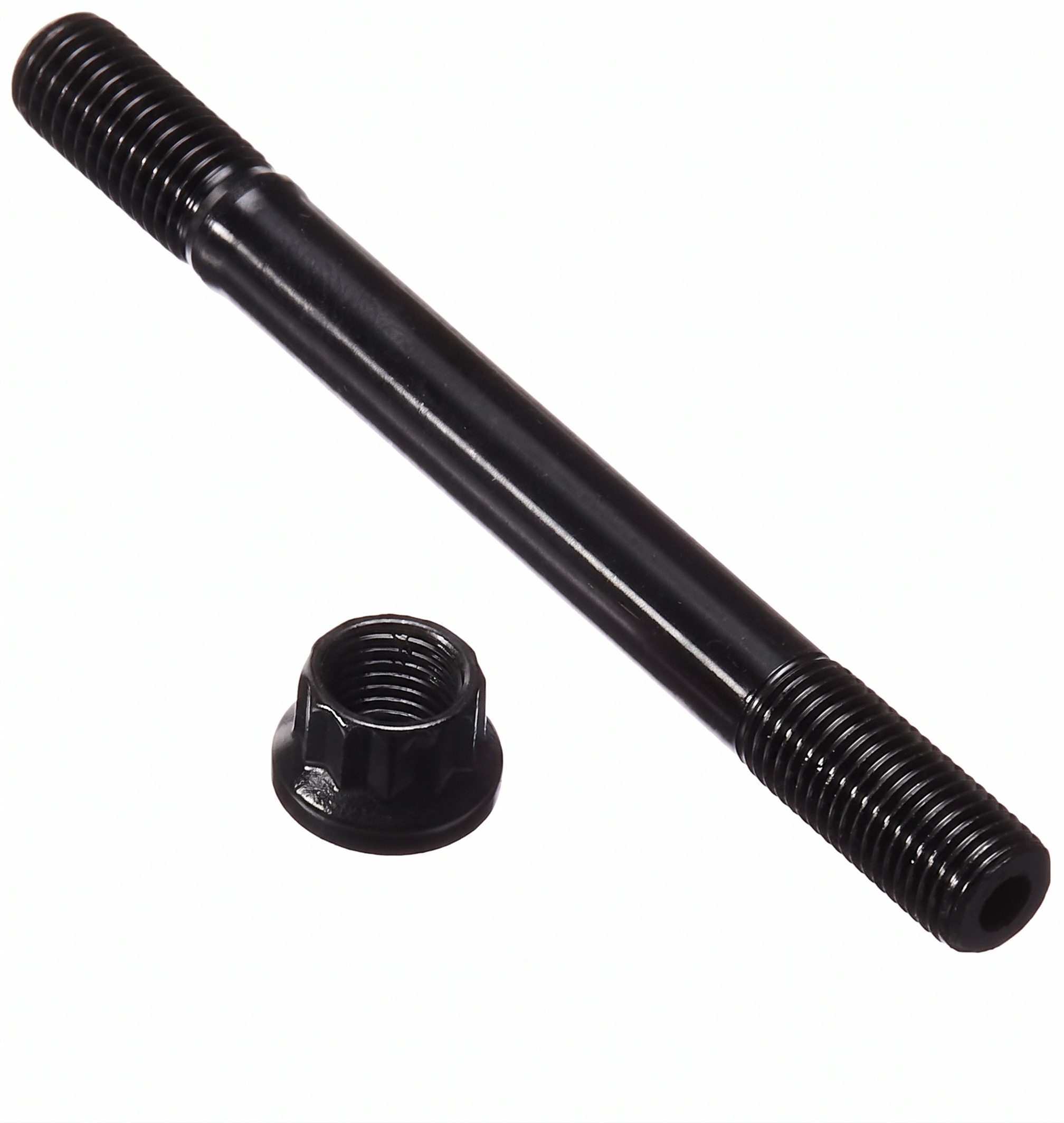
Kit of ARP 8740 cylinder head studs for the Nissan CA16DE, CA16DET, CA18DE and CA18DET four-cylinders.
The CA16DE, CA16DET, CA18DE and CA18DET are 1.6 and 1.8-litre 16-valve Nissan four-cylinder engines (1,598 and 1,809 cc in the NGK catalogue), the DET versions being turbocharged. The CA18DE powers the naturally aspirated 180SX, 200SX, Sunny and Bluebird among others, the CA18DET the turbo 180SX and 200SX as well as the Auster Xtt, and the CA16DE the EXA Targa and the Pulsar NX. ARP lists all four codes for each of its two kits.
As built, the CA18DET cylinder head is secured by head bolts, OEM part number 11056-D4200, with their washers 11058-16A01.
Every combustion cycle pushes the cylinder head upwards. The head fasteners resist it by keeping a constant clamping pressure on the gasket; if that pressure drops, the seal is no longer guaranteed.
Two ARP kits in 8740 fit these engines: studs 202-4302 and 202-4702, both of 7/16 in diameter, the second being an undercut kit according to the 2026 ARP list. The sheets do not give the pitch. They have the studs screwed in by hand only, the head fitted, then threads, nuts and washers lubricated with ARP Ultra-Torque before tightening to torque in three equal passes. 8740 is a chrome-molybdenum steel, rated by ARP at 200,000 psi tensile strength. As a reference point, an engine's standard fasteners mostly belong to property classes 10.9 and 12.9, with a minimum tensile strength between 150,800 and 176,900 psi. In 7/16 in, the 8740 studs hold up to 600 hp on this four-cylinder engine (calculated estimate).
| Part number | Brand | Grade / material | Nuts | Thread |
| ARP-202-4302 | ARP | 8740 | 12-point | 7/16 in |
| ARP-202-4702 | ARP | 8740 - Undercut | 12-point | 7/16 in |
| Part number | Stage 1 | Stage 2 | Stage 3 |
| ARP-202-4302 | 36 Nm | 72 Nm | 108 Nm |
| ARP-202-4702 | 36 Nm | 72 Nm | 108 Nm |
Studs 202-4302 and 202-4702: the studs are screwed into the block by hand, without torque. Their instruction sheet allows thread locker if they are to be fixed permanently, on the sole condition that tightening is finished before it sets.
All block threads are cleaned before fitting and, if necessary, run through again with the ARP Thread Chaser.
When a stud ends in the water jacket, its block-side threads are coated with ARP thread sealer, applied before the studs go in.
Tightening to torque is done in three steps, in the order set by the engine manufacturer, with ARP lubricant applied to the threads and under the nuts, a condition for the table values to apply.
According to the instruction sheet, ARP lubricant is also applied to the washers, as on the threads.
The torque figures are those of ARP sheets 202-4302 and 202-4702; for everything else in the procedure, including the manufacturer's recommended tightening order, the official sheet prevails. Read the ARP 202-4302 instruction sheet; Read the ARP 202-4702 instruction sheet
The stated tightening torques only make sense with ARP assembly grease, applied to the threads and under the nuts.
| Buy the ARP assembly grease → |
On an undercut stud, ARP reduces the shank between the two threads. The studs then stretch more evenly from one to the next: the clamping force becomes more consistent and compensates for head gasket compression at installation, which reduces the risk of a blown gasket.
 | Gary Holzapfel, a former aerospace engineer, created ARP (Automotive Racing Products) in the early 1970s to tackle engine failures caused by insufficiently strong fasteners in racing. Today the brand develops and manufactures thousands of parts in California, available in several material grades as needed. |
| Criterion | Original head bolts | Reinforced ARP studs |
 |  | |
| Block threads | Stressed at every tightening | Preserved: studs fitted by hand |
The original fasteners are sized for the engine as it leaves the factory. They need to be reinforced when:
| Model | Engine code | Power | Years |
| Nissan 180SX Coupé (S13) 1.8 | CA18DE | 132 hp | 1988-1992 |
| Nissan 200SX (S13) 1.8 | CA18DE | 135 hp | 1988-1994 |
| Nissan 180SX Coupé (S13) 1.8 Turbo | CA18DET | 177 hp | 1988-1992 |
| Nissan 180SX Coupé (S13) 1.8 Turbo II | CA18DET | 201 hp | 1989-1992 |
| Nissan 200SX (S13) 1.8 Turbo | CA18DET | 169 hp | 1988-1993 |
| Nissan Auster (T12) 1.8 Xtt | CA18DET | 169 hp | 1987-1989 |
| Nissan Bluebird (T72, T12, U12) 1.8 i 16V | CA18DE | 129 hp | 1989-1990 |
| Nissan EXA Targa (N13) 1.8 i | CA18DE | 128 hp | 1987-1991 |
| Nissan EXA Targa (N13) 1.6 i | CA16DE | 116 hp | 1987 |
| Nissan Pulsar NX Coupé 1.8 | CA18DE | 133 hp | 1987-1989 |
| Nissan Pulsar NX Coupé 1.6 | CA16DE | 124 hp | 1986-1987 |
| Nissan Sunny II (N13, B12) 1.8 i | CA18DE | 140 hp | 1987-1992 |
| Nissan Sunny II (B12, N13) 1.8 GTI 16V | CA18DE | 125 hp | 1989-1991 |
| Nissan Sunny III (N14, B13) 1.8 | CA18DE | 128 hp | 1990-1992 |
On a turbo or tuned CA, the standard fasteners soon reach their limit and the gasket is the first to suffer. 7/16 in 8740 studs keep their preload at much higher pressures, for a price out of all proportion to a cylinder head to be skimmed or an engine to be rebuilt.