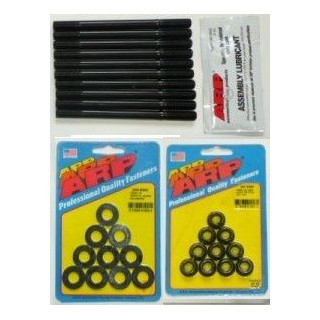
- In stock
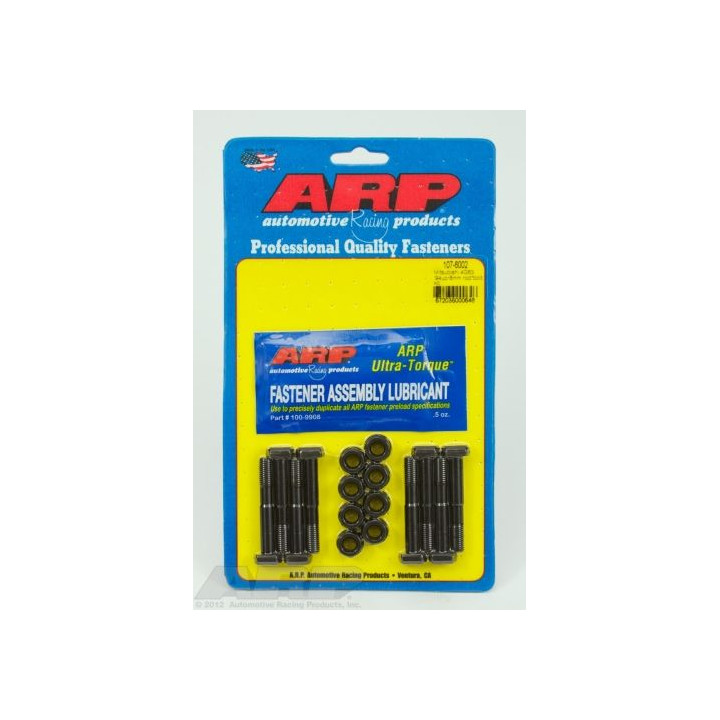
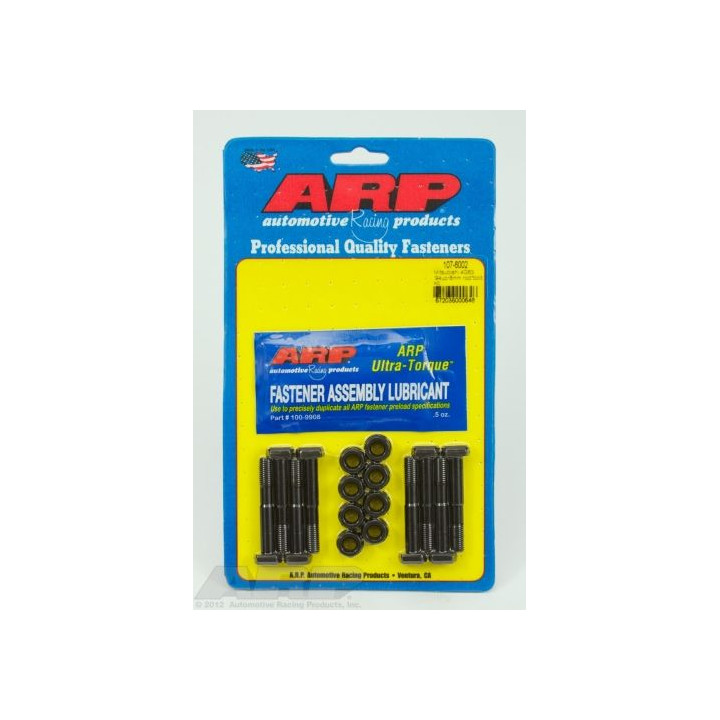


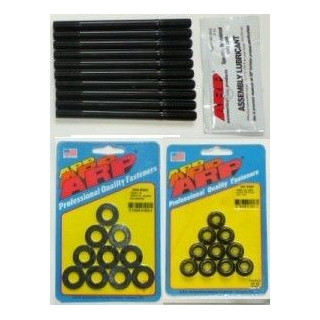
Reinforced ARP bolts for OEM rods MITSUBISHI EAGLE 4G63 7-bolt
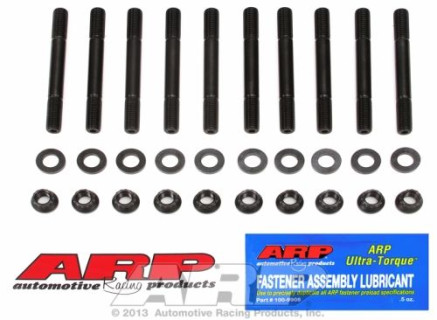
ARP 8740 connecting rod bolt and nut kit replacing the original bolts on OEM rods of the Mitsubishi 4G63 7-bolt engine.
- Brand: ARP
- Engine: 4G63
- Dimensions: M8
- Grade: 8740
The Mitsubishi 4G63 7-bolt engine concerned
This kit is intended for the 2.0-litre Mitsubishi 4G63, a twin-cam 16-valve four-cylinder, in the 7-bolt version that ARP declares for engines of 1994 and later. The NGK catalogue ties it to the second-generation Eclipse and the Eagle Talon, the Lancer Evolution II to IX, the Lancer VII, the Outlander, the Space Runner, the Santamo, the Dion and the Carisma GT Evo.
This ARP kit replaces the original rod bolt with an ARP 8740 bolt of M8 diameter, pressed into the connecting rod and closed with a nut.
Reinforced ARP bolts and nuts for connecting rods
At every revolution, the rod bolt takes the pull of the rod and piston assembly, which tries to force the cap away through inertia. As original equipment, it is sized for stock power.
Supplied for the stock 4G63 7-bolt rod, these bolts are pressed in and then secured by their nut; the ARP instructions base tightening on the stretch measured with a dial gauge and give the torque only for workshops without a gauge. These bolts are made from 8740, a chrome-moly steel brought to 180,000 psi tensile strength by ARP's heat treatment; the threads are rolled afterwards. For comparison, classes 10.9 and 12.9 of original fasteners have a minimum of 150,800 to 176,900 psi. The engine speed allowed by the 8740 bolts goes up to 8,750 rpm (calculated estimate).
Technical specifications
| Part number | Brand | Grade / material | Nut | Thread | Under-head length |
|---|---|---|---|---|---|
| ARP-107-6002 | ARP | 8740 steel | Not published | M8 | Not published |
Before pressing in, check the chamfer at the top of each rod bore: the ARP instructions require it to be wide enough for the radius under the bolt head not to bear on it.
Tightening torque and stretch
| Reference | Tightening torque | Stretch |
|---|---|---|
| ARP-107-6002 | 35.3 Nm | 0.152 - 0.165 mm |
ARP gives priority to stretch control for an accurate preload; the torque in the table is used only when no gauge is available. Torque and stretch figures in the table apply with ARP lubricant.
The values above come from the ARP 107-6002 instruction sheet applicable at the date of publication; it is authoritative in the event of any difference. Read the ARP 107-6002 instruction sheet
Assembly is done without thread locker, as the ARP instruction sheet calls for none: ARP Ultra-Torque grease is applied to the threads of each bolt and to the bearing face of its nut.
According to the ARP instructions, the big ends must be checked and resized with the fasteners in place; plan a visit to a machine shop.
Measuring bolt stretch
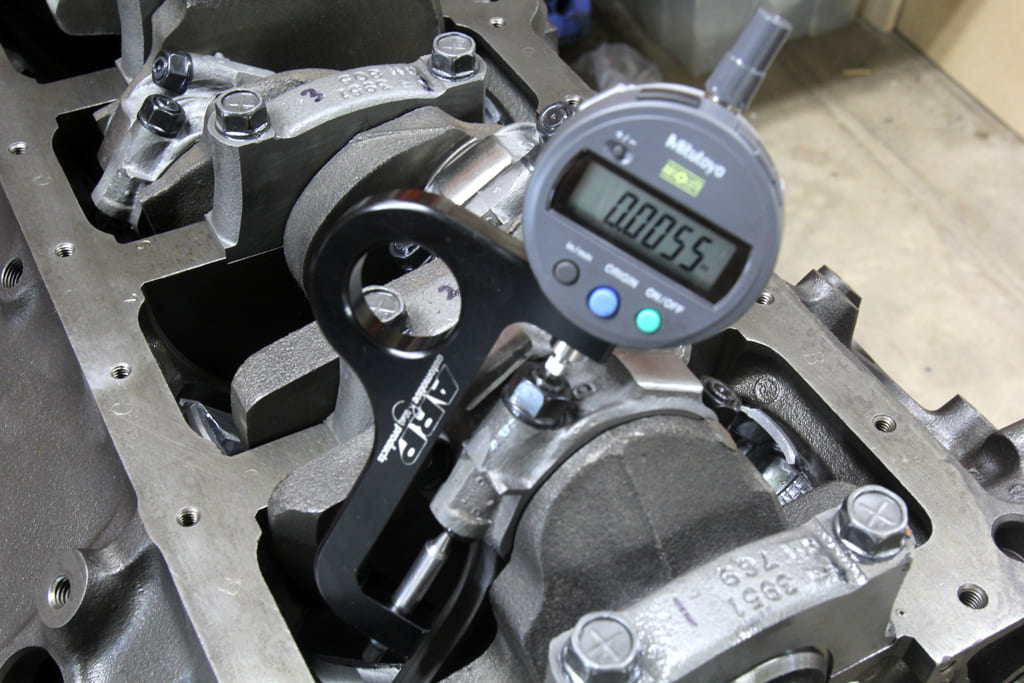
Tightening to stretch means setting the preload on how much the bolt actually stretches, rather than on a torque affected by friction. With the bolt fitted, the dial gauge is placed on both its ends and the bolt is tightened until the stretch given in the table is read. It is the safest method on a highly tuned engine.
Technical guide
Tightening is done with ARP assembly grease, on the bolt threads and on the bearing face of the nuts: the torque and stretch figures in the table were established with it.
The ARP brand 
Founded in the early 1970s by Gary Holzapfel, who came from the aerospace sector, ARP (Automotive Racing Products) was born to put an end to fastener-related engine failures in racing. Its thousands of part numbers, designed and manufactured in California for the cylinder head, the main bearings and the connecting rods, come in several materials depending on the application and are recognised for the consistency of their manufacture.
Vehicle compatibility
| Brand | Model (chassis) | Engine code | Power | Years |
|---|---|---|---|---|
| Mitsubishi | Carisma (DA_) 2.0 16V GT EVO VI/VII, Saloon | 4G63-T/C | 280 hp | 1999-2006 |
| Mitsubishi | Dion (CR_W) 2.0 GDI (CR9W), MPV | 4G63 | 135 hp | 1999-2005 |
| Mitsubishi | Eclipse 2.0, Convertible | 4G63-T/C | 214 hp | 1995-1999 |
| Mitsubishi | Eclipse 2.0, Convertible | 4G63-T/C | 208 hp | 1996-1999 |
| Mitsubishi | Eclipse II (D3_A) 2.0 Turbo 4WD (D32A), Coupé | 4G63-T/C | 200 hp | 1994-1999 |
| Mitsubishi | Eclipse II (D3_A) 2.0 Turbo (D32A), Coupé | 4G63-T/C | 200 hp | 1994-1999 |
| Mitsubishi | Eclipse II (D3_A) 2.0, Coupé | 4G63-T/C | 208 hp | 1994-1999 |
| Mitsubishi | Eclipse II (D3_A) 2000 GS 16V (D32A), Coupé | 4G63 | 146 hp | 1995-1999 |
| Mitsubishi | Eclipse II (D3_A) 2000 GT 16V, Coupé | 4G63-T/C | 214 hp | 1995-1999 |
| Mitsubishi | Eclipse II (D3_A) 2.0 Turbo 4WD (D33A), Coupé | 4G63-T/C | 214 hp | 1995-1999 |
| Mitsubishi | Eclipse II (D3_A) Turbo 16V (D32A), Coupé | 4G63-T/C | 230 hp | 1995-1999 |
| Mitsubishi | Lancer IV (C6_A, C7_A) EVO IV (CN9A), Saloon | 4G63-T/C | 280 hp | 1996-1997 |
| Mitsubishi | Lancer V (CB_A, CD_A, CE_A) EVO II (CE9A), Saloon | 4G63-T/C | 261 hp | 1994-1995 |
| Mitsubishi | Lancer V (CB_A, CD_A, CE_A) EVO III (CE9A), Saloon | 4G63-T/C | 269 hp | 1995-1996 |
| Mitsubishi | Lancer VI (CJ_, CP_, CK_) EVO V (CP9A), Saloon | 4G63-T/C | 280 hp | 1998-1998 |
| Mitsubishi | Lancer VI (CJ_, CP_, CK_) EVO V - RS450 Ralliart (CP9A), Saloon | 4G63-T/C | 456 hp | 1998-1998 |
| Mitsubishi | Lancer VI (CJ_, CP_, CK_) EVO VI (CP9A), Saloon | 4G63-T/C | 280 hp | 1999-2001 |
| Mitsubishi | Lancer VII (CS_A, CT_A) EVO VII (CT9A), Saloon | 4G63-T/C | 272 hp | 2001-2003 |
| Mitsubishi | Lancer VII (CS_A, CT_A) EVO VII (CT9A), Saloon | 4G63-T/C | 280 hp | 2001-2003 |
| Mitsubishi | Lancer VII (CS_A, CT_A) EVO VIII (CT9A), Saloon | 4G63-T/C | 280 hp | 2003-2005 |
| Mitsubishi | Lancer VII (CS_A, CT_A) EVO VIII - FQ-300 (CT9A), Saloon | 4G63-T/C | 305 hp | 2003-2004 |
| Mitsubishi | Lancer VII (CS_A, CT_A) EVO VIII - FQ-300 (CT9A), Saloon | 4G63-T/C | 309 hp | 2003-2004 |
| Mitsubishi | Lancer VII (CS_A, CT_A) EVO VIII (CT9A), Saloon | 4G63-T/C | 275 hp | 2003-2005 |
| Mitsubishi | Lancer VII (CS_A, CT_A) 2.0, Saloon | 4G63 | 116 hp | 2003-2013 |
| Mitsubishi | Lancer VII (CS_A, CT_A) EVO VIII - FQ-330 (CT9A), Saloon | 4G63-T/C | 334 hp | 2003-2006 |
| Mitsubishi | Lancer VII (CS_A, CT_A) 2.0 (CS9A), Saloon | 4G63 | 135 hp | 2003-2013 |
| Mitsubishi | Lancer VII (CS_A, CT_A) EVO VIII - 260 (CT9A), Saloon | 4G63-T/C | 265 hp | 2004-2005 |
| Mitsubishi | Lancer VII (CS_A, CT_A) EVO VIII - FQ-320 (CT9A), Saloon | 4G63-T/C | 330 hp | 2004-2006 |
| Mitsubishi | Lancer VII (CS_A, CT_A) EVO VIII - FQ-340 (CT9A), Saloon | 4G63-T/C | 347 hp | 2004-2005 |
| Mitsubishi | Lancer VII (CS_A, CT_A) EVO VIII - FQ-400 (CT9A), Saloon | 4G63-T/C | 411 hp | 2004-2006 |
| Mitsubishi | Lancer VII (CS_A, CT_A) EVO IX (CT9A), Saloon | 4G63-T/C | 280 hp | 2005-2007 |
| Mitsubishi | Lancer VII (CS_A, CT_A) EVO IX - FQ-300 (CT9A), Saloon | 4G63-T/C | 309 hp | 2005-2006 |
| Mitsubishi | Lancer VII (CS_A, CT_A) EVO IX - FQ-340 (CT9A), Saloon | 4G63-T/C | 350 hp | 2005-2007 |
| Mitsubishi | Lancer VII (CS_A, CT_A) EVO IX (CT9A), Saloon | 4G63-T/C | 290 hp | 2005-2006 |
| Mitsubishi | Lancer VII (CS_A, CT_A) EVO IX, Saloon | 4G63-T/C | 366 hp | 2006-2008 |
| Mitsubishi | Lancer VII (CS_A, CT_A) EVO IX - FQ-360 (CT9A), Saloon | 4G63-T/C | 371 hp | 2006-2007 |
| Mitsubishi | Lancer VII (CS_W, CT_W) 2.0 (CS9W), Estate | 4G63 | 135 hp | 2003-2007 |
| Mitsubishi | Lancer VII (CS_W, CT_W) EVO (CT9W), Estate | 4G63-T/C | 272 hp | 2005-2007 |
| Mitsubishi | Lancer VII (CS_W, CT_W) EVO (CT9W), Estate | 4G63-T/C | 280 hp | 2005-2007 |
| Mitsubishi | Outlander I (CU_W) 2.0 AWD (CU2W), SUV | 4G63 | 126 hp | 2001-2005 |
| Mitsubishi | Outlander I (CU_W) 2.0 Turbo-R 4WD (CU2W), SUV | 4G63-T/C | 241 hp | 2002-2006 |
| Mitsubishi | Outlander I (CU_W) 2.0 4WD (CU2W), SUV | 4G63 | 136 hp | 2003-2006 |
| Mitsubishi | Outlander I (CU_W) 2.0 (CU2W), SUV | 4G63 | 136 hp | 2003-2006 |
| Mitsubishi | Outlander I (CU_W) 2.0 Turbo 4WD (CU2W), SUV | 4G63-T/C | 201 hp | 2004-2006 |
| Mitsubishi | Santamo (UG) 2.0 16V, MPV | 4G63 | 139 hp | 1999-2004 |
| Mitsubishi | Santamo (UG) 2.0 16V 4WD, MPV | 4G63 | 139 hp | 1999-2004 |
| Mitsubishi | Space Runner (N6_W, N7_W) 2.0 AWD (N73WG), MPV | 4G63 | 230 hp | 1997-2002 |
| Eagle | Talon 2.0 Turbo AWD, Coupé | 4G63-T | 213 hp | 1994-1998 |
| Eagle | Talon 2.0 Turbo, Coupé | 4G63-T | 213 hp | 1994-1998 |
Why is it the most cost-effective solution?
On a 7-bolt 4G63 from a Lancer Evolution or a second-generation Eclipse running more boost, the original rod bolts work ever closer to their limit, and their failure destroys the rod, the piston and the block. ARP 8740 bolts cost little compared with replacing a complete bottom end.
Matching connecting rod bearings
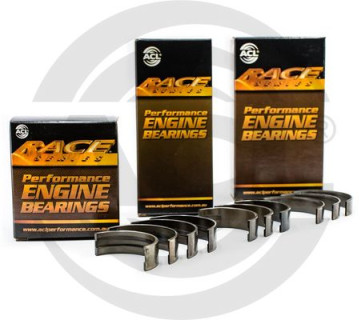
New bolts, new bearings: find below the connecting rod bearings suited to this engine.
| 4G63 7-bolt connecting rod bearings → |
-
Brand
-
ReferenceARP-107-6002
-
EAN130672036000646