Product successfully added to your shopping cart
Quantity
Total
There are 0 items in your cart. There is 1 item in your cart.
Total products
Total shipping To be determined
Total

2.0L 16v - 4G63 7-bolt
Manufacturers
2.0L 16v - 4G63 7-bolt
 View larger
 Warning: Last items in stock!
New product
Set of 8 trimetal connecting rod half-bearings for Mitsubishi 4G63 and turbocharged 4G63T engines built from 01.1992.
The 4G63 is the 2.0-litre (1,997 cc) four-cylinder of Mitsubishi's 4G6 family, with an 85 mm bore and an 88 mm stroke. It comes with a single overhead camshaft and 8 or 16 valves, with twin overhead camshafts and 16 valves, and as the turbocharged 4G63T used in the Lancer Evolution I to IX, the Galant VR-4 and the Eclipse Turbo; it also powered the Galant, Space Wagon, Space Runner, Outlander, L200, L300 and L400. This bearing set fits engines built from January 1992 onwards, 6-bolt as well as 7-bolt.
From the factory, this engine is fitted with standard production connecting rod bearings, sized for the loads of the original engine: as soon as power, engine speed or boost pressure increase, they reach their limits.
A trimetal bearing stacks three layers: a steel back, a copper-lead intermediate layer with high load capacity and an anti-friction running surface that protects the journal. The complete set contains 8 half shells, four pairs for a four-cylinder engine.
The original bearing relies on an aluminium alloy over a steel back, intended for low to medium loads, whereas trimetal is designed for high, sustained loads: an aluminium bi-metal takes around 8,000 psi, a performance trimetal up to 12,000 psi, 50% more. Hence better resistance and better durability on turbocharged, supercharged and high-revving engines.
| ACL / King bearings Crankpin Ø 44.981 / 44.996 mm (XPC: 44.981 / 45.001 mm) Housing bore Ø 47.998 / 48.019 mm (XPC: 48.001 / 48.016 mm) Width 21.1 mm (ACL Calico: 21.2 mm) |
| Reference | Brand and treatment | Size | Wall thickness (mm) |
|---|---|---|---|
| 4B1185H-STD | ACL Race - Untreated | Standard | 1.488 |
| 4B1185HX-STD | ACL Race - Untreated | Std, increased clearance (HX) | 1.475 |
| 4B1185H-.025 | ACL Race - Untreated | +0.025 | 1.501 |
| 4B1185H-.25 | ACL Race - Untreated | +0.25 | 1.613 |
| 4B1185HC-STD | ACL Race - Calico CT-1 | Standard | 1.488 |
| 4B1185HXC-STD | ACL Race - Calico CT-1 | Std, increased clearance (HX) | 1.475 |
| 4B1185HC-.025 | ACL Race - Calico CT-1 | +0.025 | 1.501 |
| CR4120XP | King Racing - Untreated | Standard | 1.488 |
| CR4120XP STDX | King Racing - Untreated | Std, increased clearance (STDX) | 1.475 |
| CR4120XP.026 | King Racing - Untreated | +0.026 | 1.501 |
| CR4120XP0.25 | King Racing - Untreated | +0.25 | 1.615 |
| CR4120XP0.5 | King Racing - Untreated | +0.50 | 1.742 |
| CR4120XPC | King Racing - pMaxKote | Standard | 1.488 |
| CR4120XPC STDX | King Racing - pMaxKote | Std, increased clearance (STDX) | 1.475 |
| CR4120XPC.026 | King Racing - pMaxKote | +0.026 | 1.501 |
| CR4120XPC0.25 | King Racing - pMaxKote | +0.25 | 1.615 |
| CR4120XPC0.5 | King Racing - pMaxKote | +0.50 | 1.742 |
The running clearance is the gap between the bearing and the journal where the oil film flows.
In operation, the crankshaft journal does not rub against the bearing: it rides on this oil film, which carries the load. Clearance sets the thickness of this film: too tight, oil flows poorly, temperature rises and the risk of seizure increases; too loose, oil escapes, the film loses load-carrying capacity and oil pressure drops. The right clearance is the balance between adequate lubrication and a well-maintained oil film.
| Size / grade | When to choose it | ACL Race Series | King XP / XPC |
|---|---|---|---|
| Standard (STD) | Standard journal, not reground | 0.049 to 0.058 mm | 0.045 mm - 0.050 mm |
| Increased clearance (HX / STDX) | Wider clearance: high oil flow, high rpm | 0.074 to 0.083 mm | 0.070 mm - 0.075 mm |
| +0.025 / +0.026 mm | Polished journal | 0.049 to 0.058 mm | 0.045 mm - 0.050 mm |
| +0.25 mm | Journal reground to 0.25 mm | 0.049 to 0.058 mm | 0.045 mm - 0.050 mm |
| +0.50 mm | Journal reground to 0.50 mm | 0.045 mm - 0.050 mm |
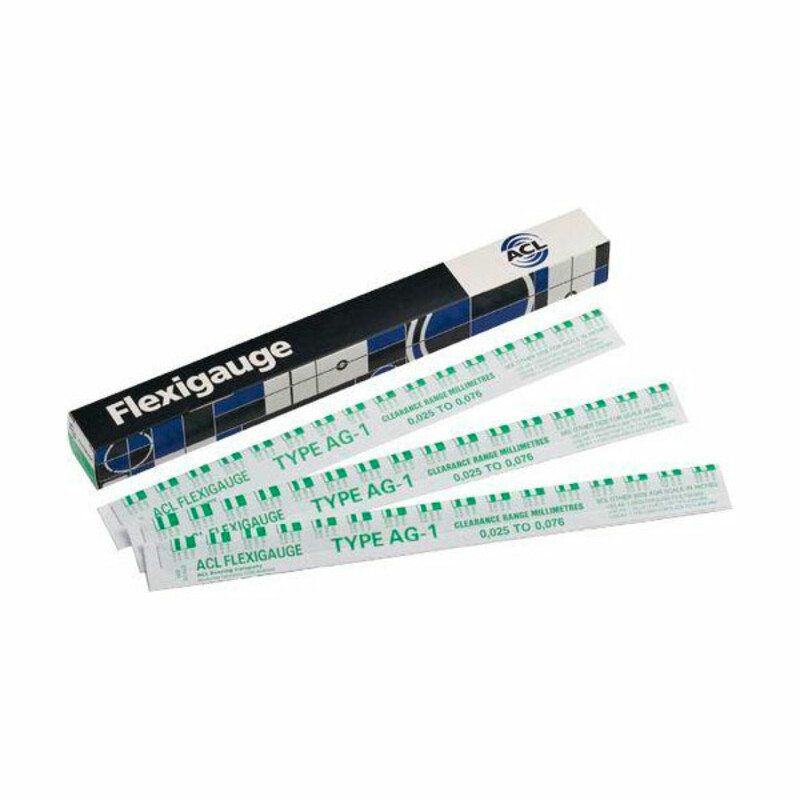
Checking on assembly: lay a calibrated strip (Plastigauge) on the journal, torque the rod cap to spec (see the torque table below), then compare the crushed strip against the gauge to read the clearance.
| Bolts | By torque | By stretch (gauge) |
| Forged rod ZRP, ARP2000 (3/8″ × 38 mm) | 61 Nm | 0.140 to 0.152 mm |
| Forged rod ZRP, ARP L19 (3/8″ × 38 mm) | 67.8 Nm | 0.152 to 0.165 mm |
ARP recommends the stretch method (gauge).
The ACL and King rod bearings shown here are trimetal bearings, designed for engine building and racing. Compared with an original bearing, they handle far higher loads: they cope with increased power, high rpm or the addition of a turbo or supercharger, where a standard bearing quickly reaches its limit.
 | ACL Bearing Company, an Australian manufacturer of high-performance engine bearings since 1949, offers with its Race Series precise trimetal bearings, available in many sizes and proven on built engines worldwide. Its Calico version (HC suffix) adds the CT-1 coating, a dry film lubricant that reduces friction and abrasive wear. |
 | King Engine Bearings, an Israeli manufacturer of high-performance engine bearings since the 1960s, offers with its pMax Black trimetal alloy bearings designed for heavy loads, with a pMaxKote coating available as an option (XPC version). |
| Criterion | ACL Race Series | King Racing |
| Cross-section | 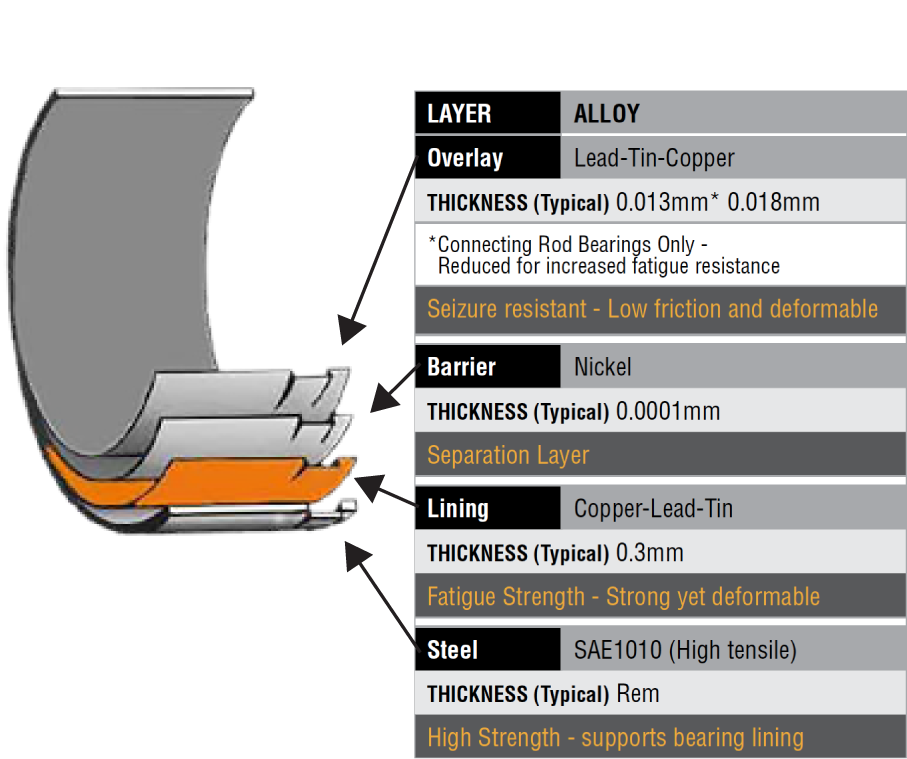 |  |
| Type | High-performance trimetal bearing | High-performance trimetal bearing |
| Country of manufacture | Australia | Israel |
| Construction | Trimetal: steel back, copper layer, soft surface | Trimetal: steel back, copper layer, soft surface |
| Alloy | Race Series (copper-lead) | pMax Black (hardened copper-lead) |
| Protective coating | No (Race); Calico CT-1 (HC) | pMaxKote (optional, XPC version): polymer coating on the surface that limits wear when lubrication drops (start-ups, thin oil film). |
| Available sizes | Standard to +0.50 mm (+ increased clearance HX) | Standard to +0.50 mm (+ increased clearance STDX) |
This connecting rod bearing set fits the 4G63 and 4G63T four-cylinder engines, built from January 1992 onwards, of the following Mitsubishi models:
| Brand | Model (chassis) | Engine code | Power | Years |
|---|---|---|---|---|
| MITSUBISHI | L 300 III Bus (P0_W, P1_W, P2_W, P3_W) 2.0 4WD (P23W, P03W, P13W) / 2.0 (P03W, P13W) / 2.0 i (P00W, P03W, P13W) / 2.0 4WD (P03W, P13W) / 2.0 GLS (P03W, P13W) / 2.0 (P03W) / 2.0 (P13W) | 4G63 (SOHC 8V), 4G63 (SOHC 16V) | 88–114 hp | 1986–2013 |
| MITSUBISHI | LANCER IV (C6_A, C7_A) EVO IV (CN9A) | 4G63-T/C (DOHC 16V) | 280 hp | 1996–1997 |
| MITSUBISHI | LANCER V (CB_A, CD_A, CE_A) EVO I (CD9A) / EVO III (CE9A) / EVO II (CE9A) | 4G63-T/C (DOHC 16V) | 250–269 hp | 1992–1996 |
| MITSUBISHI | SPACE WAGON (N3_W, N4_W) 2.0 (N33W) / 2.0 4WD (N43W) | 4G63 (SOHC 16V), 4G63 (SOHC 8V) | 105–133 hp | 1991–1998 |
| MITSUBISHI | ECLIPSE I (D2_A) 2.0 i 16V (D22A, D27A) / 2.0 i 16V 4WD (D22A, D27A) / 2.0 Turbo / 2.0 Turbo 4WD / 2.0 / 2.0 4WD | 4G63 (DOHC 16V), 4G63-T/C (DOHC 16V) | 136–214 hp | 1989–1995 |
| MITSUBISHI | GALANT VI Saloon (E3_A) 2.0 GTi 16V (E39A, E38A, E33A) / 2.0 GTi 16V 4WD (E39A, E38A, E33A) / 2.0 4WD (E39A, E38A, E33A) / 2.0 (E39A, E38A, E33A) / 2.0 GTI 16V Cat 4WD (E38A, E39A, E33A) / 2.0 I VR4 Turbo 4WD (E39A, E38A, E33A) / 2.0 / 2.0 4WD / 2.0 AMG (E33A) | 4G63 (DOHC 16V), 4G63 (SOHC 8V), 4G63-T/C (DOHC 16V) | 103–201 hp | 1987–1993 |
| MITSUBISHI | GALANT VII (E5_A, E7_A, E8_A) 2.0 GLSI (E55A) / 2.0 GLSI 4WD (E75A) / 2.0 (E55A) | 4G63 (SOHC 16V) | 122–137 hp | 1992–1996 |
| MITSUBISHI | GALANT VII Saloon (E5_A, E7_A, E8_A) 2.0 GLSI (E55A) / 2.0 GLSI 4WD (E75A) / 2.0 | 4G63 (SOHC 16V) | 136–137 hp | 1992–1996 |
| MITSUBISHI | ECLIPSE II (D3_A) 2000 GS 16V (D32A) / 2000 GT 16V / 2.0 Turbo 4WD (D33A) / 2.0 Turbo 4WD (D32A) / 2.0 Turbo (D32A) / 2.0 / Turbo 16V (D32A) | 4G63 (DOHC 16V), 4G63-T/C (DOHC 16V) | 146–230 hp | 1994–1999 |
| MITSUBISHI | LANCER VI (CJ_, CP_, CK_) EVO V (CP9A) / EVO VI (CP9A) / EVO V - RS450 Ralliart (CP9A) | 4G63-T/C (DOHC 16V) | 280–456 hp | 1998–2001 |
| MITSUBISHI | L200 (K3_T, K2_T, K1_T, K0_T) 2.0 (K12T, K32T) / 2.0 4WD (K32T, K22T) / 2.0 (K32T, K12T) / 2.0 / 2.0 4WD | 4G63 (SOHC 8V) | 86–102 hp | 1986–1996 |
| MITSUBISHI | L200 (K7_T, K6_T, K5_T) 2.0 (K62T) | 4G63 (SOHC 16V) | 122 hp | 1996–2007 |
| MITSUBISHI | CARISMA Saloon (DA_) 2.0 16V GT EVO VI/VII | 4G63-T/C (DOHC 16V) | 280 hp | 1999–2006 |
| MITSUBISHI | L 300 III Van (P0_V, P1_V, P2_V) 2.0 (P23V, P03V, P13V) / 2.0 (P23W, P23V) / 2.0 4WD (P23W, P23V) / 2.0 / 2.0 (P03V, P13V) / 2.0 (P03V) | 4G63 (SOHC 8V), 4G63 (SOHC 16V) | 86–117 hp | 1986–2013 |
| MITSUBISHI | GALANT VIII (EA_) 2.0 (EA2A) | 4G63 (SOHC 16V) | 133–136 hp | 1996–2004 |
| MITSUBISHI | GALANT VIII Estate (EA_, EC_) 2.0 (EA2W) | 4G63 (SOHC 16V) | 133–136 hp | 1996–2003 |
| MITSUBISHI | GALANT VI (E3_A) 2.0 4WD (E33A, E38A, E39A) / 2.0 GTI 16V (E39A, E38A, E33A) / 2.0 (E39A, E38A, E33A) / 2.0 GTI 16V 4x4 (E38A, E39A, E33A) / 2.0 GTi 16V 4WD (E39A) | 4G63 (SOHC 8V), 4G63 (DOHC 16V) | 105–146 hp | 1988–1992 |
| MITSUBISHI | SPACE RUNNER MPV (N1_W, N2_W) 2.0 16V (N13W) / 2.0 (N13W) / 2.0 4WD (N23W) | 4G63 (DOHC 16V) | 133–160 hp | 1992–2000 |
| MITSUBISHI | SPACE WAGON (N9_W, N8_W) 2.0 / 2.0 (N83W) | 4G63 (SOHC 16V) | 109–133 hp | 1998–2004 |
| MITSUBISHI | L 300 / DELICA II Platform/Chassis (L03_P) 2.0 | 4G63 (SOHC 8V) | 86 hp | 1986–2001 |
| MITSUBISHI | L 300 III Platform/Chassis (P1_T) 2.0 (P13T) | 4G63 (SOHC 16V) | 113–116 hp | 1994–2000 |
| MITSUBISHI | SANTAMO (UG) 2.0 16V / 2.0 16V 4WD | 4G63 (DOHC 16V) | 139 hp | 1999–2004 |
| MITSUBISHI | SPACE RUNNER (N6_W, N7_W) 2.0 (N63W) / 2.0 Traction intégrale (N73WG) | 4G63 (SOHC 16V), 4G63 (DOHC 16V) | 133–230 hp | 1997–2002 |
| MITSUBISHI | L400 Bus (PD_W, PC_W, PA_V, PB_V, PA_W) 2.0 16V (PA3V/W, PB3V, PA3W) / 2.0 (PA3W) | 4G63 (SOHC 16V) | 113–115 hp | 1995–2002 |
| MITSUBISHI | L400 Van (PD_W, PC_W, PB_V, PA_W, PA_V) 2.0 / 2.0 (PA3W) | 4G63 (SOHC 16V) | 113–116 hp | 1994–2002 |
| MITSUBISHI | OUTLANDER I (CU_W) 2.0 4WD (CU2W) / 2.0 Turbo 4WD (CU2W) / 2.0 Turbo-R 4WD (CU2W) / 2.0 (CU2W) / 2.0 AWD (CU2W) | 4G63 (DOHC 16V), 4G63-T/C (DOHC 16V), 4G63 (SOHC 16V) | 126–241 hp | 2001–2006 |
| MITSUBISHI | LANCER VII (CS_A, CT_A) EVO VIII - 260 (CT9A) / 2.0 (CS9A) / EVO IX (CT9A) / 2.0 / EVO VIII (CT9A) / EVO VII (CT9A) / EVO VIII - FQ-300 (CT9A) / EVO VIII - FQ-320 (CT9A) / EVO VIII - FQ-330 (CT9A) / EVO VIII - FQ-340 (CT9A) / EVO VIII - FQ-400 (CT9A) / EVO IX - FQ-300 (CT9A) / EVO IX - FQ-340 (CT9A) / EVO IX - FQ-360 (CT9A) / EVO IX | 4G63-T/C (DOHC 16V), 4G63 (DOHC 16V) | 116–411 hp | 2001–2013 |
| MITSUBISHI | LANCER VII Estate (CS_W, CT_W) 2.0 (CS9W) / EVO (CT9W) | 4G63 (DOHC 16V), 4G63-T/C (DOHC 16V) | 135–280 hp | 2003–2007 |
| MITSUBISHI | ECLIPSE Convertible 2.0 | 4G63-T/C (DOHC 16V) | 208–214 hp | 1995–1999 |
| MITSUBISHI | FREECA 2.0 (VB2W) | 4G63 (SOHC 16V) | 114 hp | 1998–2010 |
| MITSUBISHI | DION MPV (CR_W) 2.0 GDI (CR9W) | 4G63 (DOHC 16V) | 135 hp | 1999–2005 |
| MITSUBISHI | DELICA / SPACE GEAR 2.0 (PA3V) | 4G63 (SOHC 16V) | 106–116 hp | 1995–2004 |
| MITSUBISHI | LANCER CARGO Estate Van (CS_W, CS_V) 2.0 (CS9W) | 4G63 (DOHC 16V) | 135 hp | 2003–2008 |