Product successfully added to your shopping cart
Quantity
Total
There are 0 items in your cart. There is 1 item in your cart.
Total products
Total shipping To be determined
Total

1.6L 16v - M16A
Manufacturers
1.6L 16v - M16A
Warning: Last items in stock!
New product
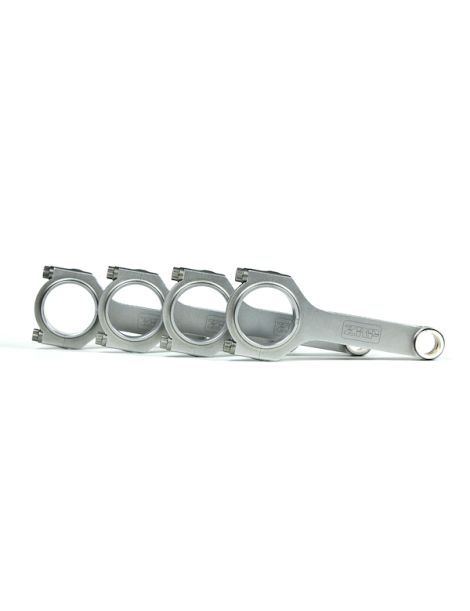
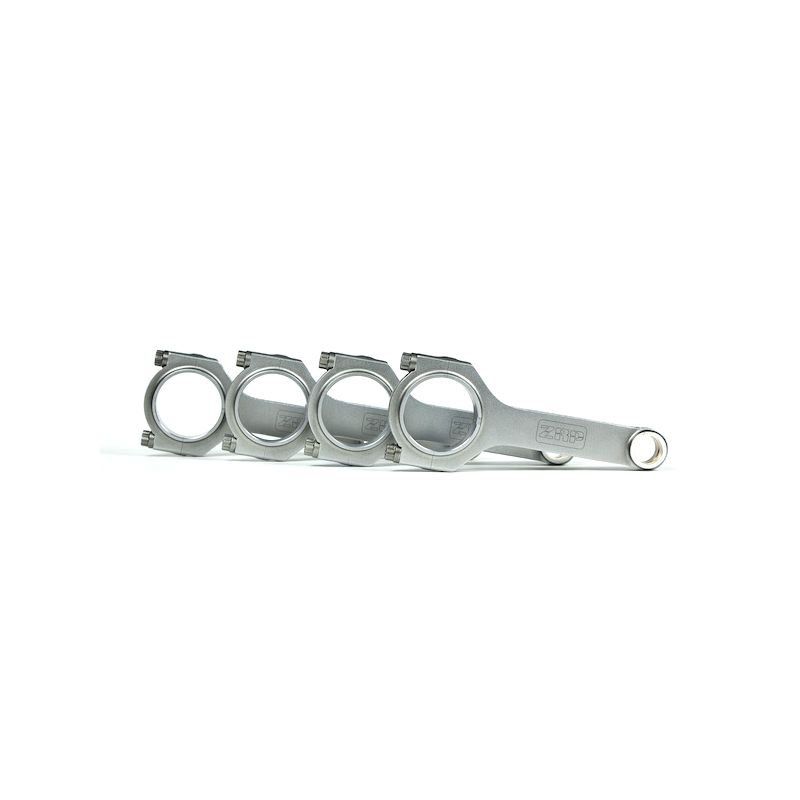
Set of 4 forged connecting rods in 4340 steel for the Suzuki 1.6L 16V M16A.
The Suzuki M16A is a 1.6 L (1,586 cc) inline-four petrol engine with double overhead camshafts and 16 valves, fitted with variable intake valve timing (VVT). Introduced in the early 2000s, it combines an aluminium block and cylinder head, a 78 mm bore and 83 mm stroke and a high compression ratio, up to 11.1:1 on the Swift Sport version. Naturally aspirated, it favours efficiency and flexibility, with output from around 102 hp on the saloons to 125 hp on the sport version.
The M16A powers a wide Suzuki range: Liana, Swift Sport, SX4, Grand Vitara then Vitara, as well as the Fiat Sedici derived from it. The Swift Sport version (ZC31S), raised to 125 hp thanks to a more aggressive camshaft and forged pistons, made it a sought-after base for light motorsport and tuning. As soon as you want to strengthen the bottom end, raise the rev range or prepare the engine for intensive use, replacing the rods with forged ones becomes a key step.
Machined from high-strength 4340 steel, reinforced forged connecting rods secure the bottom end as soon as power rises. They become essential when switching to forged pistons, raising the rev range, increasing boost pressure or gaining displacement, all situations where the stock rod quickly reaches its limits.
Designed to withstand the heavy loads of tuned engines, naturally aspirated as well as forced-induction, these forged connecting rods suit every discipline (rally, drift, drag, circuit, hillclimb, time attack) and support Stage 2, Stage 3 and beyond builds, up to the competition engine.
| Reference | Brand | Profile | Bolts | Pin diameter OEM 20 mm | Small-end width | Big-end diameter | Big-end width | Center-to-center OEM 135.16 mm | Weight per rod |
|---|---|---|---|---|---|---|---|---|---|
| R-SUZ-001H | ZRP | H | ARP 2000-5/16"-38mm | 20 mm | 45 mm | 23.84 mm | 135.16 mm | 412 g | |
| R-SUZ-001H-L19 | ZRP | H | ARP L19-5/16"-38mm | 20 mm | 45 mm | 23.84 mm | 135.16 mm | 412 g |
| Rod | Bolts | Torque | Recommended stretch |
|---|---|---|---|
| ZRP (R-SUZ-001H) | ARP 2000 | 40.7 N·m | 0.140 – 0.152 mm |
| ZRP (R-SUZ-001H-L19) | ARP L19 | 54.2 N·m | 0.127 – 0.140 mm |
The stretch method starts with a free measurement: each bolt is gauged before it is fitted, and that starting figure becomes the reference. Once the bolt is tightened, the difference between the two readings gives the real elongation, and therefore the preload, whereas a torque reading always depends on thread friction and head bearing conditions. On the M16A, the figures in the table above must be applied exactly as issued by the bolt manufacturer, keeping ARP 2000 bolts clearly separate from ARP L19: their stretch ranges are not interchangeable. Threads must be clean and dry, then coated with ARP assembly lubricant, and load is built in alternating stages across the eight bolts. On 5/16 inch bolts, a few hundredths of a millimetre separate a correct clamp from an insufficient one. The instruction sheet supplied with the kit prevails.
| 4340 is a low-alloy nickel-chromium-molybdenum steel used both in aerospace and in motorsport. Forged then heat-treated (quench and temper), it combines high tensile strength, excellent fatigue resistance and good ductility. Compared with a stock rod, usually made of sintered metal optimised for mass-production cost, a forged 4340 rod gains about 19% in yield strength, 8% in tensile strength and 19 to 37% in fatigue resistance, multiplying its life under cyclic load. This is precisely what makes it the reference material once revs and load increase. |
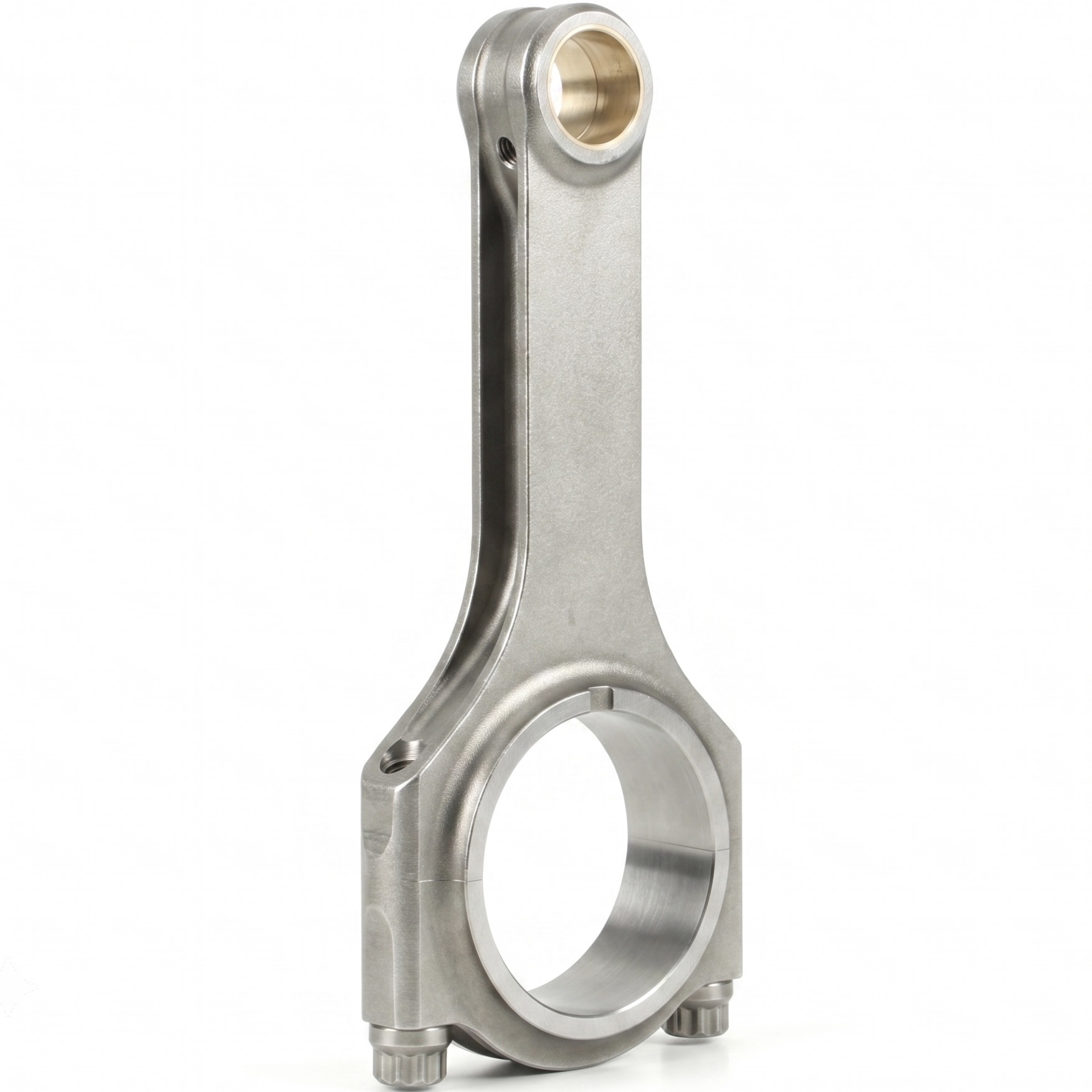 | H-Beam profile. Its 'H'-shaped section gives it great rigidity and excellent resistance to bending and compression. Slightly heavier than an I-Beam rod, it focuses on strength: the profile of choice for high-torque engines, large displacements and drag racing. On a tuned M16A, it offers a reassuring safety margin. |
The rod bolt is among the most heavily stressed parts of the engine. The right approach is to match the ARP grade to the build's actual use, then to scrupulously follow the assembly torque and stretch.
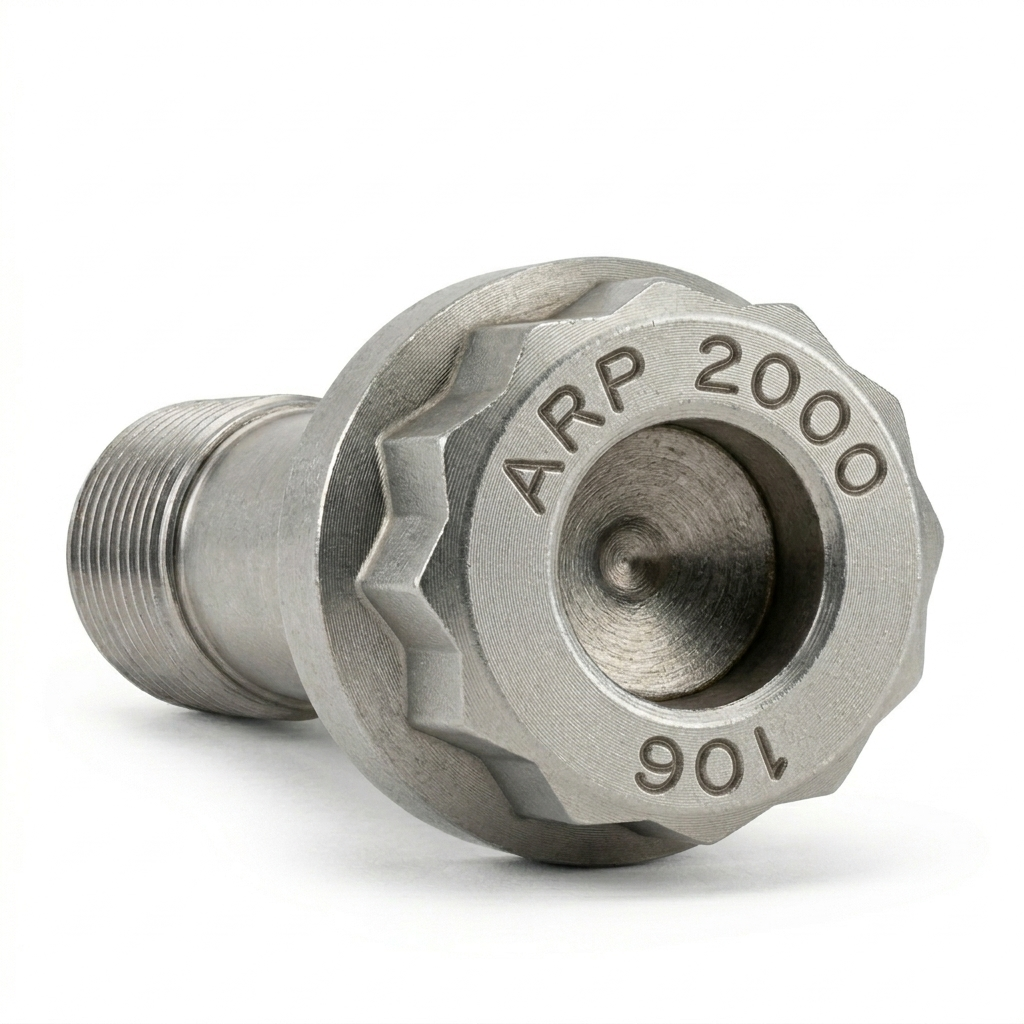 | ARP 2000 (tensile strength about 220,000 psi, around 1,517 MPa) is the high-performance standard. Suitable for builds up to 150 hp per cylinder in 5/16", and up to 8,500 rpm, it is the most common grade in circuit, trackday, drift, rally, drag and hillclimb, valued for its strength, reliability and versatility, with no particular storage precautions. |
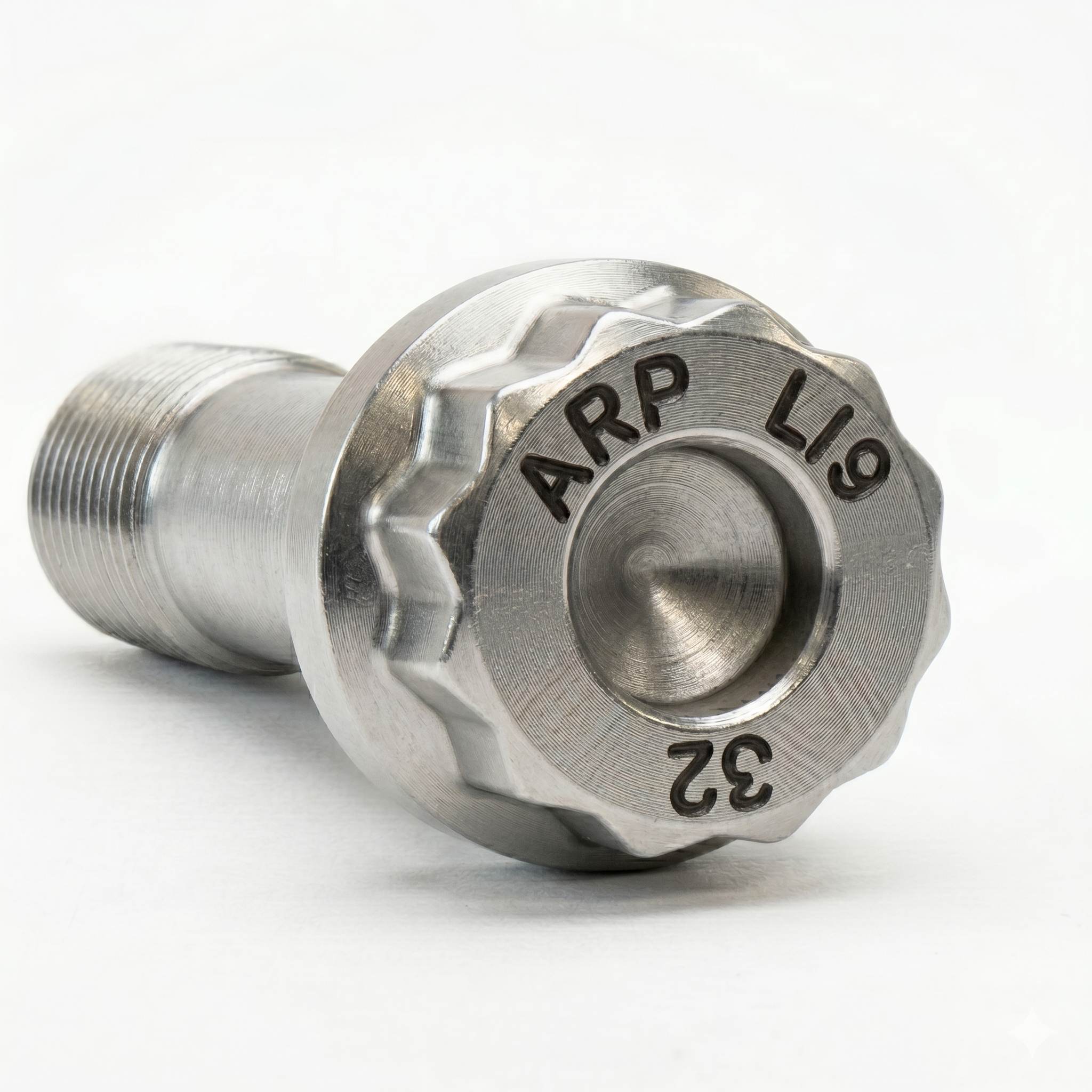 | ARP L19 (tensile strength about 260,000 psi, around 1,793 MPa) targets engines pushed to the extreme: up to 200 hp per cylinder in 5/16", and up to 10,000 rpm. It is aimed at high-power builds (drag, drift, rally, circuit) subject to very high cylinder pressures and sustained high revs. In return, sensitive to corrosion and hydrogen embrittlement, it must be stored and fitted oiled, away from moisture. |
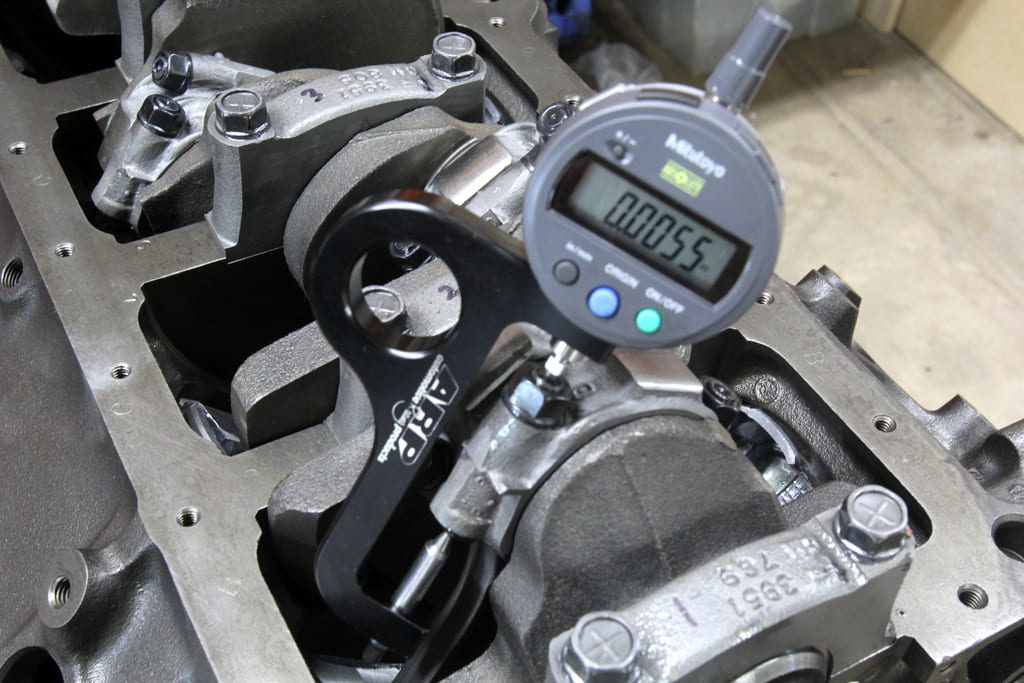
| Beyond torque tightening, measuring rod-bolt stretch remains the most reliable check to ensure correct preload. It is performed with the bolt fitted: the gauge (dial indicator) is applied to both ends of the bolt to read its actual stretch, which must match the recommended value (see the torque and stretch table above). This method cancels out the friction variations inherent in torque tightening and secures the assembly on heavily stressed engines. |
 | ZRP is a Greek brand of high-performance forged connecting rods, developed by Alex Drakos in Athens. Each rod is forged from 4340 steel, precision-machined and balanced to ±1 g to stay reliable at high revs. On the M16A, they are offered in H-Beam profile with ARP 2000 or ARP L19 bolts, designed and inspected in Greece, and proven in rally, on circuit and in drift. |
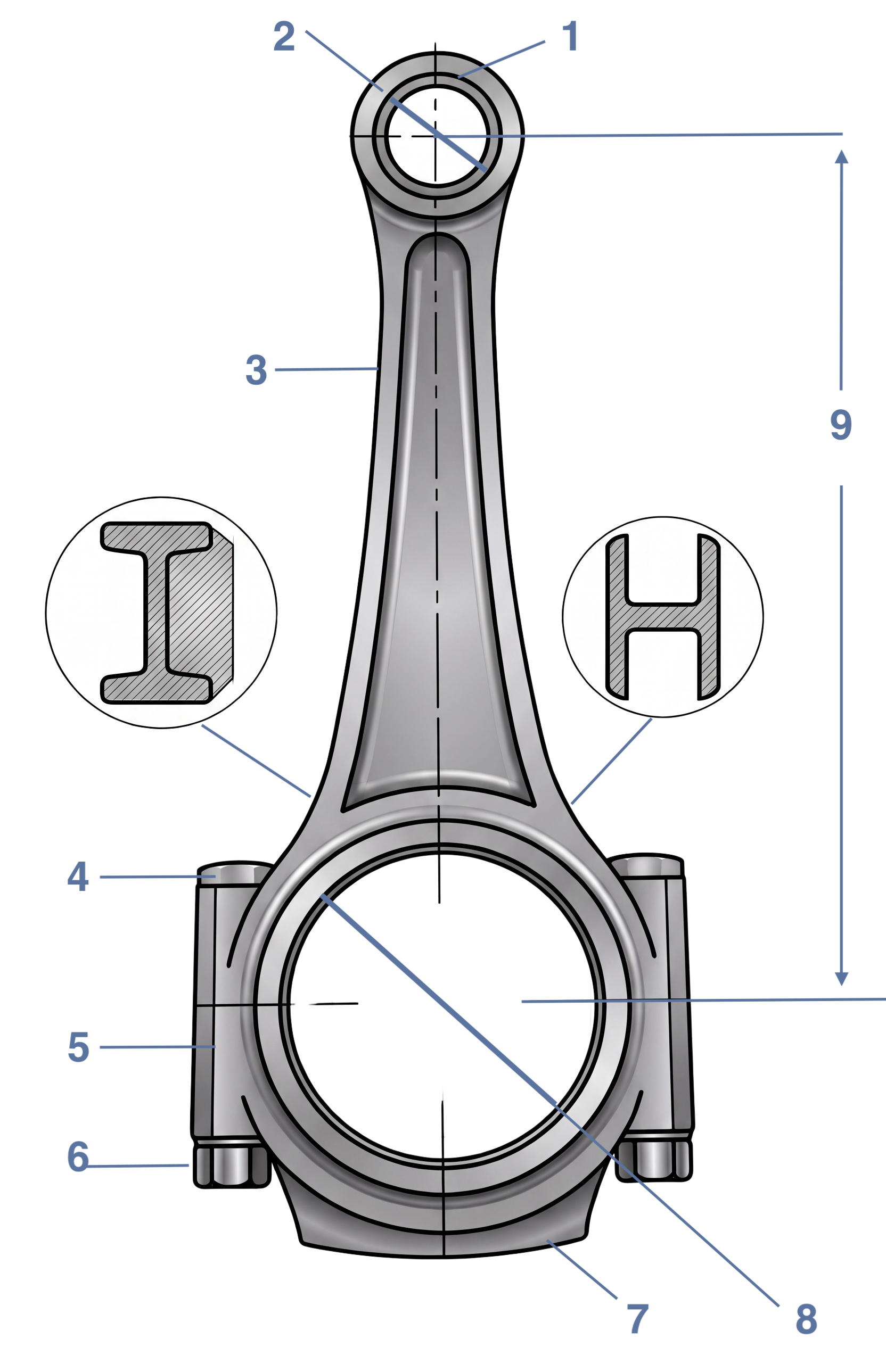 | 1) Small end 2) Small-end diameter 3) Rod beam 4) Rod bolt 5) Big end 6) Rod nut / bolt 7) Rod cap 8) Big-end diameter 9) Center-to-center |
These forged connecting rods are compatible with all vehicles fitted with the Suzuki M16A 1.6 16V engine:
| Brand | Model (chassis) | Engine code | Power | Years |
|---|---|---|---|---|
| Suzuki | Swift Sport (ZC31S) | M16A | 125 hp | 2005–2011 |
| Suzuki | Liana | M16A | 102–106 hp | 2001–2007 |
| Suzuki | SX4 | M16A | 107–120 hp | 2006–2014 |
| Suzuki | Grand Vitara | M16A | 106 hp | 2005–2015 |
| Suzuki | Vitara | M16A | 117–120 hp | 2015–2018 |
| Fiat | Sedici | M16A | 107 hp | 2007–2014 |
OEM reference: 12160-54GB0 (Suzuki, M16A)
An M16A bottom end that fails is never repaired by changing the rod alone: when a rod breaks, bends or scores its bearing, the matching piston is almost always scrap, the crankshaft and the block have to be checked, and new bearing shells, gaskets and bolts have to be added. The total cost of a like-for-like rebuild quickly climbs, for an engine that will stay just as fragile as before.
For a comparable budget, sometimes a lower one, fitting four 4340 forged steel rods together with forged pistons moves the bottom end into another class: a far wider safety margin, healthy behaviour during long high-rpm pulls, ARP bolts whose preload can be checked and documented at every teardown, and the option of raising power later without opening the block again. This is the route European engine builders have followed for more than fifteen years.
For the same budget: more reliability, more potential, more service life, season after season.