Product successfully added to your shopping cart
Quantity
Total
There are 0 items in your cart. There is 1 item in your cart.
Total products
Total shipping To be determined
Total

2.5L 24v - M50B25 (without VANOS)
Manufacturers
2.5L 24v - M50B25 (without VANOS)
Warning: Last items in stock!
New product
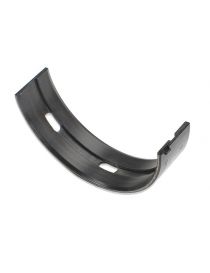
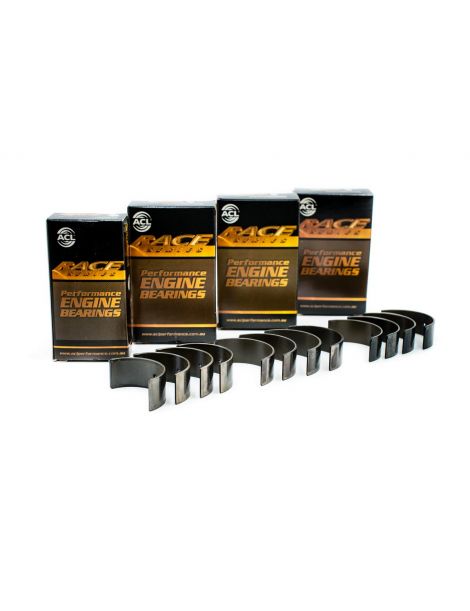
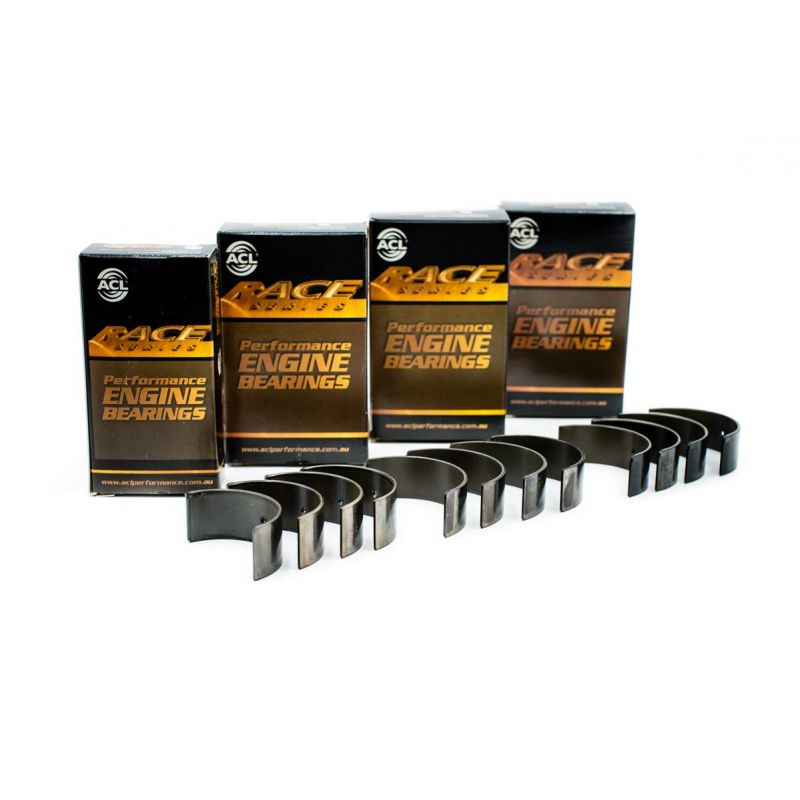
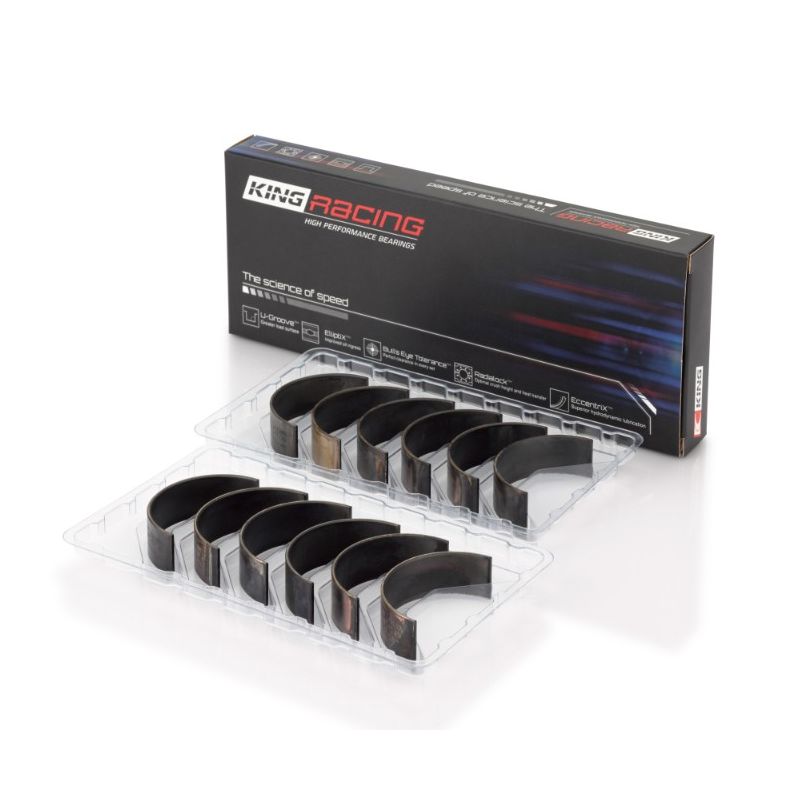
Set of 12 trimetal connecting rod half-bearings for BMW inline-six M20, M50, M52 and M54.
Launched in 1977, the M20 introduced BMW's compact inline six: cast iron block, single overhead camshaft, two valves per cylinder. The M50 followed in 1990 with an aluminium cylinder head, twin camshafts and four valves, joined by VANOS variable valve timing in 1992. From this architecture came the M52, then the M52TU with double VANOS and the M54 up to 3.0 litres, plus the North American M3 engines S50B30US and S52B32US. All share the same connecting rod journal diameter: a single bearing set covers the whole family.
From the factory, these engines are fitted with Glyco connecting rod bearings, BMW part number 11 24 1 284 849 to 854, supplied as half shells graded red and blue: BMW pairs two different grades on the same rod to absorb the machining tolerances of the journal. These are bi-metal bearings, a steel back coated with an aluminium alloy, sized for the loads of a standard engine. As soon as power, engine speed or boost pressure increase, this construction reaches its limits.
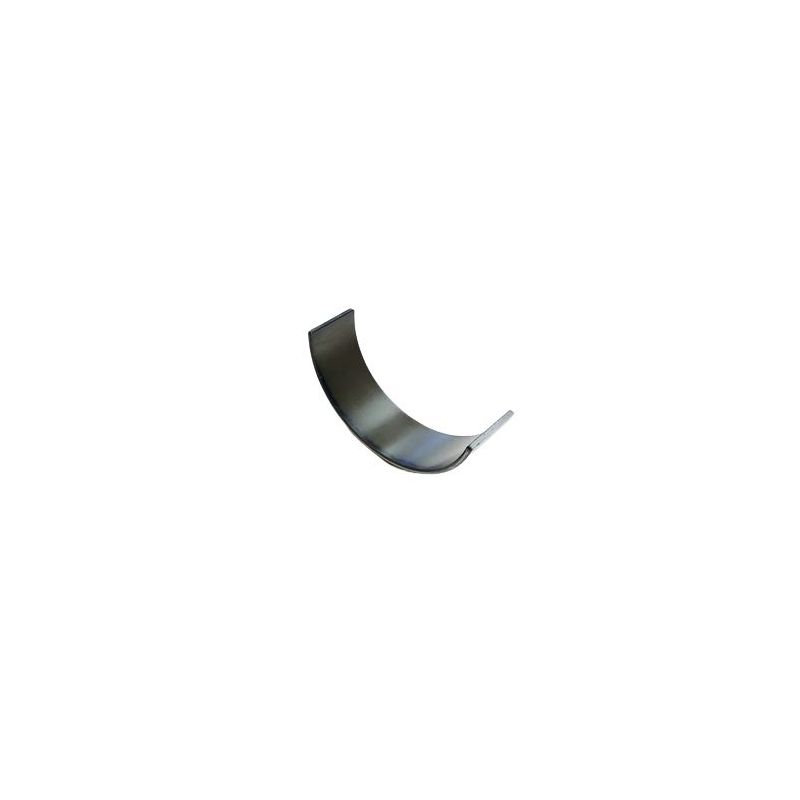
A tri-metal bearing stacks three layers: a steel back, a copper-lead intermediate layer with high load capacity and an anti-friction running surface that protects the journal. The complete set contains 12 half shells, six pairs for a six-cylinder engine.
The original bearing relies on an aluminium alloy over a steel back, intended for low to medium loads, whereas tri-metal is designed for high, sustained loads: an aluminium bi-metal takes around 8,000 psi, a performance tri-metal up to 12,000 psi, 50% more. Hence better resistance and better durability on turbocharged, supercharged and high-revving engines.
| ACL / King bearings Crankshaft journal Ø 44.973 / 44.991 mm Housing bore Ø 48.000 / 48.016 mm Width 18 mm | OEM reference Crankshaft journal Ø 44.975 / 44.991 mm Housing bore Ø 48.000 / 48.016 mm |
| Reference | Brand and treatment | Size | Wall thickness (mm) OEM : 1.493 |
|---|---|---|---|
| 6B1490H-STD | ACL Race - Untreated | Standard | 1.490 |
| 6B1490HX-STD | ACL Race - Untreated | Std, increased clearance (HX) | 1.477 |
| 6B1490H-.025 | ACL Race - Untreated | +0.025 | 1.503 |
| 6B1490H-.25 | ACL Race - Untreated | +0.25 | 1.615 |
| 6B1490H-.50 | ACL Race - Untreated | +0.50 | 1.740 |
| CR6640XP | King Racing - Untreated | Standard | 1.491 |
| CR6640XP STDX | King Racing - Untreated | Std, increased clearance (STDX) | 1.478 |
| CR6640XP0.25 | King Racing - Untreated | +0.25 | 1.618 |
| CR6640XP0.5 | King Racing - Untreated | +0.50 | 1.745 |
| CR6640XPC | King Racing - pMaxKote | Standard | 1.491 |
| CR6640XPC STDX | King Racing - pMaxKote | Std, increased clearance (STDX) | 1.478 |
| CR6640XPC.026 | King Racing - pMaxKote | +0.026 | 1.504 |
| CR6640XPC0.25 | King Racing - pMaxKote | +0.25 | 1.618 |
| CR6640XPC0.5 | King Racing - pMaxKote | +0.50 | 1.745 |
The running clearance is the gap between the bearing and the journal where the oil film flows.
In operation, the crankshaft journal does not rub against the bearing: it rides on this oil film, which carries the load. Clearance sets the thickness of this film: too tight, oil flows poorly, temperature rises and the risk of seizure increases; too loose, oil escapes, the film loses load-carrying capacity and oil pressure drops. The right clearance is the balance between adequate lubrication and a well-maintained oil film.
| Size / grade | When to choose it | ACL Race Series | King XP / XPC |
|---|---|---|---|
| Standard (STD) | Standard journal, not reground | 0.049 to 0.058 mm | 0.045 mm - 0.055 mm |
| Increased clearance (HX / STDX) | Wider clearance: high oil flow, high rpm | 0.074 to 0.083 mm | 0.070 mm - 0.080 mm |
| +0.025 / +0.026 mm | Polished journal | 0.049 to 0.058 mm | 0.045 mm - 0.055 mm |
| +0.25 mm | Journal reground to 0.25 mm | 0.049 to 0.058 mm | 0.045 mm - 0.055 mm |
| +0.50 mm | Journal reground to 0.50 mm | 0.049 to 0.058 mm | 0.045 mm - 0.055 mm |
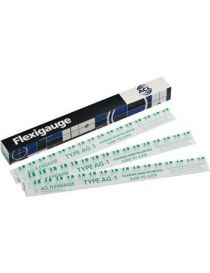
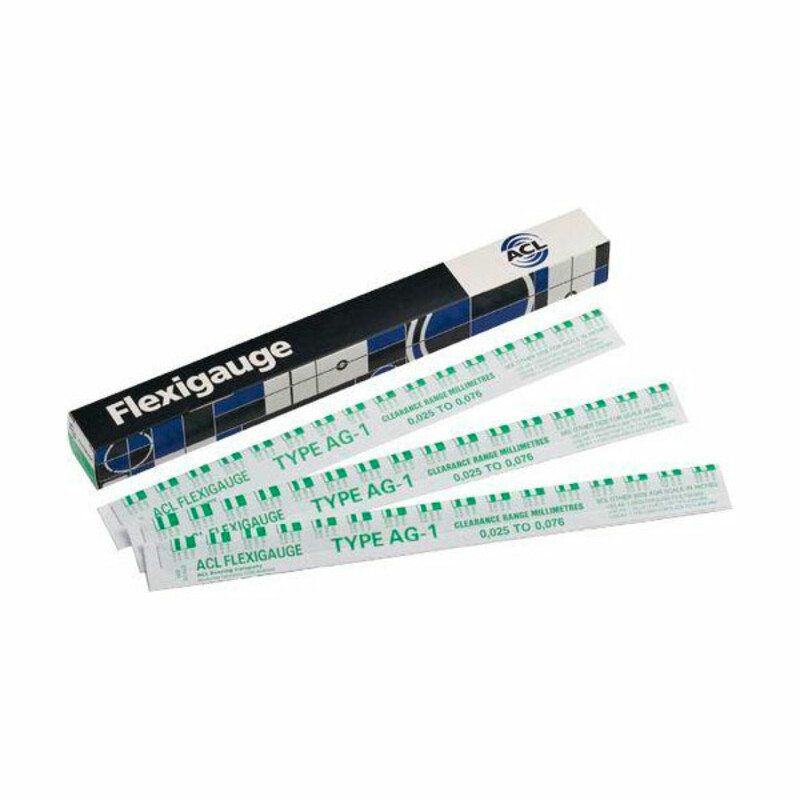
Checking on assembly: lay a calibrated strip (Plastigauge) on the journal, torque the rod cap to spec (see the torque table below), then compare the crushed strip against the gauge to read the clearance.
| Bolts | By torque | By stretch (gauge) |
| Original bolts (OEM), 24v M50/M52/M54 | 5 Nm + 20 Nm + 70° | |
| Original bolts (OEM), 12v M20 | 20 Nm + 70° | |
| Forged rod, ARP2000 (3/8″ × 38 mm) | 61 Nm | 0.140 to 0.152 mm |
| Forged rod, ARP L19 (3/8″ × 38 mm) | 67.8 Nm | 0.152 to 0.165 mm |
ARP recommends the stretch method (gauge).
The ACL and King rod bearings shown here are trimetal bearings, designed for engine building and racing. Compared with an original bearing, they handle far higher loads: they cope with increased power, high rpm or the addition of a turbo or supercharger, where a standard bearing quickly reaches its limit.
 | ACL Bearing Company, an Australian manufacturer of high-performance engine bearings since 1949, offers with its Race Series precise tri-metal bearings, available in many sizes and proven on built engines worldwide. |
 | King Engine Bearings, an Israeli manufacturer of high-performance engine bearings since the 1960s, offers with its pMax Black tri-metal alloy bearings designed for heavy loads, with a pMaxKote coating available as an option (XPC version). |
| Criterion | ACL Race Series | King Racing |
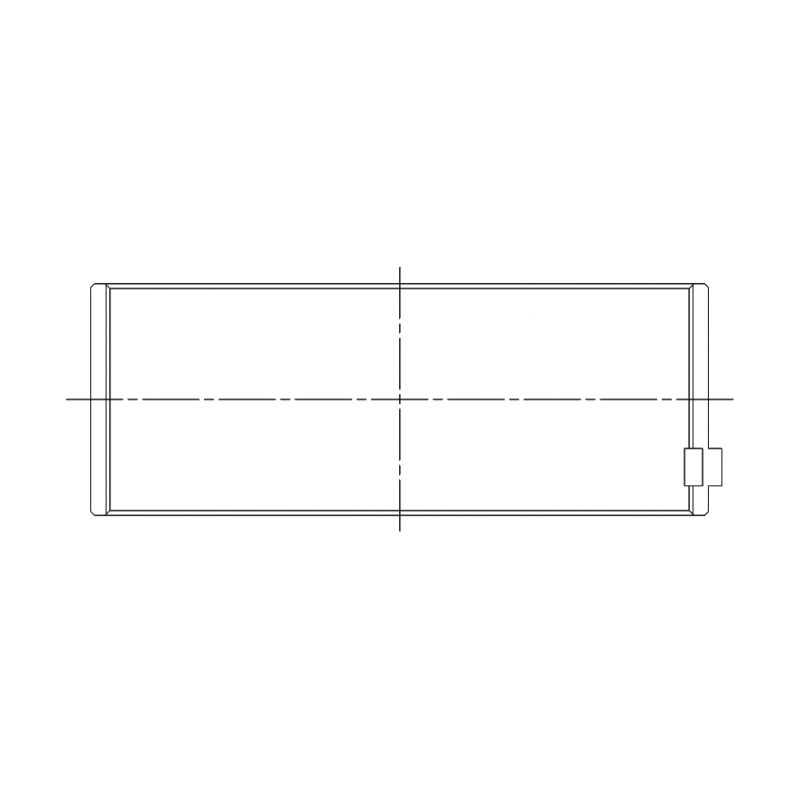
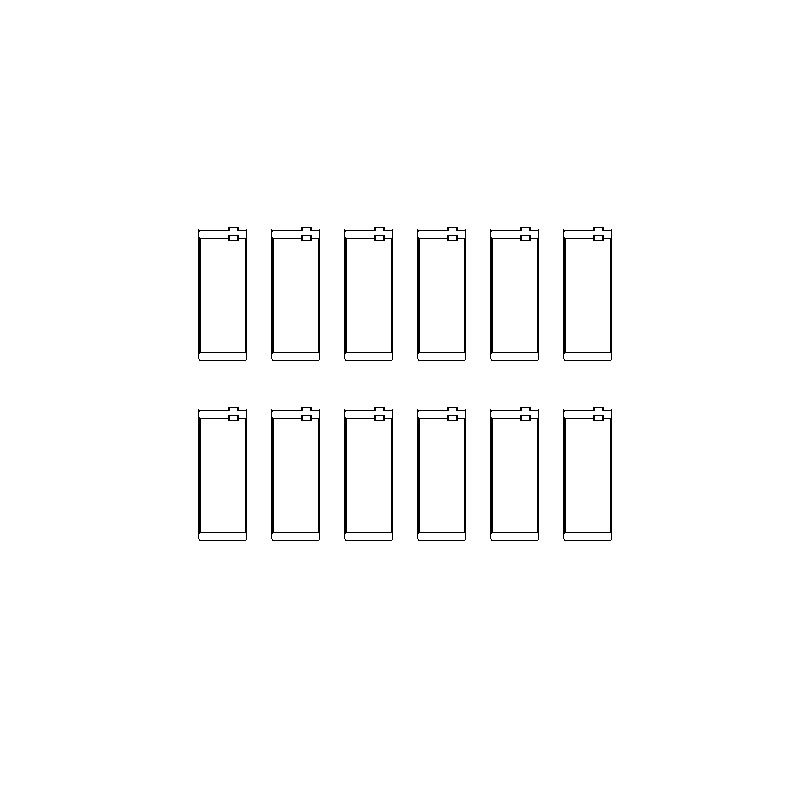
| Cross-section | 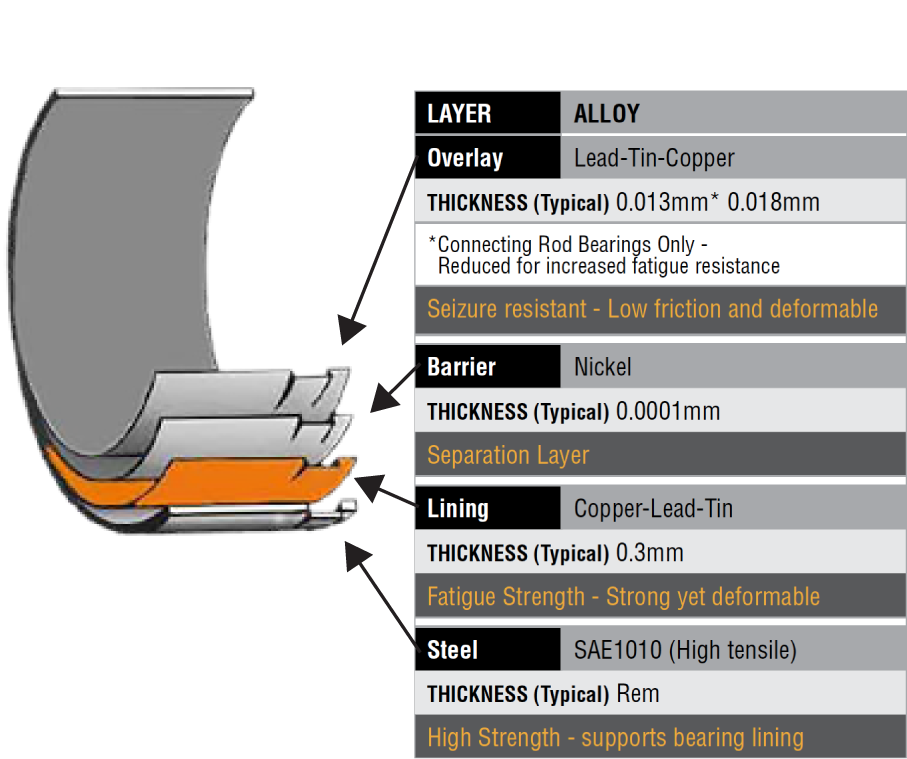 |  |
| Type | High-performance trimetal bearing | High-performance trimetal bearing |
| Country of manufacture | Australia | Israel |
| Construction | Trimetal: steel back, copper layer, soft surface | Trimetal: steel back, copper layer, soft surface |
| Alloy | Race Series (copper-lead) | pMax Black (hardened copper-lead) |
| Protective coating | No | pMaxKote (optional, XPC version): polymer coating on the surface that limits wear when lubrication drops (start-ups, thin oil film). |
| Available sizes | Standard to +0.50 mm (+ increased clearance HX) | Standard to +0.50 mm (+ increased clearance STDX) |
This connecting rod bearing set fits all BMW six-cylinder engines that share the same connecting-rod journal diameter:
| Brand | Model (chassis) | Engine code | Power | Years |
|---|---|---|---|---|
| BMW | 3 Series (E21) 320/6 | M20B20 | 122 hp | 1977–1982 |
| BMW | 3 Series (E30) 320i | M20B20 | 125–129 hp | 1982–1993 |
| BMW | 5 Series (E12) 520/6 | M20B20 | 122 hp | 1976–1981 |
| BMW | 5 Series (E28) 520i | M20B20 | 125–150 hp | 1981–1987 |
| BMW | 5 Series (E34) 520i | M20B20 | 129 hp | 1987–1990 |
| Bertone | Freeclimber 2.0 | M20B20 | 129 hp | 1990–1993 |
| Alpina | C1 (E21/E30) 2.3 | M20B23 | 170 hp | 1980–1985 |
| BMW | 3 Series (E21) 323i | M20B23 | 143 hp | 1978–1982 |
| BMW | 3 Series (E30) 323i | M20B23 | 139–150 hp | 1982–1986 |
| Alpina | C1 (E30) 2.5 | M20B25 | 190 hp | 1986–1988 |
| Alpina | C2 (E30) 2.5 | M20B25 | 185 hp | 1985–1988 |
| BMW | 3 Series (E30) 325i / 325iX | M20B25 | 170–192 hp | 1983–1993 |
| BMW | 5 Series (E34) 525i | M20B25 | 170 hp | 1988–1990 |
| BMW | Z1 Roadster 2.5 | M20B25 | 170 hp | 1988–1991 |
| Alpina | B3 (E30) 2.7 | M20B27 | 204 hp | 1987–1992 |
| Alpina | C2 (E30) 2.7 | M20B27 | 204–209 hp | 1986–1987 |
| BMW | 3 Series (E30) 325e | M20B27 | 122–129 hp | 1983–1988 |
| BMW | 5 Series (E28) 525e | M20B27 | 122–129 hp | 1981–1987 |
| Bertone | Freeclimber 2.7 | M20B27 | 129 hp | 1991–1993 |
| BMW | 3 Series (E36) 320i | M50B20 | 150 hp | 1991–1999 |
| BMW | 5 Series (E34) 520i | M50B20 | 150 hp | 1990–1996 |
| BMW | 3 Series (E36) 325i / 325is | M50B25 | 192 hp | 1990–1995 |
| BMW | 5 Series (E34) 525i / 525iX | M50B25 | 192 hp | 1990–1996 |
| BMW | 3 Series (E36/E46) 320i | M52B20 | 150 hp | 1995–2001 |
| BMW | 5 Series (E39) 520i | M52B20 | 136–150 hp | 1996–2003 |
| BMW | Z3 Roadster (E36) 2.0i | M52B20 | 150 hp | 1999–2003 |
| BMW | 3 Series (E36/E46) 323i / 323Ci / 323ti | M52B25 | 163–173 hp | 1995–2000 |
| BMW | 5 Series (E39) 523i | M52B25 | 170 hp | 1995–2000 |
| BMW | Z3 Roadster (E36) 2.5 | M52B25 | 170 hp | 1998–2000 |
| Alpina | B3 (E46) 3.3 / 3.4S | M52B28 | 280–305 hp | 1999–2006 |
| Alpina | B10 (E39) 3.3 | M52B28 | 280 hp | 1999–2003 |
| BMW | 3 Series (E36/E46) 328i / 328Ci | M52B28 | 193–196 hp | 1995–2000 |
| BMW | 5 Series (E39) 528i | M52B28 | 193 hp | 1995–2000 |
| BMW | 7 Series (E38) 728i / 728iL | M52B28 | 193 hp | 1995–2001 |
| BMW | Z3 (E36) 2.8i | M52B28 | 193 hp | 1996–2000 |
| Land Rover | Defender (L316) 2.8 4x4 | M52B28 | 190 hp | 1998–2003 |
| BMW | 3 Series (E46) 320i / 320Ci | M54B22 | 163–170 hp | 2000–2007 |
| BMW | 5 Series (E39/E60) 520i | M54B22 | 163–170 hp | 2000–2010 |
| BMW | Z3 Roadster (E36) 2.2i | M54B22 | 163–170 hp | 2000–2003 |
| BMW | Z4 Roadster (E85) 2.2i | M54B22 | 170 hp | 2003–2005 |
| BMW | 3 Series (E46) 325i / 325xi / 325Ci / 325ti | M54B25 | 186–192 hp | 2000–2006 |
| BMW | 5 Series (E39/E60/E61) 525i | M54B25 | 186–192 hp | 2000–2010 |
| BMW | X3 (E83) 2.5i | M54B25 | 186–192 hp | 2004–2006 |
| BMW | Z3 Roadster (E36) 2.5i | M54B25 | 192 hp | 2000–2002 |
| BMW | Z4 (E85/E86) 2.5i | M54B25 | 192 hp | 2002–2005 |
| BMW | 3 Series (E46) 330i / 330xi / 330Ci | M54B30 | 228–231 hp | 2000–2006 |
| BMW | 5 Series (E39/E60) 530i | M54B30 | 228–231 hp | 2000–2005 |
| BMW | 7 Series (E65/E66) 730i / 730Li | M54B30 | 231 hp | 2003–2008 |
| BMW | X3 (E83) 3.0i / xDrive | M54B30 | 231 hp | 2003–2006 |
| BMW | X5 (E53) 3.0i | M54B30 | 231 hp | 2000–2006 |
| BMW | Z3 Roadster / Coupé (E36) 3.0i | M54B30 | 228–231 hp | 2000–2003 |
| BMW | M3 (E36, North American market) 3.0 | S50B30US | 239 hp | 1994–1995 |
| BMW | M3 (E36, North American market) 3.2 | S52B32US | 243 hp | 1996–1999 |
| BMW | Z3 M Coupé / Roadster (E36, North Am. market) 3.2 | S52B32US | 239–243 hp | 1998–2000 |