Product successfully added to your shopping cart
Quantity
Total
There are 0 items in your cart. There is 1 item in your cart.
Total products
Total shipping To be determined
Total

2.5L 24v - M50B25 (without VANOS)
Manufacturers
2.5L 24v - M50B25 (without VANOS)
Warning: Last items in stock!
New product
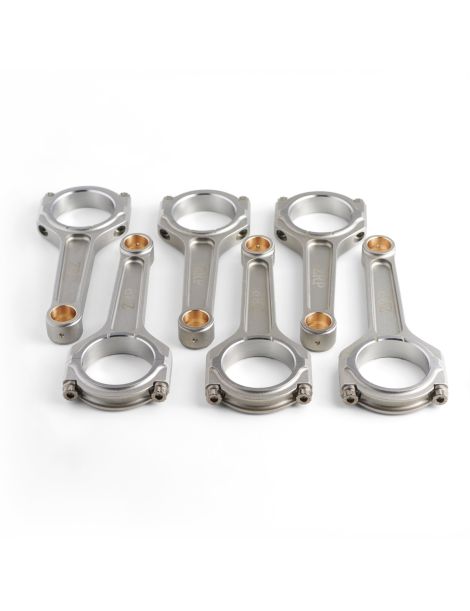
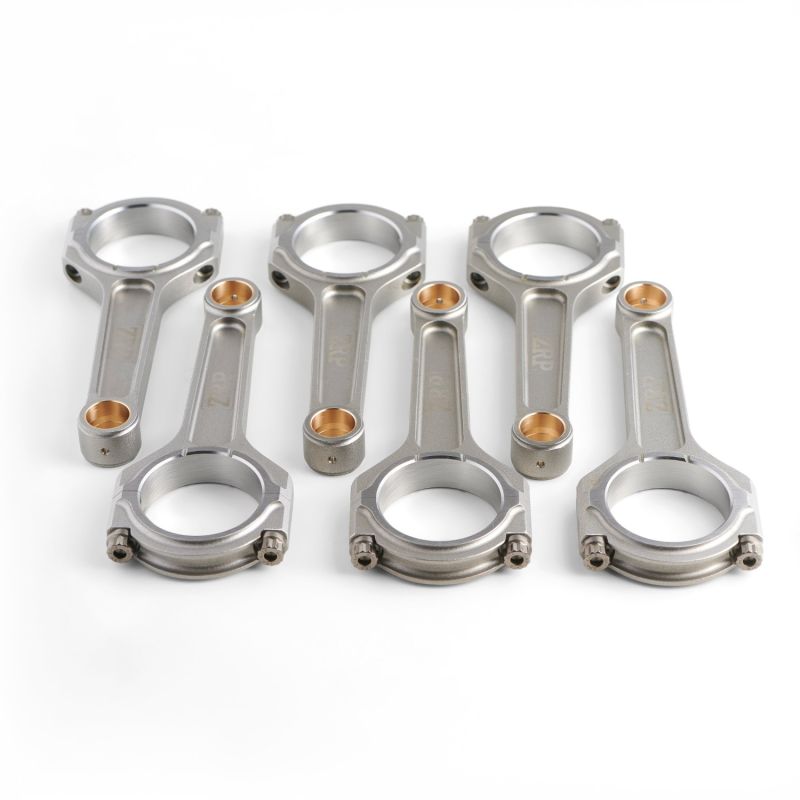
Set of 6 forged 4340-steel connecting rods for BMW 6-cylinder, 135 mm c-to-c.
BMW built a long line of inline-six engines sharing the same connecting-rod length: a 135 mm center-to-center distance. This common base links the SOHC M20 “small six” (launched in 1977) to the modern twin-cam, four-valve-per-cylinder M50, M52 and M54 families. From one generation to the next the architecture evolves (24 valves, VANOS, aluminium block), but the rod geometry stays compatible, so a single set of forged rods covers a very wide range.
Renowned for their smoothness and durability, these engines power the 3, 5 and 7 Series as well as the Z3, Z4, X3 and X5, and form the basis of many builds. Their bottom end copes well with power, but the original rods become the limiting link as soon as torque or rpm rise significantly.
Machined from high-strength 4340 steel and then heat-treated, these forged connecting rods replace the original rods to withstand the higher revs and cylinder pressures of a build without flinching. Forging aligns the metal’s grain flow and removes casting porosity: the result is markedly higher fatigue strength and the safety margin that becomes essential as soon as power climbs.
Each set is inspected and balanced, then supplied with high-performance ARP bolts sized for the target torque. Paired with forged pistons, these rods form the basis of a reinforced bottom end, able to endure intensive use and competition.
| Reference | Brand | Profile | Bolts | Pin diameter OEM 22 mm | Small-end width | Big-end diameter OEM 48 mm | Big-end width | Center-to-center OEM 135 / 140 mm | Weight per rod |
|---|---|---|---|---|---|---|---|---|---|
| R-BMW-006-I | ZRP | I-Beam | ARP 2000-3/8"-38mm | 22 mm | 48 mm | 21.9 mm | 135 mm | 499 g | |
| R-BMW-006-I-L19 | ZRP | I-Beam | ARP L19-3/8"-38mm | 22 mm | 48 mm | 21.9 mm | 135 mm | 499 g |
| Connecting rod | Bolts | Tightening torque | Recommended stretch |
|---|---|---|---|
| ZRP (R-BMW-006-I) | ARP 2000 | 61 N·m | 0.140 – 0.152 mm |
| ZRP (R-BMW-006-I-L19) | ARP L19 | 67.8 N·m | 0.152 – 0.165 mm |
First precaution with a forged rod: forget the original procedure. The values in the vehicle manual were calculated for the production bolt, often a single-use angle-tightened fastener, and mean nothing when applied to a reusable ARP bolt of different geometry and grade. On these M20B25, M50B25 no VANOS, M52B28, M54B30 and S52B32 US engines, only the values in the table above are authoritative, with one line depending on whether the rod carries ARP 2000 or ARP L19; they come from the bolt manufacturer and are never combined with an original angle specification. The verification itself does not change: torque approaches the target, the stretch gauge confirms preload on the twelve bolts. Clean threads, ARP assembly lubricant, progressive alternating tightening. The kit instruction sheet prevails over any workshop documentation.
| 4340 steel is a nickel-chromium-molybdenum alloy steel used in aerospace and motorsport alike. Forged then heat-treated (quench and temper), it offers excellent tensile strength, high fatigue resistance and real ductility. Compared with an original rod (often sintered/powder metal, optimised for series-production cost), a 4340 forged rod shows roughly +19% higher yield strength, +8% higher tensile strength and above all +19% to +37% higher fatigue strength, i.e. a fatigue life under cyclic loading several times longer. This is what makes forged 4340 the reference material as soon as boost and rpm climb. |
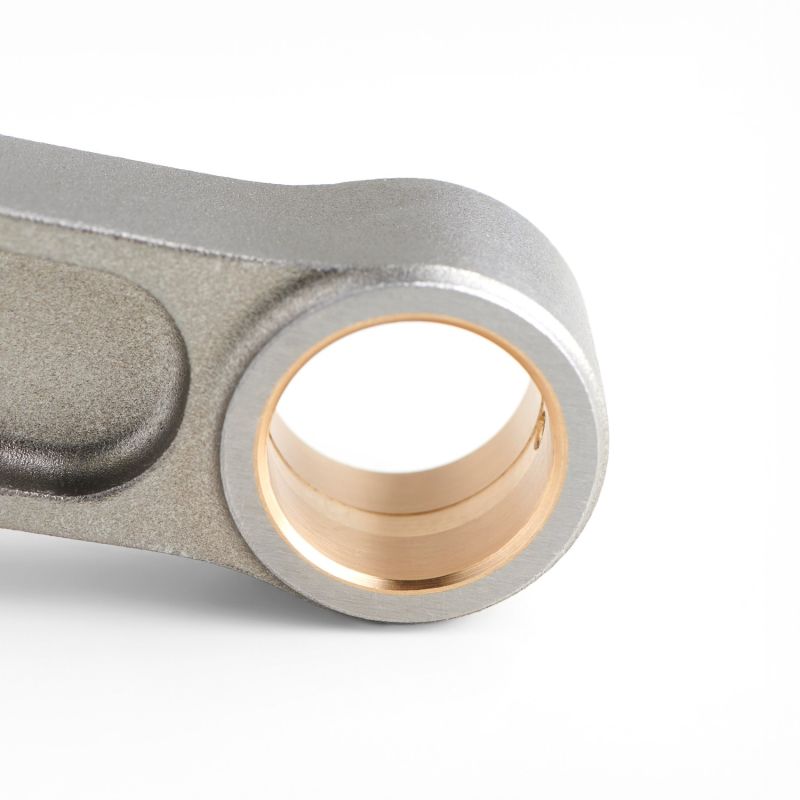
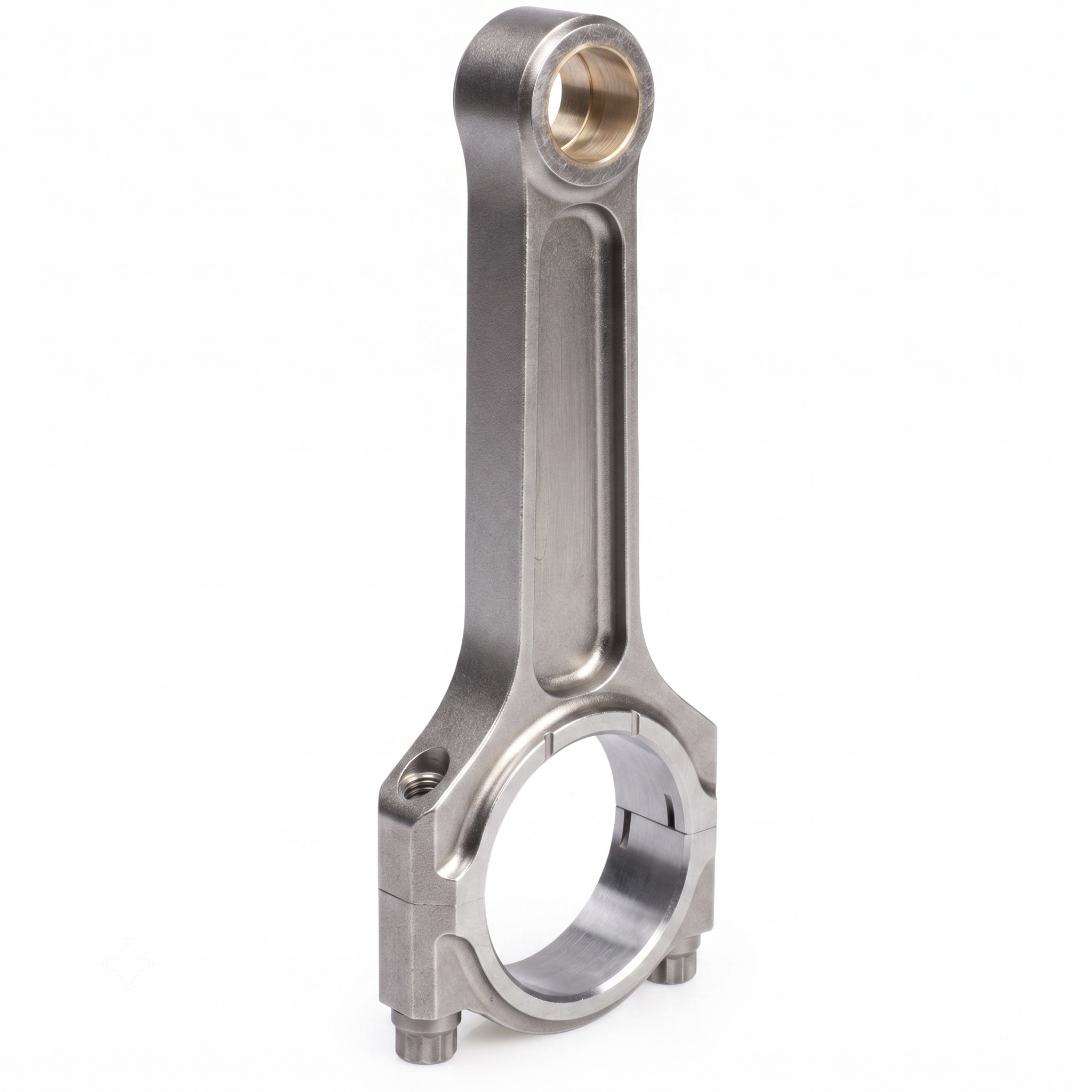 | I-Beam profile. With its slimmer central section, the I-beam rod favours light weight and an excellent stiffness-to-mass ratio. It is the most common profile, perfectly suited to builds of the BMW inline-six engines with a 135 mm rod, from a reinforced engine to high power levels. |
A rod bolt takes one tension cycle per crankshaft revolution: at 7,000 rpm that means tens of millions of cycles over a season. Its ability to absorb them comes from its metallurgy and its process: selected grade, clean steel, quench and temper uniform through the whole section, threads rolled after treatment to work-harden the thread root. Manufacturing consistency then guarantees the same preload on every bolt, and the nature of the alloy dictates the storage precautions. This BMW six-cylinder takes its bolts in 3/8"-38 mm in two grades; choose according to power and engine speed, then tighten by measured stretch.
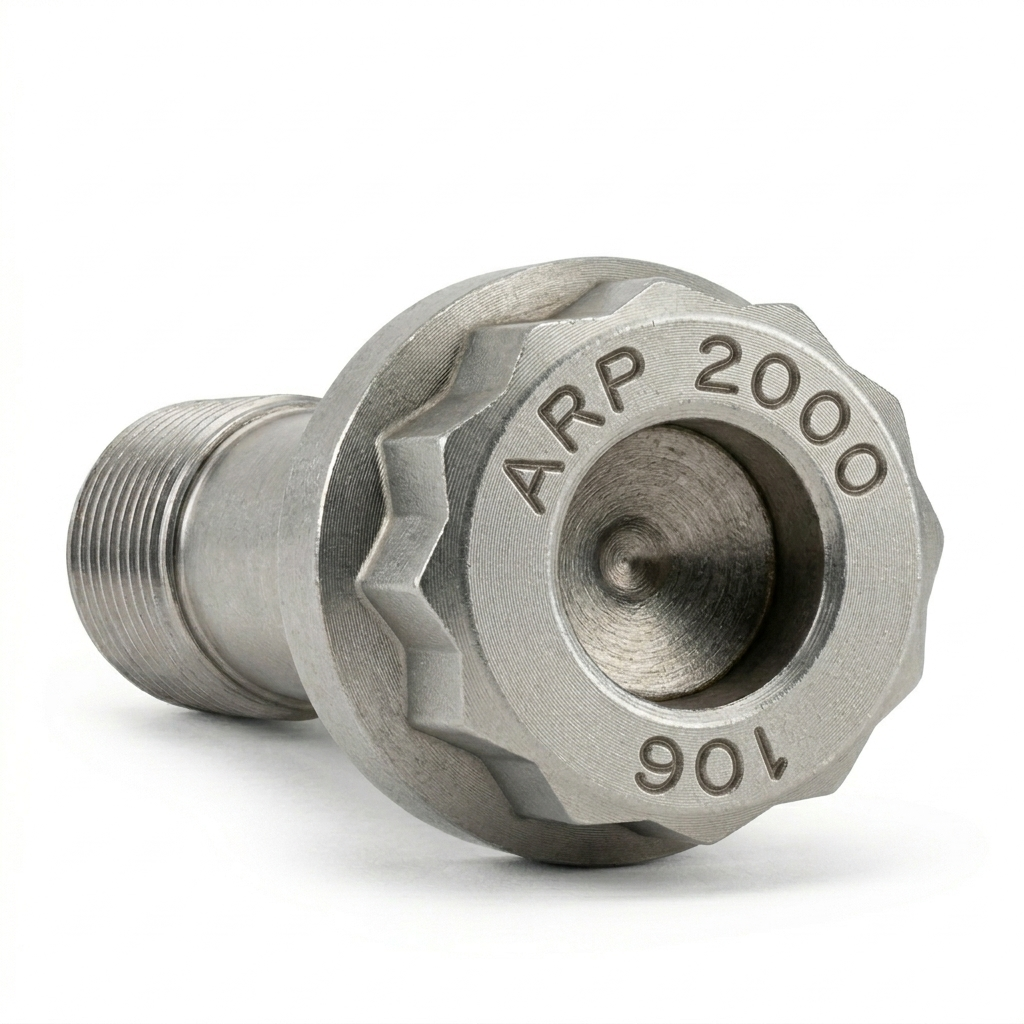 | ARP 2000 is a wrought low-alloy steel, through-hardened, with tensile strength settling around 220,000 psi, i.e. ~1,517 MPa. Threads rolled after heat treatment, hence high cyclic fatigue endurance exactly where the bolt is weakest, and good stability towards ambient corrosion: no storage constraint. The grade is rated up to 200 hp per cylinder in 3/8" and up to 8,500 rpm, which makes it the most common in circuit racing, trackdays, drift, rally, drag and hillclimb. It equips the ZRP I-profile rod of this M20 / M50 / M52 / M54 family, in 3/8"-38 mm. |
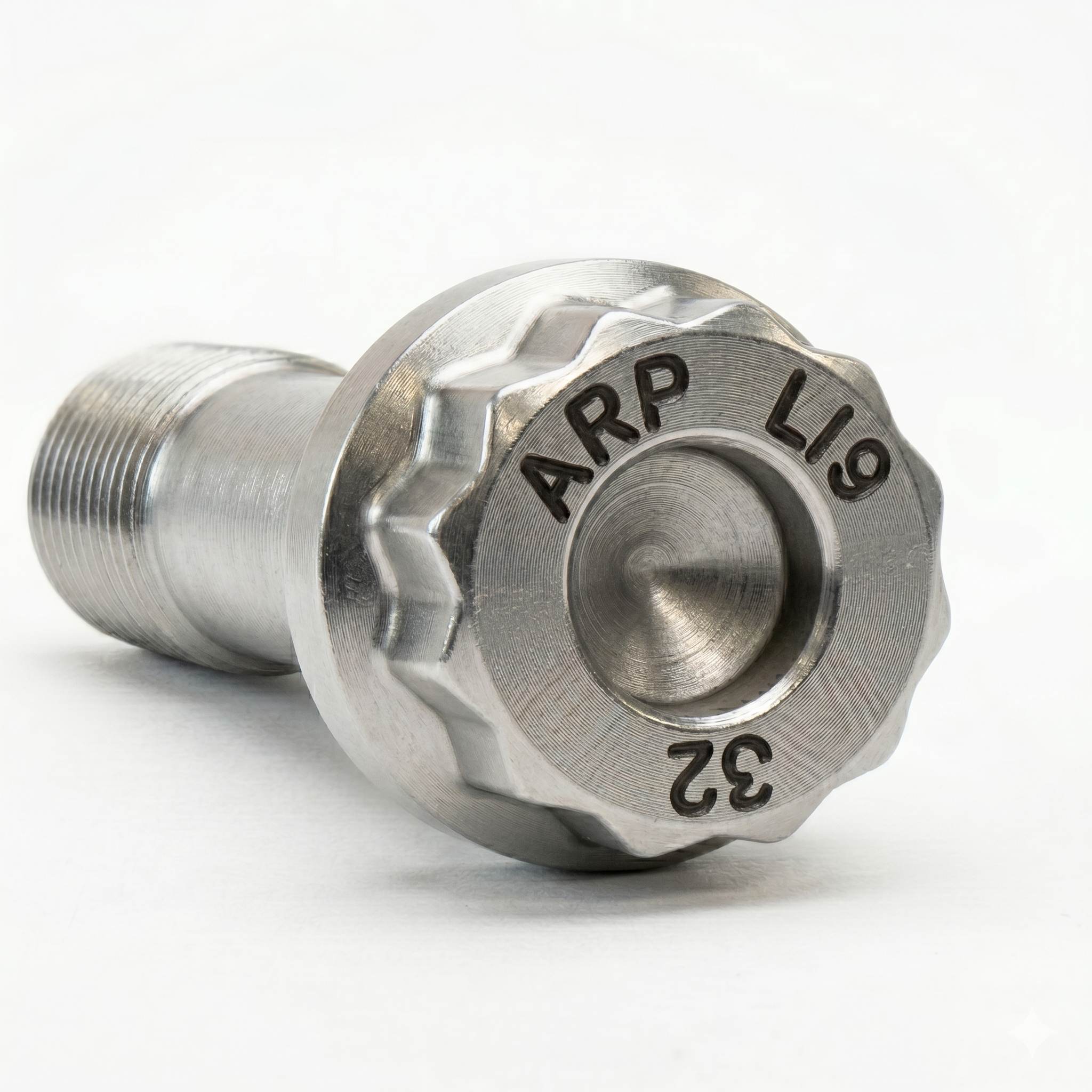 | L19 relies on a more heavily alloyed grade and on a more demanding heat treatment: tensile strength reaches about 260,000 psi, i.e. ~1,793 MPa, for 250 hp per cylinder in 3/8" and up to 10,000 rpm. It is made for very high boost pressure, sustained high engine speeds and high cylinder pressure, hence for big power in drag, drift, rally and circuit, including on a boosted BMW six-cylinder. Its metallurgy comes with a known constraint: sensitive to corrosion and to hydrogen embrittlement, L19 is stored and fitted oiled, away from moisture, and does not tolerate standing in a damp atmosphere. |
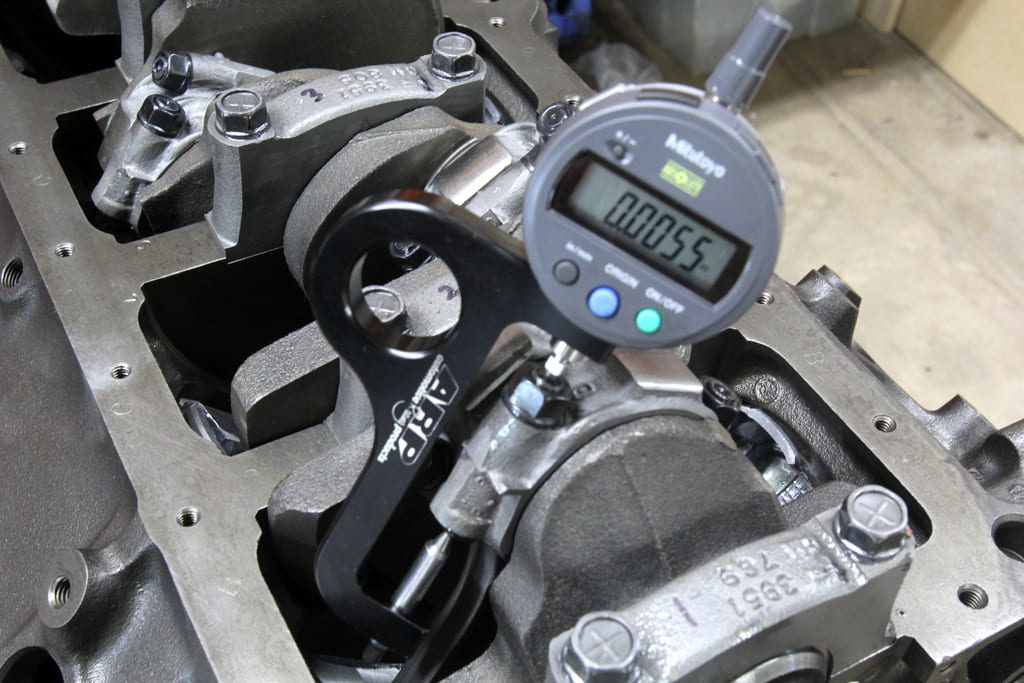
In addition to torque tightening, measuring rod-bolt stretch is the most reliable check for optimal preload. The check is done with the bolt fitted: place the gauge (dial indicator) on the two ends of the bolt and read its actual stretch, which must match the recommended value (see the torque & stretch table above). This method removes the friction variations inherent in torque tightening and secures the assembly on heavily stressed engines. |
 | ZRP, a Greek brand of high-performance forged connecting rods, designed by Alex Drakos in Athens. Each rod is forged from 4340 steel, precision-machined and balanced to ±1 g to stay reliable at high rpm. Offered here in I-beam profile with ARP 2000 or L19 bolts, they are designed and inspected in Greece, and proven in rally, on circuit and in drift. |
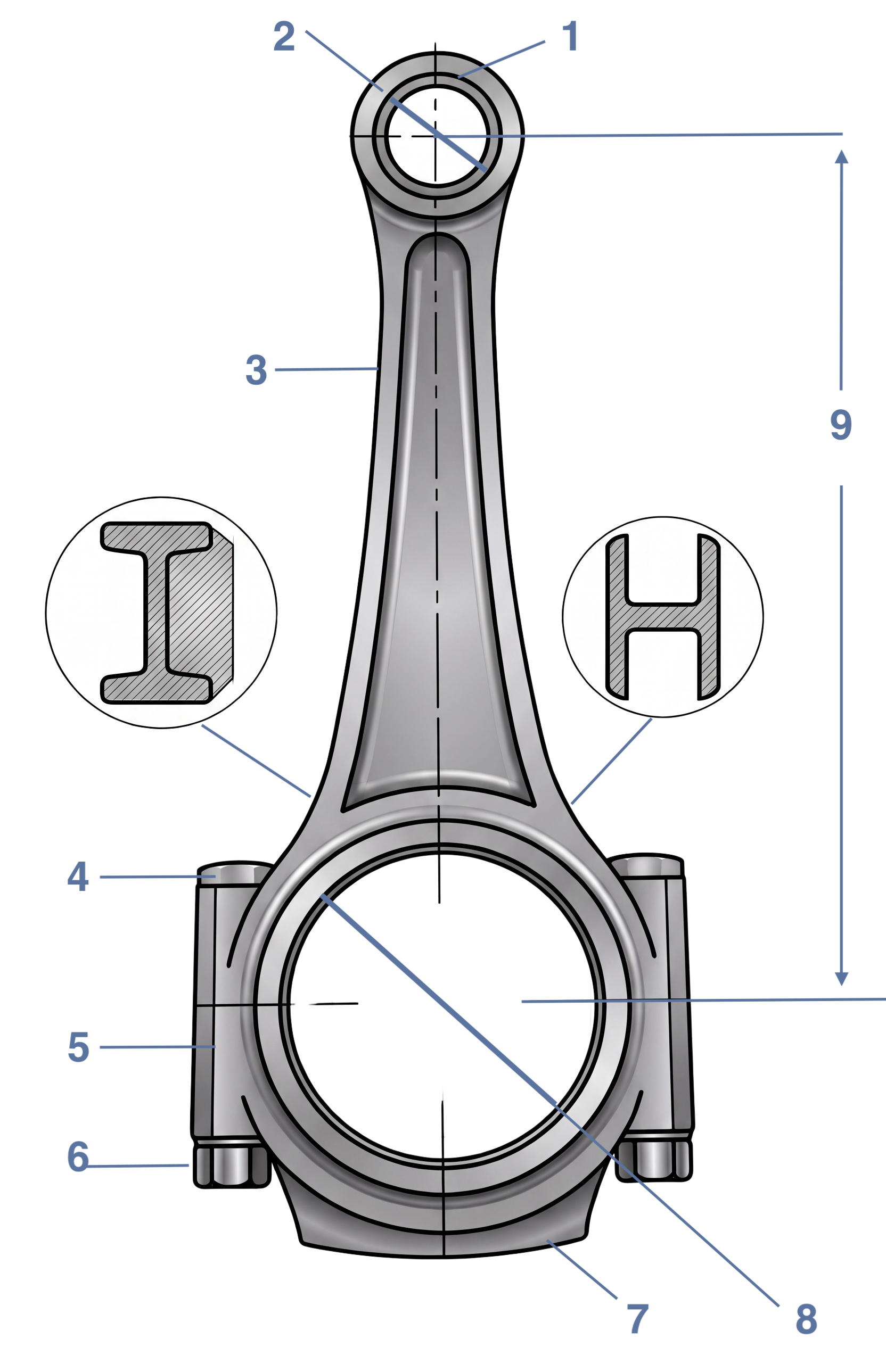 | 1) Small end 2) Small-end diameter 3) Rod beam 4) Rod bolt 5) Big end 6) Rod nut / bolt 7) Rod cap 8) Big-end diameter 9) Center-to-center |
These forged connecting rods fit all BMW inline-six engines whose rod shares a 135 mm center-to-center length. The table below lists the engines, models (with chassis code), power and model years:
| Make | Model (chassis) | Engine code | Power | Years |
|---|---|---|---|---|
| BMW | 325i / 325iX (E30) | M20B25 | 170–192 hp | 1983–1993 |
| BMW | Z1 Roadster | M20B25 | 170 hp | 1988–1991 |
| BMW | 525i (E34) | M20B25 | 170 hp | 1988–1990 |
| ALPINA | C1 / C2 (E30) | M20B25 | 185–190 hp | 1985–1988 |
| BMW | 325i (E36) | M50B25 no VANOS | 192 hp | 1990–1995 |
| BMW | 525i 24V / 525iX 24V (E34) | M50B25 no VANOS | 192 hp | 1990–1996 |
| BMW | 328i (E36) | M52B28 | 193 hp | 1995–1999 |
| BMW | 328i (E46) | M52B28 | 193 hp | 1998–2000 |
| BMW | 528i (E39) | M52B28 | 193 hp | 1995–2000 |
| BMW | 728i / 728iL (E38) | M52B28 | 193 hp | 1995–2001 |
| BMW | Z3 2.8i (E36) | M52B28 | 193 hp | 1996–2000 |
| BMW | M3 3.0 (E36, US) | S50B30 US | 240 hp | 1995 |
| BMW | M3 3.2 (E36) | S52B32 | 243 hp | 1996–2000 |
| BMW | Z3 M (E36) | S52B32 | 239–243 hp | 1998–2000 |
| BMW | 330i / 330Ci / 330xi (E46) | M54B30 | 228–231 hp | 2000–2006 |
| BMW | 530i (E39) | M54B30 | 228–231 hp | 2000–2003 |
| BMW | 530i (E60) | M54B30 | 231 hp | 2001–2005 |
| BMW | 730i / 730Li (E65/E66) | M54B30 | 231 hp | 2003–2008 |
| BMW | X3 3.0i (E83) | M54B30 | 228–231 hp | 2003–2006 |
| BMW | X5 3.0i (E53) | M54B30 | 228–231 hp | 2000–2006 |
| BMW | Z3 3.0i (E36) | M54B30 | 228–231 hp | 2000–2003 |
| BMW | Z4 3.0i (E85) | M54B30 | 231 hp | 2002–2005 |
OEM references (per engine): M20B25 11 24 1 288 386 ; M50B25 11 24 1 730 420 ; M52B28 11 24 1 744 315 ; S52B32 11 24 1 247 175 ; M54B30 11 24 1 437 210.
On these now-classic inline-sixes, replacing a tired original rod with a new genuine part is expensive and offers no extra margin against a power increase.
For a comparable budget, fitting 4340 forged connecting rods changes everything: the part is new, stronger than the original and built to handle torque and rpm. A lasting investment rather than a like-for-like repair.
For the same budget: more reliability, more potential and real peace of mind to drive hard. That’s the whole point of reinforcing these engines with forged rods as soon as the bottom end is opened up.