Product successfully added to your shopping cart
Quantity
Total
There are 0 items in your cart. There is 1 item in your cart.
Total products
Total shipping To be determined
Total

2.5L 16v - L5
Manufacturers
2.5L 16v - L5
Warning: Last items in stock!
New product
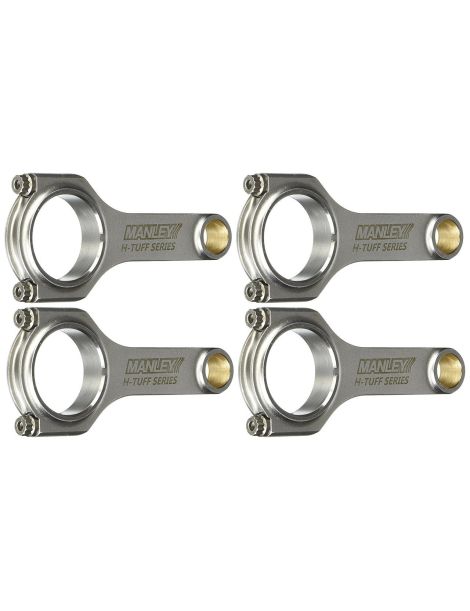
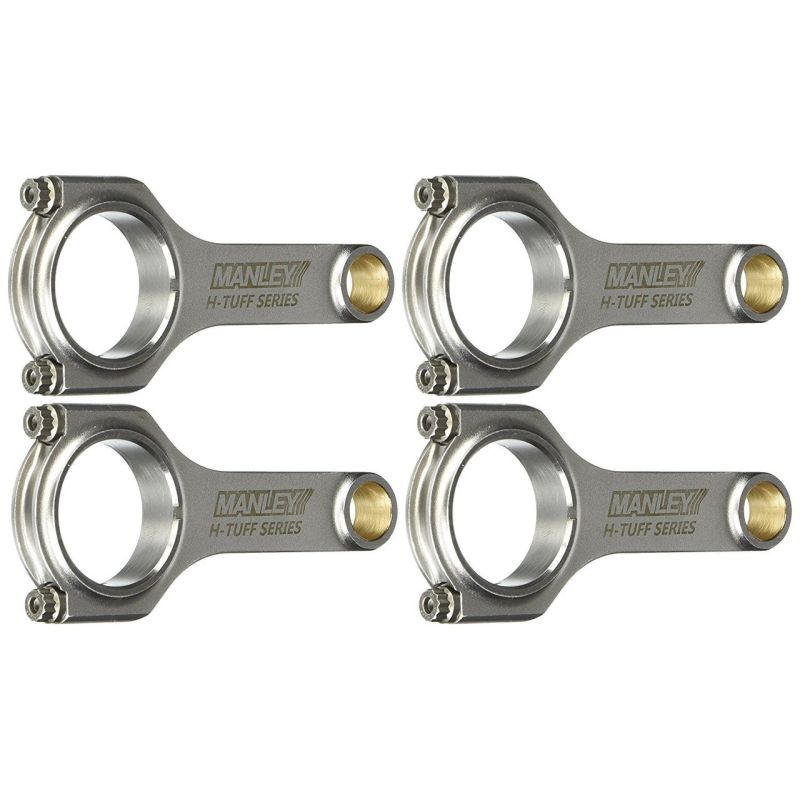
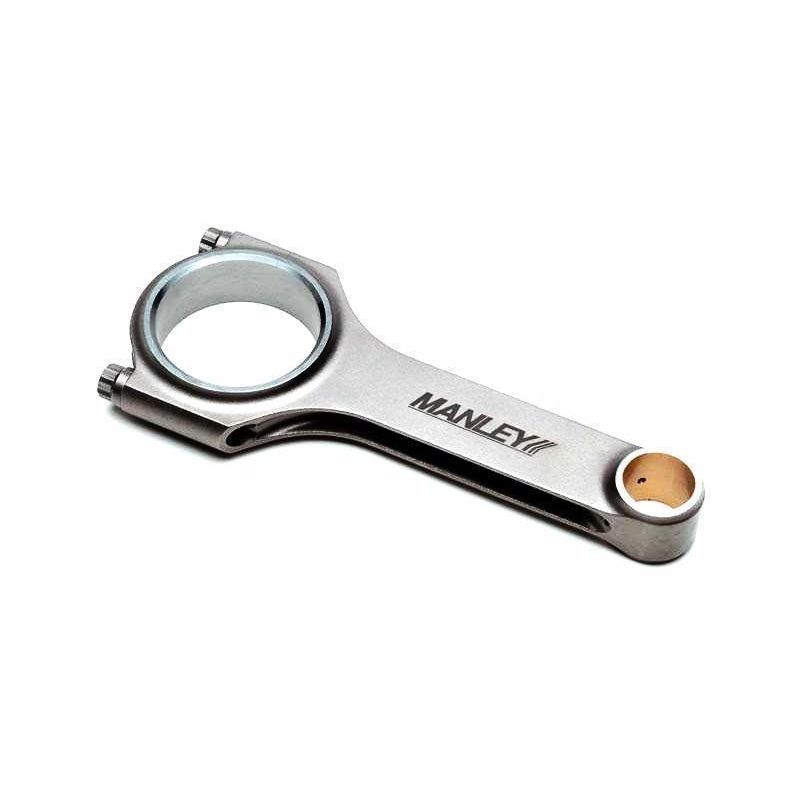
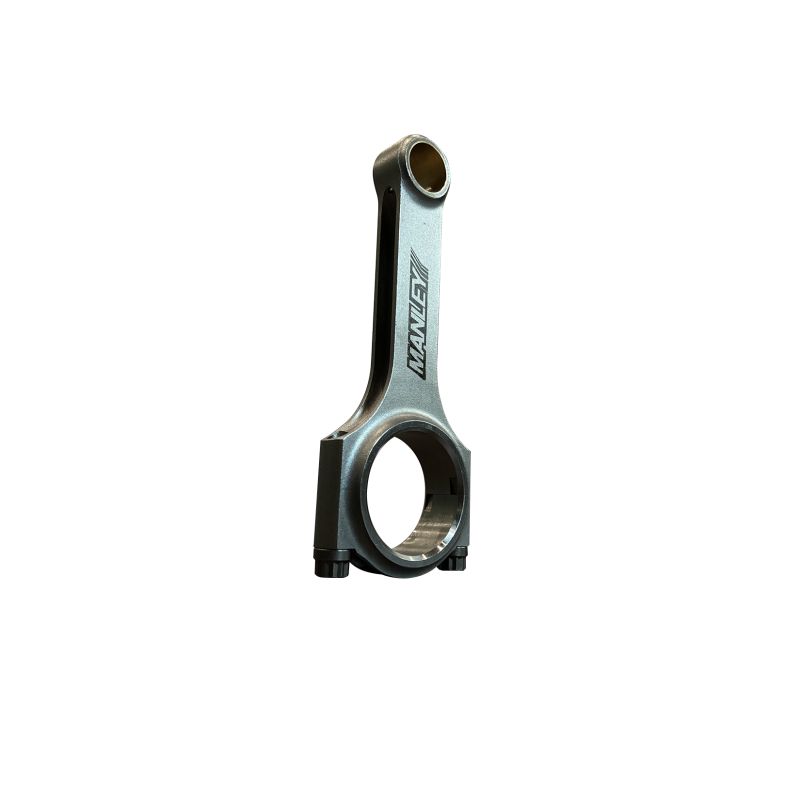
Set of 4 forged 4340 steel connecting rods for the Mazda 2.5L 16V L5.
The L5-VE is Mazda’s 2.5-litre MZR petrol four-cylinder. Naturally aspirated, it pairs an all-aluminium block with cast-iron liners, a chain-driven DOHC 16-valve valvetrain and intake iVCT variable cam timing. With an 89 mm bore and a 100 mm stroke (2,488 cc) and a 9.7:1 compression ratio, it puts out around 170 hp (127 kW) at 6,000 rpm and 226 N·m at 4,000 rpm.
Launched in 2008 (MY2009 in North America), it powered the Mazda 6 GH 2.5, the Mazda 3 BL SP25 and the Mazda CX-7 through 2013. From the factory its rods are fracture-split powder-metal parts: fine in stock form, they become the weak link as soon as a turbo is added or the block is stroked. That is exactly where a forged rotating assembly earns its place.
The L5 is a widely produced four-cylinder, easy to source parts for, which explains its success in turbo conversions: on this platform builders often aim to double the factory output. The standard rod, sintered and fracture-split, was however only sized for naturally aspirated running: its section and its bolts are calculated to the bare requirement, with no reserve for the cylinder pressure of a turbo or for the inertia loads of a longer stroke. Moving to forged rods, together with forged pistons, is therefore the structural step before raising boost pressure or displacement.
Forged from 4340 alloy steel and precision-machined, these Manley rods take over from the factory rods to handle power and engine speeds well beyond stock. Hot forging aligns the metal grain and eliminates porosity, so fatigue strength clearly exceeds that of a cast or sintered part.
This listing covers the rods with a 22.5 mm piston pin, in the H-HD profile (reinforced “Heavy Duty” H), supplied with ARP 2000 or ARP CA625+ bolts. The centre-to-centre length keeps the OEM figure (151.79 mm) for a direct fit with suitable forged pistons. Designed for L5 blocks converted to turbo and for stroker builds, they suit every discipline (rally, drift, drag, circuit and track days, hillclimb, time attack) and back Stage 2, Stage 3 and Stage 4+ builds, up to full competition engines.
| Reference | Brand | Profile | Bolts | Pin diameter OEM 22.5 mm | Small-end width | Big-end diameter | Big-end width | Centre distance OEM 151.79 mm | Weight per rod |
|---|---|---|---|---|---|---|---|---|---|
| 15038-4 | Manley | H-HD | ARP 2000-3/8"-38mm | 22,5 mm | 55,02 mm | 21,82 mm | 151.79 mm | 645 g | |
| 15038R6-4 | Manley | H-HD | ARP CA625+-3/8"-38mm | 22,5 mm | 55,02 mm | 21,82 mm | 151.79 mm | 645 g |
| Reference | Bolts | Max torque (no gauge) | Stretch (with gauge) |
|---|---|---|---|
| 15038-4 | ARP 2000 | 81,3 N·m | 0,147 – 0,157 mm |
| 15038R6-4 | ARP CA625+ | 88,1 N·m | 0,160 – 0,170 mm |
Manufacturers favour the stretch-gauge method over torque tightening: only measuring bolt stretch guarantees the exact preload. A stretch gauge is therefore essential for a reliable, repeatable build.
| 4340 is a low-alloy nickel-chromium-molybdenum steel valued for its balance of strength, toughness and fatigue life. It is the reference material for performance rods: it absorbs high combustion pressures and engine speeds without permanent deformation, where an OEM sintered rod quickly reaches its limit. Compared with a series sintered-metal rod, this forged 4340 improves by about +19% in yield strength, +8% in tensile strength and +19 to +37% in fatigue endurance, markedly extending its life under repeated stress. |
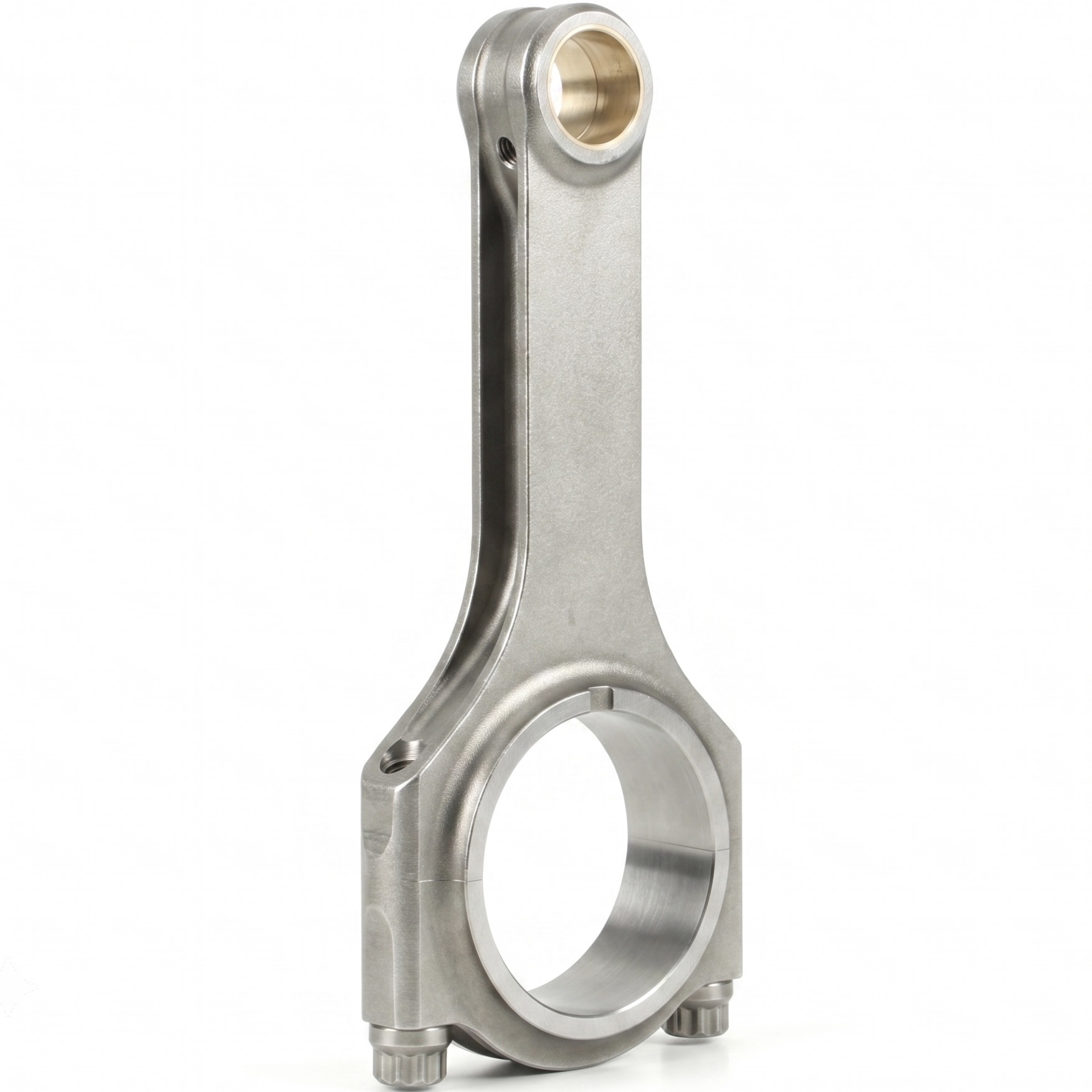 | H profile. The “H” section delivers high rigidity and excellent resistance to heavy loads: it is the go-to profile for high-torque turbo engines. The H-HD (Heavy Duty) version adds material in the most stressed areas to cope with the most demanding builds. |
The rod bolt ranks among the most heavily loaded parts of the engine: it holds the cap during load reversals at high rpm. Two ARP grades are offered on these rods. These two grades cover a wide range of builds, from track to drift, rally and hillclimb, and are chosen according to the targeted power level.
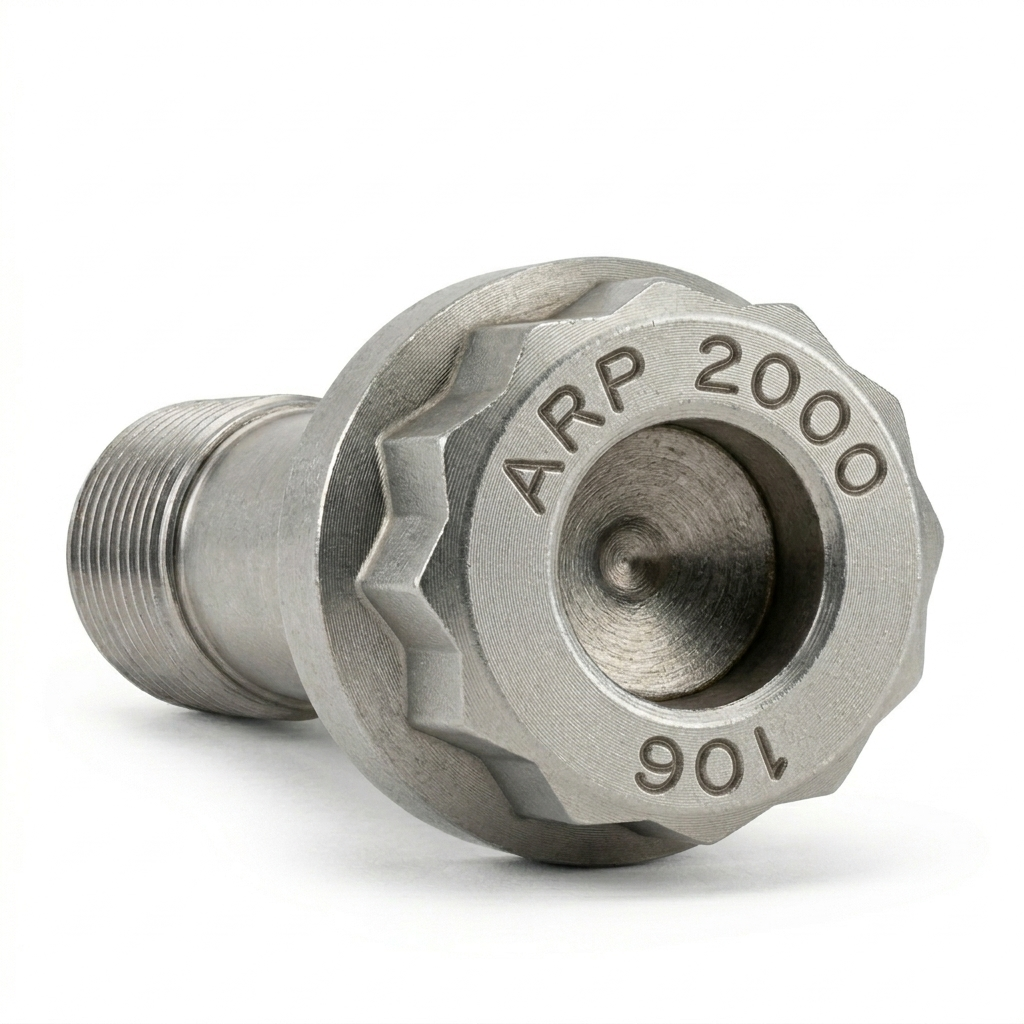 | ARP 2000 (tensile strength ~220,000 psi, i.e. ~1,517 MPa) is the high-performance standard on this 2.5-litre four: rated up to 200 hp per cylinder in 3/8" and up to 8,500 rpm, it is the most common grade in circuit racing, trackdays, drift, rally, drag and hillclimb. On the 645 g Manley H-HD rod the 3/8"-38 mm bolt is fitted with degreased threads then coated with assembly lubricant, cap and bearing shell clean, and tightened in increasing passes up to the preload shown in the table above, checked with a stretch gauge. The bolts can be reused as long as no residual stretch remains, and they call for no particular storage precaution. |
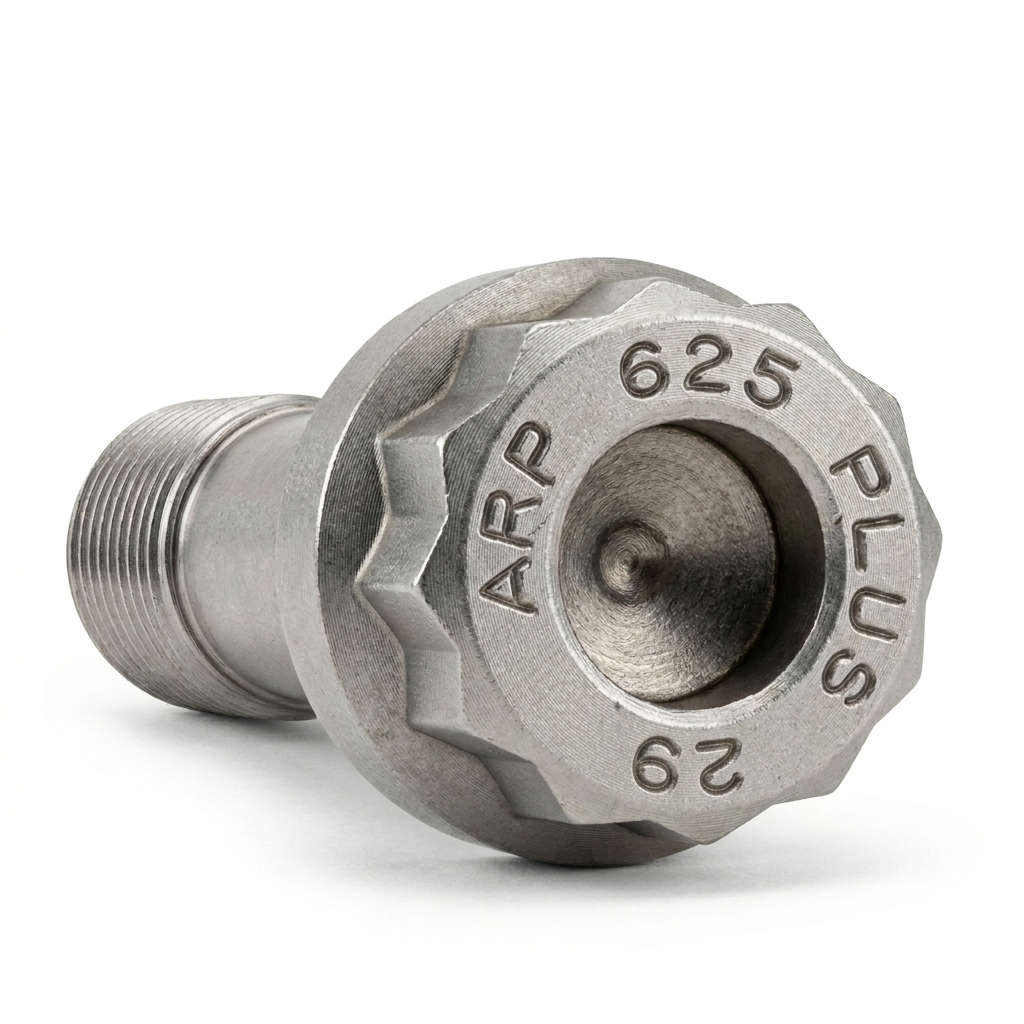 | ARP Custom Age 625+ (tensile strength of roughly 260,000 to 280,000 psi, i.e. ~1,793 to 1,931 MPa) is ARP's premium alloy, offered here in 3/8"-38 mm on the same Manley H-HD rod. It targets the most extreme L5 builds, beyond 250 hp per cylinder and beyond 10,000 rpm, where preload has to stay constant run after run. Its resistance to atmospheric corrosion and oxidation is better than that of ARP 2000 and it is immune to hydrogen embrittlement: it can be stored and refitted without particular precautions, while still being tightened to measured stretch, with clean lubricated threads and a free-length check at every teardown. |
ARP rod bolts available separately: ARP bolts 3/8" x 38 mm.
In addition to torque tightening, measuring rod-bolt stretch is the most reliable check for optimal preload. The check is done with the bolt fitted: place the gauge (dial indicator) on the two ends of the bolt and read its actual stretch, which must match the recommended value (see the torque & stretch table above). This method removes the friction variations inherent in torque tightening and secures the assembly on heavily stressed engines. |
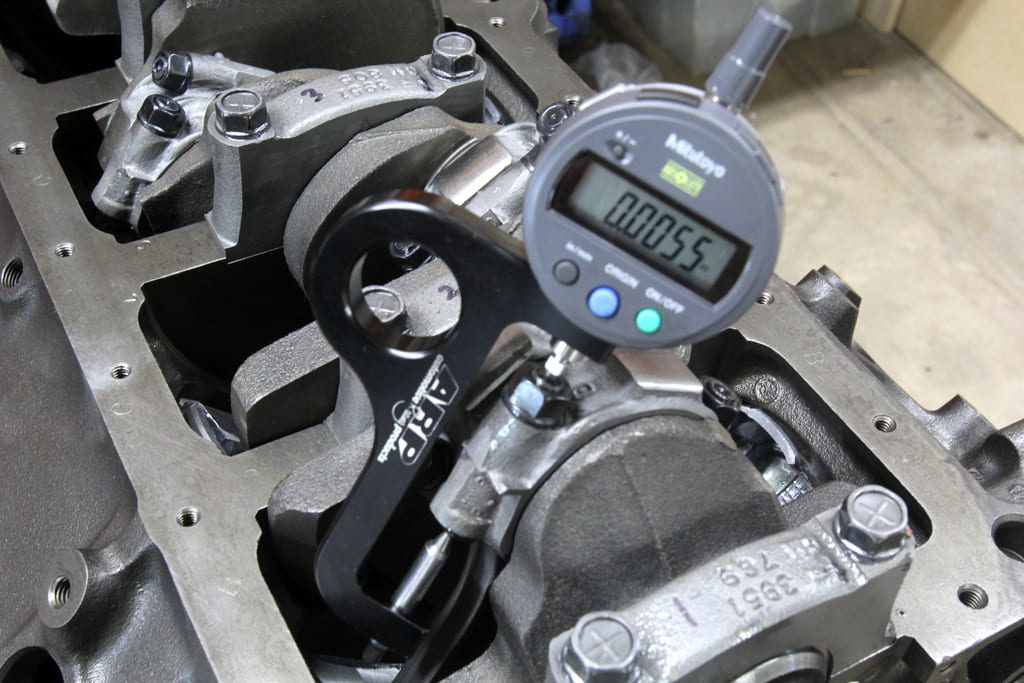
A torque figure alone does not qualify a rod assembly: it depends on thread friction and on how clean the assembly is. On the L5, it is bolt stretch that faithfully reflects the preload actually reached.
In practice: record the free length of the bolt with a stretch gauge before tightening, then read it again under load. The difference must fall within the range specified by the hardware manufacturer, 0,147 – 0,157 mm with ARP 2000 and 0,160 – 0,170 mm with ARP CA625+, according to the torque table on this page. A clean thread and the recommended lubricant govern the repeatability of the reading across all the bolts in the kit. |
 | MANLEY Performance, an American forged-rod manufacturer since 1966. Cut from vacuum-degassed aerospace-grade 4340 steel, shot-peened and inspected one by one, its “Turbo Tuff” rods are known for their toughness, with ARP 2000 or Custom Age 625+ bolts. A benchmark in engine building, from street to competition. |
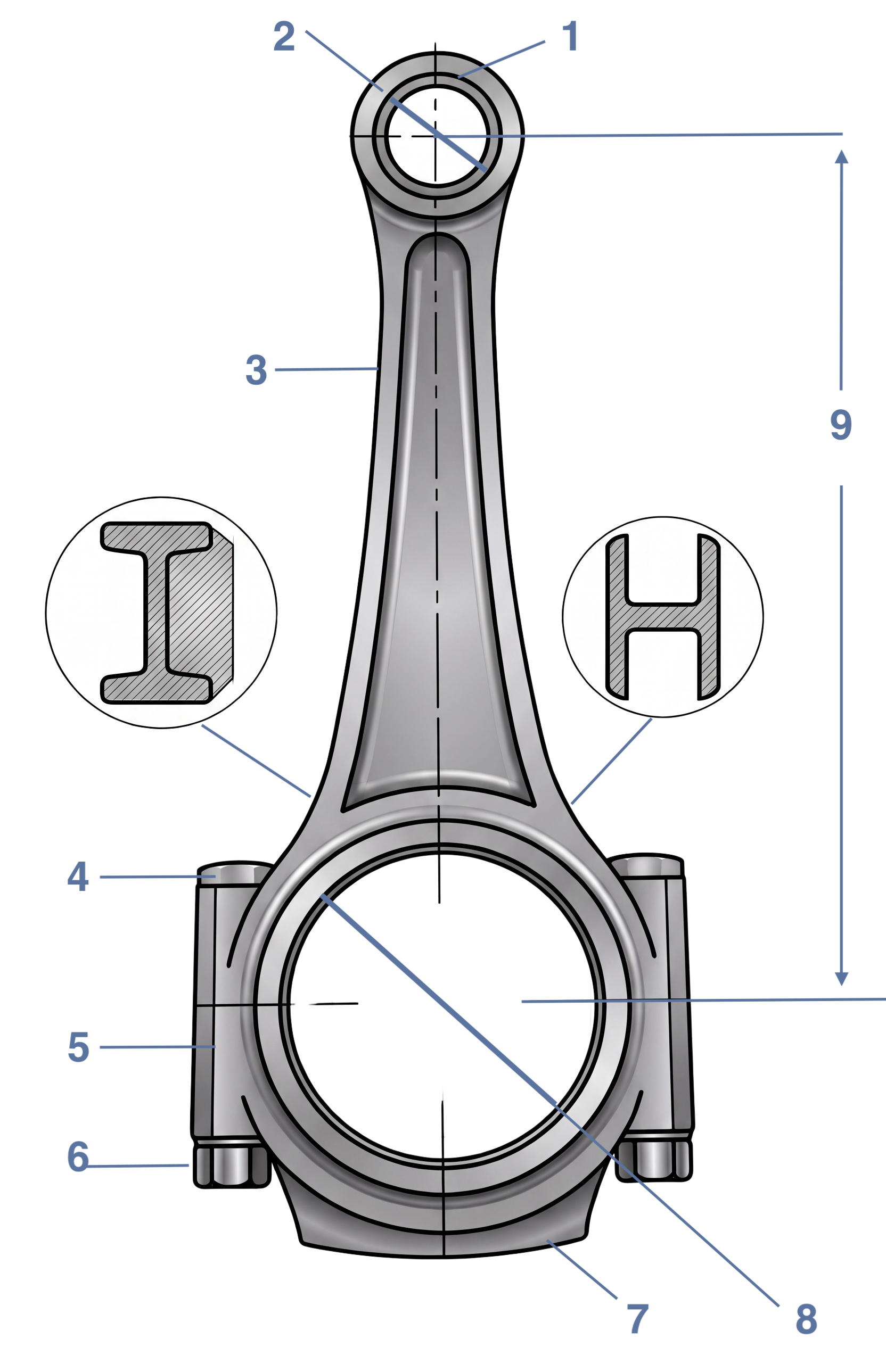 | 1) Small end 2) Small-end diameter 3) Rod beam 4) Rod bolt 5) Big end 6) Rod nut / bolt 7) Rod cap 8) Big-end diameter 9) Center-to-center |
These forged rods fit vehicles powered by the Mazda 2.5L 16V L5 engine (MZR 2.5, code L5-VE), with a 22.5 mm piston pin.
| Brand | Model (chassis) | Engine code | Power | Years |
|---|---|---|---|---|
| Mazda | 3 SP25 (BL) | L5-VE | 170 hp | 2009–2013 |
| Mazda | 6 (GH) | L5-VE | 170 hp | 2008–2012 |
| Mazda | CX-7 (ER) | L5-VE | 163 hp | 2009–2012 |
OEM reference: L504-11-210A (set of 4 connecting rods)
On a tuned Mazda 2.5 L5, a failing stock rod usually takes the piston with it and scores the block: rebuilding a wrecked bottom end costs far more than fitting a set of forged rods as a precaution.
For a controlled budget, Manley forged 4340 rods secure the build, cope with rising boost pressure and rule out failures at high power. Rather than exposing the block, you make the engine reliable for the long term while keeping headroom to evolve: the most cost-effective choice over time.
For the same budget: a short block that accepts the turbo, holds the revs and leaves room for the next step.