Product successfully added to your shopping cart
Quantity
Total
There are 0 items in your cart. There is 1 item in your cart.
Total products
Total shipping To be determined
Total

1.8L 8v - 3TC
Manufacturers
1.8L 8v - 3TC
 View larger
Warning: Last items in stock!
New product
ARP 8740 connecting rod bolt and nut kit replacing the original bolts on OEM rods of the Toyota 2TC, 2TG and 3TC engines.
This kit is for the Toyota T-series four-cylinder engines: the 2TC and 2TG of 1.6 litres and the 3TC of 1.8 litres, all 8-valve units, fitted to the Corolla, Celica and Carina built from 1970 to 1983.
The original rod bolt, tightened by a nut, gives way to an ARP 8740 bolt driven by press into the connecting rod bore.
At every revolution, the rod bolt takes the pull of the rod and piston assembly, which tries to force the cap away through inertia. As original equipment, it is sized for stock power.
The kit consists of 8740 connecting rod bolts: pressed into the rod and then tightened by their nut, preferably by stretch read on a gauge, with a fallback torque given in the ARP instruction sheet when no gauge is available. These bolts are made from 8740, a chrome-moly steel brought to 180,000 psi tensile strength by ARP's heat treatment; the threads are rolled afterwards. For comparison, classes 10.9 and 12.9 of original fasteners have a minimum of 150,800 to 176,900 psi.
| Part number | Brand | Grade / material | Nut | Thread | Under-head length |
|---|---|---|---|---|---|
| ARP-203-6003 | ARP | 8740 steel | Not published | Not published |
According to the ARP instruction sheet, the entry of the rod bore needs a sufficient chamfer to clear the radius under the bolt head before pressing.
| Reference | Tightening torque | Stretch |
|---|---|---|
| ARP-203-6003 | 54.2 Nm | 0.127 - 0.140 mm |
For this part, ARP favours tightening to a measured stretch, the key to an exact preload; torque is given only when no gauge is available. The figures in the table assume ARP lubricant.
Source of the torque and stretch figures: ARP 203-6003 instruction sheet, in the revision applicable at publication. The manufacturer's instruction sheet prevails in the event of any difference. Read the ARP 203-6003 instruction sheet
No thread locker is called for by the ARP instruction sheet for this kit: the bolts are fitted with ARP Ultra-Torque grease, on their threads and on the bearing face of the nuts.
Once the fasteners are fitted, the ARP instructions call for the big ends to be checked and resized by a machine shop.
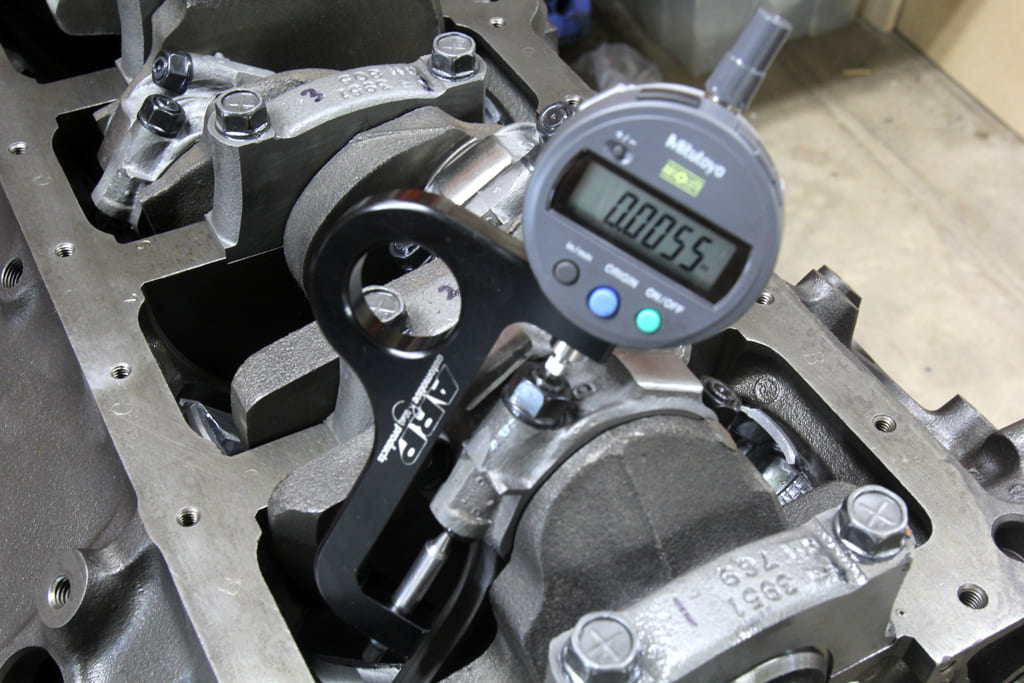
Stretch measurement supplements torque tightening and gives the most accurate preload. It is done with the bolt in place: the gauge, fitted with a dial indicator, bears on both ends of the bolt and shows the stretch achieved, to be brought to the value in the table above. This avoids the variations caused by friction, which matters on a highly stressed engine.
Torque and stretch figures are only valid with ARP assembly grease, applied to the bolt threads and to the bearing face of the nuts.

ARP (Automotive Racing Products) came into being in the early 1970s, when Gary Holzapfel, who came from the aerospace industry, decided to tackle the engine failures caused in motorsport by inadequate fasteners. Today the brand produces thousands of part numbers in California for the cylinder head, the main bearings and the connecting rods, in materials suited to each application, with manufacturing known for its consistency.
| Brand | Model (chassis) | Engine code | Power | Years |
|---|---|---|---|---|
| Toyota | Carina II (TA62 / TA63) | 3TC | 78-84 hp | 1978-1983 |
| Toyota | Carina III Break (TA60 / TA62) | 2TC, 3TC | 75-78 hp | 1981-1983 |
| Toyota | Celica (TA22 / TA40 / TA4C) | 2TC, 2TG | 103-110 hp | 1971-1981 |
| Toyota | Corolla (TE31 / TE38 / TE51 / TE71 / TE72 / E70) | 2TC, 2TG, 3TC | 73-110 hp | 1970-1983 |
A 2TG or 3TC that is pushed further, in revs or in load, subjects the rod bolts to ever greater tensile forces, and a single bolt that gives way destroys the rod, the piston and the block. For a fraction of what rebuilding a bottom end costs, ARP 8740 bolts take this weak point out of play.