Product successfully added to your shopping cart
Quantity
Total
There are 0 items in your cart. There is 1 item in your cart.
Total products
Total shipping To be determined
Total

1.8L 16v - CA18DET
Manufacturers
1.8L 16v - CA18DET
Warning: Last items in stock!
New product
Set of 8 trimetal connecting rod half-bearings for Nissan four-cylinder CA16, CA18 and CA20.
Built from 1982 to 1994, the CA family is Nissan's compact four-cylinder petrol engine: cast iron block, aluminium head and belt-driven camshafts. It comes in 1.6, 1.8 and 2.0 litres, from the single overhead cam eight-valve to the twin-cam sixteen-valve. The CA18DET is its most highly developed version, 1809 cc, 83 mm bore and 83.6 mm stroke, Garrett T25 turbocharger and intercooler, for 169 hp and 228 N·m. All of them share the same crank pin: a single bearing set covers the family, from the carburetted Bluebird to the 200SX RS13-U.
From the factory these engines are fitted with connecting rod bearings graded 0, 1 and 2, matched to the crank pin grade stamped on the crankshaft and identified by a colour mark: no mark for grade 0, brown for 1, green for 2. Their wall thickness runs from 1.501 to 1.510 mm depending on grade, and the workshop manual holds them within a clearance window of 0.018 to 0.045 mm, with a wear limit of 0.100 mm. For service Nissan offers only three undersizes, 0.08, 0.12 and 0.25 mm. As soon as power, engine speed or boost pressure rise, this production design reaches its limit.
A tri-metal bearing stacks three layers: a steel back, a high load capacity copper-lead intermediate layer and an anti-friction running layer that protects the crank pin. The complete set contains 8 half-bearings, four pairs for a four-cylinder engine.
Tri-metal is designed for high, sustained loads, where an aluminium bi-metal works at low to medium loads: an aluminium bi-metal takes around 8,000 psi, a performance tri-metal up to 12,000 psi, 50% more. Hence better resistance and better durability on turbocharged, supercharged and high-revving engines.
| ACL bearings Crank pin dia. 44.961 / 44.974 mm Housing dia. 48.000 / 48.013 mm Width 18.6 mm | OEM reference Crank pin dia. 44.954 / 44.974 mm Housing dia. 48.000 / 48.013 mm Wall thickness 1.501 - 1.510 mm |
| Part number | Brand and treatment | Size | Wall thickness (mm) |
|---|---|---|---|
| 4B1630H-STD | ACL Race - without treatment | Standard | 1.505 |
| 4B1630HX-STD | ACL Race - without treatment | Std, extra clearance (HX) | 1.492 |
| 4B1630H-.025 | ACL Race - without treatment | +0.025 | 1.518 |
| 4B1630H-.25 | ACL Race - without treatment | +0.25 | 1.630 |
| 4B1630H-.50 | ACL Race - without treatment | +0.50 | 1.755 |
Running clearance is the gap between the bearing and the crank pin in which the oil film circulates. In operation the crank pin does not rub on the bearing: it runs on that oil film, which carries the load. The clearance sets the thickness of that film: too tight and the oil flows poorly, temperature rises and the risk of seizure increases; too loose and the oil escapes, the film loses its carrying capacity and oil pressure drops. The right clearance is the balance between sufficient lubrication and a well maintained oil film.
| Size / version | When to choose it | ACL Race Series |
|---|---|---|
| Standard (STD) | Original crank pin, not reground | 0.049 to 0.058 mm |
| Extra clearance (HX) | Wider clearance: high oil flow, high rpm | 0.074 to 0.083 mm |
| +0.025 mm | Polished crank pin | 0.049 to 0.058 mm |
| +0.25 mm | Crank pin reground to 0.25 mm | 0.049 to 0.058 mm |
| +0.50 mm | Crank pin reground to 0.50 mm | 0.049 to 0.058 mm |
Check on assembly: lay a measuring strip on the crank pin, tighten the rod cap to the specified torque, then compare the crushed width against the scale to read the clearance.
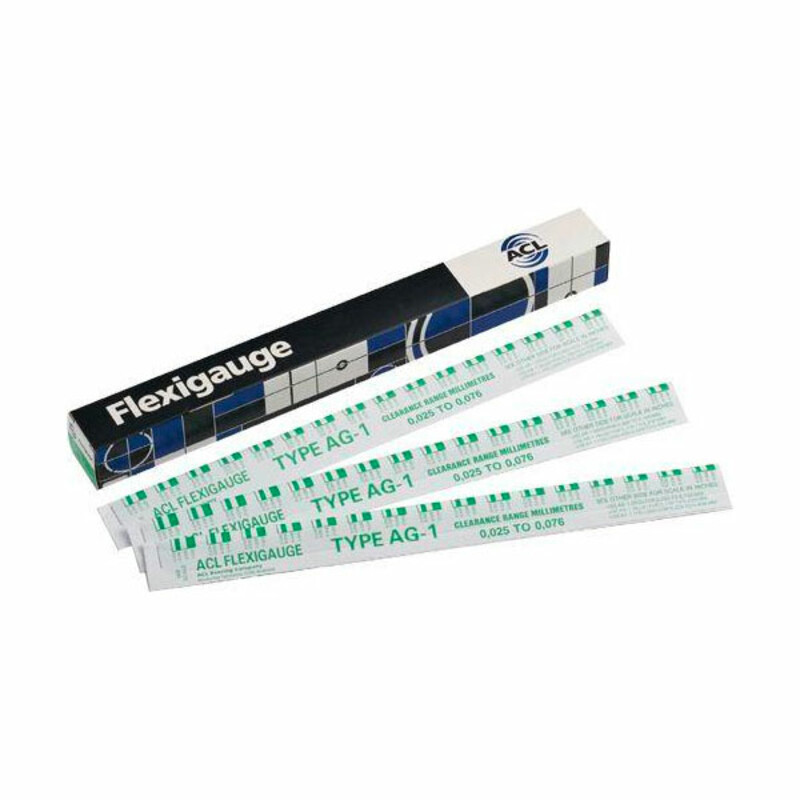
| Order the Flexigauge → |
| Bolts | Torque | By stretch (gauge) |
|---|---|---|
| Original bolts (OEM) | 41 to 44 N·m | |
| CA18 forged rod ZRP, ARP2000 (3/8″ × 38 mm) | 61 N·m | 0.140 - 0.152 mm |
| CA18 forged rod ZRP, ARP L19 (3/8″ × 38 mm) | 67.8 N·m | 0.152 - 0.165 mm |
The Nissan workshop manual requires the threads and seating faces of the original (OEM) bolts to be oiled before tightening. On forged rods, ARP recommends the stretch method (gauge).
The ACL connecting rod bearings shown here are tri-metal bearings, built for engine building and racing. Compared with the production bearing they take far higher loads, and above all they offer a choice of sizes the manufacturer does not: a standard size, a +0.025 mm size for a crank pin that has merely been polished, two regrind sizes at +0.25 and +0.50 mm, and an HX version with extra clearance for engines that rev hard or need a high oil flow. That choice is what lets you match a reworked crankshaft without changing range, and tune the clearance to the oil and the use intended.
 | ACL Bearing Company, an Australian maker of high performance engine bearings since 1949, offers with its Race Series precise tri-metal bearings, available in many undersizes and proven in built engines worldwide. |
| Make | Model (series) | Engine code | Power | Years |
|---|---|---|---|---|
| Nissan | 180SX Coupé (S13) 1.8 | CA18DE | 132 hp | 1988–1992 |
| Nissan | 180SX Coupé (S13) 1.8 Turbo II / 1.8 Turbo | CA18DET | 177–201 hp | 1988–1992 |
| Nissan | 200SX (S13) 1.8 | CA18DE | 135 hp | 1988–1994 |
| Nissan | 200SX (S13) 1.8 Turbo | CA18DET | 169 hp | 1988–1993 |
| Nissan | AUSTER (T12) 1.8 Xtt | CA18DET | 169 hp | 1987–1989 |
| Nissan | AUSTER (T12) 1.8 Turbo | CA18ET | 135 hp | 1987–1989 |
| Nissan | AUSTER (T12) 2.0 | CA20S | 102 hp | 1986–1989 |
| Nissan | AVENIR (W10) 2.0 | CA20E | 105 hp | 1989–1997 |
| Nissan | AVENIR (W10) 2.0 | CA20S | 102 hp | 1986–1990 |
| Nissan | BLUEBIRD (T72, T12, U12) 1.8 i 16V (RLT72) | CA18DE | 129 hp | 1989–1990 |
| Nissan | BLUEBIRD (T72, T12, U12) 2.0 i (HLT72, T12) / 2.0 i | CA20E | 105–115 hp | 1985–1990 |
| Nissan | BLUEBIRD (T72, T12, U12) 2.0 (T12) / 2.0 i (HLT72, T12) / 2.0 LX | CA20S | 90–105 hp | 1985–1990 |
| Nissan | BLUEBIRD (U11) 2.0 i / 2.0 | CA20E | 105–116 hp | 1984–1988 |
| Nissan | BLUEBIRD (U11) 2.0 | CA20S | 102 hp | 1985–1990 |
| Nissan | BLUEBIRD Saloon (910) 2.0 | CA20S | 101 hp | 1985–1986 |
| Nissan | BLUEBIRD Hatchback (T72, T12) 1.8 i 16V (FRLT72) | CA18DE | 129 hp | 1989–1990 |
| Nissan | BLUEBIRD Hatchback (T72, T12) 2.0 i (FHLT72, T12) / 2.0 i | CA20E | 105–115 hp | 1985–1990 |
| Nissan | BLUEBIRD Hatchback (T72, T12) 2.0 (T12) | CA20S | 102 hp | 1985–1987 |
| Nissan | BLUEBIRD Station Wagon (WU11) 1.8 Turbo | CA18ET | 135 hp | 1984–1990 |
| Nissan | BLUEBIRD Station Wagon (WU11) 2.0 i | CA20E | 105–115 hp | 1984–1990 |
| Nissan | BLUEBIRD Station Wagon (WU11) 2.0 / 2.0 LX | CA20S | 90–102 hp | 1985–1990 |
| Nissan | BLUEBIRD Traveller (W910) 2.0 | CA20S | 101 hp | 1985–1986 |
| Nissan | CEDRIC (Y30) 2.0 | CA20S | 102–110 hp | 1984–1987 |
| Nissan | EXA Targa (N13) 1.6 i (KEN13) | CA16DE | 116 hp | 1987 |
| Nissan | EXA Targa (N13) 1.8 i (KCN13) | CA18DE | 128 hp | 1987–1991 |
| Nissan | GLORIA VII (Y30) 2.0 | CA20S | 110 hp | 1984–1987 |
| Nissan | LAUREL (JC31) 2.0 GL | CA20S | 102 hp | 1984–1985 |
| Nissan | LAUREL (JC32) 2.0 GL | CA20S | 102 hp | 1984–1985 |
| Nissan | PINTARA Saloon (R31) 2.0 i | CA20E | 106 hp | 1986–1990 |
| Nissan | PINTARA Saloon (U12) 2.0 i | CA20E | 113 hp | 1989–1992 |
| Nissan | PINTARA Hatchback (U12) 2.0 i | CA20E | 113 hp | 1990–1992 |
| Nissan | PINTARA Estate (R31) 2.0 i | CA20E | 106 hp | 1986–1990 |
| Nissan | PRAIRIE (M10, NM10) 2.0 / 2.0 4x4 | CA20E | 105 hp | 1986–1988 |
| Nissan | PRAIRIE (M10, NM10) 2.0 4x4 (NM10) / 2.0 / 2.0 4x4 | CA20S | 92–98 hp | 1986–1988 |
| Nissan | PRAIRIE PRO (M11) 2.0 i / 2.0 i 4x4 / 2.0 / 2.0 4x4 | CA20E | 98–116 hp | 1988–1992 |
| Nissan | PRAIRIE PRO (M11) 2.0 / 2.0 4x4 | CA20S | 90 hp | 1989–1992 |
| Nissan | PULSAR NX Coupé 1.6 | CA16DE | 124 hp | 1986–1987 |
| Nissan | PULSAR NX Coupé 1.8 | CA18DE | 133 hp | 1987–1989 |
| Nissan | SILVIA (S12) 1.8 / 1.8 Turbo R | CA18ET | 122–135 hp | 1983–1988 |
| Nissan | SILVIA (S12) 2.0 GP / 2.0 | CA20E | 103–106 hp | 1984–1988 |
| Nissan | SILVIA Hatchback (S12) 2.0 | CA20E | 101–103 hp | 1983–1988 |
| Nissan | STANZA (T11) 2.0 | CA20E | 98 hp | 1983–1985 |
| Nissan | STANZA Saloon (T12) 2.0 | CA20E | 98 hp | 1985–1989 |
| Nissan | STANZA Hatchback (T12) 2.0 / 2.0 4WD | CA20E | 98 hp | 1986–1989 |
| Nissan | STANZA Hatchback (T11) 1.8 | CA18 | 88 hp | 1981–1985 |
| Nissan | STANZA Hatchback (T11) 2.0 | CA20E | 98 hp | 1983–1985 |
| Nissan | STANZA Hatchback (T11) 2.0 | CA20S | 102 hp | 1983–1985 |
| Nissan | SUNNY II Coupé (B12) 1.8 GTI 16V | CA18DE | 125 hp | 1989–1991 |
| Nissan | SUNNY II Hatchback (N13) 1.8 GTI 16V | CA18DE | 125 hp | 1989–1991 |
| Nissan | SUNNY III (N14, B13) 1.8 | CA18DE | 128 hp | 1990–1992 |
Original part numbers : 12111-16A00, 12111-D0200, 12111-D0210, 12111-D2800, 12111-D4200, 12111-V5500. Set graded by class 0, 1 and 2 according to the crank pin grade.
A connecting rod bearing that fails does not stop at itself: it scores the crank pin, sends its debris into the oil circuit and calls for a crankshaft regrind at the very least, when it does not take the rod and the block with it. On a built CA engine the bearing set costs a fraction of a regrind, and far less than a rebuilt engine. It is the cheapest part of the rotating assembly and the one whose failure costs the most.
A crankshaft that is out is the opportunity to go through the whole rotating assembly. The forged connecting rods and forged pistons for this engine fit in the same job, with no extra stripping.
| Forged connecting rods CA18DET → |
| Forged pistons CA18DET → |