Product successfully added to your shopping cart
Quantity
Total
There are 0 items in your cart. There is 1 item in your cart.
Total products
Total shipping To be determined
Total

3.5L 12v - M30B35 - BMW
Manufacturers
3.5L 12v - M30B35 - BMW
Warning: Last items in stock!
New product
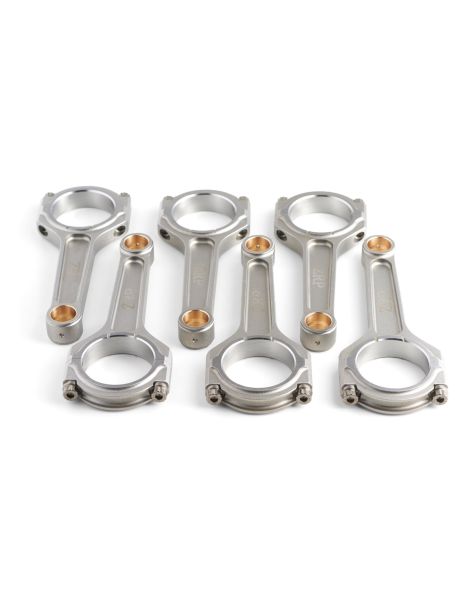
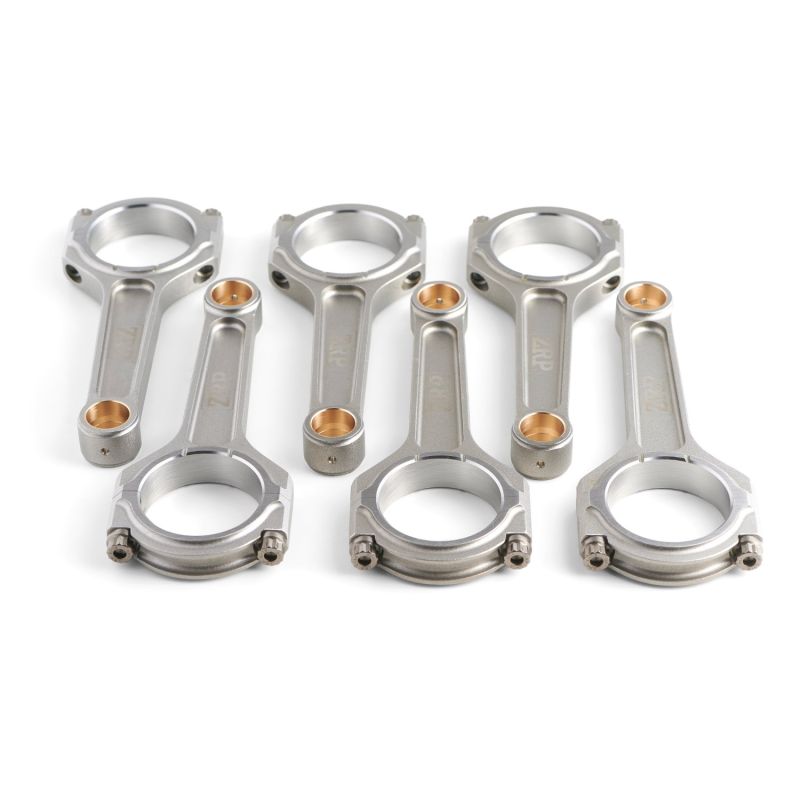
Set of 6 forged 4340-steel connecting rods for BMW 6-cylinder M30.
The M30 is BMW’s large inline-six, nicknamed the “Big Six”, built from 1968 to 1994. With a cast-iron block, an aluminium cylinder head and a chain-driven overhead camshaft with two valves per cylinder, it powered the brand’s upper-range saloons and coupés, from the 5, 6 and 7 Series to the E9 coupés. The family covers four displacements sharing the same connecting rod: M30B28 (2.8L), M30B30 (3.0L), M30B32 (3.2L) and M30B35 (3.5L).
Renowned for its smoothness and longevity, the M30 runs on a sturdy seven-bearing crankshaft that makes it an excellent tuning base. Its turbocharged version (745i Turbo) and the ALPINA derivatives show its potential. The original rods, however, remain the limiting link as soon as power or rpm rise significantly.
Machined from high-strength 4340 steel and then heat-treated, these forged connecting rods replace the M30’s original rods to withstand the higher revs and cylinder pressures of a build without flinching. Forging aligns the metal’s grain flow and removes casting porosity: the result is markedly higher fatigue strength and the safety margin that becomes essential as soon as power climbs.
Each set is inspected and balanced, then supplied with high-performance ARP bolts sized for the target torque. Paired with forged pistons, these rods form the basis of a reinforced bottom end, able to endure intensive use and competition.
| Reference | Brand | Profile | Bolts | Pin diameter OEM 22 mm | Small-end width | Big-end diameter OEM 52 mm | Big-end width | Center-to-center OEM 135 mm | Weight per rod |
|---|---|---|---|---|---|---|---|---|---|
| R-BMW-013-I | ZRP | I-Beam | ARP 2000-3/8"-38mm | 22 mm | 52 mm | 23.9 mm | 135 mm | 496 g | |
| R-BMW-013-I-L19 | ZRP | I-Beam | ARP L19-3/8"-38mm | 22 mm | 52 mm | 23.9 mm | 135 mm | 496 g |
| Connecting rod | Bolts | Tightening torque | Recommended stretch |
|---|---|---|---|
| ZRP (R-BMW-013-I) | ARP 2000 | 61 N·m | 0.140 – 0.152 mm |
| ZRP (R-BMW-013-I-L19) | ARP L19 | 67.8 N·m | 0.152 – 0.165 mm |
A stretch gauge needs a little method to deliver on its promise. The tips must seat in the machined dimples of the bolt, the tool must stay aligned, and the same hand should take every measurement in a given series: it is the repeatability of the gesture that gives the reading its value. Zero the dial on the free bolt, tighten, then read again without moving the support. The figure obtained must fall within the range in the table above, separate for ARP 2000 and ARP L19 bolts and set by the bolt manufacturer: those values, not habit, are authoritative across the twelve bolts of an M30. Torque remains useful for approaching the target, but it depends too much on thread friction to serve as a guarantee, hence the careful preparation and the ARP assembly lubricant. The kit instruction sheet decides in the last resort.
| 4340 steel is a nickel-chromium-molybdenum alloy steel used in aerospace and motorsport alike. Forged then heat-treated (quench and temper), it offers excellent tensile strength, high fatigue resistance and real ductility. Compared with an original rod (often sintered/powder metal, optimised for series-production cost), a 4340 forged rod shows roughly +19% higher yield strength, +8% higher tensile strength and above all +19% to +37% higher fatigue strength, i.e. a fatigue life under cyclic loading several times longer. This is what makes forged 4340 the reference material as soon as boost and rpm climb. |
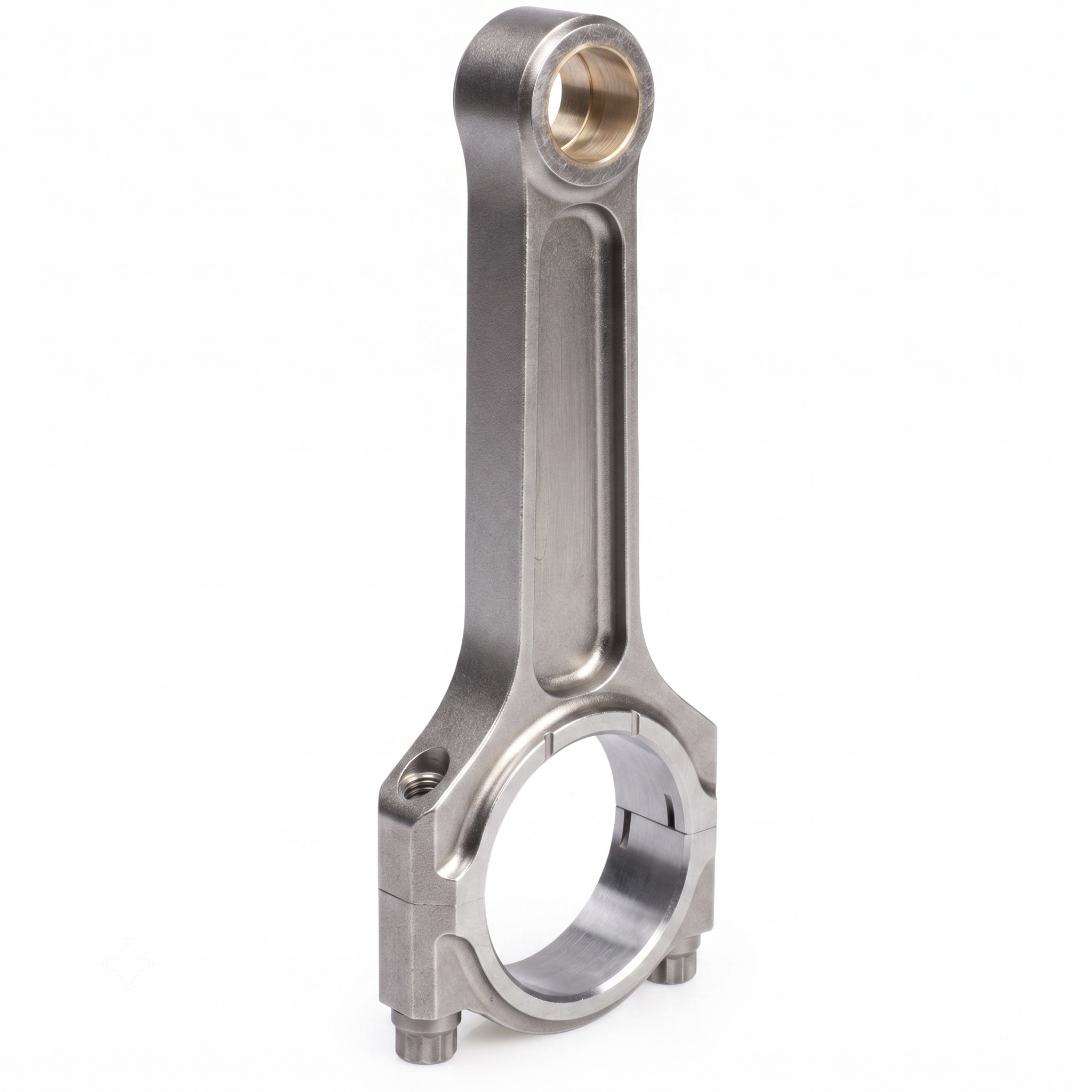 | I-Beam profile. With its slimmer central section, the I-beam rod favours light weight and an excellent stiffness-to-mass ratio. It is the most common profile, perfectly suited to BMW M30 builds, from a reinforced engine to high power levels. |
A rod bolt is a calibrated spring: it is tensioned so that it keeps the cap closed, and its ability to stay tensioned depends on its metallurgy. The grade gives the yield strength and the tensile strength; the heat treatment, carried through the whole section, makes it uniform; rolling the threads after hardening work-hardens the thread root and clearly improves fatigue life. Grades also differ in how they behave in the presence of moisture and hydrogen. On this M30 six-cylinder two grades are available in 3/8"-38 mm; choose according to power and engine speed, then tighten by measured stretch.
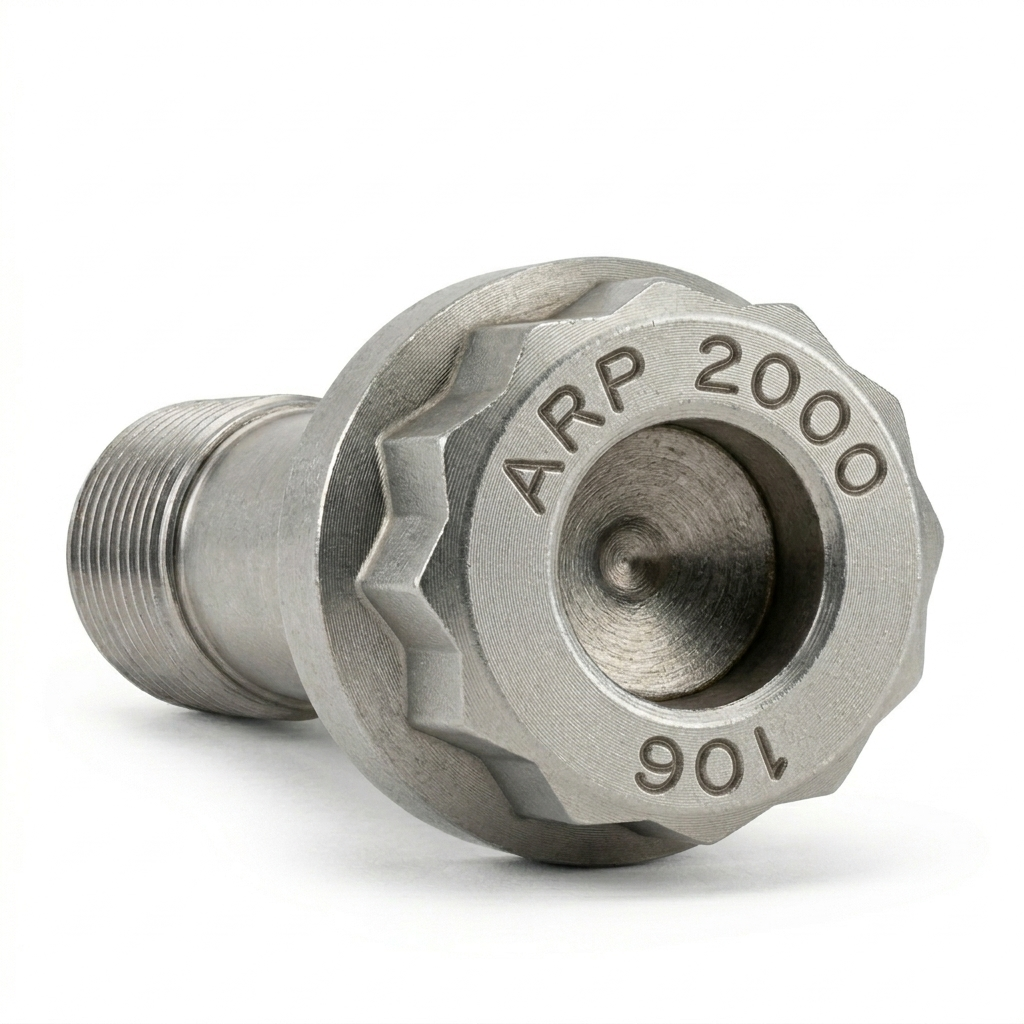 | ARP 2000 is a wrought low-alloy steel whose quench and temper are carried through the section: tensile strength settles around 220,000 psi, i.e. ~1,517 MPa. Its threads, rolled after heat treatment, work-harden the weakest area of the bolt and give very good cyclic fatigue endurance. The grade holds up to 200 hp per cylinder in 3/8" and up to 8,500 rpm: it is the most common in circuit racing, trackdays, drift, rally, drag and hillclimb. On the M30 six-cylinders it equips the ZRP I-profile rod in 3/8"-38 mm, with no storage constraint at all. |
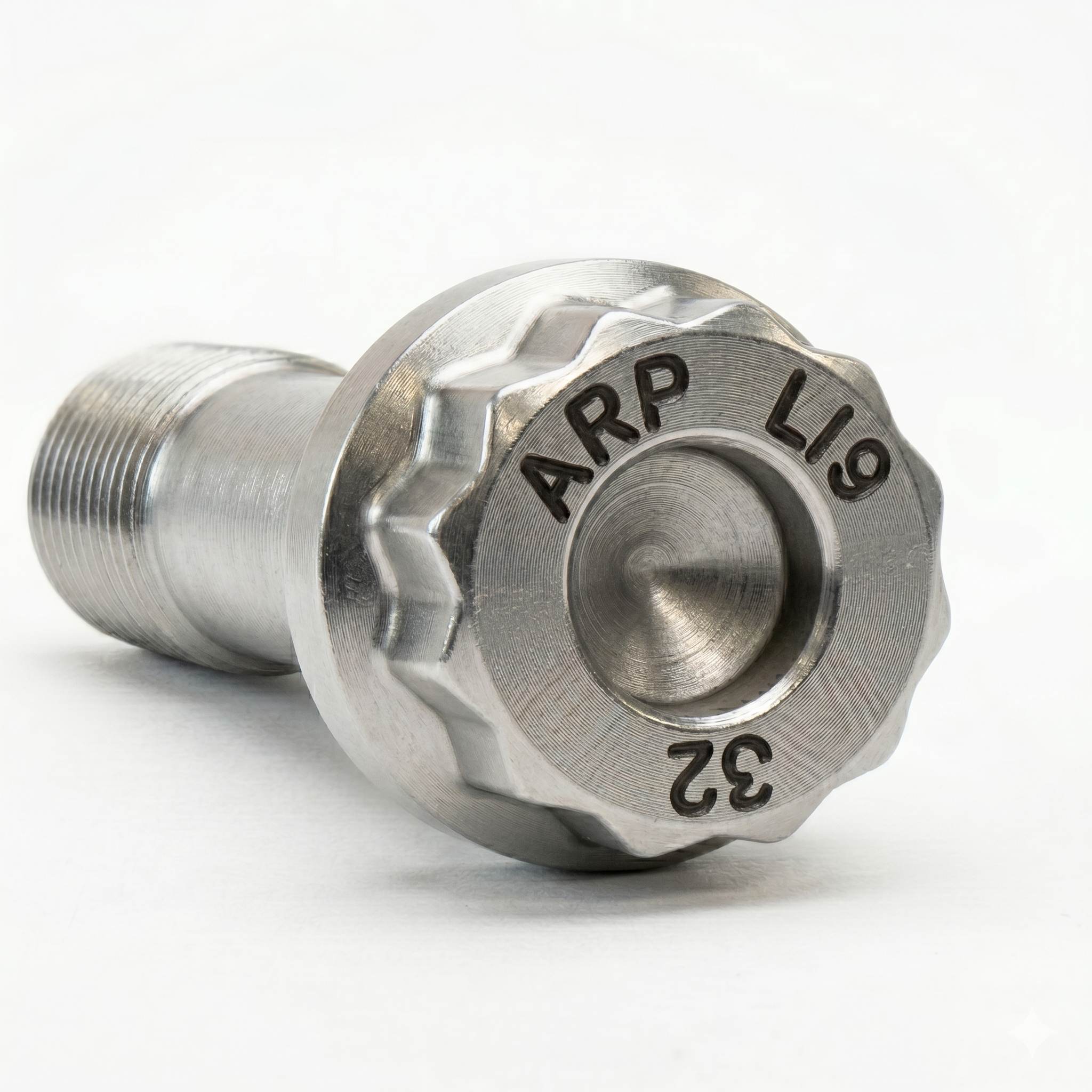 | L19 changes grade: richer alloy, tighter thermal cycle, and a tensile strength that reaches about 260,000 psi, i.e. ~1,793 MPa, for 250 hp per cylinder in 3/8" and up to 10,000 rpm. It targets very high boost pressure, sustained high engine speeds and high cylinder pressure, hence big power in drag, drift, rally and circuit, including on a fully rebuilt M30. Its chemistry has a practical consequence: sensitive to corrosion and to hydrogen embrittlement, L19 is stored and fitted oiled, away from moisture. |
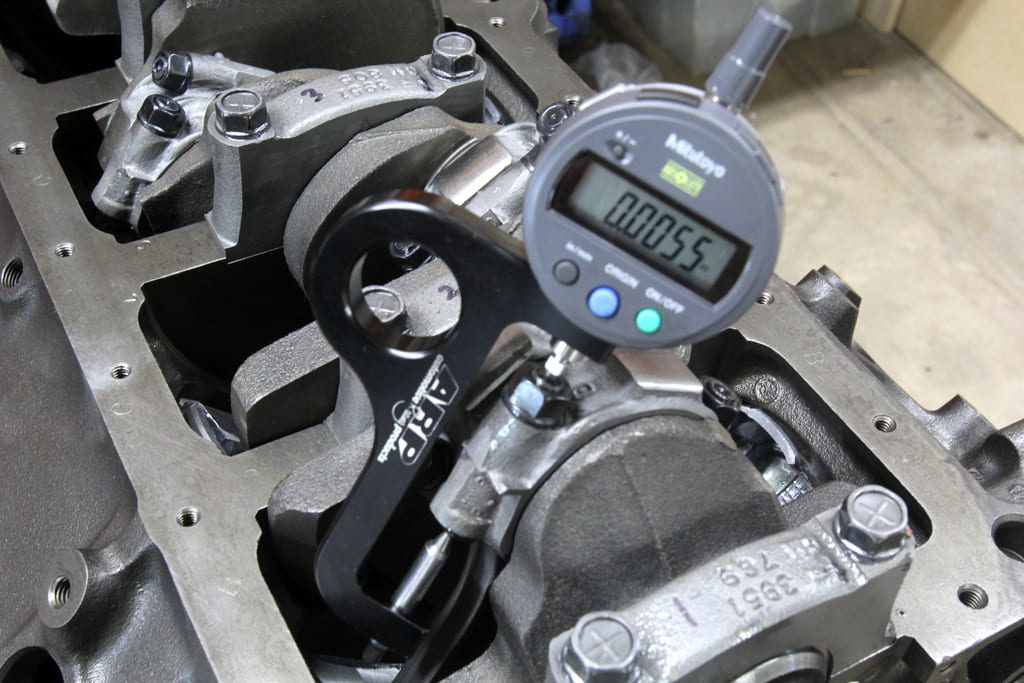
In addition to torque tightening, measuring rod-bolt stretch is the most reliable check for optimal preload. The check is done with the bolt fitted: place the gauge (dial indicator) on the two ends of the bolt and read its actual stretch, which must match the recommended value (see the torque & stretch table above). This method removes the friction variations inherent in torque tightening and secures the assembly on heavily stressed engines. |
 | ZRP, a Greek brand of high-performance forged connecting rods, designed by Alex Drakos in Athens. Each rod is forged from 4340 steel, precision-machined and balanced to ±1 g to stay reliable at high rpm. Available in I-beam or H-beam profile with ARP 2000 or L19 bolts, they are designed and inspected in Greece, and proven in rally, on circuit and in drift. |
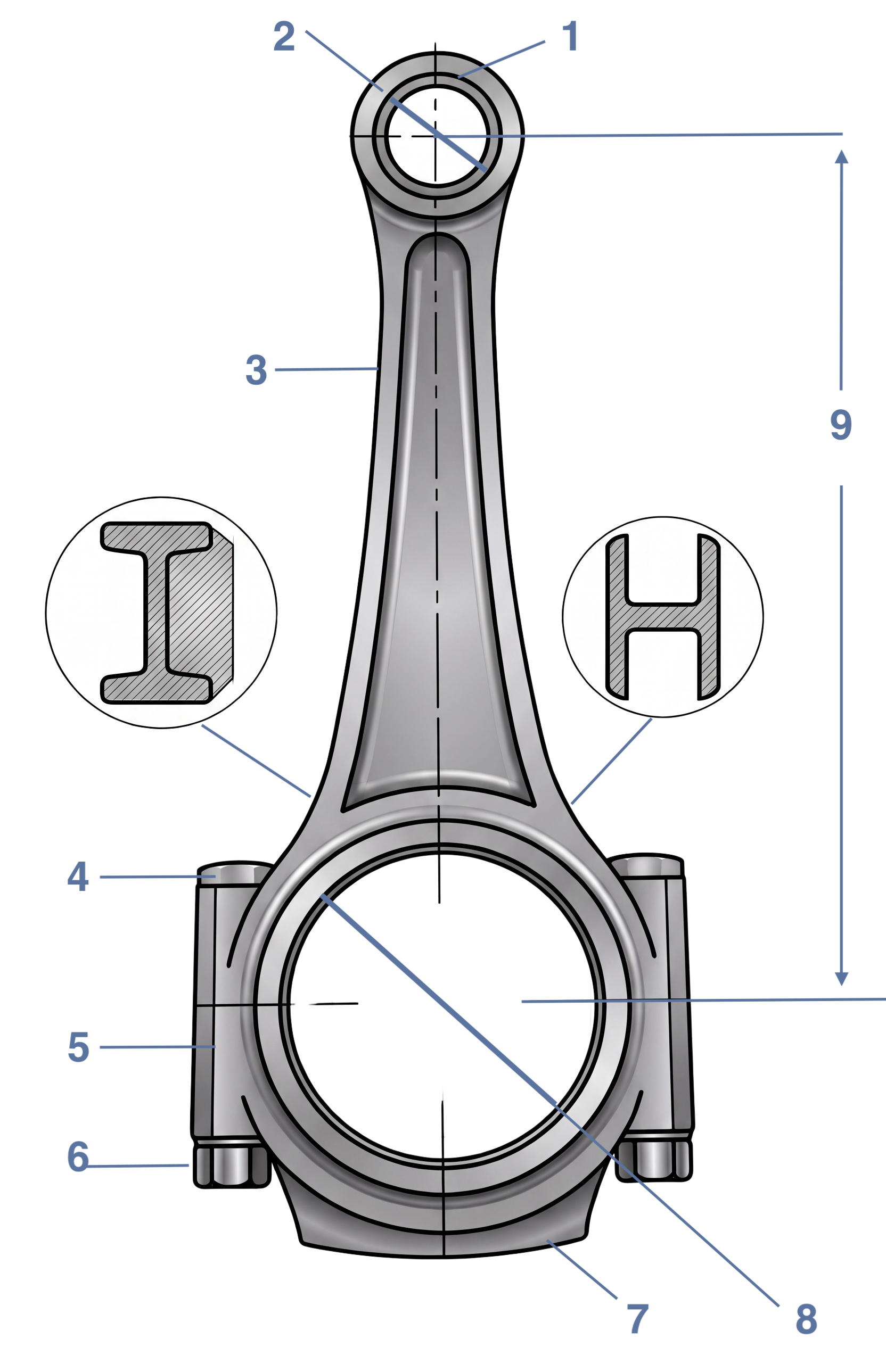 | 1) Small end 2) Small-end diameter 3) Rod beam 4) Rod bolt 5) Big end 6) Rod nut / bolt 7) Rod cap 8) Big-end diameter 9) Center-to-center |
These forged connecting rods fit all BMW M30 inline-six engines, from 2.8 to 3.5 litres, that share the same rod. The table below lists the models (with chassis code), engine code, power and model years:
| Make | Model (chassis) | Engine code | Power | Years |
|---|---|---|---|---|
| BMW | 2800 CS Coupé (E9) | M30B28 | 170–192 hp | 1967–1974 |
| BMW | 2500 / 2.8 (E3) | M30B28 | 170–173 hp | 1968–1977 |
| BMW | 528 / 528i (E12) | M30B28 | 165–184 hp | 1975–1981 |
| BMW | 528i (E28) | M30B28 | 184 hp | 1981–1987 |
| BMW | 628 CSi (E24) | M30B28 | 184 hp | 1979–1987 |
| BMW | 728 / 728i (E23) | M30B28 | 170–184 hp | 1977–1986 |
| ALPINA | B6 (E21/E30) | M30B28 | 200–218 hp | 1978–1986 |
| BMW | 3.0 CS / CSi Coupé (E9) | M30B30 | 180–200 hp | 1970–1976 |
| BMW | 2500–3.3 (E3) 3.0 | M30B30 | 179–200 hp | 1971–1977 |
| BMW | 530i (E12) | M30B30 | 178 hp | 1974–1978 |
| BMW | 530i (E34) | M30B30 | 188 hp | 1988–1990 |
| BMW | 630 CS / CSi (E24) | M30B30 | 178–185 hp | 1976–1979 |
| BMW | 730 (E23) | M30B30 | 184 hp | 1977–1979 |
| BMW | 730i / 730iL (E32) | M30B30 | 188–197 hp | 1985–1994 |
| ALPINA | B7 (E12/E24) | M30B30 | 301 hp | 1978–1982 |
| ALPINA | B10 (E34) | M30B30 | 231 hp | 1993–1996 |
| BMW | 3.0 CSiL (E9) | M30B32 | 206 hp | 1974–1975 |
| BMW | 3.2 Li (E3) | M30B32 | 200 hp | 1975–1977 |
| BMW | 333i (E30) | M30B32 | 197 hp | 1985–1987 |
| BMW | 533i (E28) | M30B32 | 184 hp | 1982–1984 |
| BMW | 633 CSi (E24) | M30B32 | 179–200 hp | 1975–1984 |
| BMW | 732i / 733i / 745i (E23) | M30B32 | 177–252 hp | 1977–1986 |
| BMW | M535i (E12) | M30B35 | 218 hp | 1980–1981 |
| BMW | 635 CSi (E24) | M30B35 | 218 hp | 1978–1982 |
| BMW | 735i (E23) | M30B35 | 218 hp | 1979–1982 |
OEM references (per engine): M30B28, M30B30, M30B35 11 24 0 618 006 ; M30B32 11 24 1 260 306.
On these now-classic inline-sixes, replacing a tired original rod with a new genuine part is expensive and offers no extra margin against a power increase.
For a comparable budget, fitting 4340 forged connecting rods changes everything: the part is new, stronger than the original and built to handle torque and rpm. A lasting investment rather than a like-for-like repair.
For the same budget: more reliability, more potential and real peace of mind to drive hard. That’s the whole point of reinforcing the M30 with forged rods as soon as the bottom end is opened up.