Product successfully added to your shopping cart
Quantity
Total
There are 0 items in your cart. There is 1 item in your cart.
Total products
Total shipping To be determined
Total

3.2L 24v - R32
Manufacturers
3.2L 24v - R32
Warning: Last items in stock!
New product
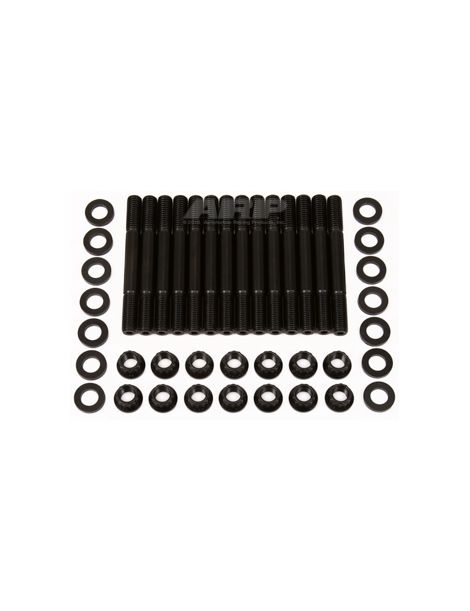
ARP 8740 steel crankshaft main studs for the VAG VR6 2.8, 2.9 and R32 3.2 engines.
This kit is made for the Volkswagen VR6 engines in 2.8 and 2.9 litres (codes AAA, ABV, AES, AMV, AQP, AUE, AYL and BDE, from 1991 to 2004) and for the VR6 of 3.2 litres in the R32 versions (codes BFH, BML, BHE, BUB and CBRA). They power the Golf 3, Golf 4 and Golf 5 R32, the Corrado, the Seat Leon Cupra, and the Audi A3 (8P) and TT (8N and 8J) with V6 engines of 3.2 litres, among others.
From the factory, this engine's main caps are secured by bolts, which this kit replaces with studs.
Each main bearing takes a share of the loads the connecting rods pass on at every combustion. Pulled downwards, the main cap tends to slide on its parting line: over time the mating faces become indented and the bearing bore loses its shape.
The original main cap bolts are replaced by 10 mm ARP studs in 8740 steel, supplied with the nuts and washers that the ARP instruction sheet mentions. Each stud is screwed into the block by hand, the caps go on, then threads, nuts and washers are coated with the ARP assembly grease provided and the nuts are torqued in three passes. Preload goes up, tightening becomes more even and the block threads no longer have to carry the turning of the bolt. 8740 is a chrome-moly steel heat treated by ARP to 200,000 psi tensile strength. To put this figure in context, standard engine fasteners mostly belong to property classes 10.9 and 12.9, i.e. 150,800 to 176,900 psi minimum tensile strength. These 8740 studs in M10 take up to 1,400 hp on this six-cylinder engine (calculated estimate).
| Part number | Brand | Grade / material | Nut | Thread |
| ARP-204-5403 | ARP | 8740 steel | Nut | M10 |
| Reference | Pass 1 | Pass 2 | Pass 3 |
| ARP-204-5403 | 27 Nm | 54 Nm | 81 Nm |
Fitting the studs: screwed into the block by hand, without a tightening tool. A Loctite thread locker may be used for a permanent installation according to the ARP instructions; tightening must then be completed before the product hardens.
The nuts are tightened following the order set by the manufacturer for the caps; every step is given in the ARP instruction sheet.
Moving to reinforced fasteners changes the clamping force on the caps. After installation, the size and roundness of the bores are checked, then the bores are line-honed if needed, always with the final fasteners and lubricant.
Torque figures taken from the ARP 204-5403 instruction sheet, in the revision in force on the day of publication. In the event of any difference, the manufacturer's instruction sheet prevails. Read the ARP 204-5403 instruction sheet
Tightening is done with ARP assembly grease: the torque figures in the table were established with it, not with engine oil.
| Buy the ARP assembly grease → |
 | ARP, short for Automotive Racing Products, was born in the early 1970s on the initiative of Gary Holzapfel, an engineer from the aerospace sector, in response to the engine failures caused in racing by inadequate fasteners. Today the brand produces thousands of part numbers in California, offered in several materials depending on the application. |
| Criterion | Original main bolts | Reinforced ARP studs |
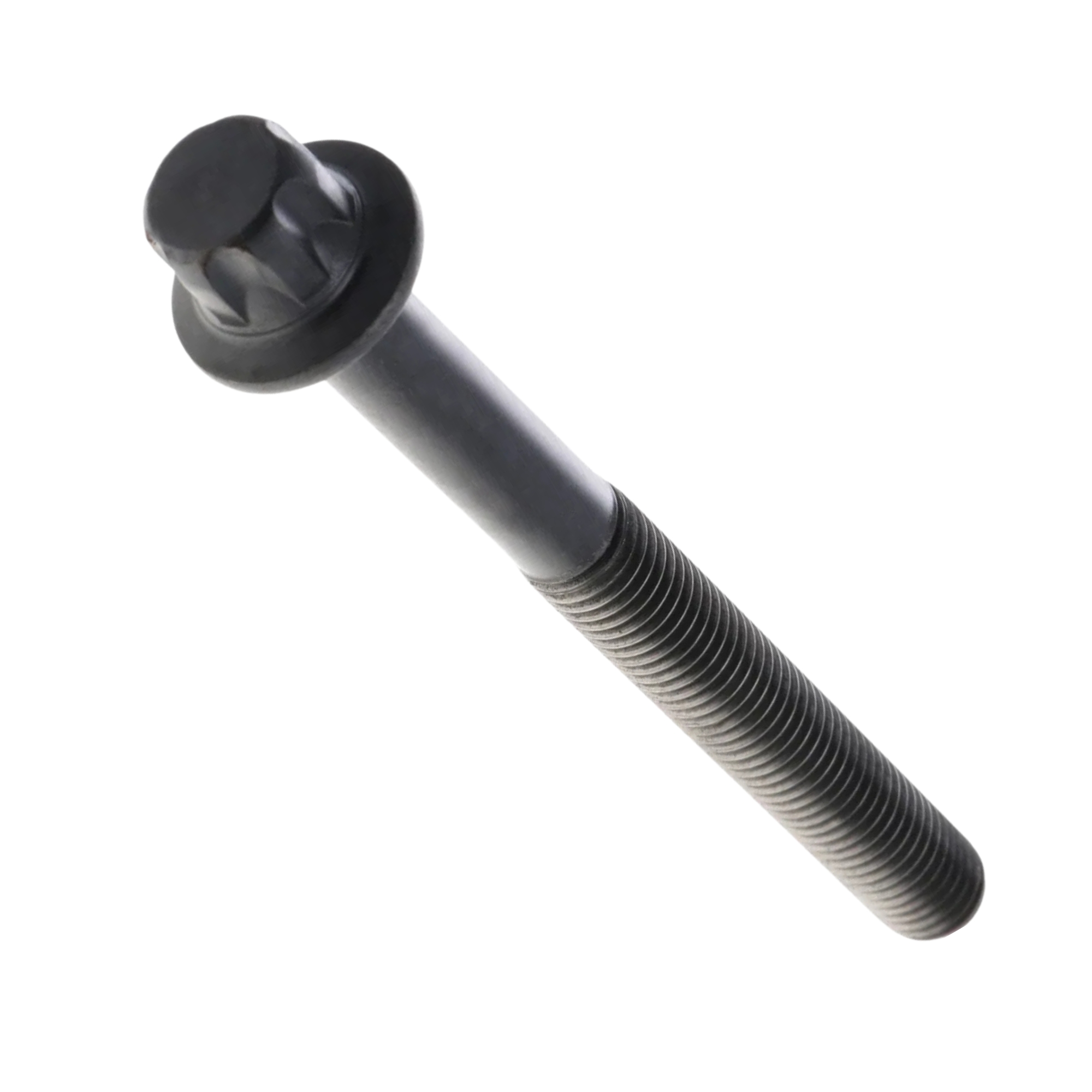 |  | |
| Tightening | Bolt turned into the block at every assembly | Nuts torqued in three passes |
| Block threads | Run through by the bolt at every tightening | Stud placed by hand, no torque load |
| Fitting the caps | Cap held by hand | Cap located by the studs |
| Model | Engine code | Power | Years |
| AUDI A3 8P 3.2 | BUB | 250 hp | 2003-2009 |
| AUDI TT 8J 3.2 | BUB CBRA | 250 hp | 2006-2010 |
| AUDI TT 8N 3.2 V6 | BHE | 250 hp | 2003-2006 |
| SEAT Leon 1M | BDE | 204 hp | 2002-2004 |
| SEAT Leon Cupra 1M | AUE BDE | 204 hp | 2001-2006 |
| VW Corrado | ABV | 190 hp | 1991-1995 |
| VW Golf 3 | AAA | 174 hp | 1992-1997 |
| VW Golf 3 | ABV | 190 hp | 1994-1999 |
| VW Golf 4 | AQP AUE BDE | 204 hp | 1999-2006 |
| VW Golf 4 R32 | BFH BML | 241 hp | 2002-2005 |
| VW Golf 5 R32 | BUB CBRA | 250 hp | 2005-2008 |
On a tuned or boosted VR6, ARP 8740 steel studs, stronger and more consistent in tightening than the original bolts, hold the main caps more firmly and reduce bottom-end failures. Their price stays modest next to the cost of rebuilding a crankshaft and a block.
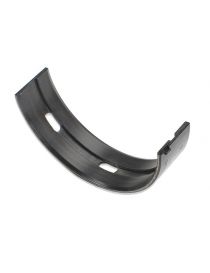
To complete the bottom end overhaul, consider the tri-metal crankshaft main bearings suited to these engines:
| King Racing crankshaft main bearings VAG VR6 → |
| ACL crankshaft main bearings VAG VR6 → |