Product successfully added to your shopping cart
Quantity
Total
There are 0 items in your cart. There is 1 item in your cart.
Total products
Total shipping To be determined
Total

2.9L 24v - EA839
Manufacturers
2.9L 24v - EA839
Warning: Last items in stock!
New product
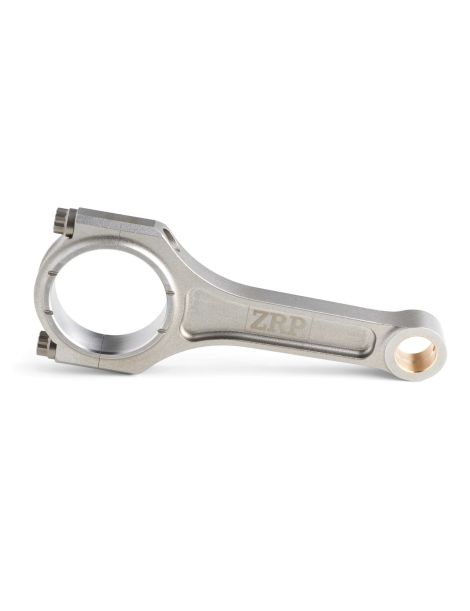
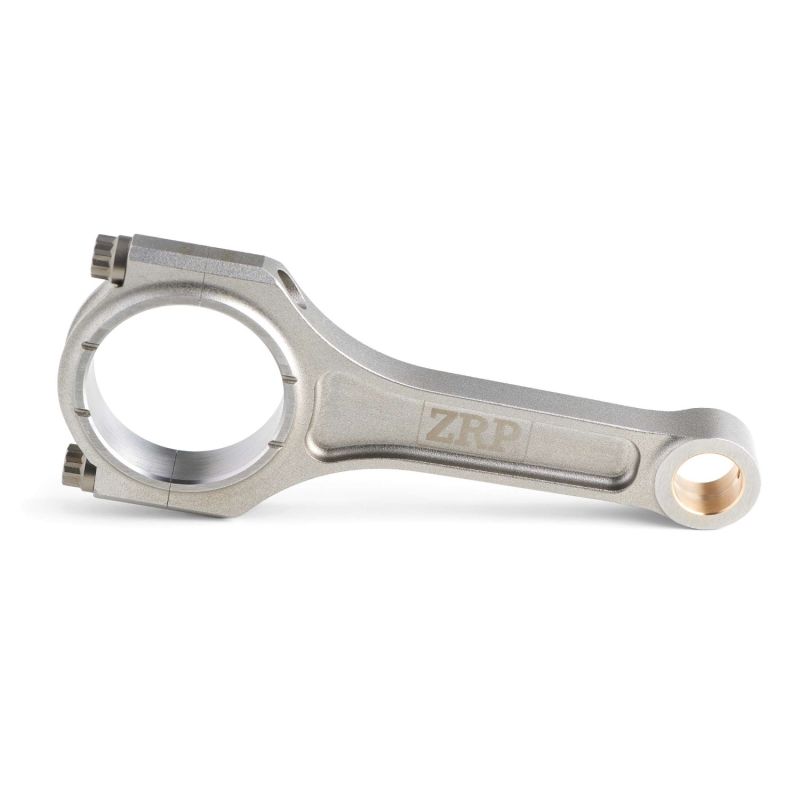
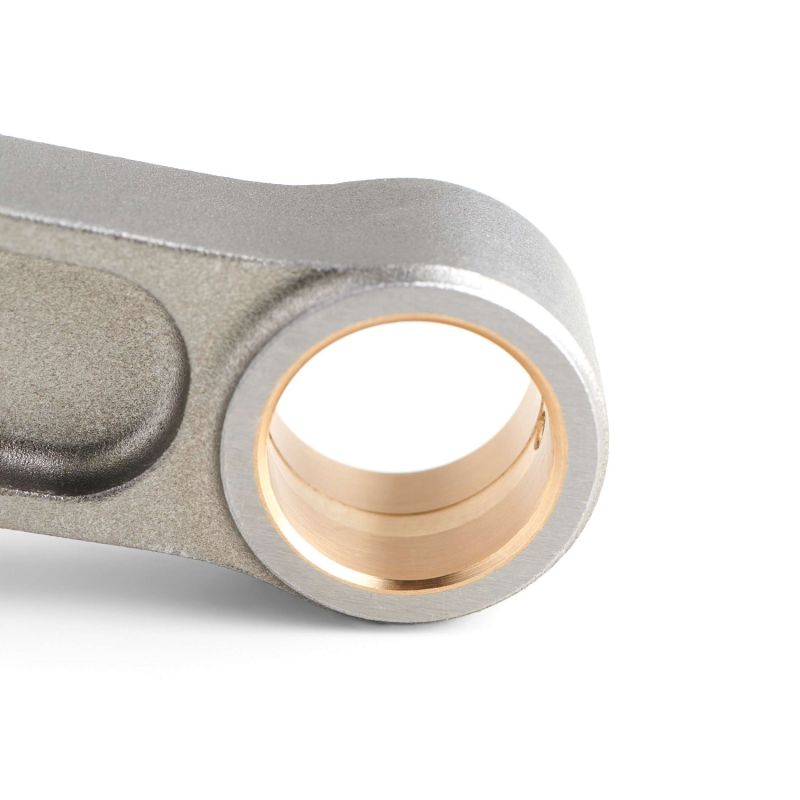
Set of 6 forged 4340 steel connecting rods for Audi RS4/RS5 and Porsche 2.9L 24V Biturbo EA839.
Launched in 2016, the EA839 2.9-litre (2,894 cc) petrol V6 is a biturbo engine developed by Porsche within the Volkswagen Group. It uses the “hot-vee” layout inherited from the 4.0 TFSI V8: both turbochargers sit inside the V formed by the cylinder banks, which shortens the ducting and sharply improves throttle response. With an 84.5 mm bore and an 86 mm stroke, it powers the Panamera 4S (971), the Cayenne S (9YA) and the Audi RS4 and RS5 (B9), where it delivers 440 to 450 hp depending on the version.
On these heavily boosted engines the connecting rods face high combustion pressures and sustained engine speeds. Fitting 4340 forged rods widens the safety margin of the rotating assembly, an essential step as soon as you aim for more torque and power through remapping or turbo upgrades.
With every cycle, the connecting rod turns the piston’s reciprocating motion into rotation of the crankshaft: it is violently compressed during combustion, then stretched at the end of the exhaust stroke. On a stock engine these loads stay within bounds, but as soon as boost pressure, engine speed or displacement rise they climb sharply, and the factory rod, usually sintered metal designed for production cost, becomes the weakest link in the rotating assembly.
A forged connecting rod is shaped by hot die-forging of an alloy steel: the process aligns the metal’s grain flow and gives the part far greater resistance to fatigue and breakage. Precision-machined, balanced and fitted with high-performance hardware, it secures the bottom end and forms the essential foundation of any build aiming for high, lasting power: a switch to forged pistons, higher boost, increased engine speed or a displacement gain. Designed for built engines, these forged rods suit every discipline (rally, drift, drag racing, circuit and track days, hillclimb, time attack) and support Stage 2, Stage 3 and Stage 4+ builds, up to full competition engines.
| Reference | Brand | Profile | Bolts | Pin diameter OEM 22 mm | Small-end width | Big-end diameter OEM 58.8 mm | Big-end width | Center-to-center OEM 155 mm | Weight per rod |
|---|---|---|---|---|---|---|---|---|---|
| R-POR-001-I | ZRP | I | ARP 2000-5/16"-38mm | 22 mm | 58.8 mm | 20.05 mm | 155 mm | 525 g | |
| R-POR-001-I-L19 | ZRP | I | ARP L19-5/16"-38mm | 22 mm | 58.8 mm | 20.05 mm | 155 mm | 525 g |
| Rod | Bolts | Tightening torque | Recommended stretch |
|---|---|---|---|
| ZRP (R-POR-001-I) | ARP 2000 | 40.7 N·m | 0.140 – 0.152 mm |
| ZRP (R-POR-001-I-L19) | ARP L19 | 54.2 N·m | 0.127 – 0.140 mm |
Moving to ARP hardware on the 2.9 biturbo changes the working method: you leave behind the angle-tightening logic of the single-use original bolts and go back to a build driven by measurement. In practice, prepare all twelve bolts, record each free length, tighten progressively, then read the stretch obtained. The torque and stretch figures in the table are those specified by the bolt manufacturer, ARP 2000 or ARP L19 in 5/16" 38 mm depending on the chosen variant, and must be followed scrupulously: the stretch value read on the gauge is the reference, torque giving only an order of magnitude for checking.
4340 is a low-alloy steel containing nickel, chromium and molybdenum, used in aerospace as well as motorsport for its rare balance of strength and toughness. Forged and then heat-treated by quenching and tempering, it delivers excellent tensile strength, outstanding fatigue endurance and genuine ductility that lets it absorb shock loads without breaking. Compared with the sintered metal of a stock rod, optimised for mass production, forged 4340 shows about 19% more yield strength, nearly 8% more tensile strength and, above all, 19 to 37% more fatigue resistance, for a service life under cyclic load several times longer. That is what makes forged 4340 the reference material once boost and engine speed climb. |
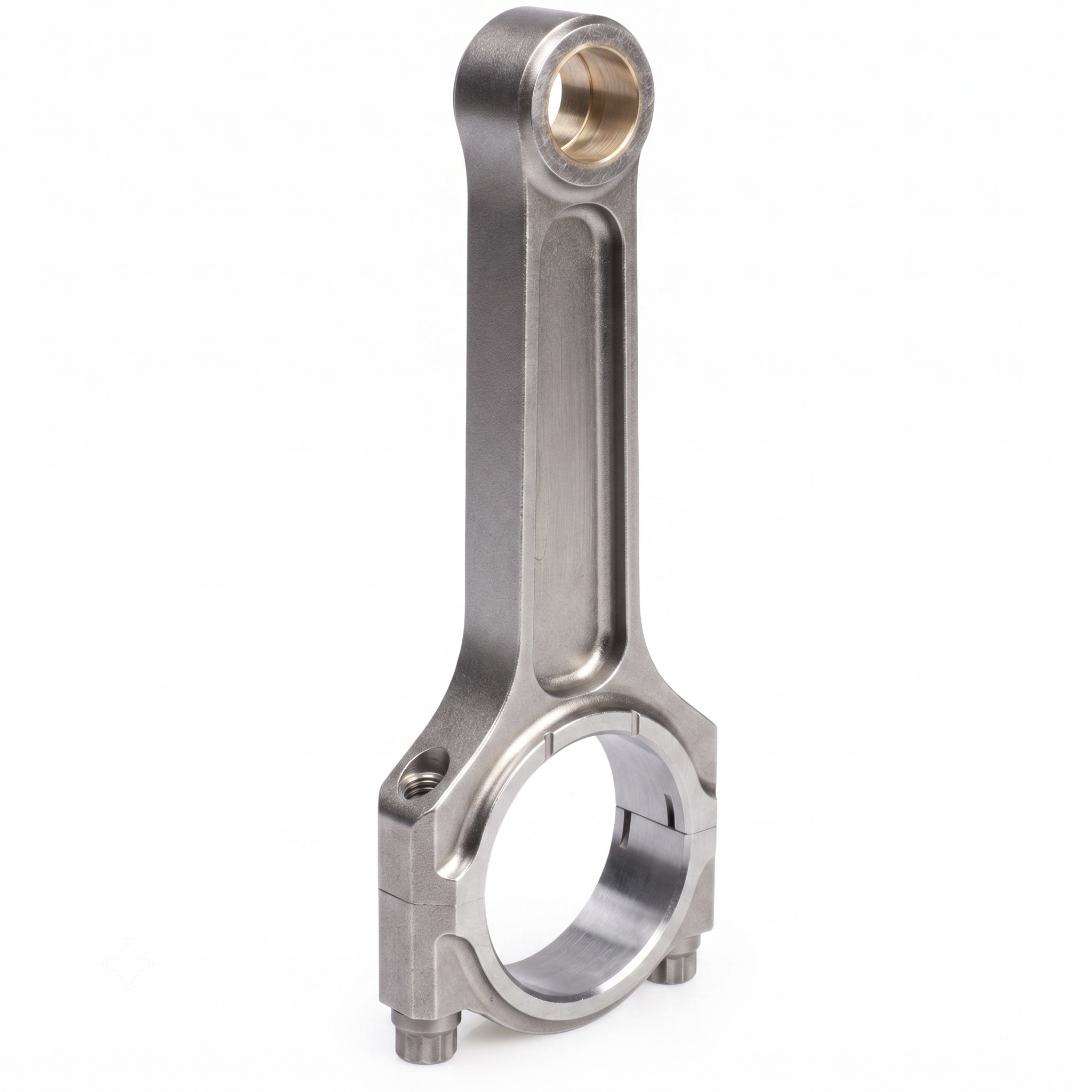 | I-beam profile: the rod body has an I-shaped cross-section, narrower at its centre. Lighter than an H-beam, it reduces reciprocating mass, frees up the rev range and limits the inertia of the rotating assembly. It is the profile of choice on modern turbo engines such as the EA839, offering the best compromise between mass and strength, from the prepared road car to the track. It is the profile chosen for these rods. |
The rod bolt is among the most heavily loaded parts in the engine: it holds the cap closed on the big end and keeps the assembly together with every revolution. The key is to match the ARP grade to the build’s real use, then to follow the tightening torque and stretch figures to the letter. Two ARP grades are offered for this engine:
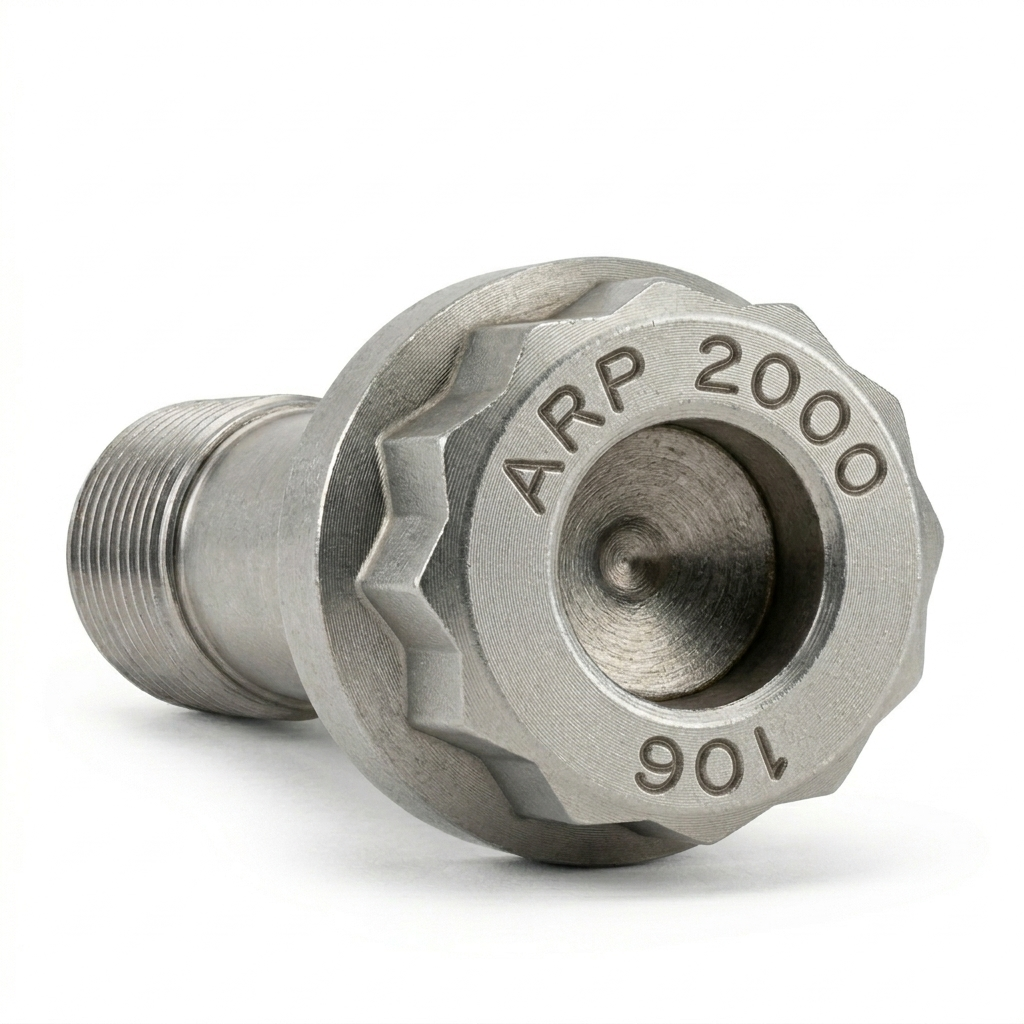 | ARP 2000 (tensile strength around 220,000 psi, i.e. ~1,517 MPa) is the high-performance standard. It suits builds up to 150 hp per cylinder in 5/16″, and up to 8,500 rpm. It is the most widely used grade in circuit racing, track days, drift, rally, drag and hillclimb: robust, reliable and versatile, it needs no particular storage precautions. |
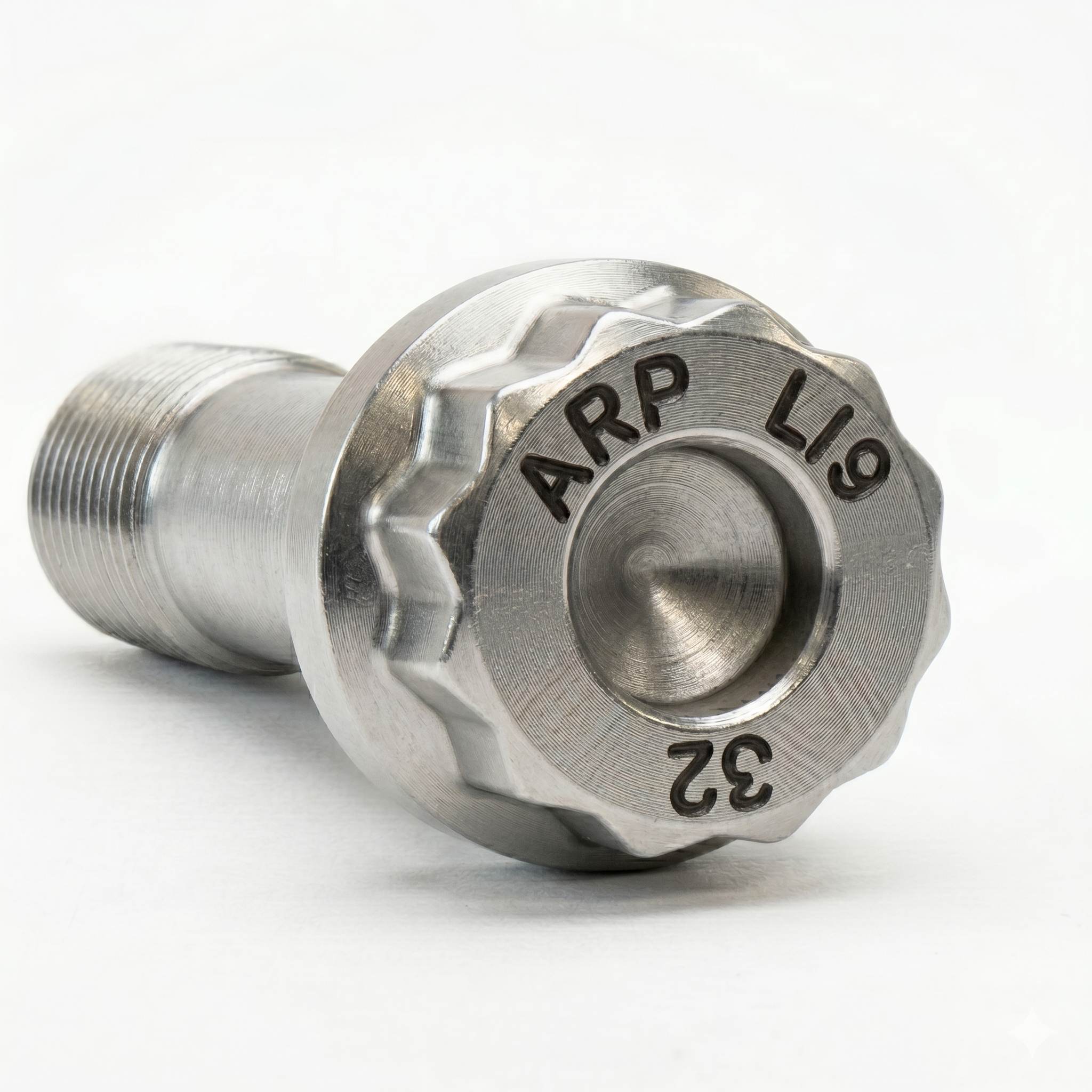 | ARP L19 (tensile strength around 260,000 psi, i.e. ~1,793 MPa) is intended for engines pushed to the extreme: up to 200 hp per cylinder in 5/16″, and up to 10,000 rpm. It targets high boost pressure, sustained high revs and elevated cylinder pressure. In return, the alloy is sensitive to corrosion and hydrogen embrittlement: it must be stored and fitted oiled, away from moisture. |
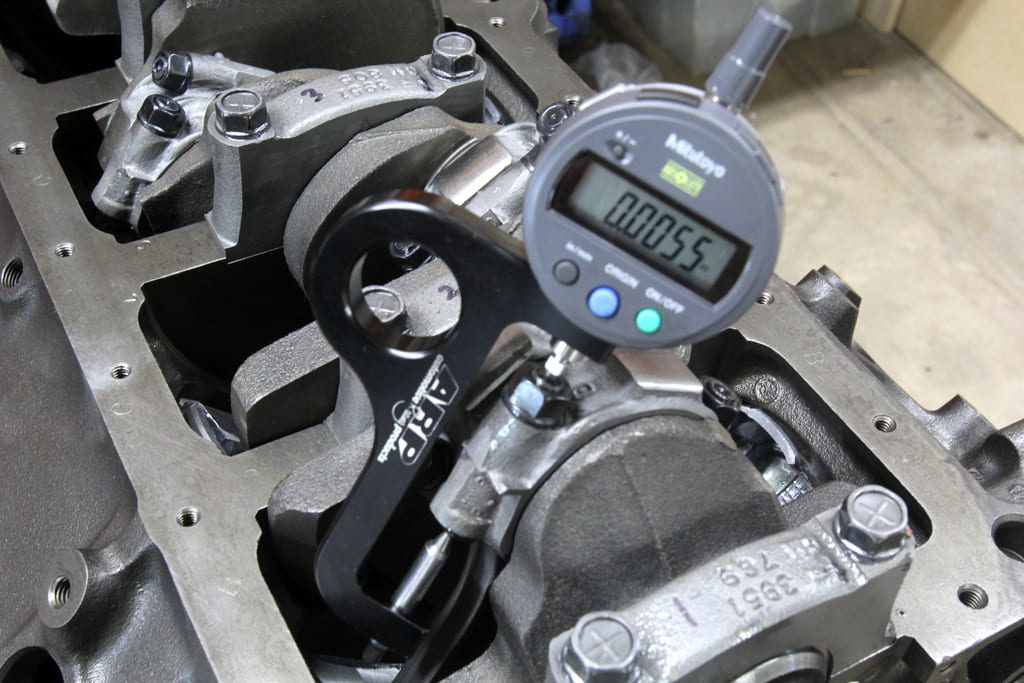
| Beyond torque tightening, measuring rod-bolt stretch is the most reliable way to reach the ideal preload. The check is done with the bolt fitted: a gauge (dial indicator) is placed on both ends of the bolt to read its actual stretch, which must match the recommended value (see the torque and stretch table above). This method removes the friction variations inherent to torque tightening and secures the assembly on heavily stressed engines. |
 | ZRP is a Greek brand of high-performance forged connecting rods, designed in Athens by Alex Drakos. Each rod is forged from 4340 steel, precision-machined and balanced to ±1 g to stay reliable at high rpm. Designed and inspected in Greece, proven in rally, on track and in drift, they are offered here in I-beam profile with ARP 2000 or ARP L19 hardware. |
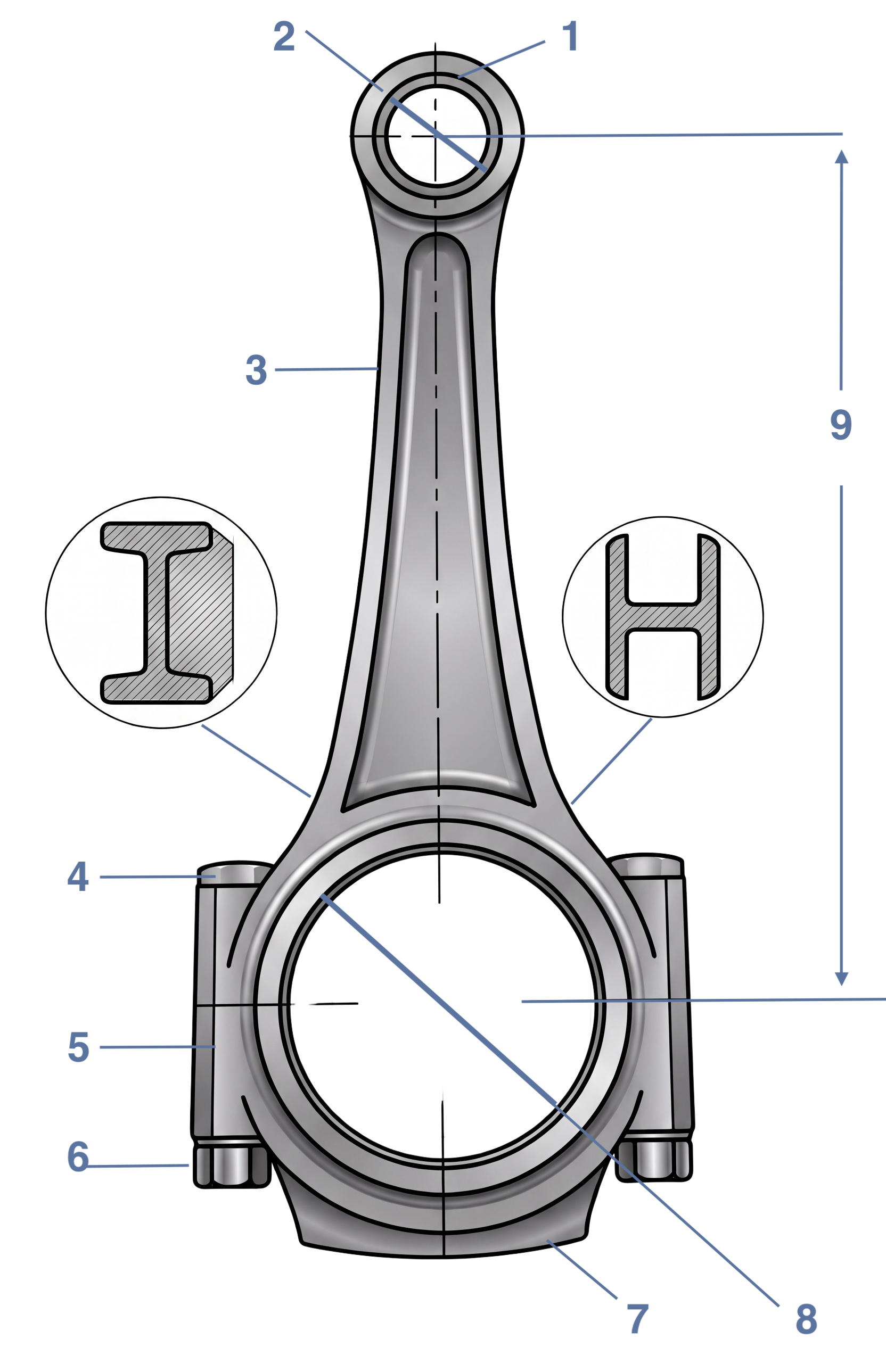 | 1) Small end 2) Small-end diameter 3) Rod beam 4) Rod bolt 5) Big end 6) Rod nut / bolt 7) Rod cap 8) Big-end diameter 9) Center-to-center |
These forged rods fit all vehicles equipped with the EA839 2.9 biturbo V6 listed below.
| Make | Model (chassis) | Engine code | Power | Years |
|---|---|---|---|---|
| Porsche | Panamera 4S (971) | EA839 | 440 hp | 2016 – 2023 |
| Porsche | Cayenne S (9YA) | EA839 | 440 hp | 2017 – 2023 |
| Audi | RS4 Avant (B9) | EA839 | 450 hp | 2017 – 2024 |
| Audi | RS5 Coupé / Sportback (B9) | EA839 | 450 hp | 2017 – 2023 |
OEM reference: 06M 198 401 (set of 6 rods).
When a stock bottom end fails (a rod broken, bent or scored), simply returning to the factory configuration means replacing both the rods and the pistons, almost always damaged at the same time. The bill rises quickly for a repair that brings no gain.
For a comparable budget, sometimes lower, fitting forged 4340 rods together with forged pistons from the outset provides a far greater safety margin and reliability, plus real headroom for power increases. It is the approach European engine builders have chosen for more than fifteen years.
For the same budget: more reliability, more potential, more longevity.