Product successfully added to your shopping cart
Quantity
Total
There are 0 items in your cart. There is 1 item in your cart.
Total products
Total shipping To be determined
Total

2.8L 24v - B6284T
Manufacturers
2.8L 24v - B6284T
Warning: Last items in stock!
New product
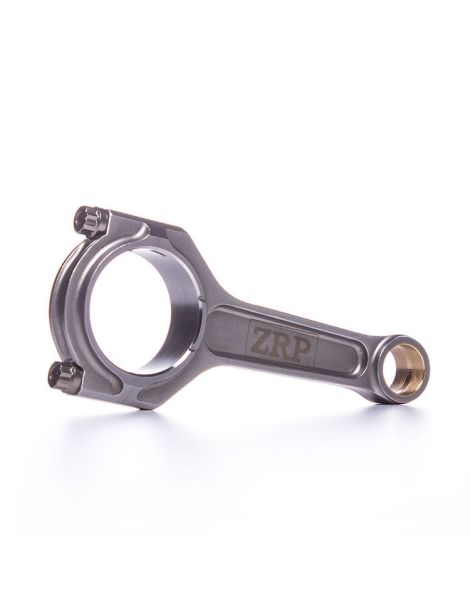
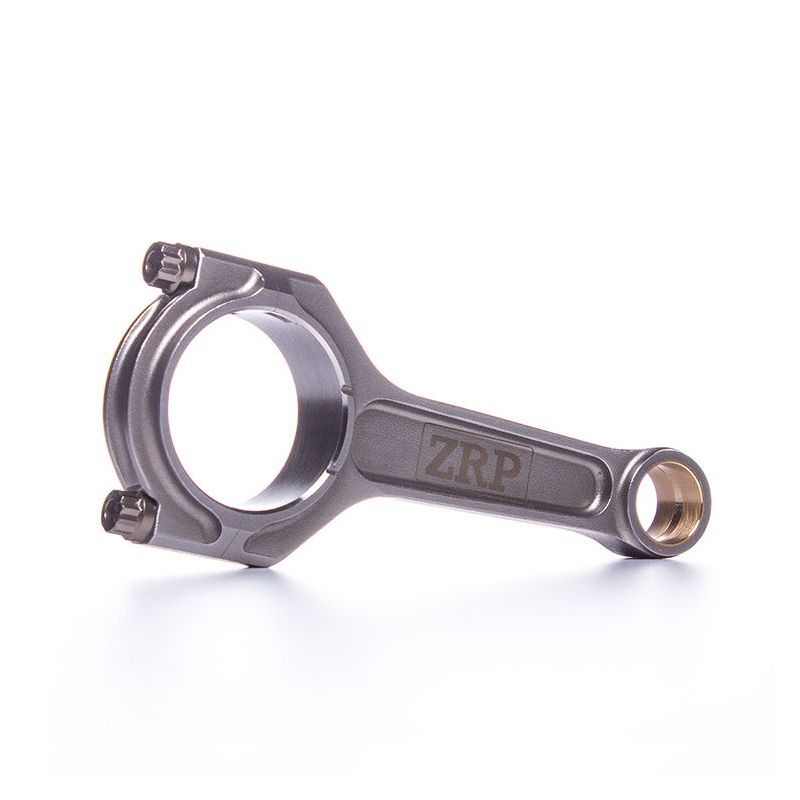
Set of 6 forged 4340 steel connecting rods for Volvo 2.8L 24V Turbo B6284.
The B6284 is the 2.8-litre in-line six of Volvo’s modular family: aluminium block and head, four valves per cylinder, overhead camshafts. Mounted transversely in the S80 T6, it runs two turbochargers and puts out around 272 hp, which placed the big Swedish saloon among the quickest in its class between 1998 and 2005.
That architecture was calibrated first for refinement and long life, not for escalation. The factory rods, sized for standard output, become the first link to give way as soon as boost pressure is raised, larger turbochargers are fitted or more engine speed is asked for: the beam buckles, the big end goes oval, and the bottom end follows.
Fitting forged rods moves that limit. The die-forged, machined beam takes the alternating loads of a boosted in-line six without deforming, ARP hardware keeps the cap seated under high load, and weight matching preserves crankshaft balance. It is the compulsory step for a build that aims to hold significantly more power than standard, forged pistons included.
The connecting rod turns the piston's reciprocating motion into the crankshaft's rotation: on every cycle it withstands tensile, compressive and bending loads that grow with engine speed, boost pressure and torque. A forged rod, produced by hot die forging, has an oriented grain flow that gives it far greater fatigue strength than a cast or sintered factory rod.
These ZRP forged rods are intended for built B6284 engines used in competition and intensive use: circuit racing, track days, drift, rally, drag and hillclimb. They secure Stage 2, Stage 3 and Stage 4+ builds, where forged pistons, larger turbos, higher boost and higher engine speed demand a bottom end able to handle power far above stock without compromising reliability.
| Reference | Brand | Profile | Bolts | Pin Ø OEM 23 mm | Small-end width | Big-end Ø OEM n.p. | Big-end width | Center-to-center OEM 139,5 mm | Weight per rod |
|---|---|---|---|---|---|---|---|---|---|
| R-VOL-005-I-6 | ZRP | I | ARP 2000-3/8"-38mm | 23 | 53 | 25,65 | 139,5 | 531 | |
| R-VOL-005-I-6-L19 | ZRP | I | ARP L19-3/8"-38mm | 23 | 53 | 25,65 | 139,5 | 531 |
| Rod | Bolts | Torque | Recommended stretch |
|---|---|---|---|
| ZRP (R-VOL-005-I-6) | ARP 2000 | 61 N·m | 0,140–0,152 mm |
| ZRP (R-VOL-005-I-6-L19) | ARP L19 | 67,8 N·m | 0,152–0,165 mm |
A rod bolt is a part that works in fatigue, and the free length recorded before assembly is its identity card. If, after loosening, that length does not return to its original figure, the bolt has gone beyond its elastic domain and no longer belongs in an engine: only a gauge allows that check, and it is another reason why the stretch method is treated as the reference across the twelve bolts of a B6284. The ranges shown in the table above come from the bolt manufacturer and differ according to the grade fitted, ARP 2000 or ARP L19; they are applied in full, with no rounding up. Torque keeps its usefulness for approaching the target, but it depends on friction and proves nothing on its own. Hence the preparation: clean threads, a thin coat of ARP assembly lubricant, progressive tightening. The kit instruction sheet remains the final authority.
| 4340 is a low-alloy nickel-chromium-molybdenum steel, the benchmark for highly stressed mechanical parts, used even in aerospace. After hot forging, the rods are quenched and tempered to balance hardness and toughness. Compared with a production sintered metal, forged 4340 offers around 19% more yield strength, about 8% more tensile strength and 19 to 37% greater fatigue endurance depending on loading: extra margin that translates directly into a more reliable bottom end under high load. |
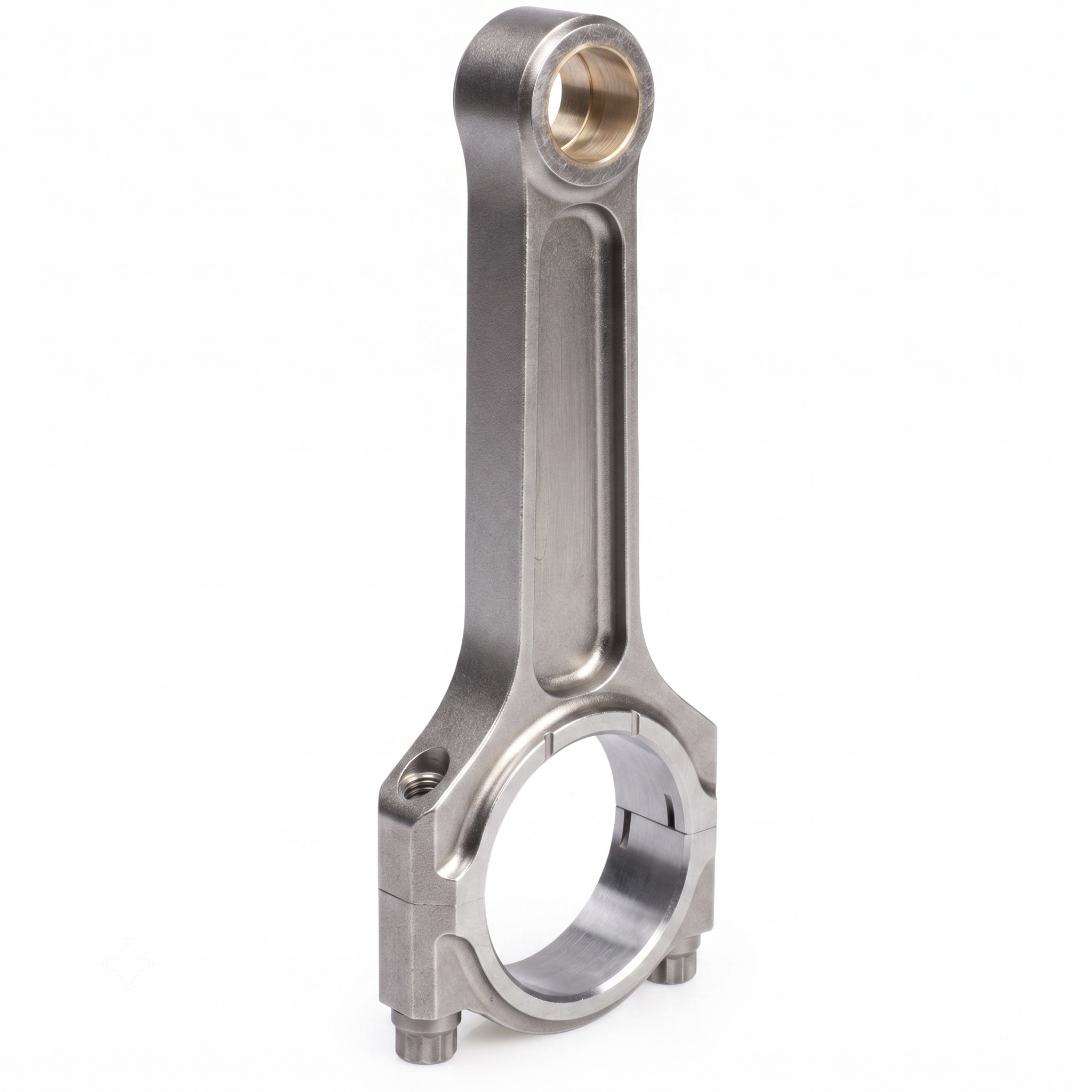 | I-beam profile: an I-shaped section that favours an excellent stiffness-to-weight ratio. Light and stable at high rpm, the I-beam rod is ideally suited to the B6284 straight-six, where controlling moving masses and high-rpm stability come first. |
On a rod bolt, performance is the product of a chemistry and a sequence of operations: selected grade, clean steel, austenitising then quench and temper carried through the whole section, and finally thread rolling on the treated part, which work-hardens the thread root and raises the endurance limit. Chemical stability then decides whether the bolt can be stored without precautions. On this B6284 six-cylinder the hardware comes in 3/8"-38 mm in two grades; the choice is made on target power and engine speed, and tightening is checked by stretch.
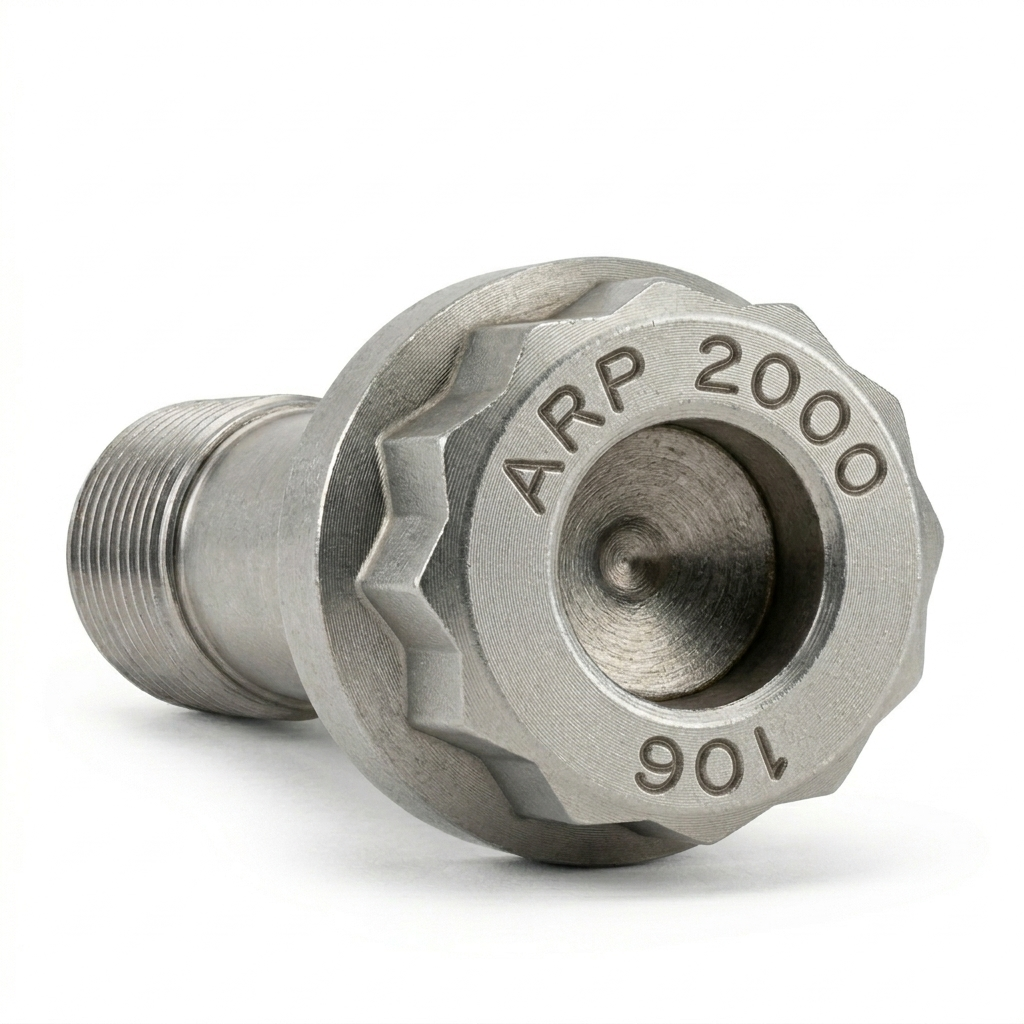 | ARP 2000 is a wrought, through-hardened steel with tensile strength around 220,000 psi, i.e. ~1,517 MPa. Its threads are rolled after heat treatment, which earns it high cyclic fatigue endurance, and its composition makes it stable against ambient corrosion: nothing particular to plan for storage. The grade is rated up to 200 hp per cylinder in 3/8" and up to 8,500 rpm, the most common in circuit racing, trackdays, drift, rally, drag and hillclimb. It equips the ZRP I-profile rod of this B6284, in 3/8"-38 mm. |
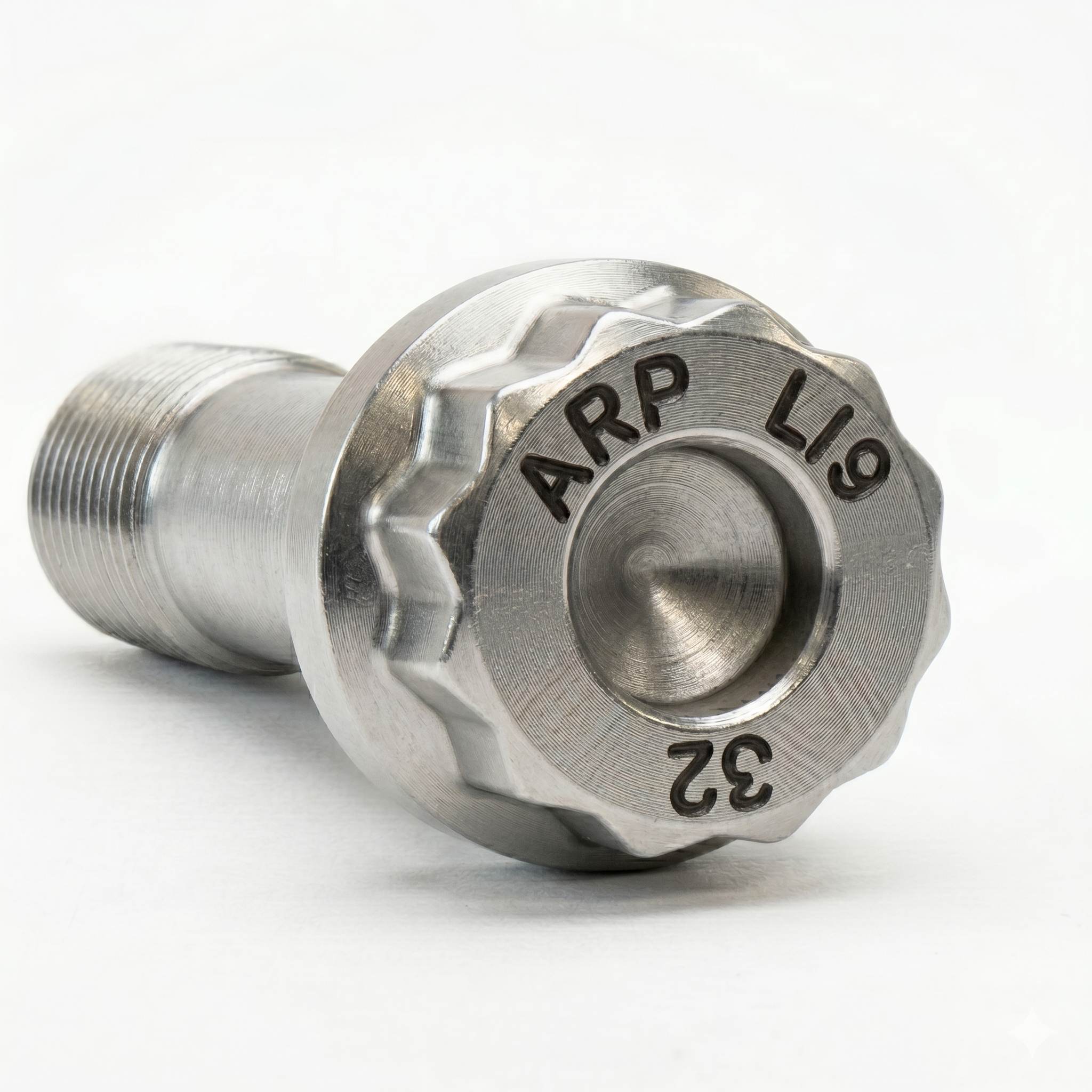 | ARP L19 is the grade above: richer alloy, more demanding quench and temper cycle, tensile strength of about 260,000 psi, i.e. ~1,793 MPa, for 250 hp per cylinder in 3/8" and up to 10,000 rpm. It covers very high boost pressure, sustained high engine speeds and high cylinder pressure, that is big power in drag, drift, rally and circuit on this six-cylinder. Its trade-off is chemical: sensitive to corrosion and to hydrogen embrittlement, L19 must be stored and fitted oiled, away from moisture. |
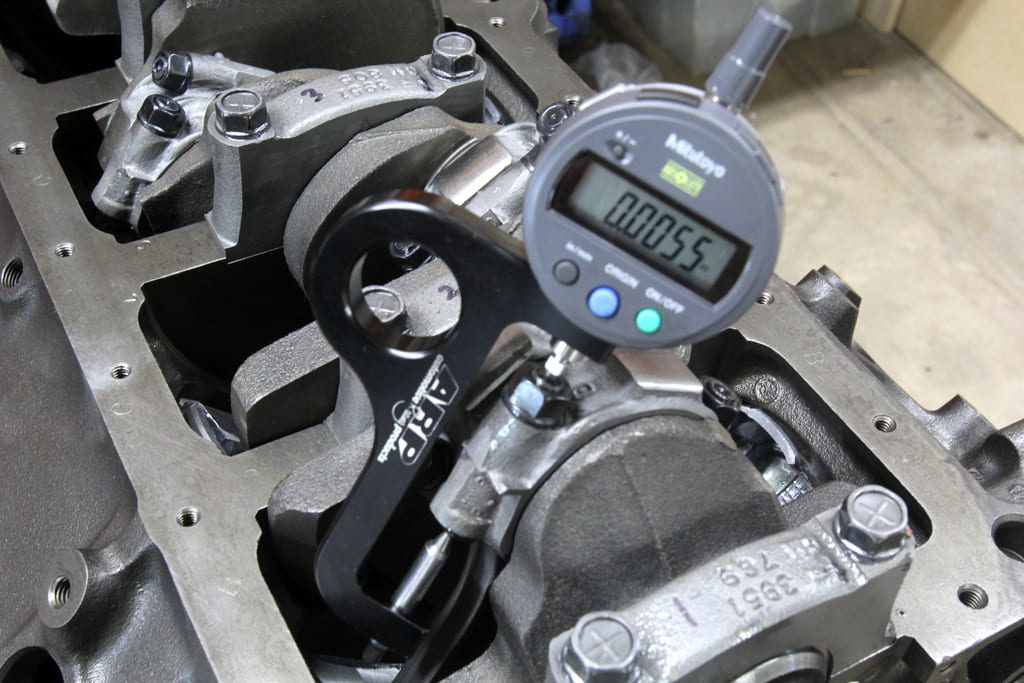
| The most reliable tightening method is to measure bolt stretch with a gauge, between its two ends, rather than relying on torque alone: it eliminates parasitic friction and guarantees exact preload. The target stretch value is given in the manufacturer's instructions. |
 | ZRP is the brand of Alex Drakos, based in Athens, Greece. Its rods are precision-machined from 4340 steel, inspected and weight-matched to within ±1 g for optimal bottom-end balance. They excel in circuit, rally and drift as well as in high-power builds. |
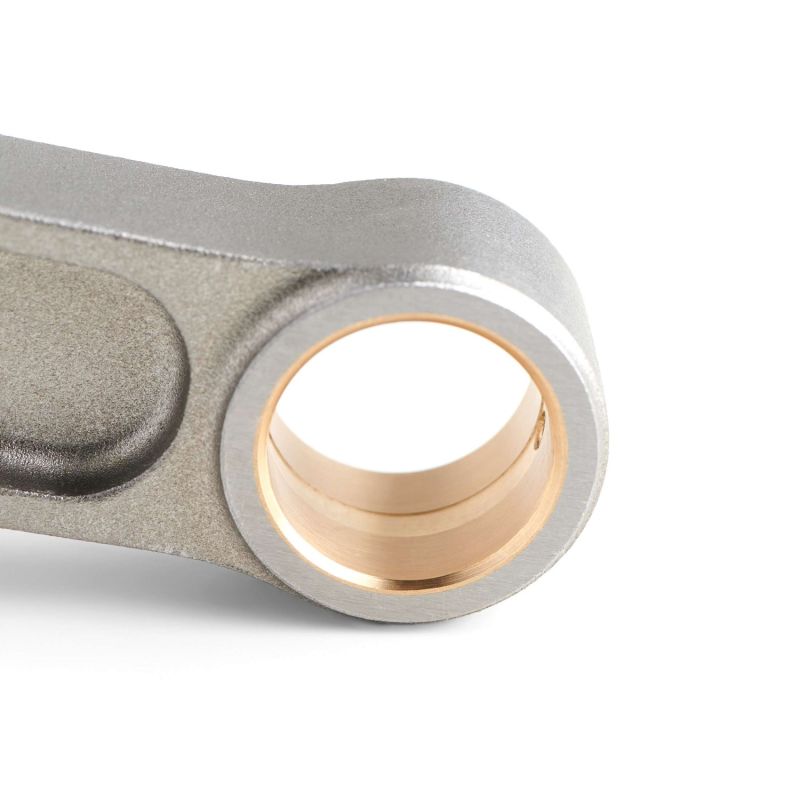
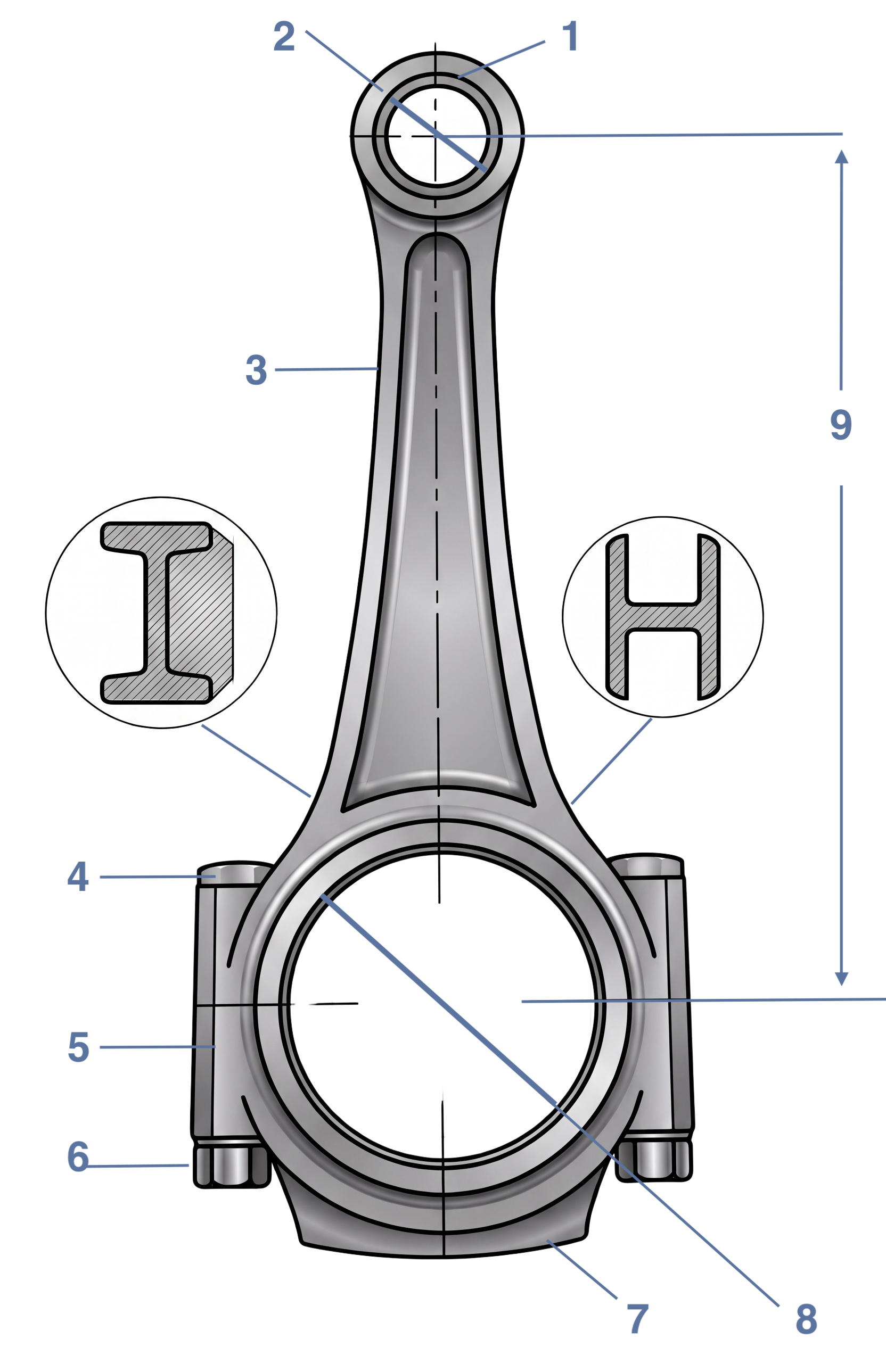 | 1) Small end 2) Small-end diameter 3) Rod beam 4) Rod bolt 5) Big end 6) Rod nut / bolt 7) Rod cap 8) Big-end diameter 9) Center-to-center |
Listed below are the vehicles equipped with the Volvo 2.8L 24V B6284 engine. Before ordering, take the piston pin diameter and the rod length from the engine concerned.
| Brand | Model (chassis) | Engine code | Power | Years |
|---|---|---|---|---|
| Volvo | S80 T6 (TS) | B6284T | 272 ch | 1998–2005 |
OEM reference:
Set against the price of a complete engine or a rebuild after failure, a set of forged rods is a contained expense. Yet it is the part that makes everything else possible: forged pistons, larger turbochargers, higher boost and higher engine speed. Without it, every extra horsepower is paid for in risk to the bottom end.
A rod never fails alone: it takes the crankshaft with it, often the block, sometimes the head, and it strands the car at the worst possible moment. Securing the reciprocating assembly while the engine is already open costs a fraction of what putting it right would cost, labour included. On a prepared B6284, the forged rod is the best euro spent on reliability.