Product successfully added to your shopping cart
Quantity
Total
There are 0 items in your cart. There is 1 item in your cart.
Total products
Total shipping To be determined
Total

2.3L 8v - B230
Manufacturers
2.3L 8v - B230
Warning: Last items in stock!
New product
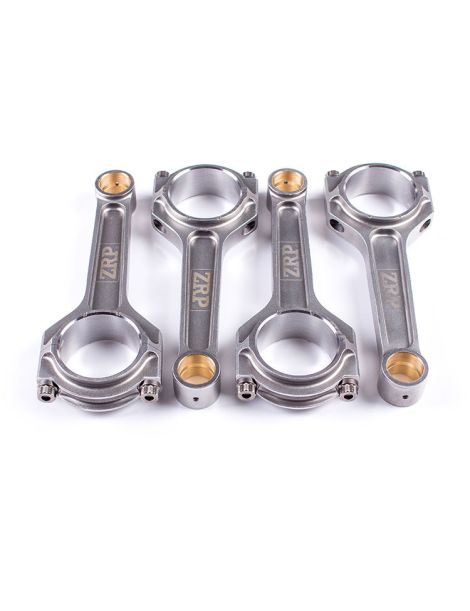
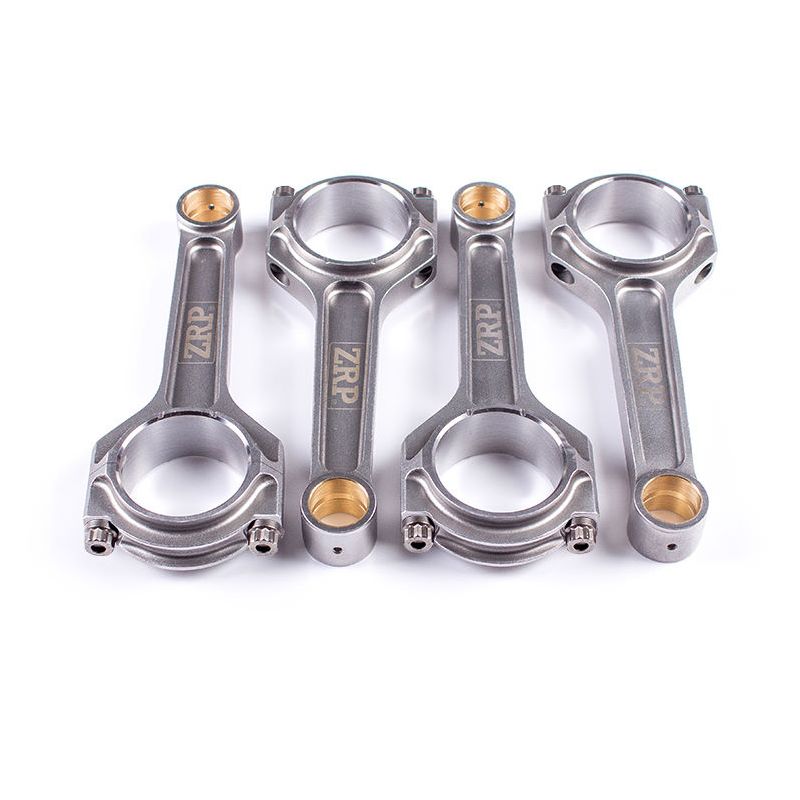
Set of 4 forged 4340 steel connecting rods for Volvo 2.3L B230 / B234 (158 mm).
The "red block" is the inline four-cylinder that built Volvo's reputation for durability. Launched in the mid-1980s and produced until 1998, it powered the Volvo 240, 740, 760 and 940. Its 2,316 cc displacement (96 mm bore, 80 mm stroke) is built around a massive cast-iron block and a five-bearing crankshaft, delivering a longevity well beyond the standards of its era.
The family comes as an eight-valve B230 (naturally aspirated B230F, 114 to 131 hp, or turbocharged B230FT, 160 to 200 hp depending on the build) and a sixteen-valve B234F (155 hp), introduced in 1988. This simple, over-engineered and easy-to-build architecture made it a favourite platform for forced induction: it is precisely when cylinder pressure rises that the original sintered-steel rod becomes the weak link.
On the red block, the cast-iron cylinder block and five-bearing crankshaft handle far more power than standard, which is why high-boost builds are so common on the 240 and 740. The limiting factor then moves to the rotating assembly, and first of all to the connecting rod — whose 158 mm centre-to-centre distance identifies this variant. A forged set, matched to the gram and torqued with ARP hardware, lets you use the block's reserve without turning the rod into a mechanical fuse.
The connecting rod turns the piston's reciprocating motion into rotation of the crankshaft. On every cycle it absorbs tensile, compressive and bending loads that grow with engine speed, boost pressure and torque. On a built red block, these stresses quickly exceed what the original sintered-metal rod was designed for: a rod failure almost always destroys the block.
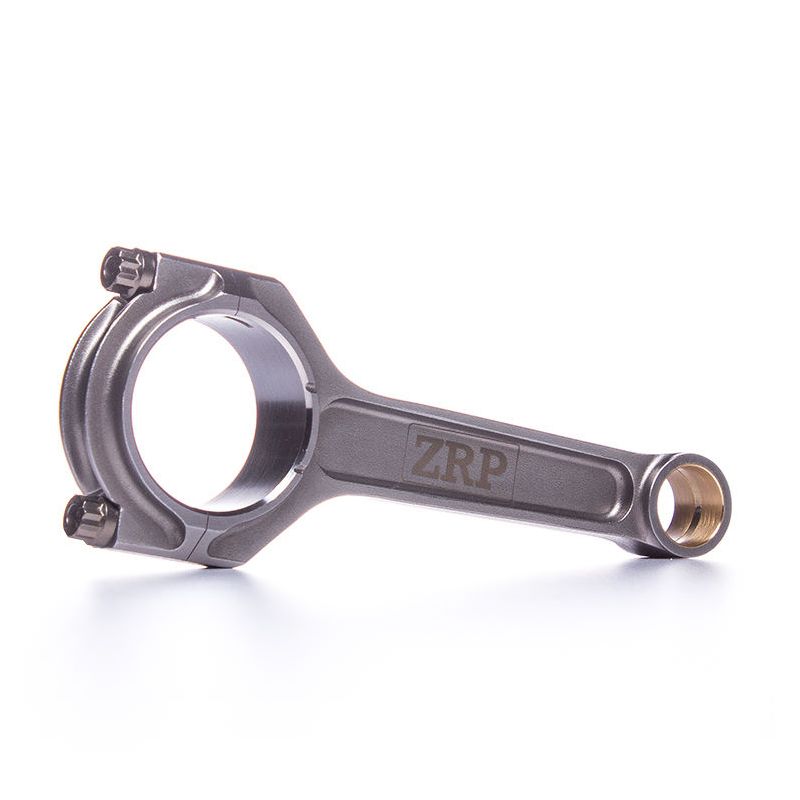
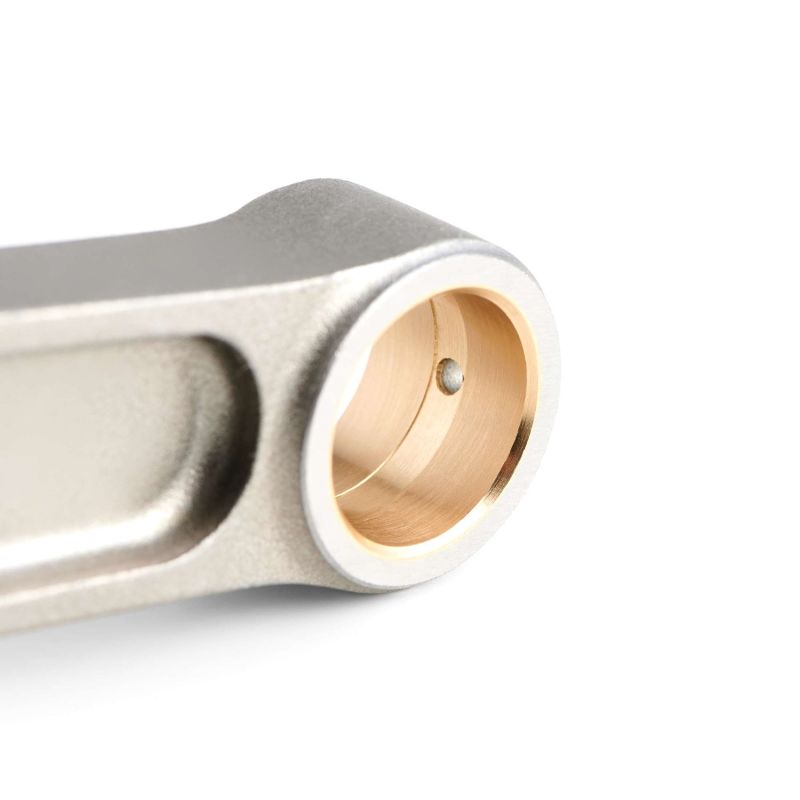
These ZRP forged connecting rods in 4340 steel are hot-forged then machined, so the grain flow of the metal follows the shape of the part, greatly increasing fatigue strength compared with a sintered component. Offered here in a long 158 mm centre-to-centre, they are aimed at red block builds seeking a better rod/stroke ratio (overbore, modified-stroke crankshaft, stroker setups) while keeping the family's 23 mm pin and 52 mm big end. Balanced to ±1 g, they suit naturally aspirated and forced-induction engines alike, from Stage 2 up to competition: circuit, hill climb, drift, rally, drag and time attack. Combined with forged pistons, they form the basis of a reliable rotating assembly able to withstand sustained high rpm and high cylinder pressure.
| Reference | Brand | Profile | Hardware | Pin Ø OEM 23 mm | Small-end width | Big-end Ø OEM n.p. | Big-end width | Center-to-center OEM 152 mm | Weight per rod |
|---|---|---|---|---|---|---|---|---|---|
| R-VOL-004-I | ZRP | I | ARP 2000-3/8"-38mm | 23 mm | 52 mm | 29.5 mm | 158 mm | 604 g | |
| R-VOL-004-I-L19 | ZRP | I | ARP L19-3/8"-38mm | 23 mm | 52 mm | 29.5 mm | 158 mm | 604 g |
| Reference | Hardware | Torque | Recommended stretch |
|---|---|---|---|
| ZRP (R-VOL-004-I) | ARP 2000-3/8"-38mm | 61 N·m | 0.140 – 0.152 mm |
| ZRP (R-VOL-004-I-L19) | ARP L19-3/8"-38mm | 67.8 N·m | 0.152 – 0.165 mm |
Bolt stretch is counted in hundredths of a millimetre: at that scale, measuring conditions matter as much as the tightening itself. Bolts, rods and gauge must all be at the same settled temperature, and a bolt should not be handled at length just before it is measured. On a rebuilt B230 or B234, that simple precaution avoids blaming the wrench for a deviation that is only a thermal effect. The ranges in the table above are the bolt manufacturer’s and differ depending on whether the rod carries ARP 2000 or ARP L19 bolts: they are observed with no room for interpretation. Torque, dependent on friction in the threads and under the head, is never enough to guarantee preload; stretch measurement does report it. Clean threads, a thin film of ARP assembly lubricant, load raised progressively across the eight bolts. The kit instruction sheet remains the priority.
| 4340 is a low-alloy nickel-chromium-molybdenum steel, the benchmark for highly stressed mechanical parts, used even in aerospace. After hot forging, the rods are quenched and tempered to balance hardness and toughness. Compared with a production sintered metal, forged 4340 offers around 19% more yield strength, about 8% more tensile strength and 19 to 37% greater fatigue endurance depending on loading: extra margin that translates directly into a more reliable bottom end under high load. |
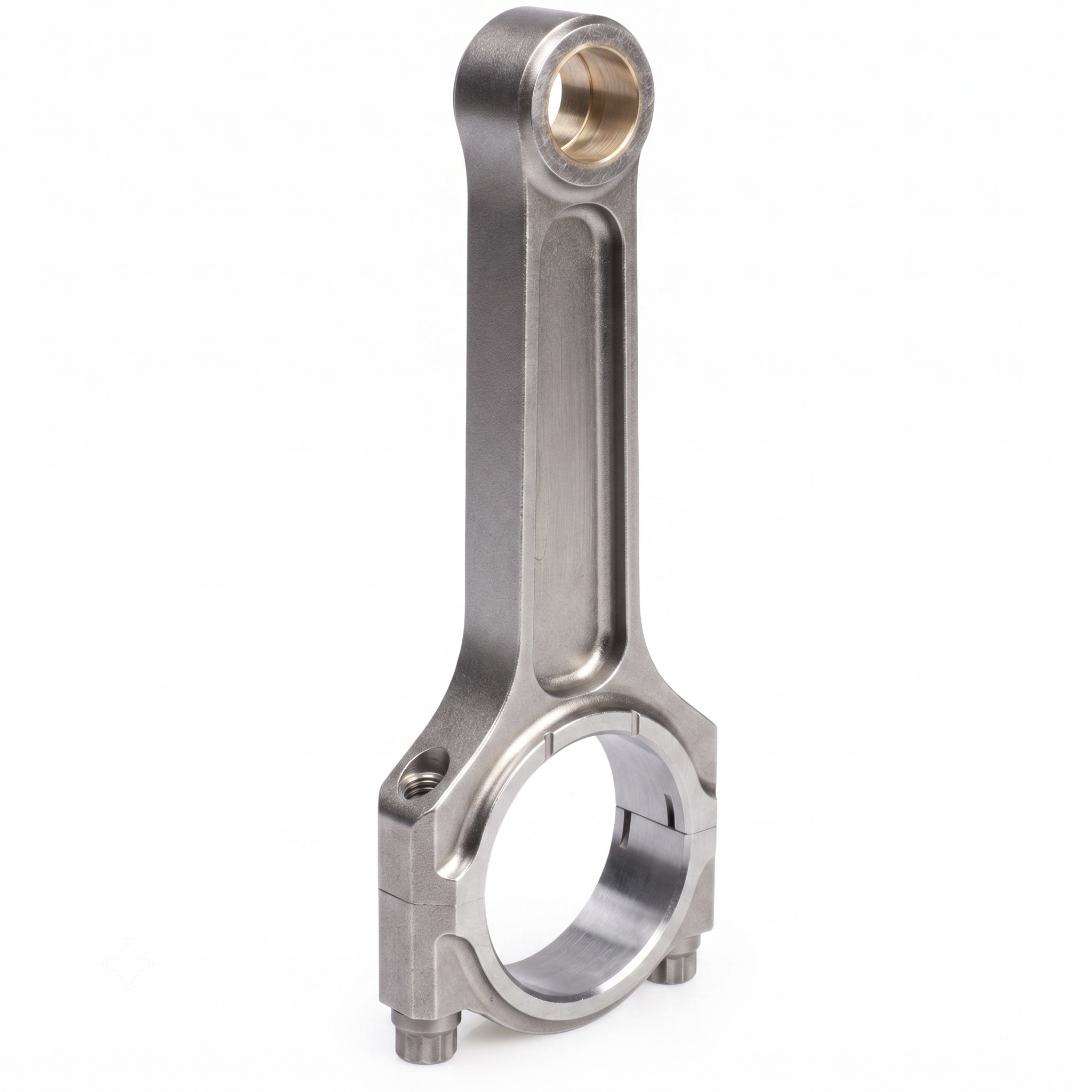 | I-beam profile: an I-shaped section that favours an excellent stiffness-to-weight ratio. Light and stable at high rpm, the I-beam rod is ideally suited to the B6284 straight-six, where controlling moving masses and high-rpm stability come first. |
Choosing a rod bolt means choosing a steel and a process. The grade sets the yield strength and the tensile strength; quench and temper, carried through the whole section, give uniform hardness; rolling the threads after heat treatment work-hardens the thread root, the only place where fatigue really starts. Behaviour towards moisture and hydrogen then changes the storage rules. This 158 mm centre-to-centre version of the red block takes its bolts in 3/8"-38 mm in two grades; match the grade to the target power and engine speed, then tighten by measured stretch.
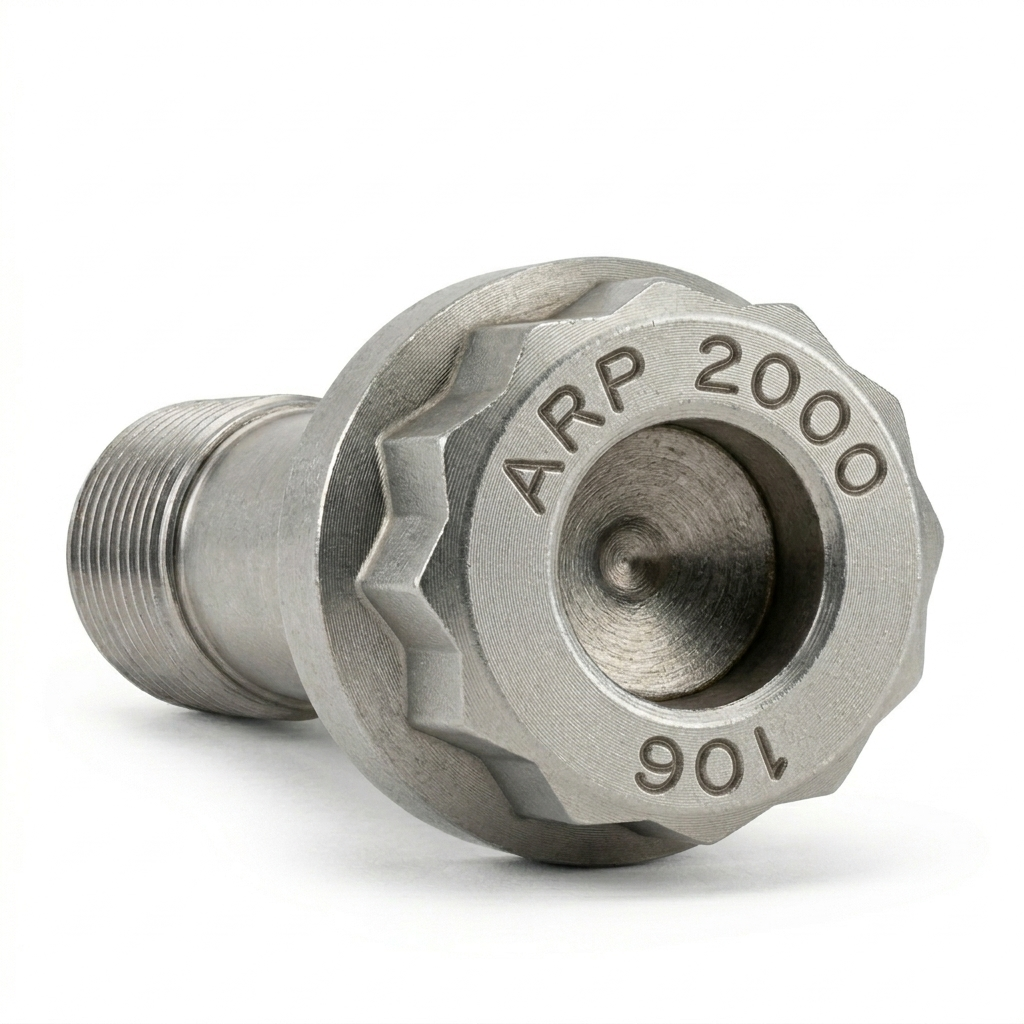 | ARP 2000 is a wrought steel, quenched and tempered through the section, with tensile strength around 220,000 psi, i.e. ~1,517 MPa, with threads rolled after treatment for high cyclic fatigue endurance. Chemically stable, it requires no storage precaution. The grade is rated up to 200 hp per cylinder in 3/8" and up to 8,500 rpm, which makes it the most common in circuit racing, trackdays, drift, rally, drag and hillclimb. Here it equips the ZRP I-profile rod with 158 mm centre-to-centre, in 3/8"-38 mm. |
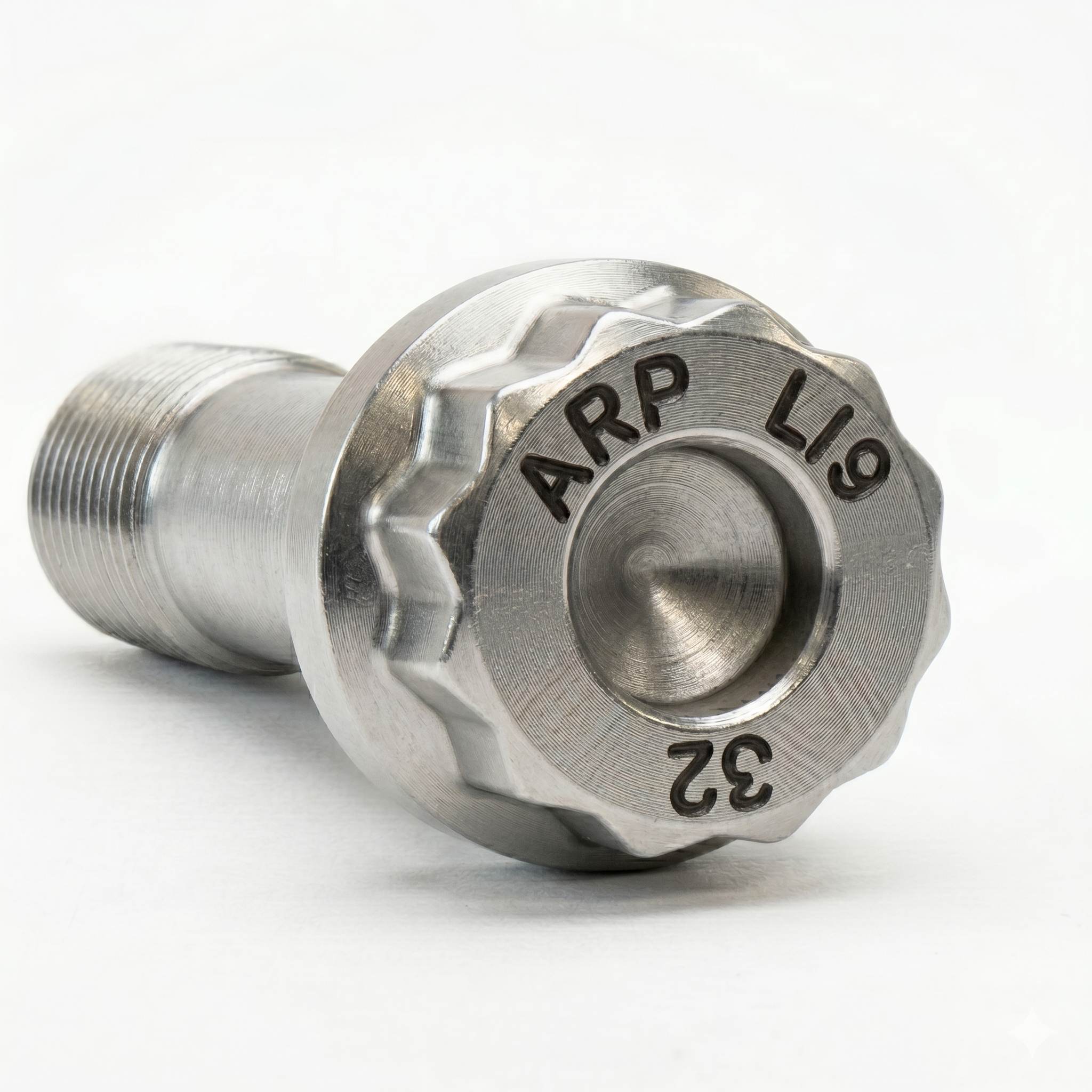 | ARP L19 moves up a step: richer alloy, more demanding heat treatment, tensile strength of about 260,000 psi, i.e. ~1,793 MPa, and a stated capability of 250 hp per cylinder in 3/8" up to 10,000 rpm. It addresses very high boost pressure, sustained high engine speeds and high cylinder pressure, hence big power in drag, drift, rally and circuit, which suits a lengthened 158 mm rod. Its metallurgy has a trade-off: sensitive to corrosion and to hydrogen embrittlement, L19 must be stored and fitted oiled, away from moisture. |
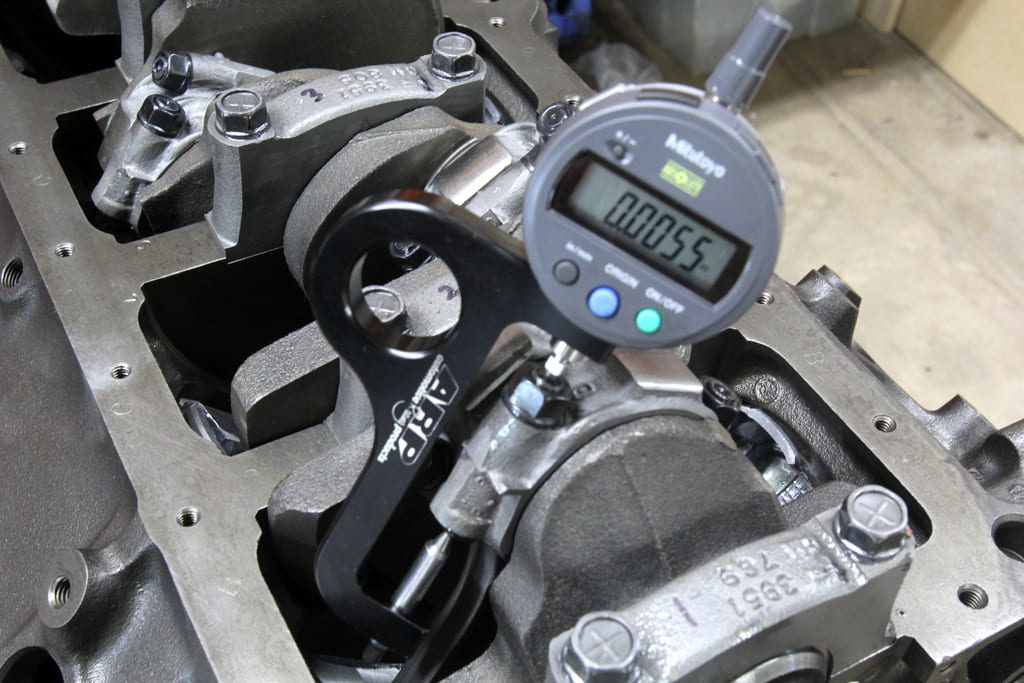
| The most reliable tightening method is to measure bolt stretch with a gauge, between its two ends, rather than relying on torque alone: it eliminates parasitic friction and guarantees exact preload. The target stretch value is given in the manufacturer's instructions. |
 | ZRP is the brand of Alex Drakos, based in Athens, Greece. Its rods are precision-machined from 4340 steel, inspected and weight-matched to within ±1 g for optimal bottom-end balance. They excel in circuit, rally and drift as well as in high-power builds. |
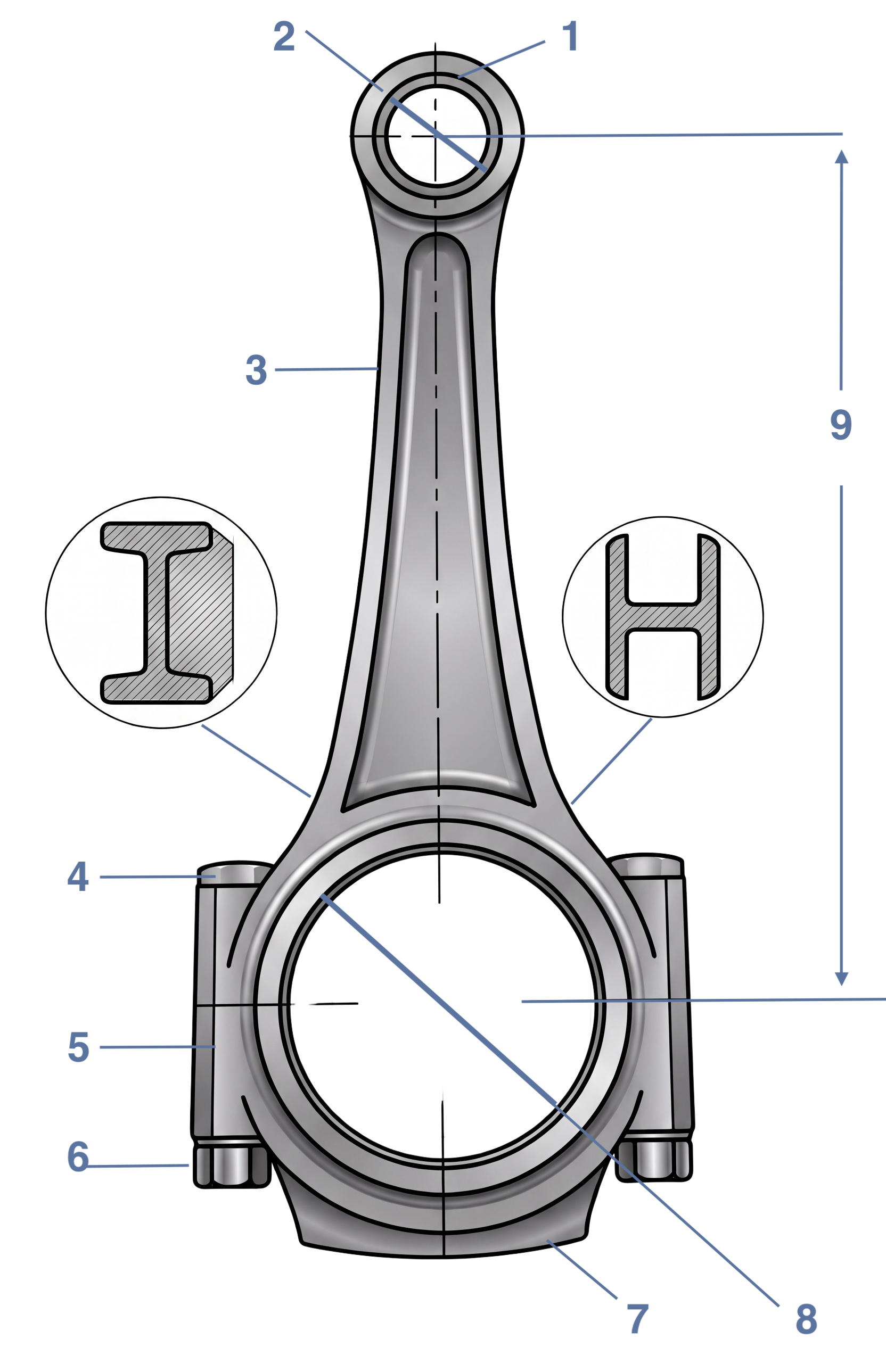 | 1) Small end 2) Small-end diameter 3) Rod beam 4) Rod bolt 5) Big end 6) Rod nut / bolt 7) Rod cap 8) Big-end diameter 9) Center-to-center |
Below is the list of vehicles equipped with the Volvo 2.3L 8V & 16V B230 / B234 engine. The piston pin diameter and the centre-to-centre length must be confirmed on your engine before ordering. Variant concerned: red block 158 mm.
| Brand | Model (chassis) | Engine code | Power | Years |
|---|---|---|---|---|
| Volvo | 240 (244, 245) | B230 | 114 – 155 hp | 1985 – 1993 |
| Volvo | 740 (744, 745) | B230 | 114 – 200 hp | 1984 – 1992 |
| Volvo | 740 / 940 16v | B234F | 155 hp | 1988 – 1994 |
| Volvo | 760 (764, 765) | B230 | 114 – 182 hp | 1985 – 1990 |
| Volvo | 940 (944, 945) | B230 | 114 – 190 hp | 1990 – 1998 |
OEM reference:
On a built red block, a failed original rod rarely stops at the rod: it takes the block, the crankshaft and often the cylinder head with it. The cost of a full rebuild far exceeds that of a set of forged rods fitted as a precaution. Investing from the outset in ZRP 4340 rods secures the entire rotating assembly and spares you a far heavier repair. It is the part that protects everything else: the most profitable spend of a durable engine build.
On a base this old the maths work out differently: a rebuild with forged rods costs a fraction of a replacement short block, which is no longer available new, and it takes the car off the road only once. It is also the chance to start again with controlled clearances, new cap bolts and a matched assembly, whereas a like-for-like repair leaves parts that are already at the end of their life.