Product successfully added to your shopping cart
Quantity
Total
There are 0 items in your cart. There is 1 item in your cart.
Total products
Total shipping To be determined
Total

2.2L 20v - RS2
Manufacturers
2.2L 20v - RS2
Warning: Last items in stock!
New product
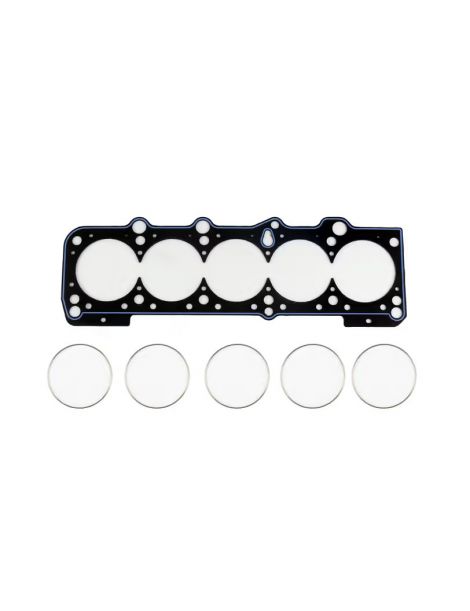
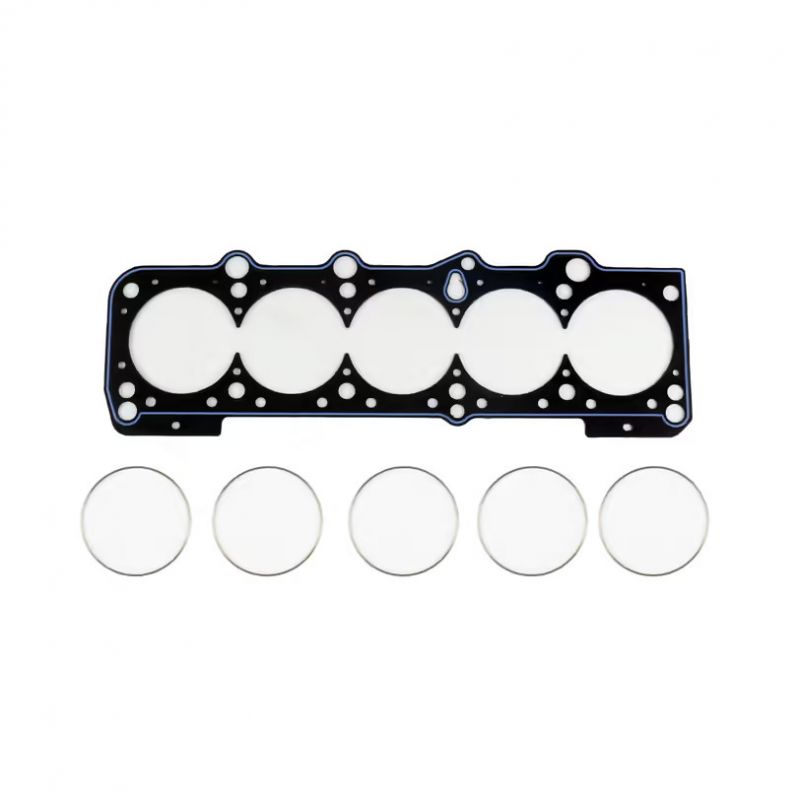
Reinforced Athena head gasket in O-Ring. Sold individually, one gasket per engine.
The Audi 3B, AAN, ABY, ADU, RR and NM petrol engines are inline five-cylinder 20-valve units, turbocharged in 2.2 litres (3B, AAN, ABY, ADU, RR) and naturally aspirated in 2.0 litres (NM). They power the Audi 200, 100 S4, A6 S6, 80 S2 and RS2, Coupé and Quattro models listed below.
The original gasket of these engines carries the part number 034 103 383 AD. Audi publishes neither its bore, nor its construction, nor its thickness. It is sized for the stock combustion pressure: when that rises, the clamping load fades, the head lifts and coolant seeps into a cylinder.
Sealing does not rest on the gasket alone, but also on the fasteners that clamp the head onto the block. With the O-Ring the work is shared: the stainless ring seals the combustion chamber by itself, the body handles the water and oil passages, and the block needs no machining.
This page presents two part numbers from Athena, an Italian maker of competition gaskets, in a single construction: the O-Ring, a steel sheet clad in aramid fibre and ringed with a stainless steel ring. The bores offered are 83.5 and 82 mm, and the thickness is 1.60 mm for both. As a rule, the gasket bore chosen is at least 0.5 mm larger than the actual cylinder bore. Each part number is sold individually, one gasket per engine.
| Gasket bore | Thickness | Gasket volume | Gasket type OEM not specified | Brand | Part number OEM 034 103 383 AD |
| 82 mm | 1.60 mm | 8.45 | O-Ring | Athena | 330048R |
| 83.5 mm | 1.60 mm | 8.76 | O-Ring | Athena | 330047R |
Gasket volume is the space left free above each cylinder. Added to the combustion chamber, it lowers the compression ratio; two gaskets can only be compared at equal bore.
| Fasteners | Engines | Tightening torque |
| Original cylinder head bolts | 3B, AAN, ABY | 40 Nm, 60 Nm, then 90° twice, new bolts |
| Original cylinder head bolts | ADU, NM, RR | not published by the manufacturer |
Before fitting, check the flatness of the head and block with a straight edge, then have them resurfaced if needed. Athena supplies this gasket ready to fit: there is no need to add sealing paste.
 | Athena O-Ring A steel sheet coated with asbestos-free aramid fibre, encircling each cylinder with a stainless steel compression ring. The ring carries the clamping load onto a thin band, where the seal is made, and a silicone bead protects the water and oil channels around the cylinders. The gasket is delivered with its coating already applied. This construction withstands the highest pressures in the range. |
Gasket bore. The Athena O-Ring is offered in 83.5 mm (330047R) and in 82 mm (330048R).
Thickness. Audi does not publish the thickness of the original gasket. A thicker gasket enlarges the combustion chamber and lowers the compression ratio; a thinner one reduces it and raises the ratio.
| Your goal | Thickness to choose |
| Keep the original compression ratio | Original thickness not published by the manufacturer: note that of the removed gasket and compare it with the 1.60 mm of both gaskets offered |
| Skimmed cylinder head, make up the lost height | A single thickness is offered, 1.60 mm, for both bores: compare it with that of the removed gasket, plus the material taken off |
| Forced induction build, lower the ratio | 1.60 mm, if the thickness read on the original gasket at removal is smaller |
| Naturally aspirated build, raise the ratio | 1.60 mm, if the thickness read on the original gasket at removal is greater |
As the original thickness is not published, use a dial gauge to measure how far the pistons stand proud of the block deck, especially if the removed gasket is thinner than 1.60 mm: it shows the clearance left between piston and head.
 | Athena S.p.A., an Italian group specialising in gaskets and engine parts, is based in Alonte, in the Veneto, where its main plant stands. Other sites exist in Spain, the United States, Brazil and India. Car makers fit its multi-layer gaskets as original equipment, and the competition range is entirely designed and made in Italy. |
| Criterion | Original gasket 034 103 383 AD | Reinforced gaskets |
| Construction | Construction not stated by the manufacturer | Steel and aramid fibre with a stainless ring (O-Ring) |
| Gasket bore | not published by the manufacturer | 82 to 83.5 mm |
| Thicknesses available | thickness not published by the manufacturer | 1.60 mm |
| Compression ratio adjustment | None | Through the gasket thickness (1.60 mm) |
| Resistance to overpressure | Limited to standard output | Designed for forced induction |
| Model | Engine code | Power | Years |
| Audi 200 C3 Avant (447, 448) 2.2 20V Turbo quattro | 3B | 220 hp | 1989-1990 |
| Audi 200 C3 Berline tricorps (447, 448) 2.2 20V Turbo quattro | 3B | 220 hp | 1989-1990 |
| Audi Coupé B3 (89, 8B3) S2 quattro | 3B | 220 hp | 1990-1992 |
| Audi 100 C4 Avant (4A5) S4 Turbo quattro | AAN | 230 hp | 1991-1994 |
| Audi 100 C4 Berline tricorps (4A2) S4 Turbo quattro | AAN | 230 hp | 1991-1994 |
| Audi A6 C4 Berline tricorps (4A2) S6 Turbo quattro | AAN | 230 hp | 1994-1997 |
| Audi A6 C4 Avant (4A5) S6 Turbo quattro | AAN | 230 hp | 1994-1997 |
| Audi 80 B4 Avant (8C5) S2 quattro | ABY | 230 hp | 1993-1995 |
| Audi 80 B4 Berline tricorps (8C2) S2 quattro | ABY | 230 hp | 1993-1994 |
| Audi Coupé B3 (89, 8B3) S2 quattro | ABY | 230 hp | 1992-1996 |
| Audi 80 B4 Avant (8C5) RS2 quattro | ADU | 315 hp | 1994-1995 |
| Audi Quattro (85) 2.2 20V Turbo | RR | 220 hp | 1989-1991 |
| Audi 90 B3 (893, 894, 8A2) 2.0 20V | NM | 160 hp | 1989-1991 |
| Audi 90 B3 (893, 894, 8A2) 2.0 20V quattro | NM | 160 hp | 1988-1991 |
| Audi Coupé B3 (89, 8B3) 2.0 20V | NM | 160 hp | 1989-1991 |
| Audi Coupé B3 (89, 8B3) 2.0 20V quattro | NM | 160 hp | 1989-1991 |
OEM part number: 034 103 383 AD.
Important: the part numbers on this page suit only the 3B, AAN, ABY, ADU, RR and NM engines: check your vehicle's engine code before ordering.
When the original gasket is no longer enough, the reinforced gasket takes over: under greater combustion pressure it keeps its shape and does not settle.
With a bigger turbo, higher boost pressure or a modified compression ratio, the head gasket is the first part to give way on these five cylinders. A reinforced gasket prevents the leak and the head removal that goes with it.