Product successfully added to your shopping cart
Quantity
Total
There are 0 items in your cart. There is 1 item in your cart.
Total products
Total shipping To be determined
Total

2.0L 8v - ABA
Manufacturers
2.0L 8v - ABA
Warning: Last items in stock!
New product
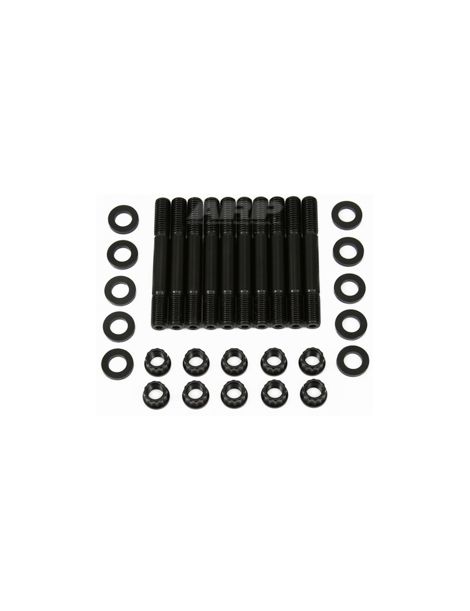
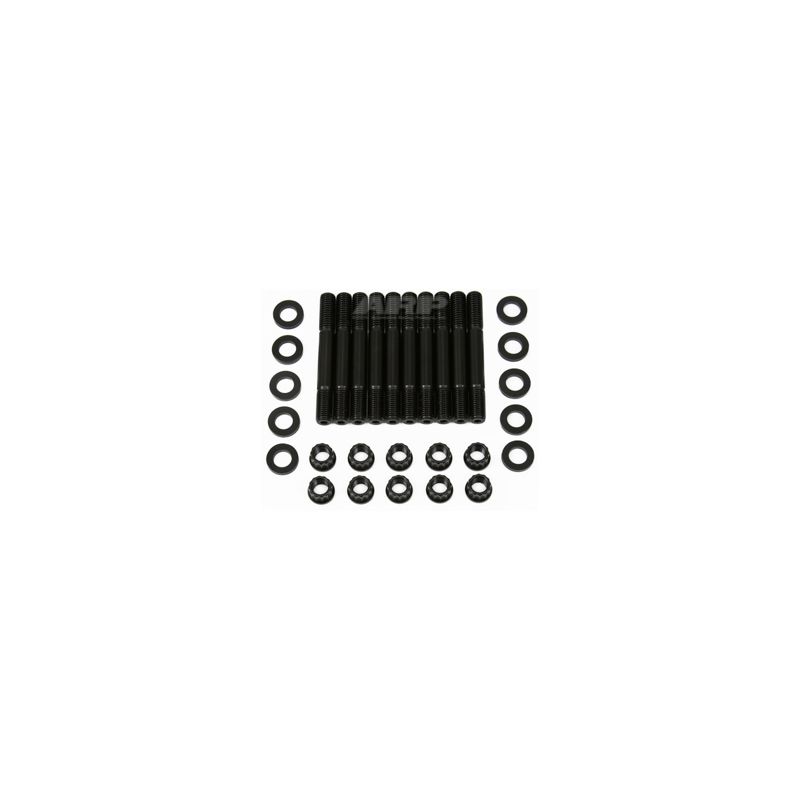
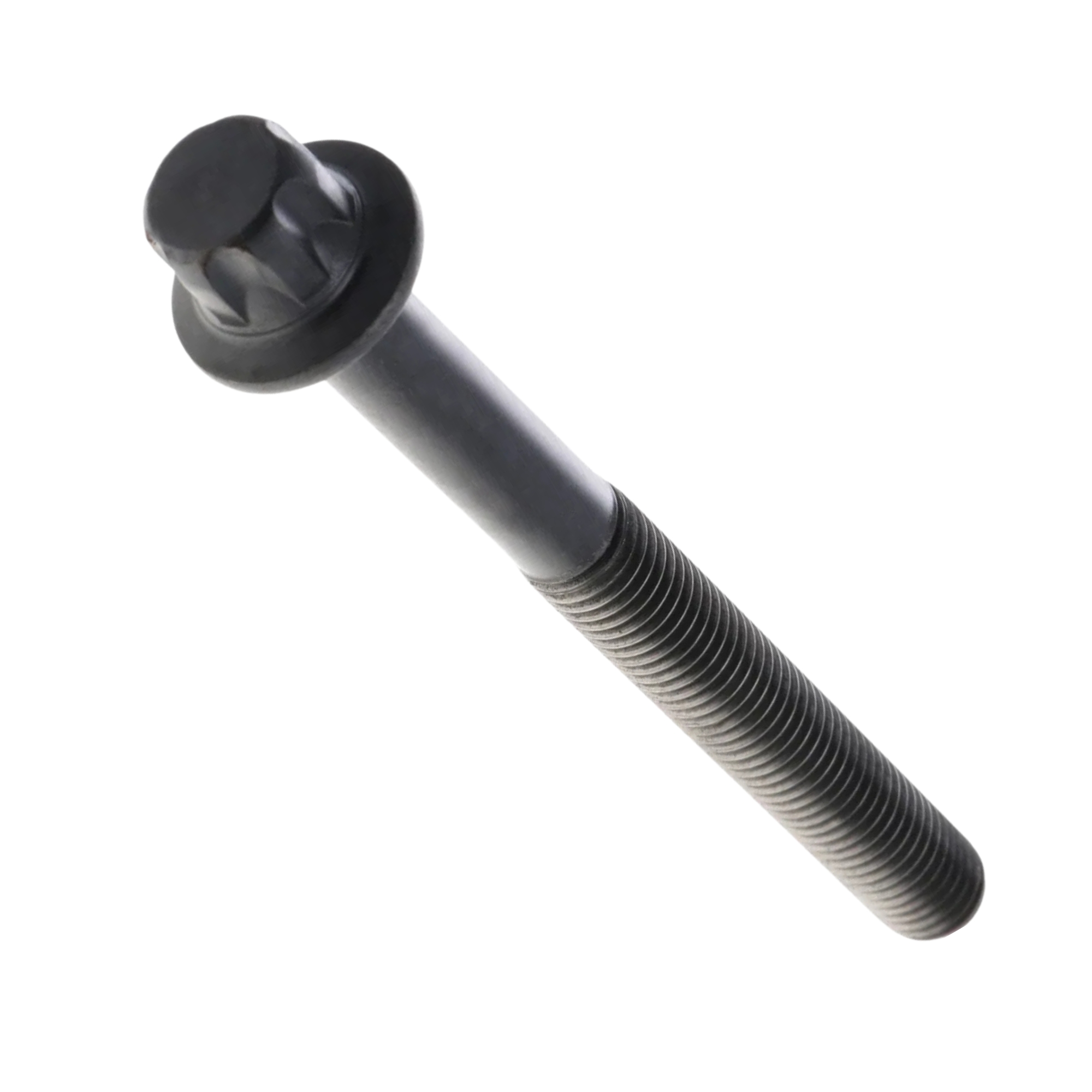
ARP 8740 steel crankshaft main studs for the VAG 1.8 and 2.0 8V and 16V engines.
This kit is made for the Volkswagen four-cylinder engines of 1.8 and 2.0 litres with 8 and 16 valves (codes ABA, ABF, 9A, KR, DX, EV, GX, HT, JH, PB, PF, PG, PL, RD and RV), including those fitted with a 20-valve head for the 9A, KR, ABA and ABF. They power the Golf 1, 2 and 3, the Corrado, the Scirocco 2 and the Seat Ibiza 6K, among others.
As standard, bolts clamp the crankshaft main caps; this kit swaps them for studs.
On a crankshaft, the main caps are what hold the shaft against the loads passed on by the connecting rods. If their clamping force drops, the cap shifts slightly on its parting line at every cycle: the mating faces become indented, then the bearing bore goes out of round.
Here the original main cap bolts give way to 10 mm ARP studs in 8740 steel, accompanied by the nuts and washers that the ARP instruction sheet mentions. Each stud is screwed into the block by hand; the caps are then fitted, threads, nuts and washers receive the ARP assembly grease provided, and the nuts are torqued in three passes. Tightening becomes more uniform, preload rises and the block threads are no longer stressed by the turning of the bolt. ARP makes these fasteners in 8740, a chrome-moly steel brought by heat treatment to 200,000 psi tensile strength. As a reference point, an engine's original fasteners generally fall into classes 10.9 and 12.9, whose minimum ranges from 150,800 to 176,900 psi. On this four-cylinder engine, the 8740 studs in M10 are rated for 1,000 hp at most (calculated estimate).
| Part number | Brand | Grade / material | Nut | Thread |
| ARP-204-5402 | ARP | 8740 steel | Nut | M10 |
| Reference | Pass 1 | Pass 2 | Pass 3 |
| ARP-204-5402 | 27 Nm | 54 Nm | 81 Nm |
The studs are screwed into the block by hand, with no torque. If the assembly is to remain permanent, the ARP instruction sheet accepts a Loctite thread locker, with tightening carried through before the product cures.
Follow the cap tightening sequence recommended by the manufacturer when bringing the nuts up to torque; the kit's instruction sheet details each step.
Stronger fasteners change the clamping force: the size and roundness of the main bearing bores are checked after installation, and the bores are line-honed if necessary, using the final fasteners and lubricant.
The torque figures above come from the ARP 204-5402 instruction sheet, revision applicable at publication. The official instruction sheet is authoritative in the event of any difference. Read the ARP 204-5402 instruction sheet
The torque figures given only apply with ARP assembly grease, never with engine oil.
| Buy the ARP assembly grease → |
 | Founded in the early 1970s by Gary Holzapfel, who came from the aerospace industry, ARP (Automotive Racing Products) set out to prevent fastener-related engine failures in motorsport. Its thousands of part numbers are designed and manufactured in California, in materials chosen for each use. |
| Criterion | Original main bolts | Reinforced ARP studs |
 |  | |
| Tightening method | Bolt turned into the block | Nuts tightened progressively, in three passes |
| Block thread | Loaded by the turning bolt | Stud placed by hand, no torque load |
| Refitting the caps | Cap to be held while screwing | Cap positioned by the studs |
| Model | Engine code | Power | Years |
| SEAT Ibiza 6K | ABF | 150 hp | 1996-1999 |
| VW Corrado 2.0 16V | 9A | 136 hp | 1991-1995 |
| VW Golf 1 1.8 8V | DX | 112 hp | 1982-1992 |
| VW Golf 1 1.8 8V | JH | 95 hp | 1983-1993 |
| VW Golf 1 GTI | DX | 112 hp | 1982-1983 |
| VW Golf 2 1.8 8V | GX | 90 hp | 1984-1991 |
| VW Golf 2 GTI 16S | KR | 139 hp | 1986-1990 |
| VW Golf 2 GTI 16S | PL | 129 hp | 1986-1991 |
| VW Golf 2 GTI 8S | DX EV PB | 112 hp | 1983-1991 |
| VW Golf 2 GTI 8S | RD | 107 hp | 1985-1987 |
| VW Golf 2 GTI 8S | HT RV | 105 hp | 1985 |
| VW Golf 2 GTI 8S Cat. | PF | 107 hp | 1987-1991 |
| VW Golf 2 GTI G60 | PG | 160 hp | 1988-1991 |
| VW Golf 3 GTI | ABF | 150 hp | 1992-1997 |
| VW Scirocco 2 1.8 8V | JH | 95 hp | 1985-1992 |
On a tuned 1.8 or 2.0 litre engine, ARP 8740 steel studs, stronger than the original bolts, clamp the main caps more firmly and reduce the risk of bottom-end failure. Their cost stays reasonable next to the cost of rebuilding a crankshaft and a block.
A bottom end rebuild calls for new bearings. We offer the tri-metal crankshaft main bearings that match these engines:
| ACL crankshaft main bearings VAG 1.8 2.0 → |