Product successfully added to your shopping cart
Quantity
Total
There are 0 items in your cart. There is 1 item in your cart.
Total products
Total shipping To be determined
Total

2.0L 16v - HF Integrale
Manufacturers
2.0L 16v - HF Integrale
 View larger
 Warning: Last items in stock!
New product
Kit of ARP2000 ARP rod bolts replacing the original bolts on the OEM rods of the 2.0-litre turbo 8-valve and 16-valve engines of the Lancia Delta HF Integrale.
This kit is intended for the 2.0-litre turbocharged four-cylinder (1,995 cc, 84 mm bore, 90 mm stroke) of the Lancia Delta HF 4WD and the Delta HF Integrale, in both 8-valve and 16-valve form, built from 1986 to 1994.
The kit replaces every original rod bolt of this 2.0-litre engine with an ARP bolt made of ARP2000.
Few parts of the bottom end work as hard as the rod bolt: at every revolution, it is what stops the cap from pulling away under the inertia loads of the rod and piston assembly. The original bolt is designed for stock power and is single-use.
For these ARP2000 bolts, ARP favours tightening checked with a stretch gauge; without a gauge, its instruction sheet specifies a torque of 94.9 Nm. Material: ARP2000, an alloy steel developed by ARP, heat treated to 220,000 psi tensile strength, with threads rolled after heat treatment. Against classes 10.9 and 12.9 of original fasteners, between 150,800 and 176,900 psi minimum, the margin is 24 to 46%. In ARP2000, these bolts are rated for 11,750 rpm at most (calculated estimate).
| Part number | Brand | Grade / material | Head | Thread | Under-head length |
|---|---|---|---|---|---|
| ARP-275-6001 | ARP | ARP2000 | Not published | M10 | Not published |
The ARP instruction sheet states that the bolt hole of the rod cap needs a sufficient chamfer to clear the radius under the bolt head.
| Reference | Tightening torque | Stretch |
|---|---|---|
| ARP-275-6001 | 94.9 Nm | 0.190 - 0.203 mm |
ARP recommends tightening to a measured stretch, which gives a more accurate preload than torque alone, given as a fallback. Torque and stretch figures assume ARP lubricant.
Source of the torque and stretch figures: ARP 275-6001 instruction sheet, in the revision applicable at publication. The manufacturer's instruction sheet prevails in the event of any difference. Read the ARP 275-6001 instruction sheet
Assembly is done without thread locker, as the ARP instruction sheet calls for none: ARP Ultra-Torque grease is applied to the threads and under the head of each bolt.
According to the ARP instructions, the big ends must be checked and resized with the fasteners in place; plan a visit to a machine shop.
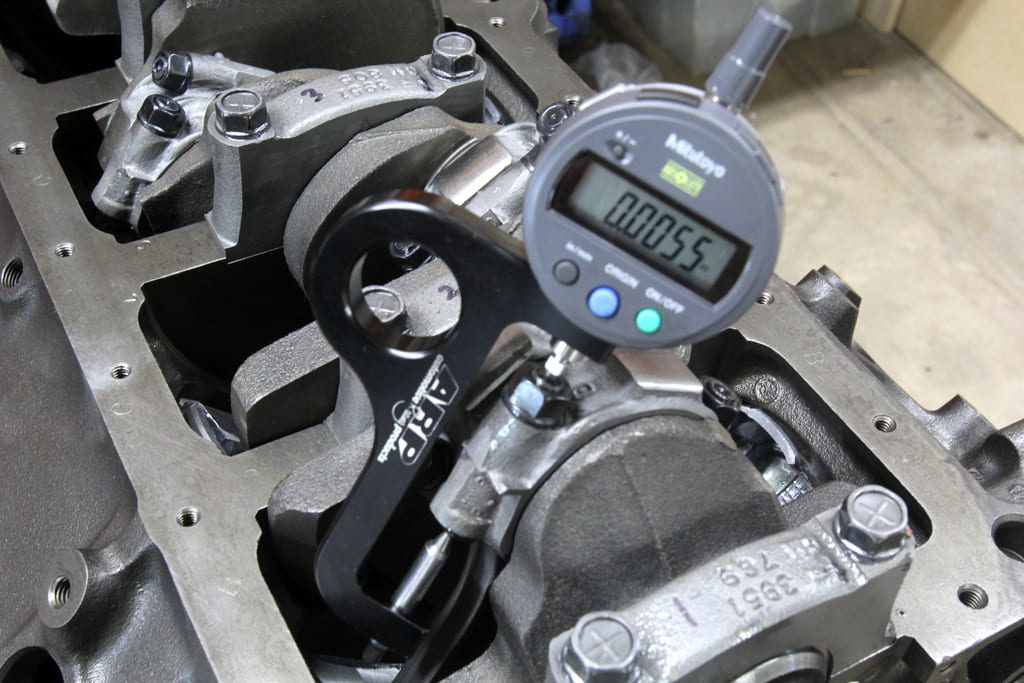
With the stretch gauge, you read directly how much the bolt stretches during tightening: the dial gauge sits on both ends of the fitted bolt, and tightening stops when the stretch reaches the value in the table. Friction no longer comes into play, hence a more consistent preload on a heavily stressed engine.
All the torque and stretch values on this page assume ARP assembly grease on the threads and under the bolt head; engine oil does not replace it.
An engineer with an aerospace background, Gary Holzapfel launched ARP (Automotive Racing Products) in the early 1970s with one goal: to eliminate engine failures caused by weak fasteners in racing. ARP designs and manufactures thousands of part numbers in California, cylinder head, main and rod bolts, in several materials depending on the use, and has become known for the consistency of its manufacturing.
| Brand | Model (chassis) | Engine code | Power | Years |
|---|---|---|---|---|
| Lancia | Delta HF 4WD 8v | 831 | 165 hp | 1986-1987 |
| Lancia | Delta HF Integrale 8v | 831 | 185 hp | 1987-1990 |
| Lancia | Delta HF Integrale 8v catalysed | 831 | 177 hp | 1990-1991 |
| Lancia | Delta HF Integrale 16v | 831 | 200 hp | 1989-1991 |
| Lancia | Delta HF Integrale Evoluzione 16v | 831 | 210 hp | 1991-1992 |
| Lancia | Delta HF Integrale Evoluzione II 16v | 831 | 215 hp | 1993-1994 |
When the 2.0-litre turbo of a Delta HF runs above its factory boost pressure, the pull on the rod bolts grows with every crank revolution. A single broken bolt generally means losing the rod, the piston and the block: a set of ARP2000 bolts costs a fraction of the rebuild that would follow.
A forged connecting rod starts as a steel billet, usually 4340, shaped hot under very high pressure: its material is denser and more homogeneous than that of a stock rod. Compared with an original rod, often made of sintered metal and designed for cost, a 4340 forged rod offers about +19% yield strength, +8% tensile strength and +19 to +37% fatigue strength. It is the foundation of a reliable high-power build. For your engine:
| Forged connecting rods Lancia Delta Integrale 16V, 149 mm centres → |