Product successfully added to your shopping cart
Quantity
Total
There are 0 items in your cart. There is 1 item in your cart.
Total products
Total shipping To be determined
Total

2.0L 16v - EJ20
Manufacturers
2.0L 16v - EJ20
Warning: Last items in stock!
New product
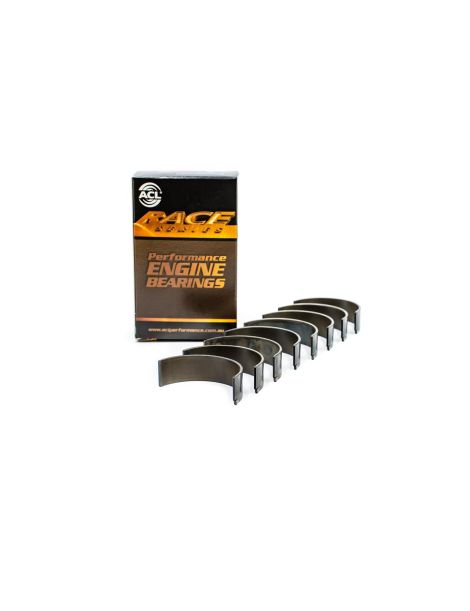
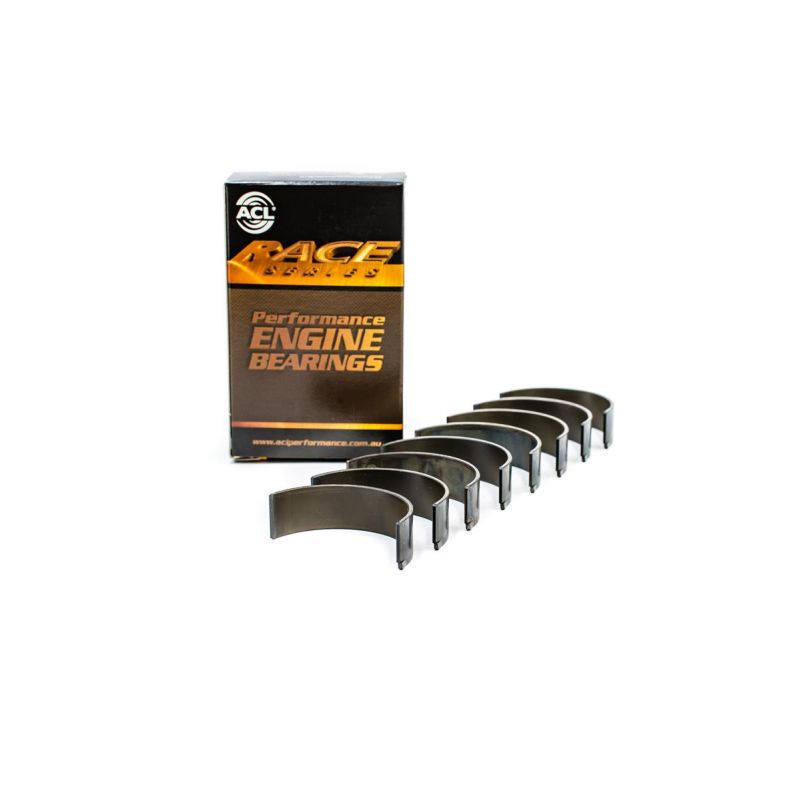
Set of 8 trimetal connecting rod half-bearings for Subaru EJ20, EJ22, EJ25.
The EJ engines are the 1.5 to 2.5 litre flat-four (boxer) engines of Subaru's EJ family, in naturally aspirated and turbocharged versions; they power the Impreza, Legacy, Forester, Outback and WRX. This bearing set fits the EJ engines with a 48 mm crankpin: EJ15, EJ16, EJ18, EJ20E, EJ20G, EJ22E and EJ25D.
From the factory, this engine is fitted with standard production connecting rod bearings, sized for the loads of the original engine: as soon as power, engine speed or boost pressure increase, they reach their limits.
From the factory, Subaru fits these engines with connecting rod bearings under part number 12108AA890, and its workshop manual specifies a running clearance of 0.016 to 0.044 mm.
In a trimetal bearing, a steel back carries a copper-lead intermediate layer with high load capacity, itself covered by an anti-friction running layer that spares the crankpin. The set is supplied complete: 8 half shells, i.e. 4 pairs.
Trimetal targets high, sustained loads, whereas aluminium bi-metal is limited to low to medium loads: about 8,000 psi for the latter, up to 12,000 psi for a performance trimetal, 50% more. The benefit shows in strength and durability on turbo, supercharged and high-revving engines.
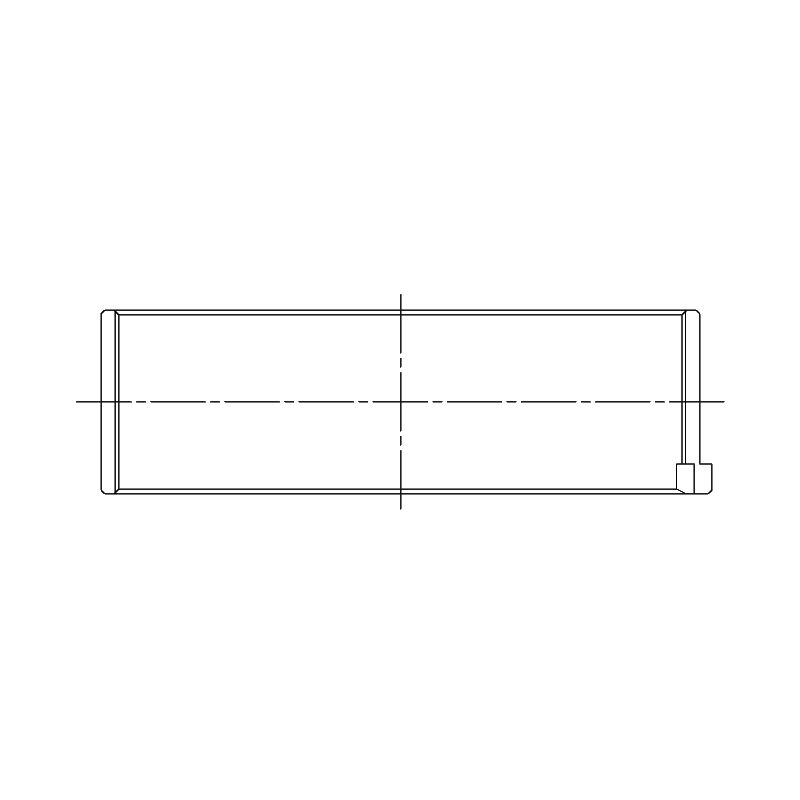
| ACL bearings Crankpin Ø 47.984 / 48.000 mm Housing bore Ø 51.000 / 51.020 mm Width 15.63 mm |
| Reference | Brand and treatment | Size | Wall thickness (mm) |
|---|---|---|---|
| 4B8320H-STD | ACL Race - Untreated | Standard | 1.498 |
| 4B8320HX-STD | ACL Race - Untreated | Std, increased clearance (HX) | 1.485 |
| 4B8320H-.025 | ACL Race - Untreated | +0.025 | 1.511 |
| 4B8320H-.25 | ACL Race - Untreated | +0.25 | 1.623 |
| 4B8320H-.50 | ACL Race - Untreated | +0.50 | 1.748 |
Running clearance is the gap between the bearing and the crankpin, filled by the oil film.
While the engine turns, the crankpin floats on this oil film, which carries the load without direct contact with the bearing. Film thickness depends on clearance: too tight, oil passes poorly, temperature rises and the risk of seizure grows; too wide, oil escapes, the film carries less and oil pressure decreases. A correct clearance ensures both sufficient lubrication and a well-maintained film.
| Size / grade | When to choose it | ACL Race Series |
|---|---|---|
| Standard (STD) | Standard journal, not reground | 0.051 to 0.061 mm |
| Increased clearance (HX) | Wider clearance: high oil flow, high rpm | 0.077 to 0.086 mm |
| +0.025 mm | Polished journal | 0.051 to 0.061 mm |
| +0.25 mm | Journal reground to 0.25 mm | 0.051 to 0.061 mm |
| +0.50 mm | Journal reground to 0.50 mm | 0.051 to 0.061 mm |
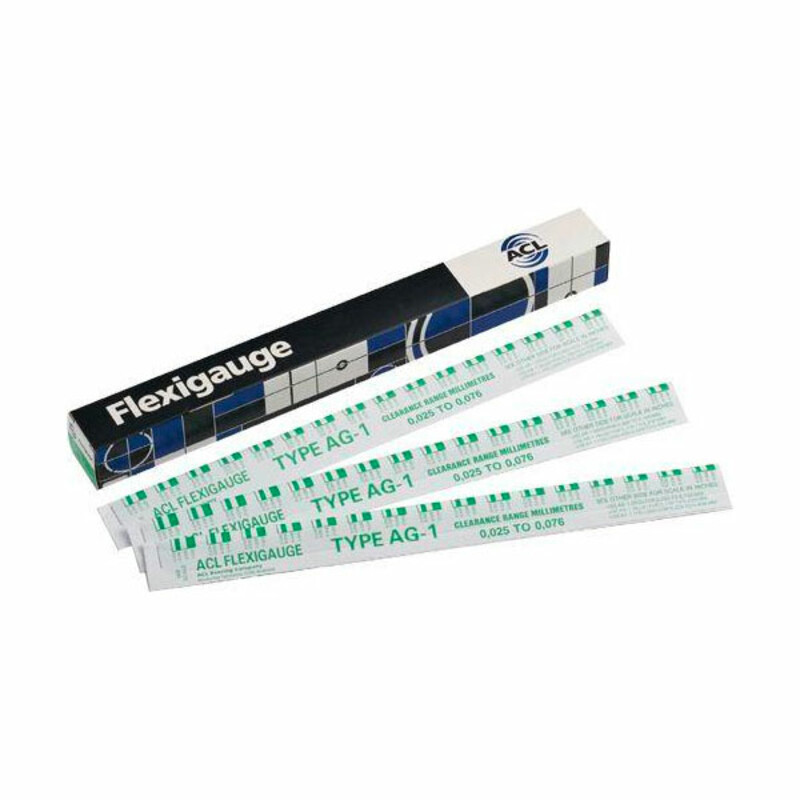
Checking on assembly: lay a calibrated strip (Plastigauge) on the journal, torque the rod cap to spec, then compare the crushed strip against the gauge to read the clearance.
These ACL trimetal connecting rod bearings are aimed at built engines and racing: where a standard bearing quickly reaches its limit, they accept more power, more rpm and more boost. The range includes the standard size, a +0.025 mm size for a crankpin that has only been polished, +0.25 and +0.50 mm regrind sizes and the HX version with increased clearance for high-revving engines or engines needing a high oil flow. It allows the same part number to be kept after the crankshaft is reground and the clearance to be tailored to the oil used and the engine's duty.
 | An Australian specialist in high-performance engine bearings since 1949, ACL Bearing Company produces the Race Series: precisely made trimetal bearings, available in numerous sizes and recognised on built engines across the world. |
This connecting rod bearing set fits the EJ boxer engines of the following Subaru models:
| Brand | Model (chassis) | Engine code | Power | Years |
|---|---|---|---|---|
| SUBARU | FORESTER (SF_) | EJ25D | 167 hp | 1997–2002 |
| SUBARU | IMPREZA Saloon (GC) | EJ15E, EJ161, EJ16E, EJ18E, EJ20E, EJ20G, EJ22E | 90–275 hp | 1992–2000 |
| SUBARU | IMPREZA Saloon (GD) | EJ15, EJ161, EJ22E | 95–128 hp | 2000–2009 |
| SUBARU | IMPREZA Estate (GF) | EJ151, EJ15E, EJ161, EJ16E, EJ18E, EJ20E, EJ20G, EJ22E | 90–260 hp | 1992–2000 |
| SUBARU | IMPREZA Estate (GG) | EJ15, EJ161, EJ22E | 95–128 hp | 2000–2007 |
| SUBARU | IMPREZA Coupé (GFC) | EJ161, EJ16E, EJ18E, EJ20E, EJ20G, EJ22E | 90–211 hp | 1993–2000 |
| SUBARU | LEGACY I (BC) | EJ16, EJ20E, EJ22E | 95–140 hp | 1989–1994 |
| SUBARU | LEGACY I Estate (BC, BF, BJ) | EJ16, EJ22E | 95–132 hp | 1989–1994 |
| SUBARU | LEGACY II (BD) | EJ18E, EJ20E, EJ22E, EJ25D | 103–167 hp | 1994–1999 |
| SUBARU | LEGACY II Estate (BG) | EJ20E, EJ22E, EJ25D | 116–167 hp | 1994–1999 |
| SUBARU | LEGACY OUTBACK (BG) | EJ25D | 150–156 hp | 1996–1999 |
Replacing the bearings during a build or rebuild guards against the most expensive failure: a worn-out connecting rod bearing scores the crankpin, contaminates the oil circuit with debris and forces at least a crankshaft regrind, or even a new rod and block. Against such costs a new set weighs little: it is the cheapest part of the rotating assembly, but the one whose failure costs the most.