Product successfully added to your shopping cart
Quantity
Total
There are 0 items in your cart. There is 1 item in your cart.
Total products
Total shipping To be determined
Total

1.8L 16v - CA18DET
Manufacturers
1.8L 16v - CA18DET
Warning: Last items in stock!
New product
Set of 10 tri-metal crankshaft main bearing half shells for the five main bearings of the Nissan CA16, CA18 and CA20 engines (Ø 52.95 mm).
The CA16DE, CA18, CA18DE, CA18ET, CA18DET, CA20E and CA20S are four-cylinder petrol engines of the Nissan CA family: 1.6 litre for the CA16DE, 1.8 litre for the CA18, CA18DE, CA18ET and CA18DET (the CA18ET and CA18DET are turbocharged) and 2.0 litre for the CA20E and CA20S. They share the same crankshaft journal diameter: a single main bearing set covers the whole family.
The crankshaft of these engines runs on five main bearings. Each journal turns between two half shells, one seated in the block and the other in the main bearing cap: they carry the crankshaft. The ACL Race Series tri-metal set shown here replaces them on built engines.
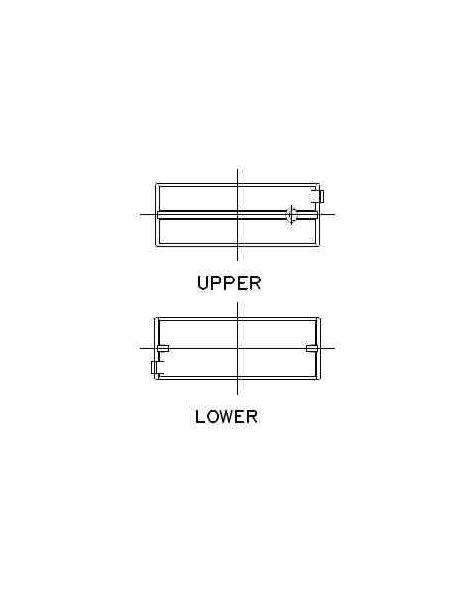
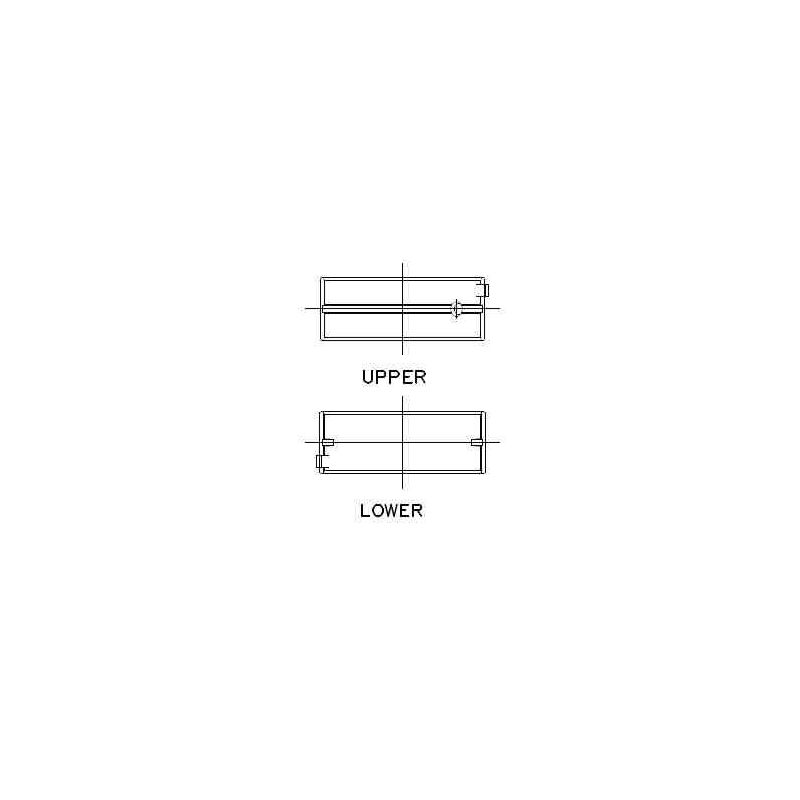
Three layers make up a trimetal bearing: the steel back for stiffness, the copper-lead intermediate layer for load capacity, then the anti-friction running layer that protects the main journal. The complete set covers the five main bearings of the crankshaft. The upper and lower half shells are different: each goes in its own position.
Where an aluminium bi-metal bearing, designed for low to medium loads, withstands about 8,000 psi, a performance trimetal bearing goes up to 12,000 psi: 50% extra margin. That is what keeps it durable on an engine boosted by a turbo or supercharger, or pushed to high rpm.
| ACL bearings Crankshaft journal Ø 52.951 / 52.964 mm Housing bore Ø 56.654 / 56.667 mm Width 20 mm |
| Reference | Brand and treatment | Size | Wall thickness (mm) |
|---|---|---|---|
| 5M1633H-STD | ACL Race - Untreated | Standard | 1.827 |
| 5M1633HX-STD | ACL Race - Untreated | Std, increased clearance (HX) | 1.814 |
| 5M1633H-.025 | ACL Race - Untreated | +0.025 | 1.8395 |
| 5M1633H-.25 | ACL Race - Untreated | +0.25 | 1.952 |
| 5M1633H-.50 | ACL Race - Untreated | +0.50 | 2.077 |
Between the main journal and the bearing there is a small gap, the running clearance, in which the oil film circulates.
In operation there is no metal-to-metal contact: the main journal turns on this oil film, which supports the whole load. The clearance determines its thickness. A clearance that is too tight hinders oil flow, heats the assembly and promotes seizure; one that is too wide lets oil leak away, weakens the film and makes oil pressure drop. The correct clearance balances oil flow and film strength.
| Size / grade | When to choose it | ACL Race Series |
|---|---|---|
| Standard (STD) | Standard journal, not reground | 0.055 to 0.066 mm |
| Increased clearance (HX) | Wider clearance: high oil flow, high rpm | 0.081 to 0.091 mm |
| +0.025 mm | Polished journal | 0.055 to 0.066 mm |
| +0.25 mm | Journal reground to 0.25 mm | 0.055 to 0.066 mm |
| +0.50 mm | Journal reground to 0.50 mm | 0.055 to 0.066 mm |
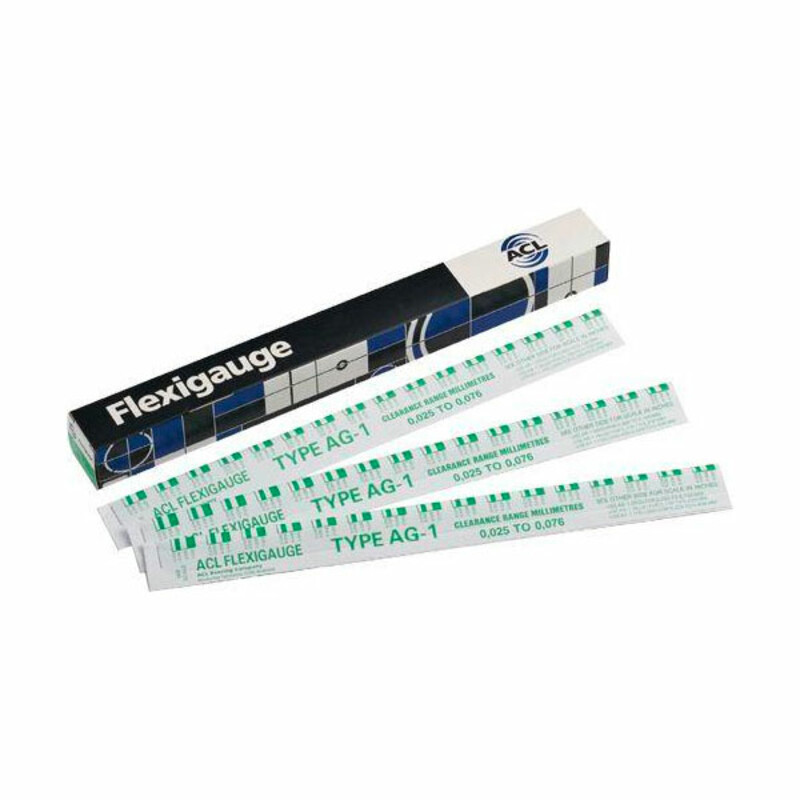
Checking on assembly: lay a calibrated strip (Plastigauge) on the journal, torque the main cap to spec, then compare the crushed strip against the gauge to read the clearance.
Designed for engine building and motorsport, these ACL trimetal main bearings carry much more load than an original bearing, whether the engine gains power, revs higher or receives a turbo or supercharger. They are available in several sizes: the standard size, a +0.025 mm size for a main journal that has only been polished, +0.25 and +0.50 mm regrind sizes and the HX version with increased clearance for high-revving engines or engines needing a high oil flow. That makes it possible to put a reground crankshaft back into service without changing range and to set the clearance for the oil and use.
 | ACL Bearing Company has been making high-performance engine bearings in Australia since 1949. Its Race Series offers precise trimetal bearings, available in many sizes and proven in tuned and racing engines worldwide. |
This main bearing set fits the following vehicles, by engine code:
| Brand | Model (chassis) | Engine code | Power | Years |
|---|---|---|---|---|
| Ford Australia | Corsair Saloon (UA) | CA20E | 113 hp | 1989–1992 |
| Ford Australia | Corsair Hatchback (UA) | CA20E | 113 hp | 1989–1992 |
| Nissan | 180SX Coupe (S13) | CA18DE, CA18DET | 132–201 hp | 1988–1992 |
| Nissan | 200SX (S13) | CA18DE, CA18DET | 135–169 hp | 1988–1994 |
| Nissan | Auster (T12) | CA18DET, CA18ET, CA20S | 102–169 hp | 1986–1989 |
| Nissan | Avenir (W10) | CA20E, CA20S | 102–105 hp | 1986–1997 |
| Nissan | Bluebird (T72, T12, U12) | CA18DE, CA20E, CA20S | 90–129 hp | 1985–1990 |
| Nissan | Bluebird (U11) | CA20E, CA20S | 102–116 hp | 1984–1990 |
| Nissan | Bluebird Saloon (910) | CA20S | 101 hp | 1985–1986 |
| Nissan | Bluebird Hatchback (T72, T12) | CA18DE, CA20E, CA20S | 102–129 hp | 1985–1990 |
| Nissan | Bluebird Station Wagon (WU11) | CA18ET, CA20E, CA20S | 90–135 hp | 1984–1990 |
| Nissan | Bluebird Traveller (W910) | CA20S | 101 hp | 1985–1986 |
| Nissan | Cedric (Y30) | CA20S | 102–110 hp | 1984–1987 |
| Nissan | EXA Targa (N13) | CA16DE, CA18DE | 116–128 hp | 1987–1991 |
| Nissan | Gloria VII (Y30) | CA20S | 110 hp | 1984–1987 |
| Nissan | Laurel (JC31) | CA20S | 102 hp | 1984–1985 |
| Nissan | Laurel (JC32) | CA20S | 102 hp | 1984–1985 |
| Nissan | Pintara Saloon (R31) | CA20E | 106 hp | 1986–1990 |
| Nissan | Pintara Saloon (U12) | CA20E | 113 hp | 1989–1992 |
| Nissan | Pintara Hatchback (U12) | CA20E | 113 hp | 1990–1992 |
| Nissan | Pintara Estate (R31) | CA20E | 106 hp | 1986–1990 |
| Nissan | Prairie (M10, NM10) | CA20E, CA20S | 92–105 hp | 1986–1988 |
| Nissan | Prairie PRO (M11) | CA20E, CA20S | 90–116 hp | 1988–1992 |
| Nissan | Pulsar NX Coupe | CA16DE, CA18DE | 124–133 hp | 1986–1989 |
| Nissan | Silvia (S12) | CA18ET, CA20E | 103–135 hp | 1983–1988 |
| Nissan | Silvia Hatchback (S12) | CA20E | 101–106 hp | 1983–1988 |
| Nissan | Skyline (R31) | CA20S | 98 hp | 1987–1992 |
| Nissan | Stanza (T11) | CA20E, CA20S | 90–98 hp | 1982–1985 |
| Nissan | Stanza Saloon (T12) | CA20E | 98 hp | 1985–1989 |
| Nissan | Stanza Hatchback (T12) | CA20E | 98 hp | 1986–1989 |
| Nissan | Stanza Hatchback (T11) | CA18, CA20E, CA20S | 88–102 hp | 1981–1985 |
| Nissan | Sunny II (N13, B12) | CA18DE | 140 hp | 1987–1992 |
| Nissan | Sunny II Coupe (B12) | CA18DE | 125–140 hp | 1989–1992 |
| Nissan | Sunny II Hatchback (N13) | CA18DE | 125 hp | 1989–1991 |
| Nissan | Sunny III (N14, B13) | CA18DE | 128 hp | 1990–1992 |
| Nissan | Vanette Bus (C22) | CA20S | 103 hp | 1986–1993 |
| Reliant | Scimitar Roadster | CA18ET | 135 hp | 1986–1990 |
| Reliant | Scimitar Sabre Roadster | CA18ET | 135 hp | 1992–1994 |
When a main bearing gives way, the damage quickly spreads beyond the part itself: a scored main journal, debris carried through the whole oil circuit, a crankshaft to regrind at the very least, sometimes a damaged block. A bearing set costs far less than a regrind and is nothing compared with a complete engine rebuild. It is the cheapest part of the crankshaft assembly, yet the one whose failure is most expensive.