Product successfully added to your shopping cart
Quantity
Total
There are 0 items in your cart. There is 1 item in your cart.
Total products
Total shipping To be determined
Total

1.8L 16v - 18K4F
Manufacturers
1.8L 16v - 18K4F
Warning: Last items in stock!
New product
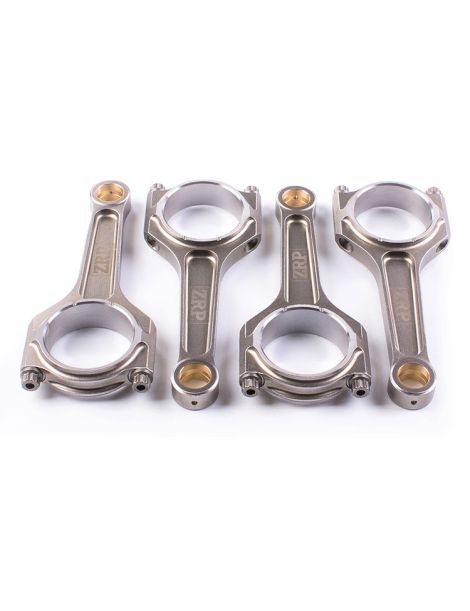
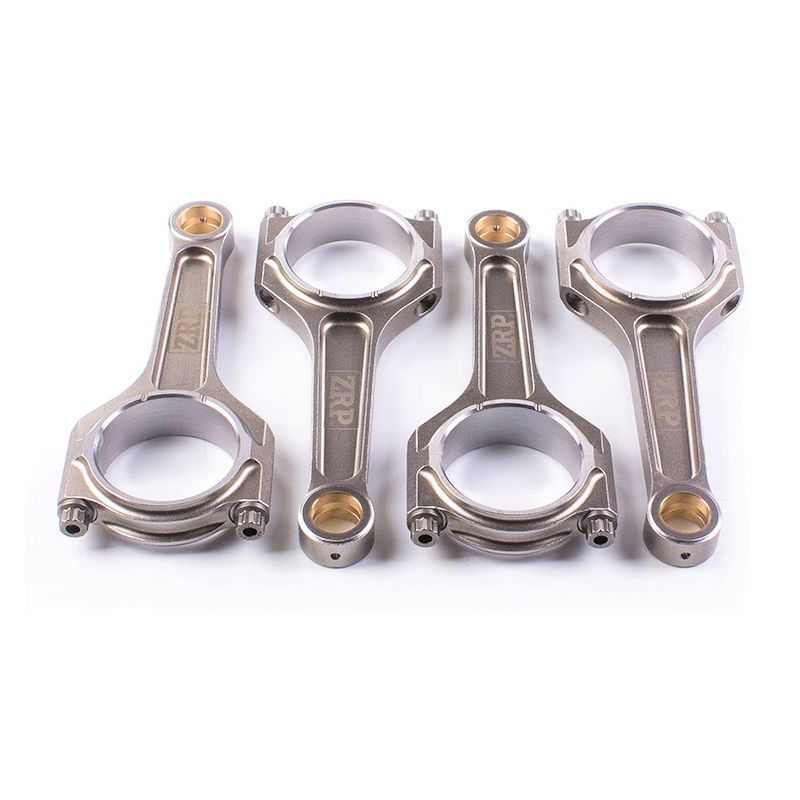
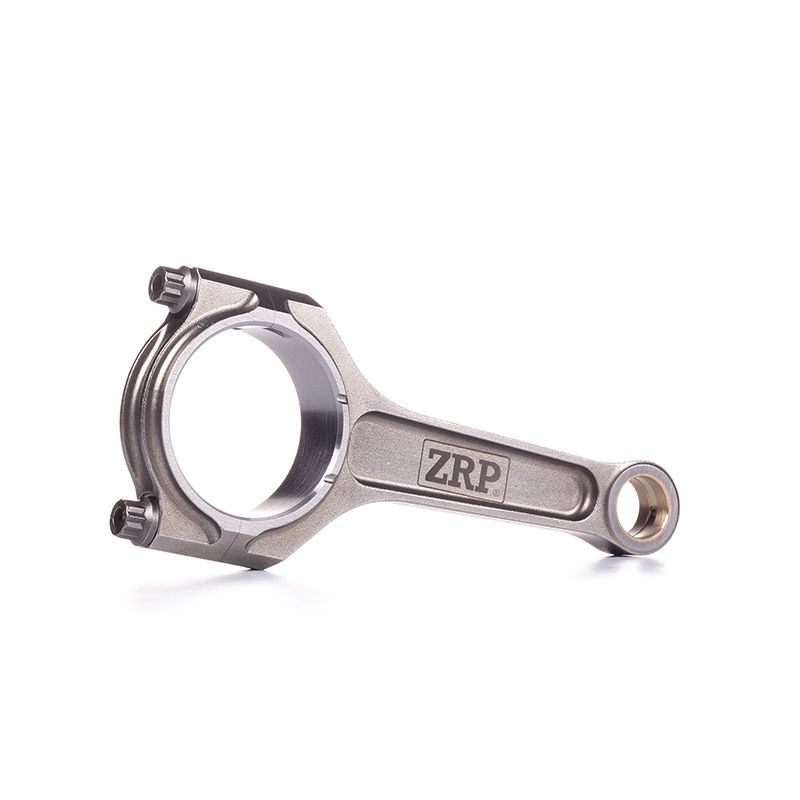
Set of 4 forged 4340 steel connecting rods for Rover 1.8L 16V 18K4F.
The 18K4F is the 1.8-litre sixteen-valve member of the Rover K-series, an in-line four of 1,796 cc obtained from an 80 mm bore and an 89.3 mm stroke, with twin overhead camshafts. Built from 1995 to 2005, this naturally aspirated all-aluminium unit relies on an unusual design: replaceable wet liners and long head bolts running right through the block down to the lower main bearing carrier. The result is a remarkably light and compact engine, two qualities that explain its career in Britain's lightest sports cars.
Rated from 116 hp to over 160 hp, the 18K4F powered a very wide range: MG MGF and TF, MG ZR, ZS and ZT, Rover models, the Land Rover Freelander, but also the Lotus Elise and the Caterham Seven, two cars that gave it a lasting place in club motorsport. It is precisely in that kind of use that the rotating assembly becomes the weak spot: sustained high-rpm work, track sessions, head or intake work and, above all, a rise in cylinder pressure load the standard rod well beyond its original brief. Replacing it with a forged rod keeping the original 133.1 mm centre distance and 18 mm pin secures the bottom end with no other modification.
Forged from high-strength 4340 steel and then machined to 18K4F dimensions, with an 18 mm pin and a 133.1 mm centre-to-centre length, these rods weigh 367 g each. They make the bottom end reliable as soon as the K-Series leaves its factory configuration: forged pistons, raised maximum rpm, added forced induction or increased displacement.
Designed for tuning, on a highly tuned naturally aspirated engine as well as on a boosted one, they serve every discipline: rally, drift, drag racing, circuit and track use, hillclimb, time attack, and support Stage 2, Stage 3 and Stage 4+ builds up to a fully rebuilt competition engine. The I profile used here keeps inertia down across the four cylinders.
| Reference | Brand | Profile | Bolts | Pin diameter OEM 18 mm | Small-end width | Big-end diameter | Big-end width | Center-to-center OEM 133.1 mm | Weight per rod |
|---|---|---|---|---|---|---|---|---|---|
| R-ROV-001-I | ZRP | I | ARP 2000-5/16"-38mm | 18 mm | 51.7 mm | 22.5 mm | 133.1 mm | 367 g |
| Rod | Bolts | Torque | Recommended stretch |
|---|---|---|---|
| ZRP (R-ROV-001-I) | ARP 2000 | 40.7 N·m | 0.140 – 0.152 mm |
Pulling a rod bolt up in one movement is the surest way to miss the preload. On the 18K4F, good practice is to bring both cap bolts up by hand, then build load in stages, alternating from one side to the other, before reaching the final figure shown in the table above. That progression lets the cap settle and spreads tension without loading one bolt ahead of the other. The figures used are those of the ARP 2000 bolt manufacturer: they are not negotiable, and they assume clean threads coated with an even film of ARP assembly lubricant. Finally, since torque only reflects the resulting tension indirectly, measuring stretch with a dial gauge remains the reference method for validating the engine’s eight bolts, especially on 5/16 inch bolts where the margin is narrow. The instruction sheet supplied with the kit is authoritative.
| 4340 steel is a nickel-chromium-molybdenum alloy steel used in aerospace and motorsport alike. Forged then heat-treated (quench and temper), it offers excellent tensile strength, high fatigue resistance and real ductility. Compared with an original rod (often sintered/powder metal, optimised for series-production cost), a 4340 forged rod shows roughly +19% higher yield strength, +8% higher tensile strength and above all +19% to +37% higher fatigue strength, i.e. a fatigue life under cyclic loading several times longer. This is what makes forged 4340 the reference material as soon as boost and rpm climb. |
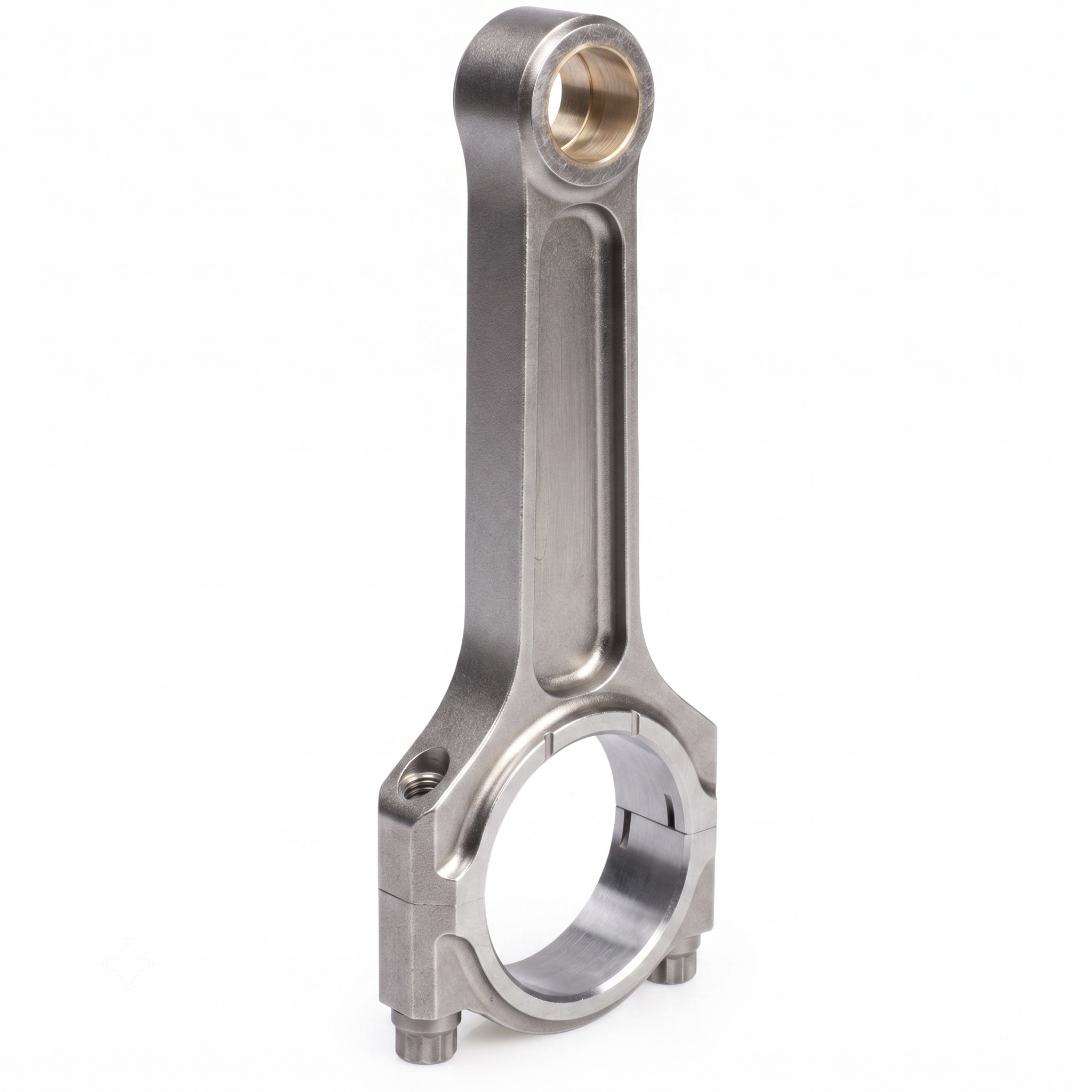 | I-Beam profile. Its I-shaped centre section puts the material where the rod works in compression and lightens the rest of the beam: it is the best compromise between low mass and stiffness for a naturally aspirated engine that lives at high rpm, like the 18K4F. A lighter beam means smaller inertia loads on the crank journal and bearings at high speed, and therefore contained wear. It is also the most widely used profile in engine building, at every budget, because it covers most needs without penalising balancing. |
The rod bolts are the first item to settle in an 18K4F build: they set the maximum rpm and the cylinder pressure the bottom end can take. The choice follows use, from torque demanded early in rally or hillclimb to rpm held high on circuit, up to the short peaks of drag racing, before looking at power per cylinder. On this rod the bolts are supplied in 5/16"-38 mm and are fitted to the torque and stretch of the table.
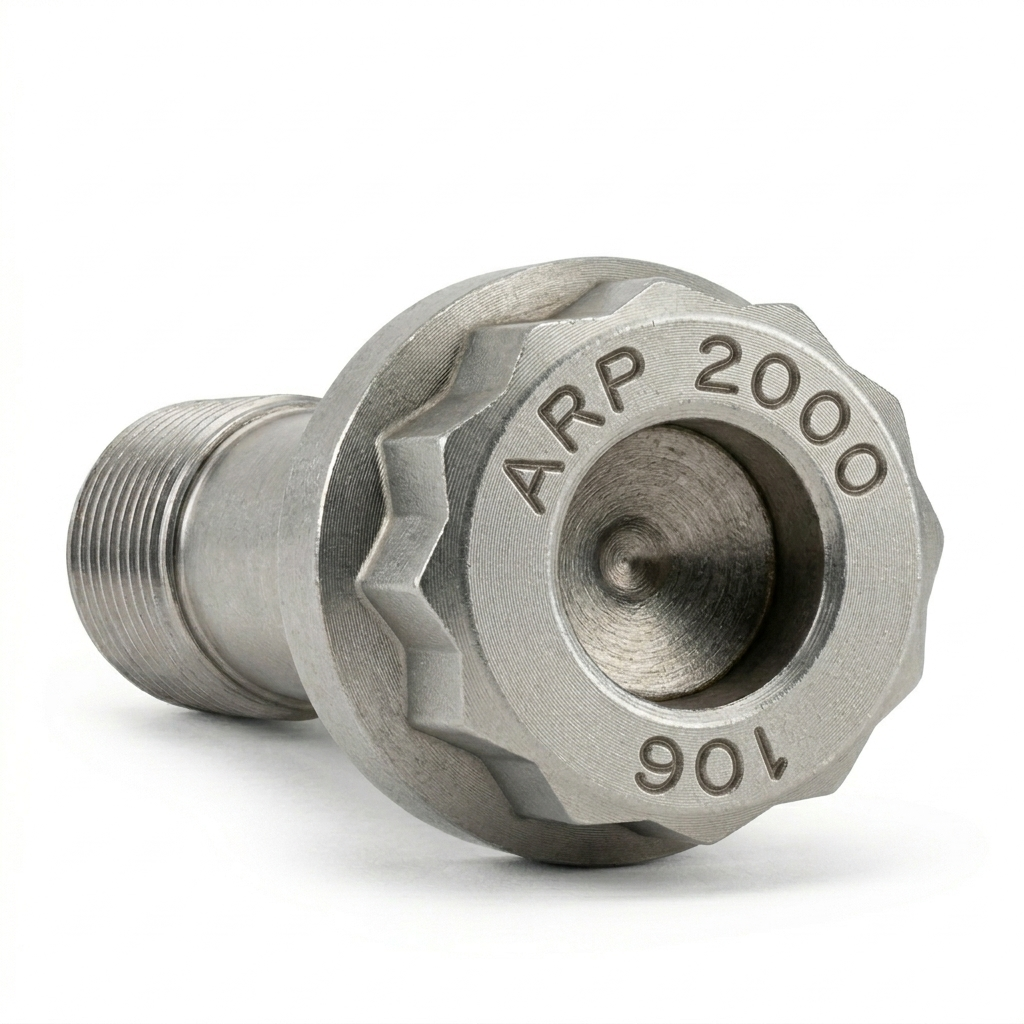 | ARP 2000 shows a tensile strength of ~220,000 psi (~1,517 MPa): the grade is rated up to 150 hp per cylinder for a 5/16" bolt and up to 8,500 rpm. It is the one found in circuit racing and track days, in drift, rally, drag racing and hillclimb. Here it is offered in the 5/16" diameter chosen for this rod, and it calls for no particular storage constraint. A safe and simple choice. |
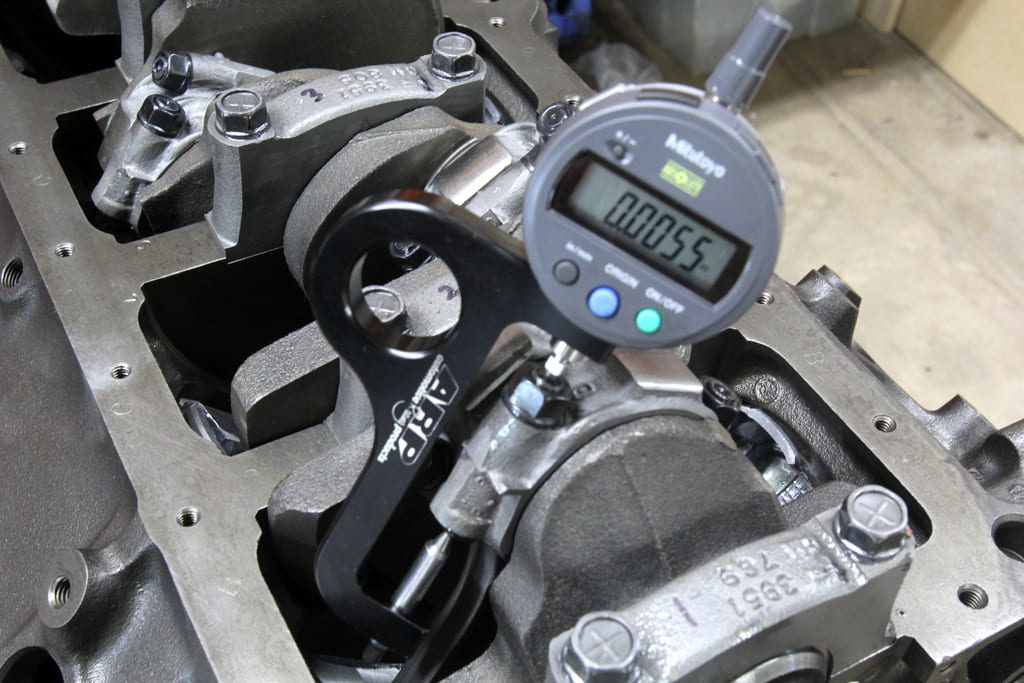
In addition to torque tightening, measuring rod-bolt stretch is the most reliable check for optimal preload. The check is done with the bolt fitted: place the gauge (dial indicator) on the two ends of the bolt and read its actual stretch, which must match the recommended value (see the torque & stretch table above). This method removes the friction variations inherent in torque tightening and secures the assembly on heavily stressed engines. |
 | ZRP, a Greek manufacturer based in Athens, designs and machines high-performance forged rods widely used in motorsport. For the 18K4F the range is deliberately limited to a single part number: I-beam profile with ARP 2000 5/16" 38 mm hardware, a combination that suits a prepared 1.8-litre naturally aspirated engine, where low mass matters as much as strength. The set is supplied complete, bolts included, with the tightening figures to be respected (40.7 Nm and 0.140 to 0.152 mm of stretch) shown in the table above. |
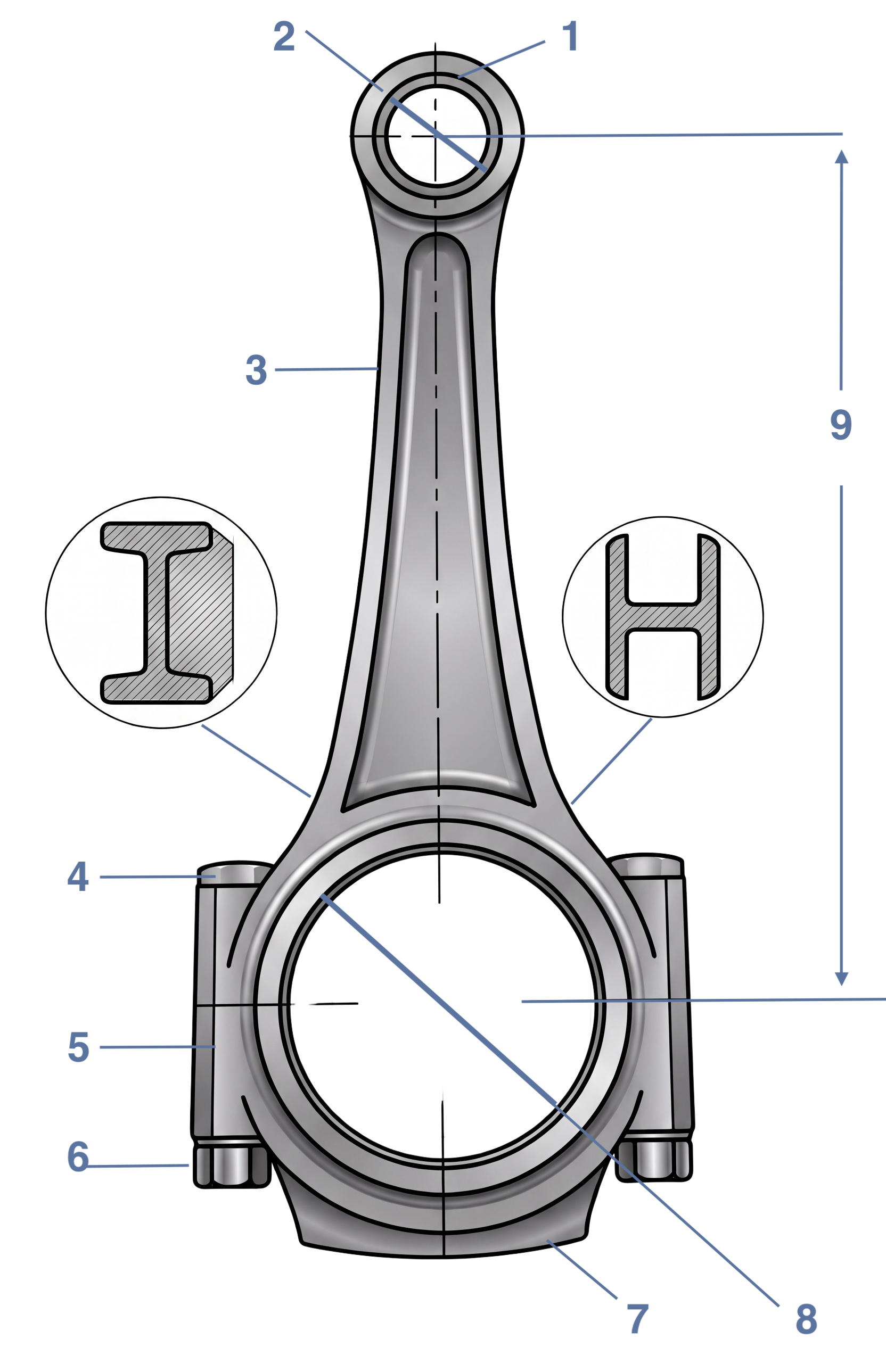 | 1) Small end 2) Small-end diameter 3) Rod beam 4) Rod bolt 5) Big end 6) Rod nut / bolt 7) Rod cap 8) Big-end diameter 9) Center-to-center |
These forged connecting rods are compatible with all vehicles fitted with the Rover 18K4F engine (1.8L 16V):
| Brand | Model (chassis) | Engine code | Power | Years |
|---|---|---|---|---|
| Caterham | Seven (CF, CS) 1.8 | 18K4F | 121–162 hp | 1996–2015 |
| Land Rover | Freelander (L314) 1.8 16V | 18K4F | 117–120 hp | 1998–2006 |
| Lotus | Elise (S1, S2) 1.8 | 18K4F | 118–137 hp | 1995–2005 |
| MG | MGF (RD) 1.8 16V | 18K4F | 120 hp | 1995–2002 |
| MG | TF 120 / 135 | 18K4F | 120–136 hp | 2002–2009 |
| MG | ZR 120 | 18K4F | 117 hp | 2001–2005 |
| MG | ZS 120 | 18K4F | 117 hp | 2001–2005 |
| MG | ZT / ZT-T 1.8 16V | 18K4F | 120 hp | 2003–2005 |
| Minelli | TF 1800 | 18K4F | 117 hp | 1998–2011 |
| Rover | 25 (RF) 1.8 16V | 18K4F | 116 hp | 1999–2005 |
| Rover | 45 (RT) 1.8 | 18K4F | 117 hp | 2000–2005 |
| Rover | 75 (RJ) 1.8 | 18K4F | 120 hp | 1999–2005 |
| Rover | 200 (RF) 1.8 16V | 18K4F | 120 hp | 1999–2000 |
| Rover | Streetwise 1.8 | 18K4F | 117 hp | 2003–2005 |
OEM reference:
On an 18K4F, a standard rod that breaks takes the piston with it and calls for a check of the block: repair with standard parts is paid for in new rods and pistons, without changing anything about the limits of the engine. It is better to put that money into parts that push the limit further.
For an equivalent, often lower budget, forged 4340 steel rods and forged pistons bring far greater reliability and safety margin, with power potential that stays open. This has been the method of European engine builders for more than 15 years on built K-Series engines.
For the same budget: more reliability, more potential, more service life, and an engine that can be developed further.