Product successfully added to your shopping cart
Quantity
Total
There are 0 items in your cart. There is 1 item in your cart.
Total products
Total shipping To be determined
Total

1.6L 16v - N18B16
Manufacturers
1.6L 16v - N18B16
Warning: Last items in stock!
New product
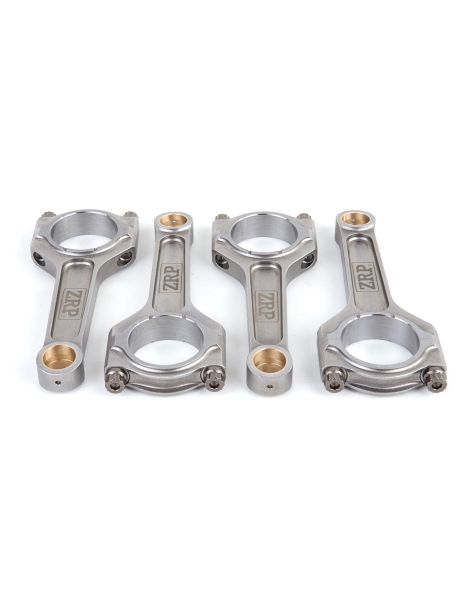
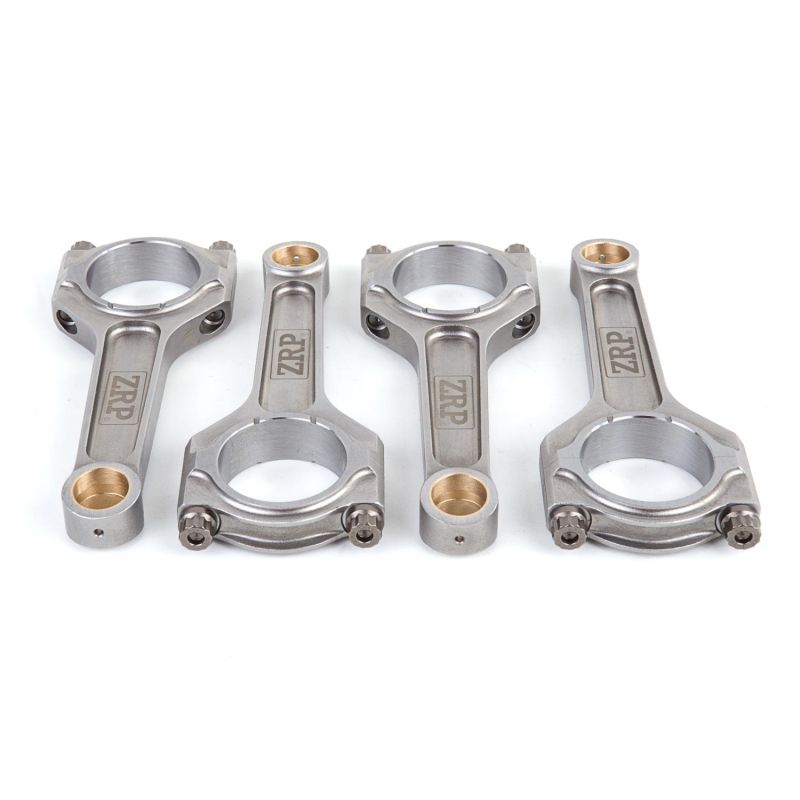
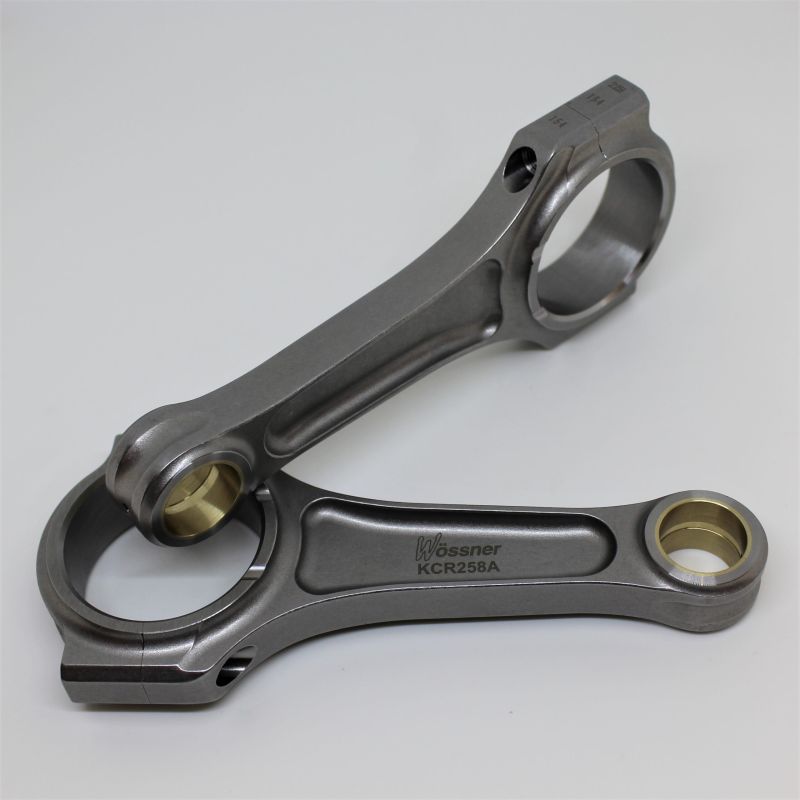
Set of 4 forged 4340 steel connecting rods for MINI Cooper S/JCW 1.6 16V Prince.
The 1.6 16V "Prince" engine is a 1,598 cc four-cylinder petrol unit (77 mm bore × 85.8 mm stroke) developed jointly by the BMW Group and PSA. On MINI it comes as the naturally aspirated N12 (Cooper) and as the direct-injection turbocharged N14 then N18 (Cooper S and John Cooper Works). The N14 and N18 combine a turbocharger, direct injection and, on the N18, Valvetronic valve control, for high efficiency in a compact package.
From the entry-level Cooper (around 120 hp) to the turbocharged Cooper S and JCW (around 174 to 211 hp), the Prince block powers the MINI R55, R56 and R57. Popular with tuners, it quickly exposes the limits of its stock rods as boost pressure and engine speed rise. To make high power reliable, those rods are replaced with forged 4340 steel rods fitted alongside forged pistons.
On the turbocharged Prince versions, direct injection and boost bring cylinder pressure up very early in the rev range: the rod takes its peak load while the crankshaft is still turning slowly, an unfavourable case for a mass-produced part. Stage 2 builds and beyond — larger turbine, freer exhaust, remapping — sharpen that peak without the stock rod ever being redesigned. That is exactly where a forged set, matched to the gram and torqued with ARP hardware, gives the whole rotating assembly its margin back.
Forged from high-strength 4340 steel, these upgraded rods secure the bottom end of the 1.6 Prince as soon as power goes beyond standard figures. They become essential when moving to forged pistons, raising the rev limit, increasing boost pressure or adding capacity, all situations in which the factory rod, sized to the bare minimum, reaches its limits. Both sets offered reproduce the engine's own dimensions exactly: 20 mm piston pin, 138.55 mm centre distance and 48 mm big end.
Designed to absorb the loads of a prepared engine, turbocharged or supercharged, they suit Stage 2 builds (intercooler, exhaust, remap), Stage 3 (larger turbo, head and camshafts) and Stage 4+ up to full race engines. They are found in every discipline practised with a Cooper S or a JCW: rally and tarmac rally, circuit racing and track days, hillclimb, drift, drag and time attack. The choice then depends on the target: 450 g per rod for the ZRP with 3/8" hardware, or 510.89 g for the Wössner with ARP 2000 hardware in 5/16".
| Reference | Brand | Profile | Bolts | Pin diameter OEM 20 mm | Small-end width | Big-end diameter OEM n.p. | Big-end width | Center-to-center OEM 138.55 mm | Weight per rod |
|---|---|---|---|---|---|---|---|---|---|
| KCR212A-T | Wössner | I | ARP 2000-5/16"-38mm | 20 mm | 20.80 / 10.50 mm | 48 mm | 20.85 mm | 138.6 mm | 510.89 g |
| R-MIN-002-I | ZRP | I | ARP 2000-3/8"-38mm | 20 mm | 48 mm | 20.87 mm | 138.55 mm | 450 g | |
| R-MIN-002-I-L19 | ZRP | I | ARP L19-3/8"-38mm | 20 mm | 48 mm | 20.87 mm | 138.55 mm | 450 g |
ZRP: Tapered pin end.
| Rod | Bolts | Torque | Recommended stretch |
|---|---|---|---|
| Wössner (KCR212A-T) | ARP 2000 | 40.7 N·m | 0.1270 – 0.1397 mm |
| ZRP (R-MIN-002-I) | ARP 2000 | 61 N·m | 0.140 – 0.152 mm |
| ZRP (R-MIN-002-I-L19) | ARP L19 | 67.8 N·m | 0.152 – 0.165 mm |
The reference method remains stretch-gauge measurement; the instructions supplied with the kit always take priority. The quoted torque figures assume assembly with ARP lubricant.
| 4340 is a nickel-chromium-molybdenum alloy steel used in aerospace as well as in motorsport. Forged then heat-treated (quenched and tempered), it combines high tensile strength, excellent fatigue life and real ductility. Compared with a stock rod, often sintered metal optimised for series cost, a forged 4340 rod gains about 19% in yield strength, 8% in tensile strength and 19 to 37% in fatigue strength, giving far greater endurance under cyclic loads. That is why forged 4340 is the benchmark once boost and engine speed rise. |
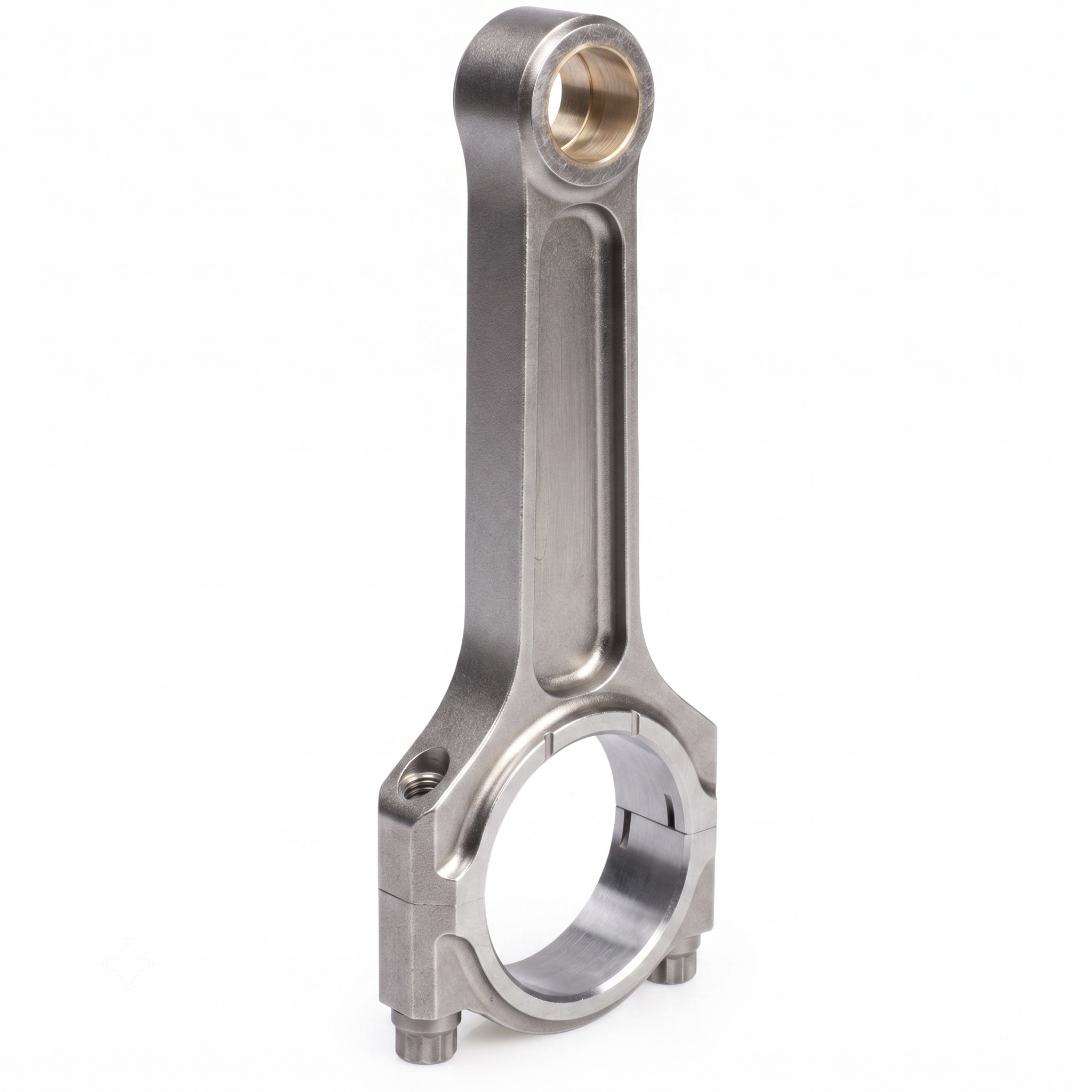 | I-beam profile. Its thinner central section makes the rod lighter: less inertia and crisper rev pick-up. It is the favoured profile on modern turbo engines such as the Prince. Its I-HD (Heavy Duty) variant is a reinforced version intended for the highest loads. |
The rod bolt is among the most heavily loaded parts of the engine. The key is to match the ARP grade to the real use of the build, then to follow the assembly torque and stretch figures rigorously.
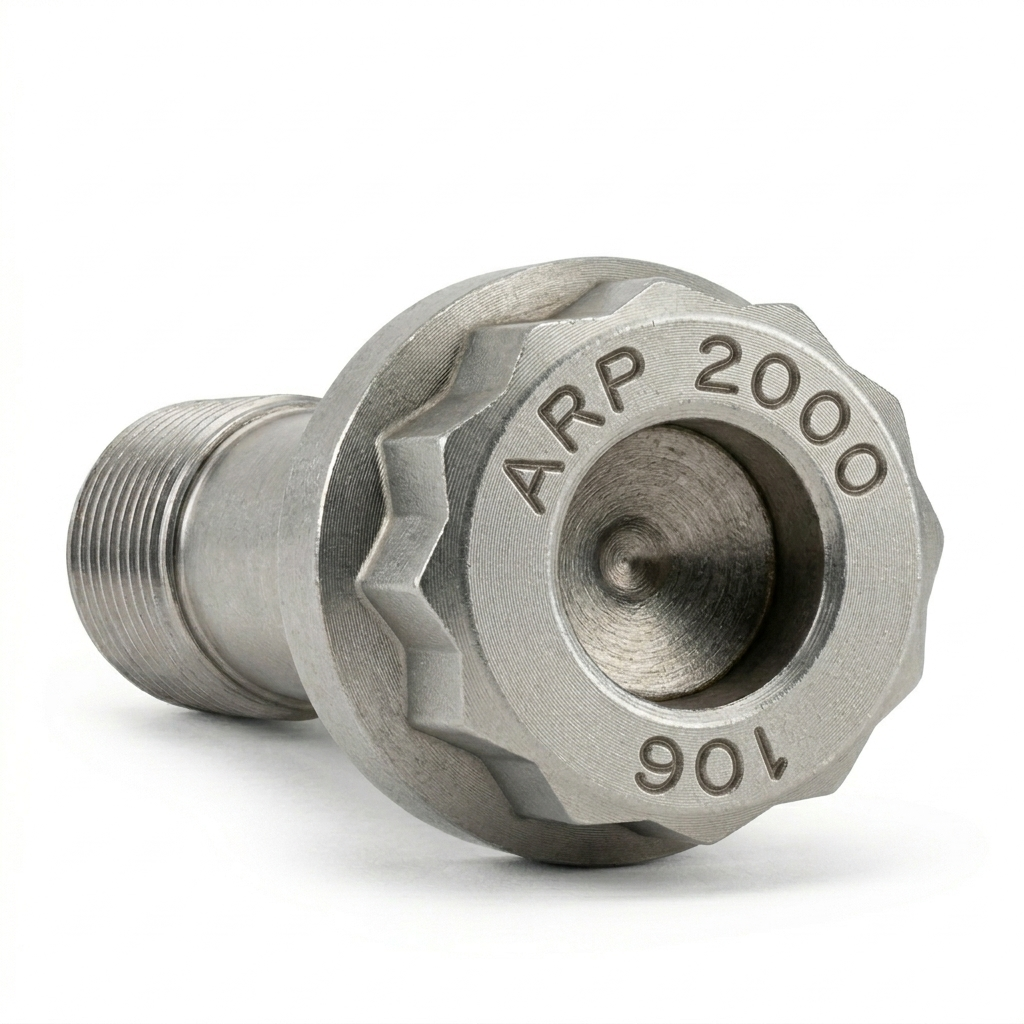 | ARP 2000 (tensile strength ~220,000 psi, i.e. ~1,517 MPa) is the high-performance standard. Suitable up to 150 hp/cylinder in 5/16" and 200 hp/cylinder in 3/8", and up to around 8,500 rpm, it is the most common grade in circuit, trackday, drift, rally, drag and hillclimb use: tough, reliable and versatile, with no special storage precautions. |
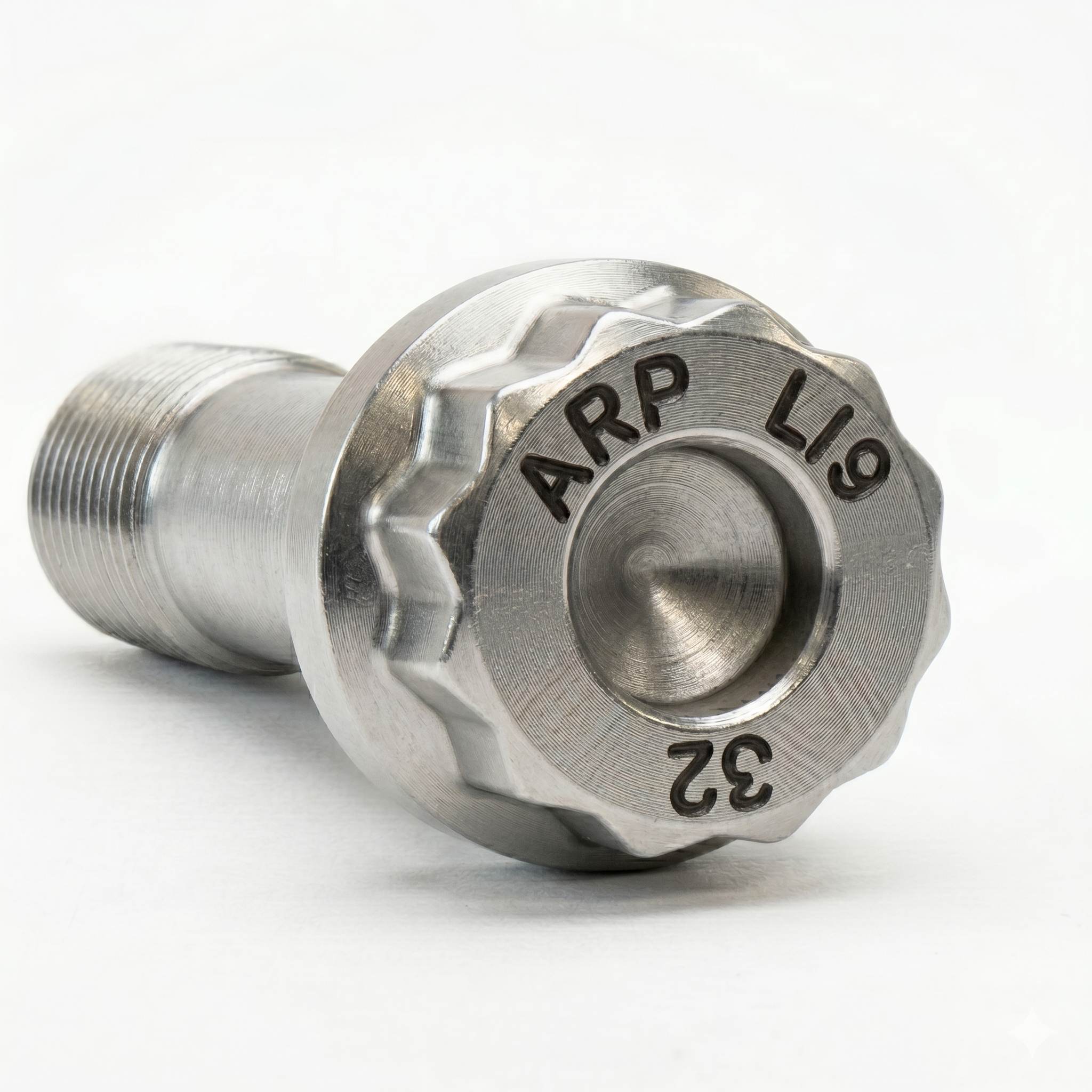 | L19 (tensile strength ~260,000 psi, i.e. ~1,793 MPa) targets engines pushed to the extreme: up to 200 hp/cylinder in 5/16" and 250 hp/cylinder in 3/8", and up to around 10,000 rpm, under high boost and sustained high revs. It is the choice for big-power builds (drag, drift, rally, circuit). Sensitive to corrosion and hydrogen embrittlement, it must be stored and fitted oiled, away from moisture. |
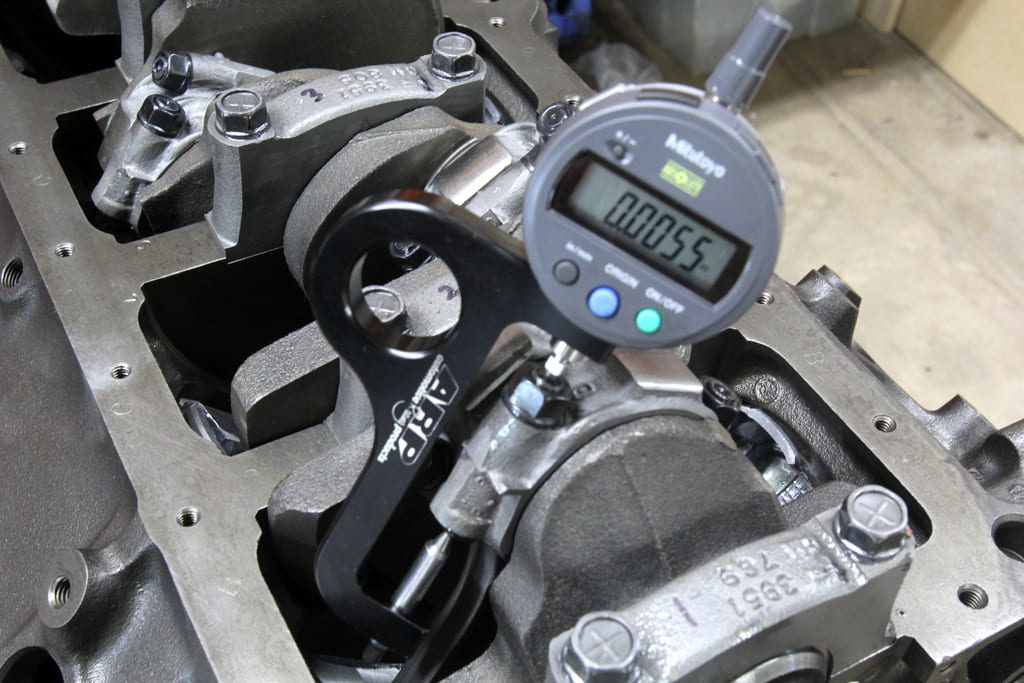
| Beyond torque tightening, measuring bolt stretch remains the most reliable check for reaching the target preload. It is done with the bolt fitted: a dial gauge is placed on both ends of the bolt to read actual stretch, which must match the recommended value (see the torque and stretch table above). This approach removes the friction scatter inherent in torque tightening and secures the assembly on heavily stressed engines. |
 | Wössner, a German forging specialist known for its high-performance forged pistons and rods. Its rods are forged from 4340 steel, carefully machined and balanced, and supplied complete with their ARP 2000 hardware in 5/16". The optimised I-beam profile it uses seeks the best compromise between low mass and strength on boosted engines; on the 1.6 Prince the rod weighs 510.89 g for a 138.6 mm centre distance and a stepped small end (20.80 / 10.50 mm) faithful to the original design. It is the integrated choice, consistent with a piston set from the same maker. |
 | ZRP, a Greek manufacturer founded by Alex Drakos in Athens, produces high-performance forged rods proven in rally, on track and in drift. Each rod is forged from 4340 steel, precisely machined and matched to within ±1 g, an essential condition to stay reliable at high rpm on a four-cylinder that revs. For the 1.6 Prince the range consists of an I-beam profile at 450 g per rod, available with ARP 2000 or ARP L19 hardware in 3/8" 38 mm: the lighter of the two versions offered here, and the one allowing the greater clamping margin. |
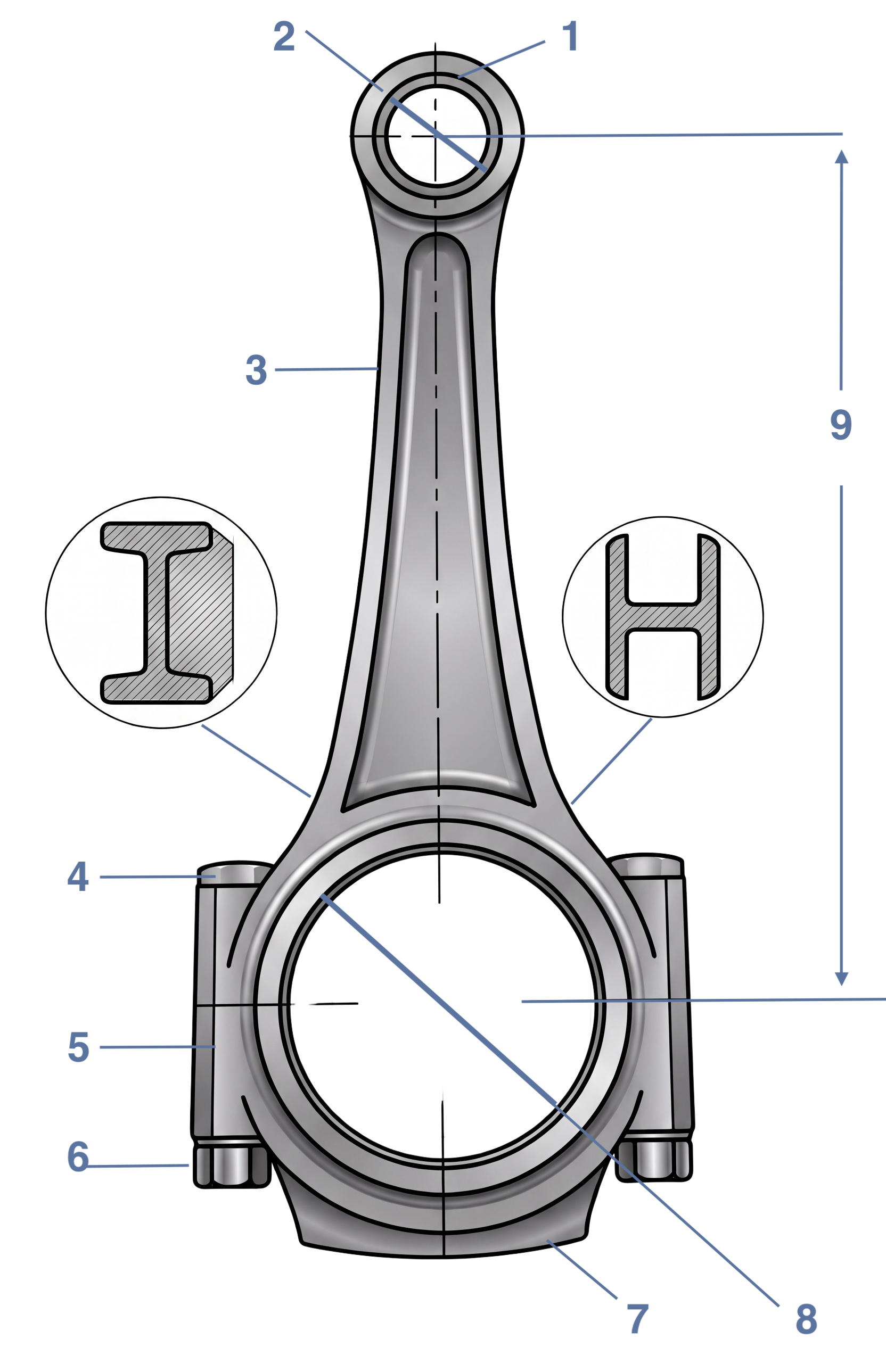 | 1) Small end 2) Small-end diameter 3) Rod beam 4) Rod bolt 5) Big end 6) Rod nut / bolt 7) Rod cap 8) Big-end diameter 9) Center-to-center |
These forged connecting rods fit MINI models with the 1.6 16V "Prince" engine (naturally aspirated N12 and turbo N14 / N18):
| Brand | Model (chassis) | Engine code | Power | Years |
|---|---|---|---|---|
| MINI | Cooper (R55 / R56 / R57) | N12B16A | 120 hp | 2006 – 2012 |
| MINI | Cooper S (R55 / R56 / R57) | N14B16A | 174 hp | 2006 – 2011 |
| MINI | Cooper S (R56 LCI) | N18B16A | 184 hp | 2010 – 2013 |
| MINI | Cooper S / John Cooper Works (R56) | N18B16C | 211 hp | 2008 – 2013 |
OEM reference: 11247597419 (set of 4 rods; the Prince engine uses several factory references depending on revision and weight class).
When a standard bottom end fails, with a rod broken, bent or simply marked, going back to the factory configuration means replacing rods and pistons, which are almost always damaged together, then checking the crankshaft and the bores. The bill climbs very quickly, for a simple restoration that brings neither reliability nor power.
For a comparable budget, sometimes lower, a set of 4340 forged rods combined with forged pistons brings an incomparable safety margin and real room to grow: the same engine will later accept more boost without having to open the bottom end again. This is the route European tuners have taken on the 1.6 Prince for more than fifteen years.
For the same budget the outcome is unambiguous: more reliability, more power potential and more longevity, with a part that will only be fitted once.