Product successfully added to your shopping cart
Quantity
Total
There are 0 items in your cart. There is 1 item in your cart.
Total products
Total shipping To be determined
Total

1.4L 16v - EA111
Manufacturers
1.4L 16v - EA111
Warning: Last items in stock!
New product
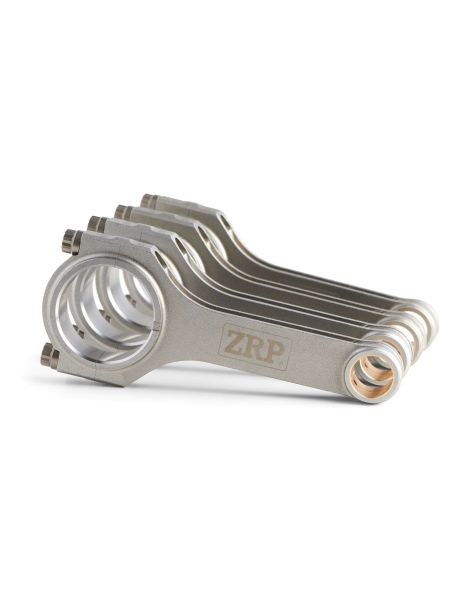
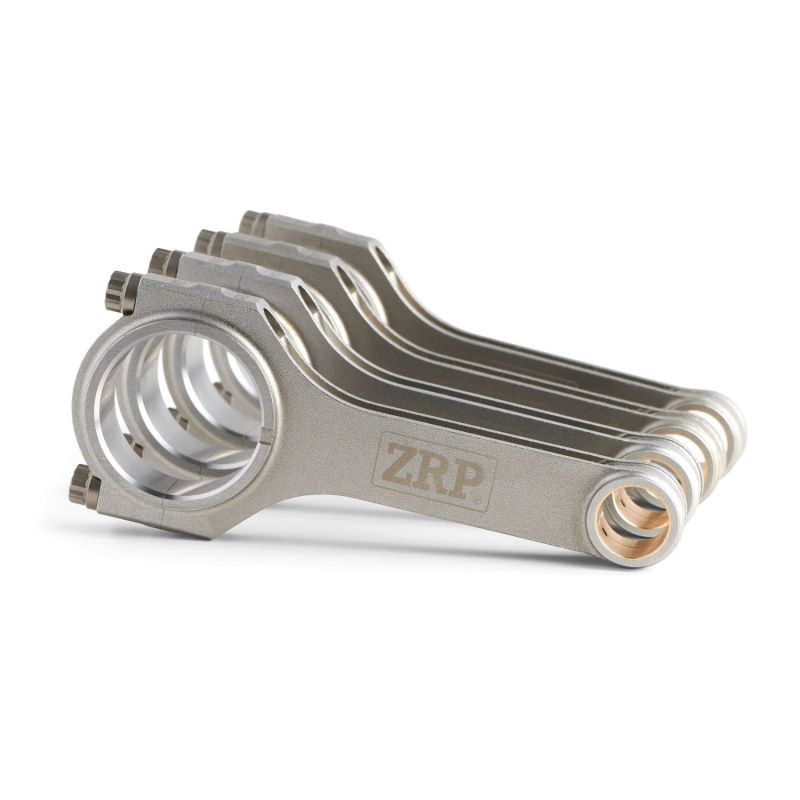
Set of 4 forged 4340 connecting rods for Audi/Volkswagen 1.4 TSI EA111.
The 1.4 TSI from the EA111 family is an inline four-cylinder petrol engine with direct injection and forced induction, launched in the mid-2000s within the Volkswagen group. Displacing 1,390 cc (76.5 mm bore, 75.6 mm stroke), it was built mainly between 2005 and 2015. Depending on the version it uses a single turbocharger or, on the most powerful variants, a turbo combined with a supercharger (Twincharger). It appears across a broad VAG range: Volkswagen Golf V and VI, Golf Plus, Jetta, EOS, Scirocco, Beetle, Touran, Sharan and Tiguan, Audi A1, SEAT Toledo and Alhambra, Škoda Octavia, Rapid and Yeti, with outputs from roughly 122 to 170 hp depending on the engine code (CAXA, CAVA, CAVD, BLG). This generation pairs a 19 mm piston pin with a 144 mm connecting-rod center-to-center.
Compact and a favourite with tuners, the 1.4 TSI soon pushes its factory rod to the limit as boost, engine speed and torque rise. On the most heavily worked engines it is the first part to give way. Fitting forged connecting rods is therefore the decisive reliability step to exploit the full potential of a tuned EA111 with confidence.
Dedicated to the 1.4 TSI EA111, our forged connecting rods are forged from wrought 4340 steel, the benchmark for the most demanding builds. They suit every use: circuit and track days, drift, rally, drag, time attack and hillclimb, on a heavily tuned street engine as much as on a competition unit. From Stage 2 to high-power Stage 3, then up to Stage 4 and beyond, they follow the power climb without ever compromising on strength. Each set contains 4 weight-matched rods and faithfully keeps the original 19 mm pin and 144 mm center-to-center.
Where the factory rod stays sized for very high-volume cost, the 4340 forged rod delivers a markedly greater mechanical margin: around +19% on yield strength, +8% on tensile strength and +19 to +37% on fatigue life. This reserve lets the small boosted 1.4 absorb cylinder-pressure peaks and inertial loads without any crack initiation. For this engine we choose the ZRP H profile, shaped to withstand torque and boost.
| Reference | Brand | Profile | Rod bolts | Pin bore (mm) | Small-end width (mm) | Big-end bore (mm) | Big-end width (mm) | Center-to-center (mm) | Weight (g) |
|---|---|---|---|---|---|---|---|---|---|
| R-VW-004-H | ZRP | H | ARP 2000-5/16"-38mm | 19 | 50.6 | 23 | 144 | 467 | |
| R-VW-004-H-L19 | ZRP | H | ARP L19-5/16"-38mm | 19 | 50.6 | 23 | 144 | 467 |
ZRP: Rods without oil feed drilling.
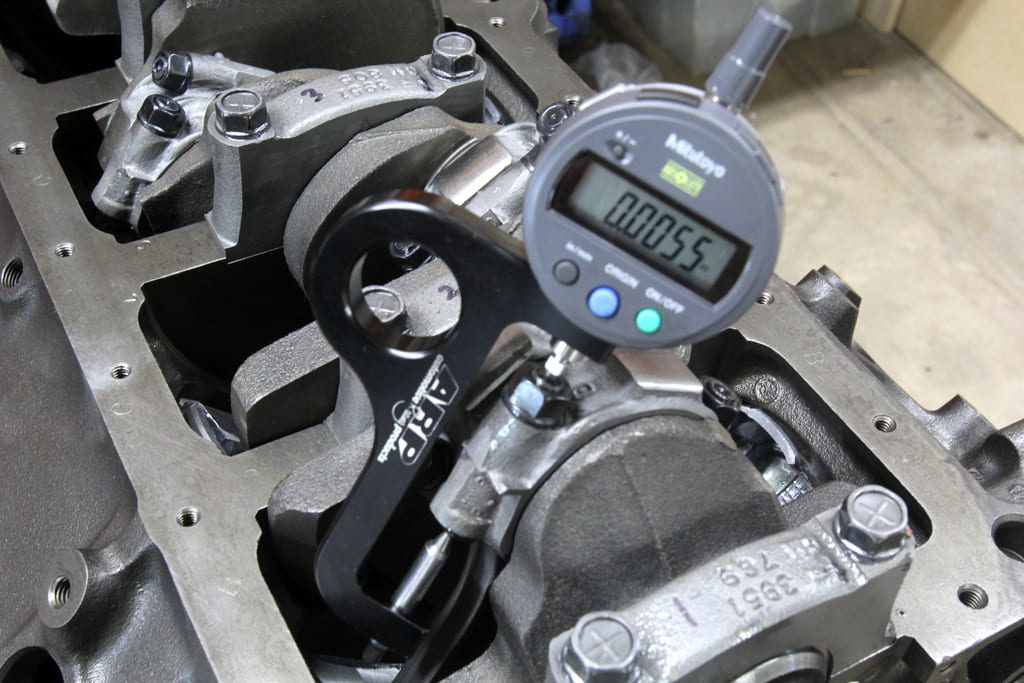
The torque and stretch figures below are given as a guide for each bolt grade; always refer to your rod manufacturer’s data sheet. The stretch method, using a dial gauge, remains the benchmark for a reliable preload.
| Reference | Brand | Rod bolts | Torque | Recommended stretch |
|---|---|---|---|---|
| R-VW-004-H | ZRP | ARP 2000-5/16"-38mm | 40.7 N·m | 0.140 to 0.152 mm |
| R-VW-004-H-L19 | ZRP | ARP L19-5/16"-38mm | 54.2 N·m | 0.127 to 0.140 mm |
4340 is a highly alloyed nickel-chromium-molybdenum steel prized for its rare balance of strength and toughness. Chosen in aerospace as well as motorsport, it is quenched then tempered, refining its grain and giving it top-tier endurance. Against a widely used sintered steel it brings about +19% yield strength, +8% tensile strength and +19 to +37% fatigue life: this margin is what separates a factory rod from a forged rod able to cope with a tuned engine. |
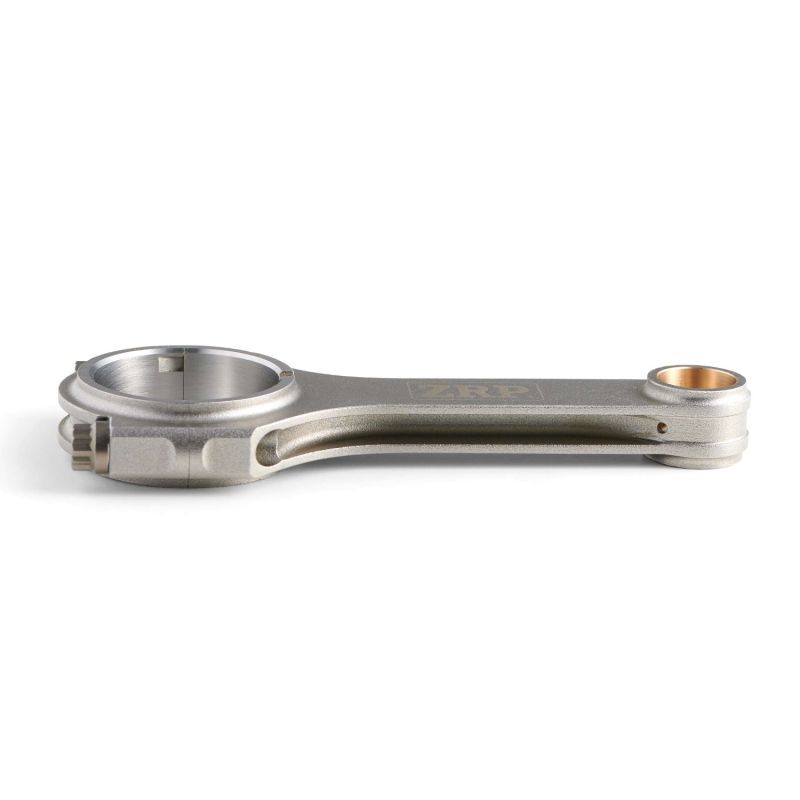
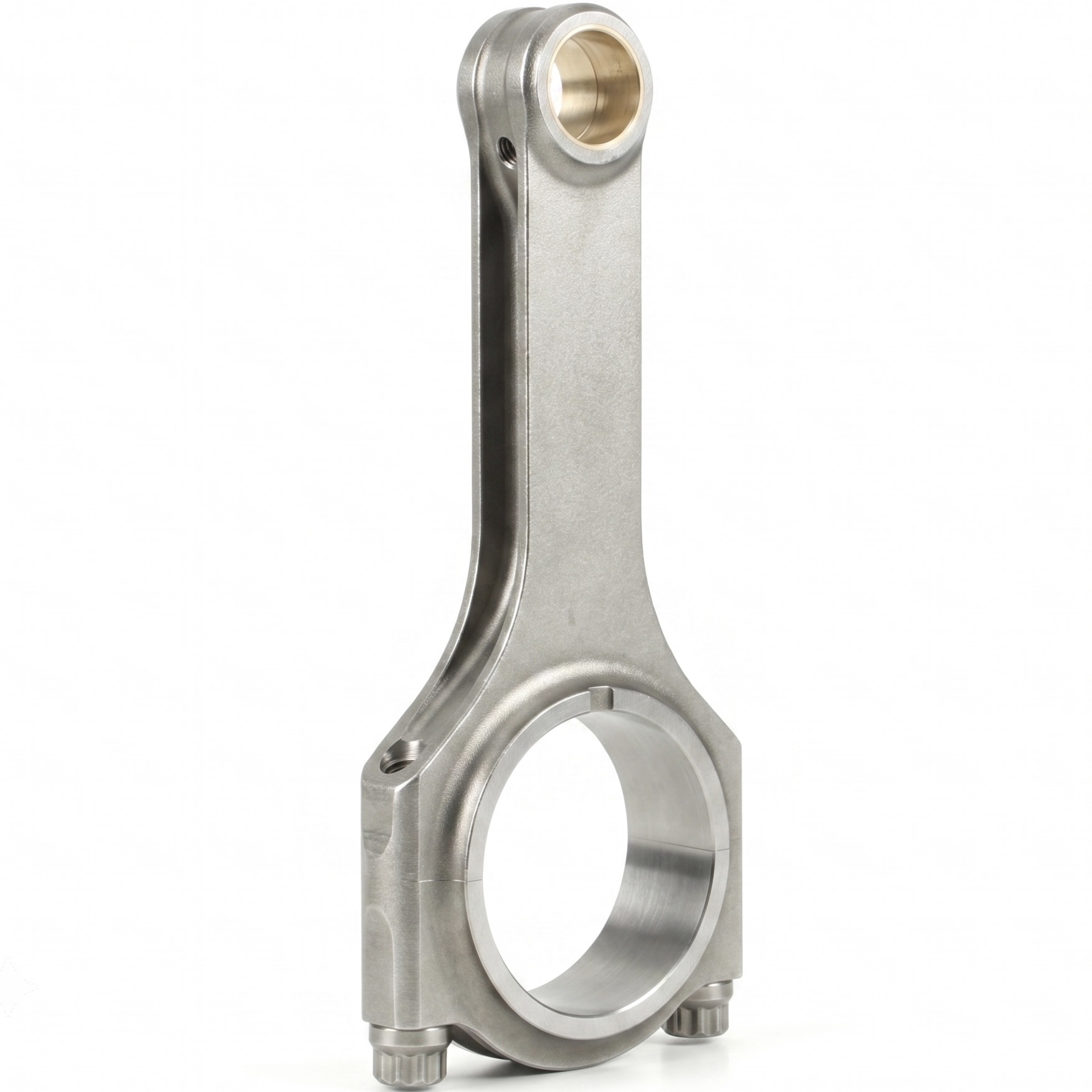 | H profile. The H-beam section, with its two broad flat flanks, excels in bending and compression. It is the profile of choice as soon as torque and boost climb, notably on high-load, drag-oriented engines. It offers pronounced structural strength, well matched to the boosted character of the 1.4 TSI, for a mass barely higher than an I-beam section. |
The rod bolt is one of the most heavily stressed parts of the engine: it must keep the cap firmly clamped despite endlessly repeated inertial loads. The grade is chosen according to the target power and the operating engine speed. On this listing both grades are offered in 5/16".
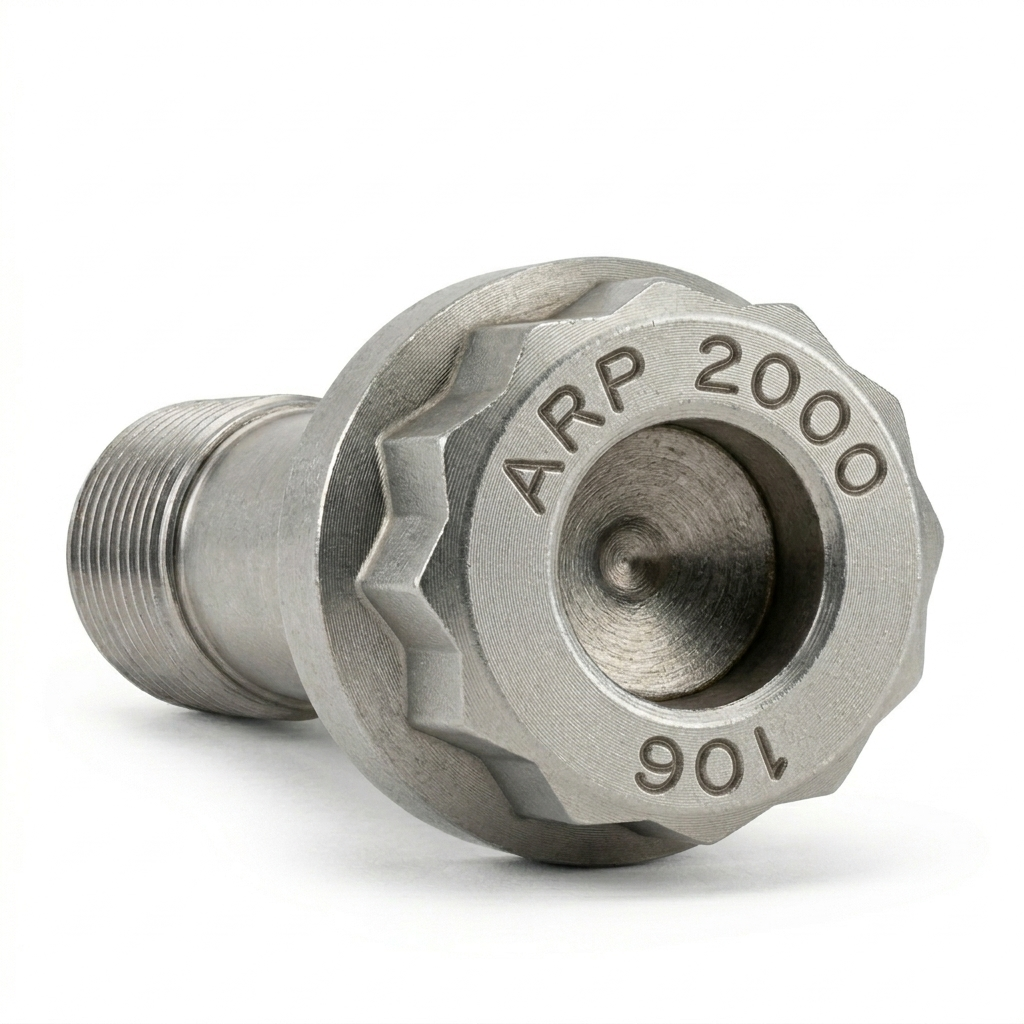 | ARP 2000. With a tensile strength of about 220,000 psi (≈ 1,517 MPa), ARP 2000 covers the vast majority of builds. In 5/16" it comfortably handles up to about 150 hp per cylinder, at engine speeds reaching 8,500 rpm. It is the ideal all-round choice for circuit, track day, drift, rally, drag and hillclimb. |
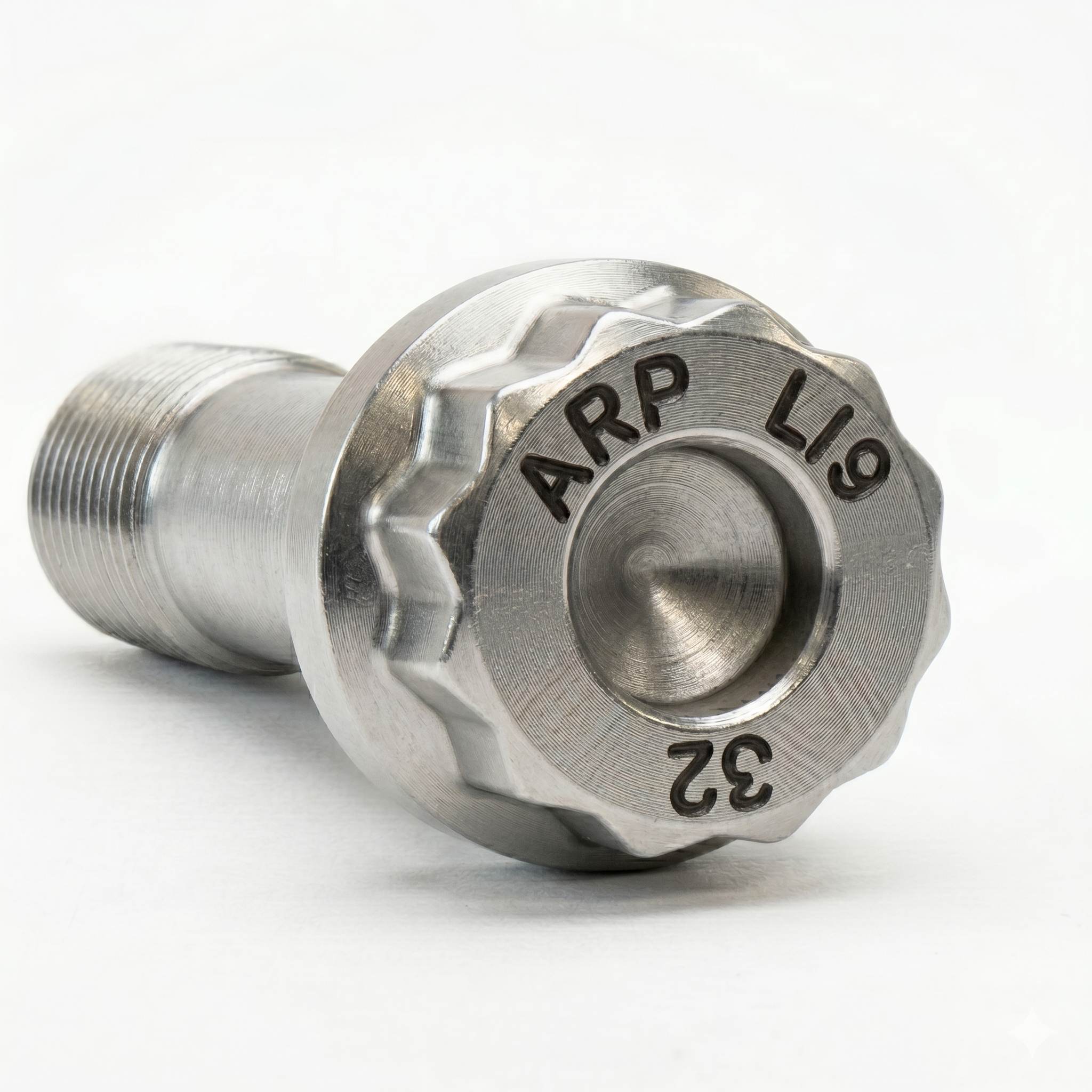 | ARP L19. More capable, ARP L19 develops about 260,000 psi (≈ 1,793 MPa). In 5/16" it targets the most heavily loaded engines, up to about 200 hp per cylinder, at engine speeds approaching 10,000 rpm. It is reserved for high boost and sustained high rpm; sensitive to corrosion and hydrogen, it demands quality oil and careful storage. |
| Manufacturers recommend tightening to stretch rather than to torque: measuring the bolt’s actual stretch with a dial gauge ensures an even, reliable preload from one rod to the next, whereas a torque wrench depends on thread friction. Each bolt has a target stretch range: you measure the free bolt, then the tightened bolt, and the difference must fall within the recommended window. |
 | ZRP. Designed by Alex Drakos in Athens (Greece), ZRP rods are machined with high precision from 4340 steel and delivered weight-matched to ±1 g. Offered here in the H profile with ARP 2000 or ARP L19 bolts, they stand out in circuit, drift, rally and drag as a robust solution. |
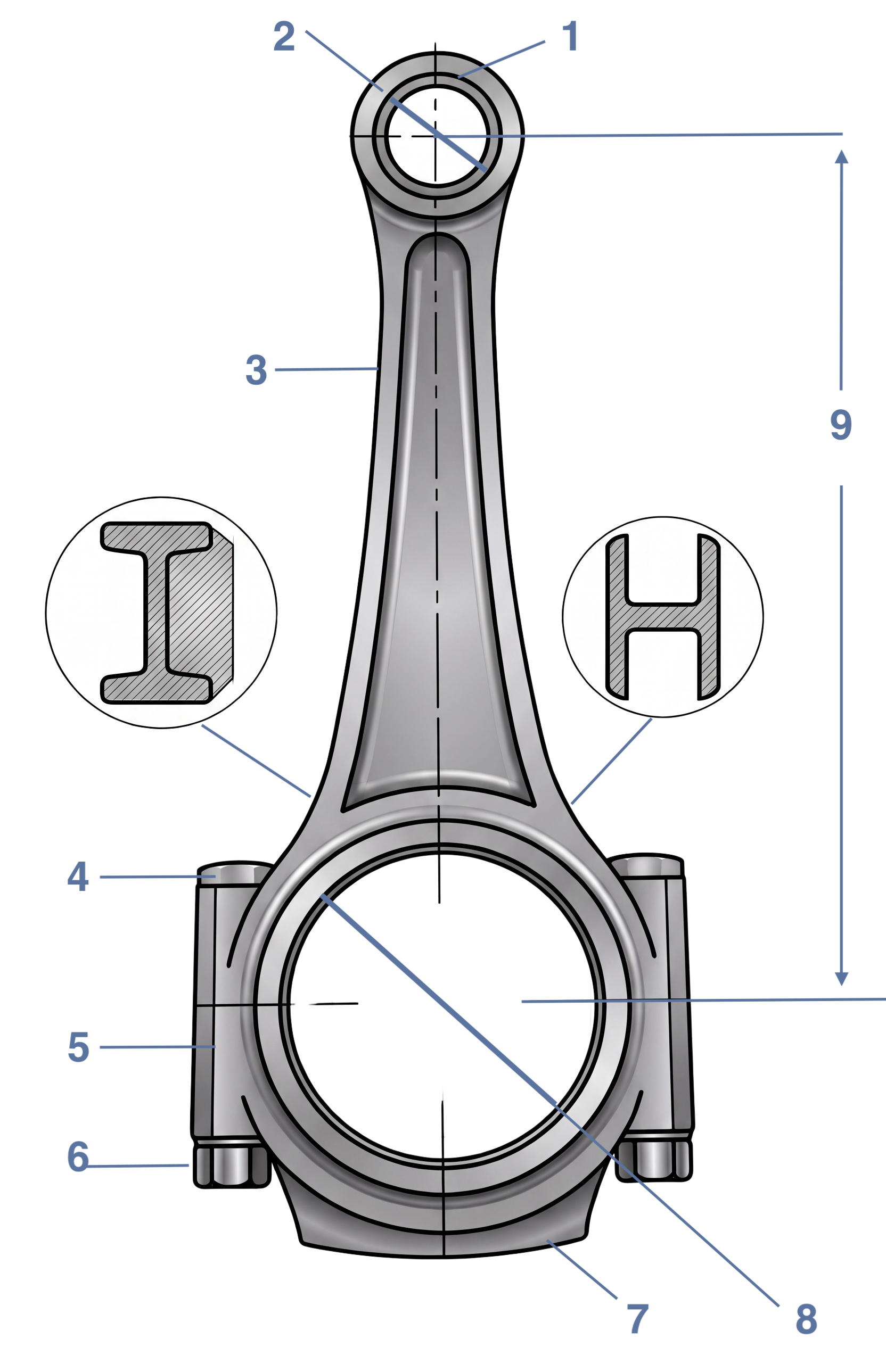 | 1) Small end 2) Small-end diameter 3) Rod beam 4) Rod bolt 5) Big end 6) Rod nut / bolt 7) Rod cap 8) Big-end diameter 9) Center-to-center |
This table gathers the vehicles powered by the Audi Volkswagen 1.4L 16V TSI EA111. Measure the piston pin diameter and the rod length before ordering to rule out any fitting error. Variant concerned: 19 mm pin.
| Make | Model (chassis) | Engine code | Power | Years |
|---|---|---|---|---|
| Volkswagen | Golf V / VI, Golf Plus V, Jetta III / IV, EOS, Scirocco III, Beetle, Tiguan | CAVD | 160 hp | 2008–2018 |
| Audi | A1 (8X1, 8XK / 8XA, 8XF) | CAXA | 122 hp | 2010–2015 |
| SEAT | Toledo IV (KG3) | CAXA | 122 hp | 2012–2015 |
| Škoda | Octavia II (1Z), Rapid (NH), Yeti (5L) | CAXA | 122 hp | 2008–2015 |
| Volkswagen | Golf V / VI, Golf Plus V, EOS | CAXA | 122 hp | 2007–2016 |
| SEAT | Alhambra (710, 711) | CAVA | 150 hp | 2010–2015 |
| Volkswagen | Jetta IV, Sharan (7N), Tiguan (5N) | CAVA | 150 hp | 2007–2018 |
| Volkswagen | Golf V (1K1), Golf Plus V, Jetta III (1K2), Touran (1T) | BLG | 170 hp | 2005–2010 |
Replacing the factory rods with forged rods during a build remains the most cost-effective spend: it costs only a fraction of a new engine or of a full rebuild after failure. On a heavily worked 1.4 TSI, a forged rod prevents the failure that takes out block, crankshaft and cylinder head. It is a lasting mechanical insurance to unlock the engine’s potential with peace of mind.