Product successfully added to your shopping cart
Quantity
Total
There are 0 items in your cart. There is 1 item in your cart.
Total products
Total shipping To be determined
Total

1.0L 12v - Ecoboost 3-cyl
Manufacturers
1.0L 12v - Ecoboost 3-cyl
Warning: Last items in stock!
New product
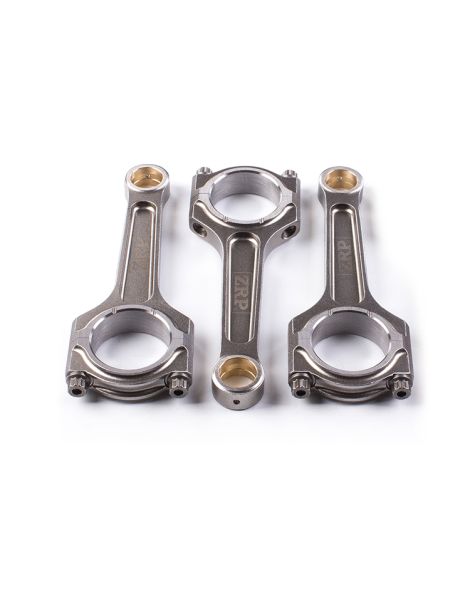
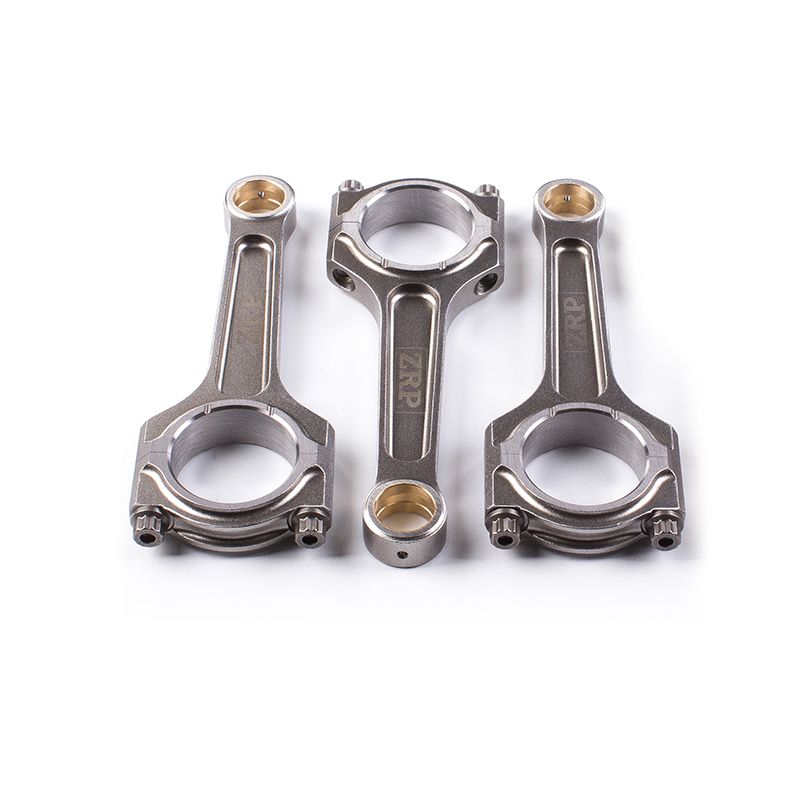
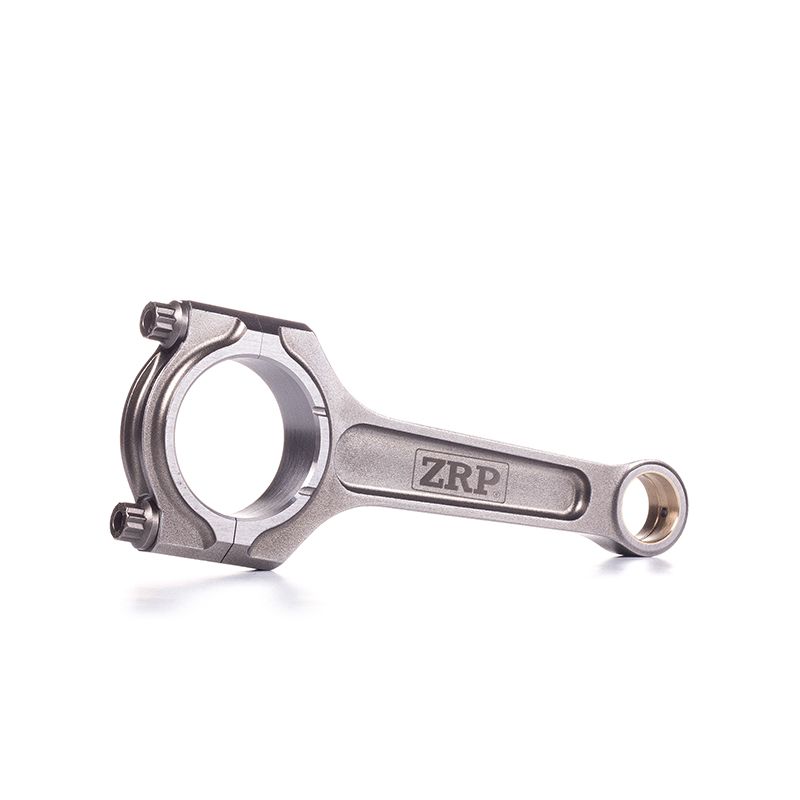
Set of 3 forged connecting rods in 4340 steel for the Ford 1.0L 12V Turbo EcoBoost.
The 1.0 EcoBoost is the 999 cc turbocharged three-cylinder Ford has been building since 2012. Its very long-stroke dimensions (71.9 mm bore, 82 mm stroke) and its turbocharger give it torque early on despite a tiny displacement, which is why it ended up powering a large part of the maker’s range.
The trade-off is a hard-working engine: only three cylinders to make the power, high boost pressure from the factory and a bottom end sized as tightly as possible. The standard rod uses a fractured cap and is not sold on its own, which leaves few options once it is damaged.
That is exactly where a forged rod earns its place. A die-forged beam in treated steel, machined and then weight-matched, lifts the admissible load ceiling well above standard and makes a power increase realistic without gambling on reliability. On a prepared 1.0 EcoBoost it governs both the ability to rev and the life of the crankshaft.
Machined from high-strength 4340 forged steel, these reinforced forged connecting rods secure the bottom end of the 1.0 EcoBoost as soon as power climbs beyond the factory target. They become essential when fitting forged pistons, raising the rev limit, increasing boost pressure or chasing extra torque, situations where the sintered-metal original rod eventually bends or breaks. Designed to absorb the heavy loads of highly tuned small three-cylinder turbo engines, these I-beam rods fitted with ARP 2000 bolts cover every discipline (rally, drift, drag, circuit and track days, hillclimb, time attack) and support Stage 2, Stage 3 and Stage 4+ builds, right up to full competition engines. Each rod is balanced and supplied with its high-performance bolts.
| Reference | Brand | Profile | Bolts | Pin diameter OEM 20 mm | Small-end width | Big-end diameter OEM n.p. | Big-end width | Center-to-center OEM 137 mm | Weight per rod |
|---|---|---|---|---|---|---|---|---|---|
| R-FOR-006-I | ZRP | I | ARP 2000 - 5/16" - 38 mm | 20 | - | 43 | 19,55 | 137 | 383 g |
ZRP: Straight, non-tapered pin end.
| Rod | Bolts | Torque | Recommended stretch |
|---|---|---|---|
| ZRP - I | ARP 2000 | 40,7 N·m | 0,140 – 0,152 mm |
On this three-cylinder EcoBoost, only six bolts hold the rod caps closed, so every one of them matters. A torque reading says nothing about the force actually installed in the bolt, because a large share of the effort is lost to friction in the threads and under the head. The figures in the table above are those specified by the bolt manufacturer and must be applied without interpretation. Checking bolt stretch with a dial gauge remains the reference method: it measures how far the bolt has elongated, and therefore the preload truly achieved. Degreased threads, an even film of ARP assembly lubricant, progressive tightening in several alternating passes: on 5/16 inch ARP 2000 bolts these details make all the difference. The instruction sheet supplied with the kit always takes precedence.
| 4340 steel is a nickel-chromium-molybdenum alloy steel used in aerospace and motorsport alike. Forged then heat-treated (quench and temper), it offers excellent tensile strength, high fatigue resistance and real ductility. Compared with an original rod (often sintered/powder metal, optimised for series-production cost), a 4340 forged rod shows roughly +19% higher yield strength, +8% higher tensile strength and above all +19% to +37% higher fatigue strength, i.e. a fatigue life under cyclic loading several times longer. This is what makes forged 4340 the reference material as soon as boost and rpm climb. |
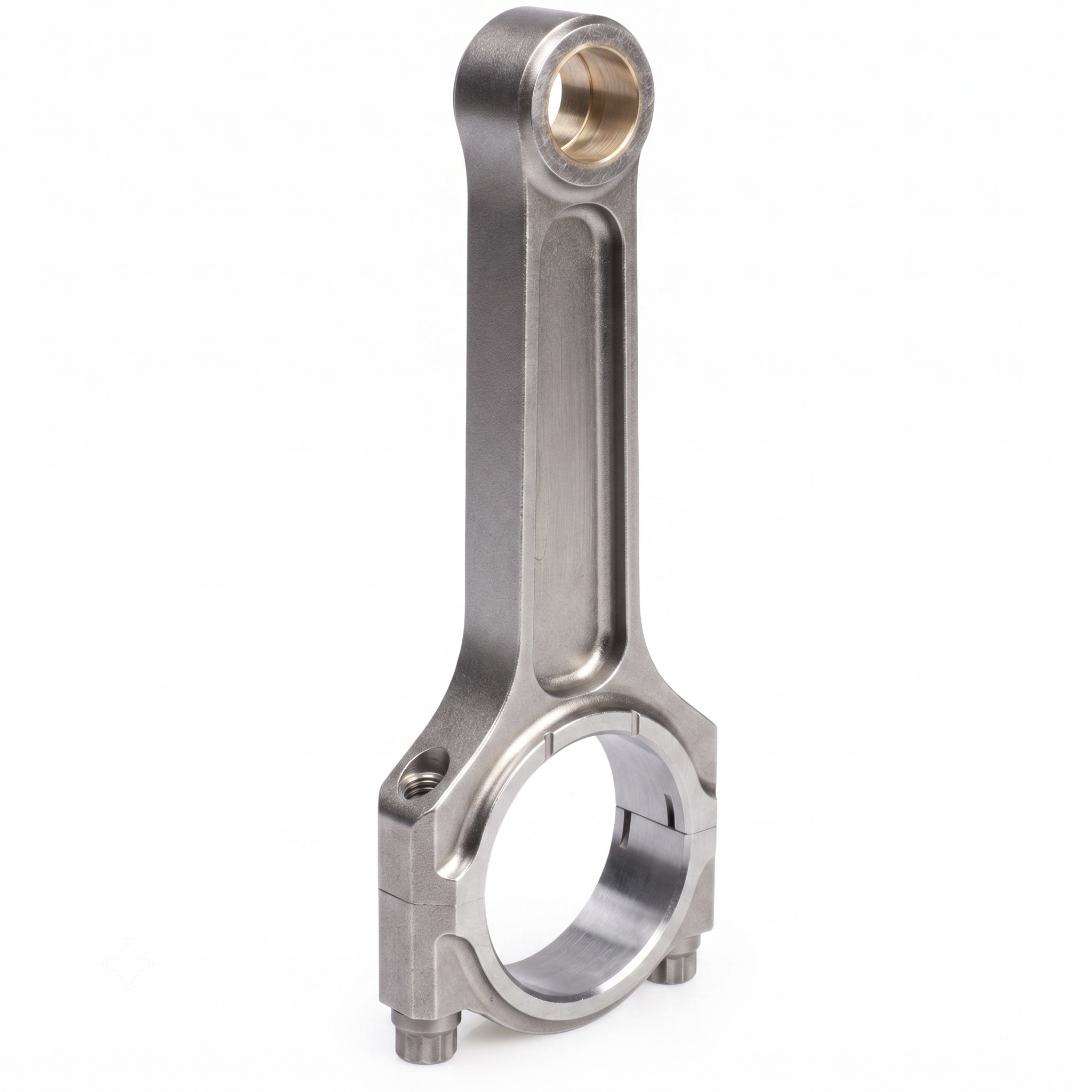 | I-Beam profile. With its slimmer central section, the I-Beam rod is lighter: less inertia and freer rev pickup. It is the most common profile on modern turbo engines and the natural choice for a 1.0 EcoBoost build focused on revs. |
On a rod bolt, metallurgy counts for more than size. The alloy grade sets the yield strength and the tensile strength, heat treatment carried through the section gives uniform hardness, and the rolling of the threads, done after that treatment, work-hardens the thread root and pushes back the fatigue crack initiation. The chemistry of the steel finally determines corrosion resistance and any sensitivity to hydrogen. This 1.0-litre EcoBoost three-cylinder is supplied with ARP 2000 hardware in 5/16"-38 mm: refer to the table for torque and stretch, and always check the tightening by measured stretch.
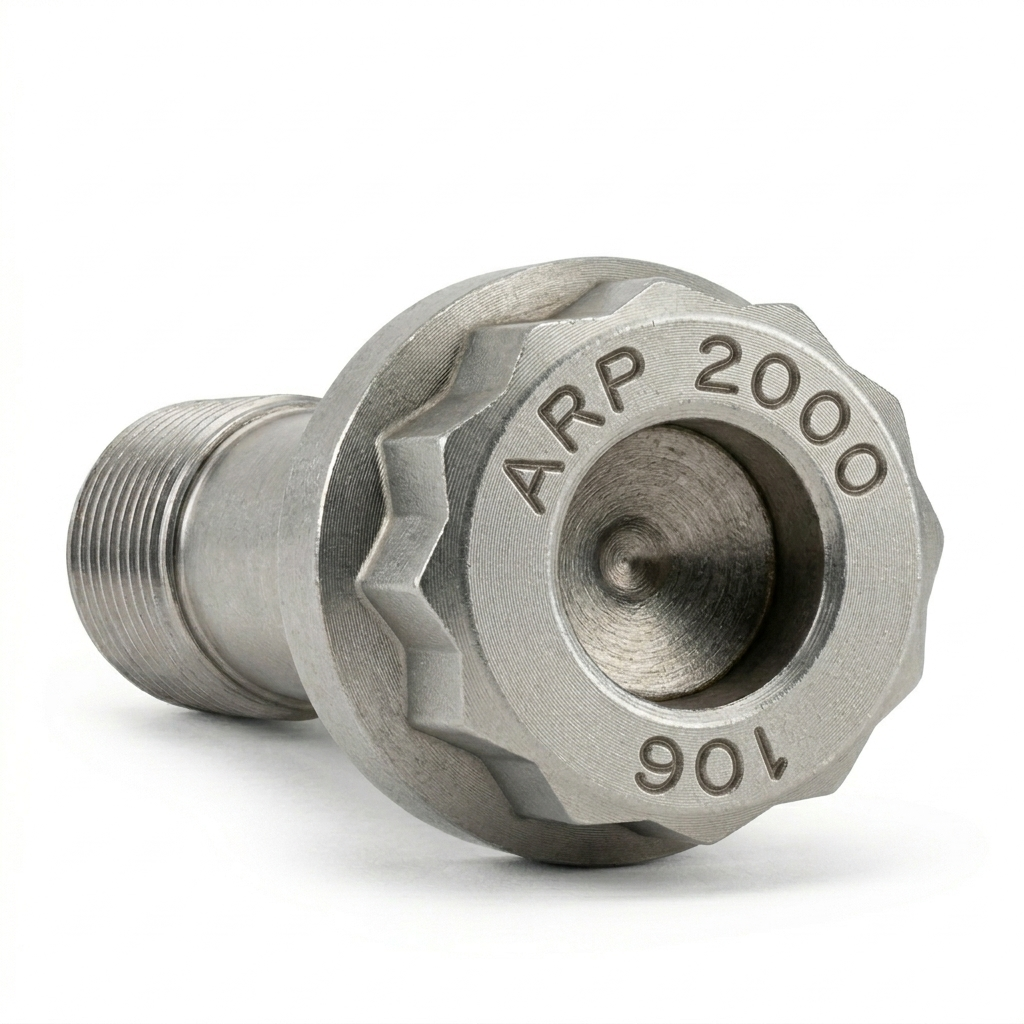 | ARP 2000 is a wrought, through-hardened steel with tensile strength around 220,000 psi, i.e. ~1,517 MPa; its threads are rolled after heat treatment, which gives excellent cyclic fatigue endurance, and its composition makes it stable against ambient corrosion, with no storage constraint. The grade is rated up to 150 hp per cylinder for a 5/16" bolt and up to 8,500 rpm, and remains the most common in circuit racing, trackdays, drift, rally, drag and hillclimb. On this EcoBoost three-cylinder it is offered in 5/16" diameter and 38 mm width, matching the ZRP I-profile rod. |
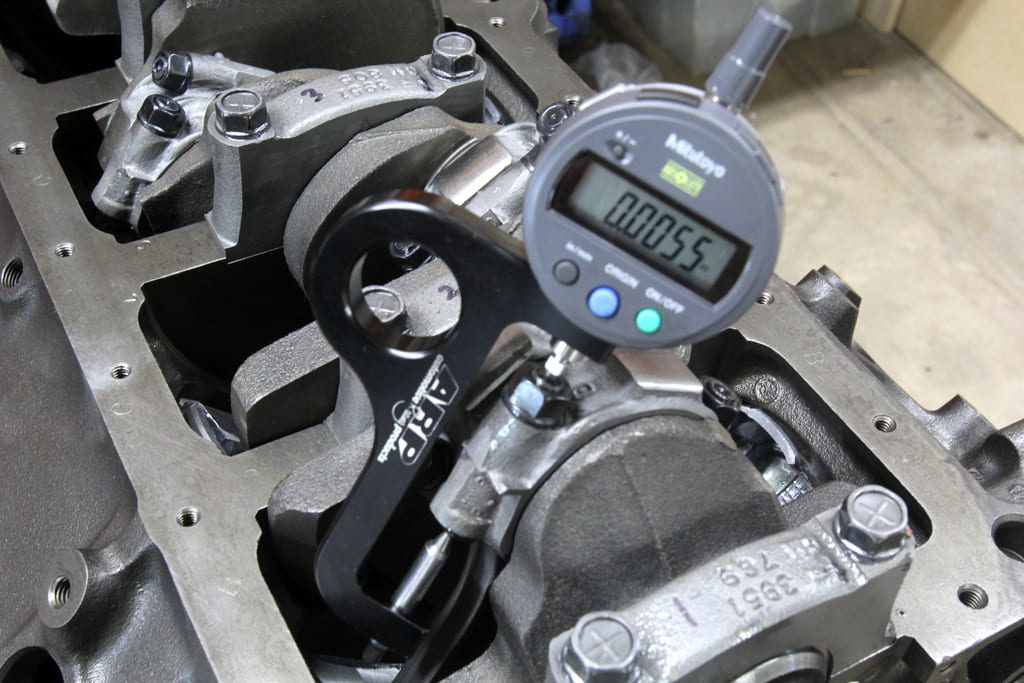
In addition to torque tightening, measuring rod-bolt stretch is the most reliable check for optimal preload. The check is done with the bolt fitted: place the gauge (dial indicator) on the two ends of the bolt and read its actual stretch, which must match the recommended value (see the torque & stretch table above). This method removes the friction variations inherent in torque tightening and secures the assembly on heavily stressed engines. |
 | ZRP is the Greek brand of Alex Drakos, whose Athens workshop covers design, forging and machining. For this three-cylinder the rod is made in 4340 steel, machined on every face, then weighed and matched to ±1 g, care that counts on an engine with a short, heavily loaded crankshaft. The I profile comes with 5/16" ARP 2000 hardware. The brand built its experience in rallying, on track and in drift. |
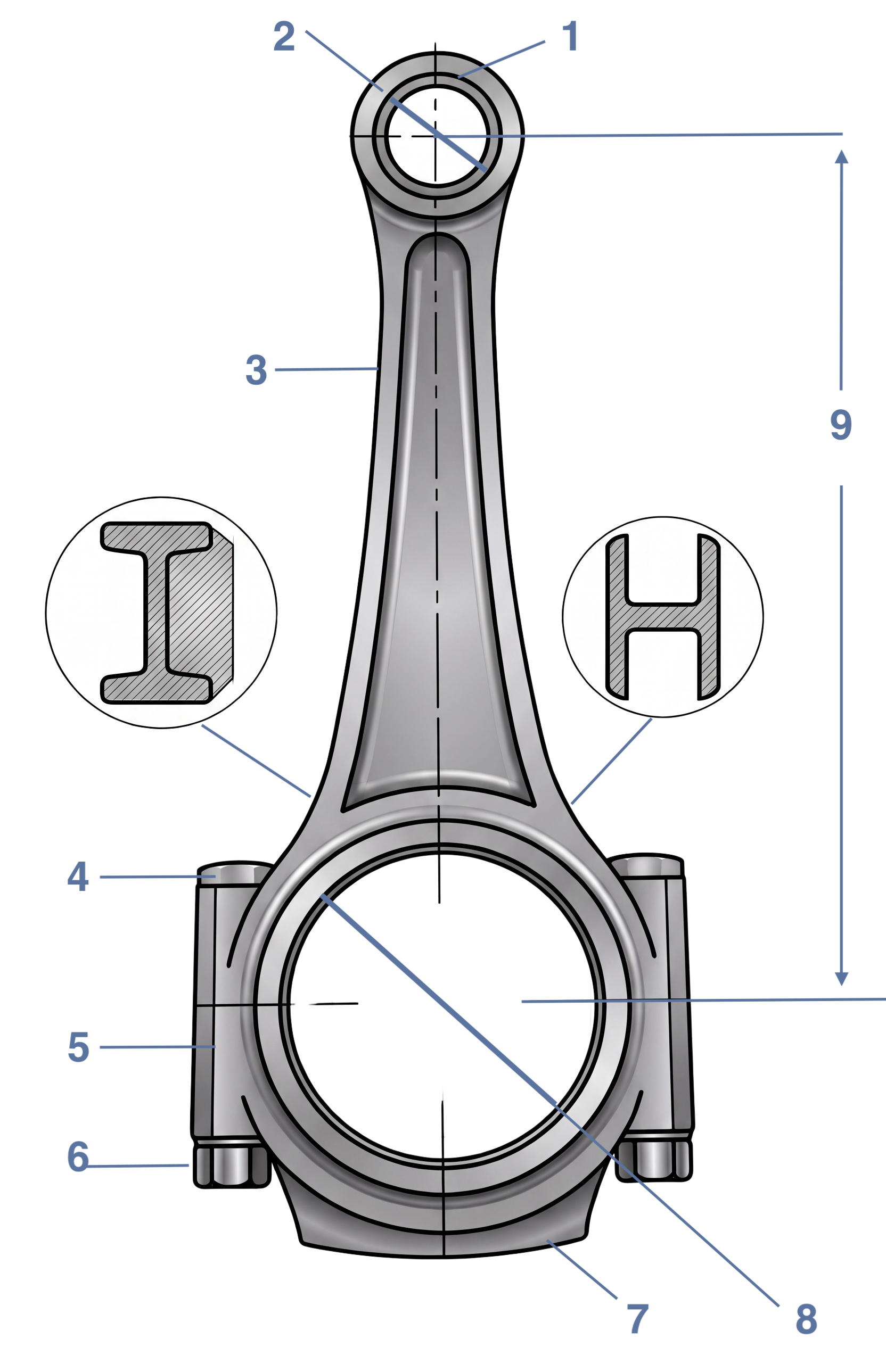 | 1) Small end 2) Small-end diameter 3) Rod beam 4) Rod bolt 5) Big end 6) Rod nut / bolt 7) Rod cap 8) Big-end diameter 9) Center-to-center |
These forged rods are designed for the Ford 1.0 EcoBoost three-cylinder engine, codes SFJA, SFJB, SFJC, SFJD, M1JH, M1JE, fitted notably to the Ford Fiesta and Focus 1.0 EcoBoost.
OEM reference: rod not sold separately (fractured-cap design specific to the EcoBoost range).
Investing in forged connecting rods means, above all, protecting the whole engine. A stock rod that lets go almost always destroys the block, the crankshaft and the cylinder head.
For the 1.0 EcoBoost, the extra cost of forged rods is nothing compared with the price of a full rebuild after a failure. It is the guarantee of a reliable build, able to handle the added power over time.
With their included ARP hardware and a versatile I-Beam profile, these forged connecting rods offer the best balance of performance, mechanical safety and durability for your Ford 1.0 EcoBoost.