Product successfully added to your shopping cart
Quantity
Total
There are 0 items in your cart. There is 1 item in your cart.
Total products
Total shipping To be determined
Total

TRIUMPH TR7 2.0 SOHC
Manufacturers
TRIUMPH TR7 2.0 SOHC
 View larger
Warning: Last items in stock!
New product
ARP rod bolts and nuts ARP-206-6006 in 8740 for OEM rods of the Triumph TR7 2.0 litre SOHC.
With this kit ARP targets the 2.0 litre (1,998 cc) single-overhead-camshaft four-cylinder of the Triumph TR7, built from 1975 to 1982 in versions I and II.
This ARP kit replaces the original rod bolt with 8740 steel bolts pressed into the rods and closed by nuts. In the documentation for this kit ARP says nothing about the part number or the diameter of the bolt fitted originally.
At every engine revolution, the rod and piston assembly pulls on the rod cap, and only its bolts hold it against these inertia loads. The original ones are intended for stock power.
The ARP 206-6006 bolts, in 8740, are preferably tightened by stretch, the method ARP advocates; without a gauge, the instruction sheet gives 74.6 Nm. 8740 is a chrome-moly steel that ARP heat treats to 180,000 psi tensile strength, with threads rolled after heat treatment. As a reference point, standard engine fasteners mostly belong to classes 10.9 and 12.9, i.e. 150,800 to 176,900 psi minimum strength.
| Part number | Brand | Grade / material | Nut | Thread | Under-head length |
|---|---|---|---|---|---|
| ARP-206-6006 | ARP | 8740 steel | Not published | Not published |
Before the bolts are pressed in, ARP asks you to check that the top of each rod bore has a chamfer open enough to clear the radius under the head.
| Reference | Tightening torque | Stretch |
|---|---|---|
| ARP-206-6006 | 74.6 Nm | 0.165 - 0.178 mm |
ARP gives priority to stretch control for an accurate preload; the torque in the table is used only when no gauge is available. Torque and stretch figures in the table apply with ARP lubricant.
Figures taken from the ARP 206-6006 instruction sheet, revision in force on the day of publication. Should any difference appear, the official instruction sheet takes precedence. Read the ARP 206-6006 instruction sheet
Assembly is done without thread locker, as the ARP instruction sheet calls for none: ARP Ultra-Torque grease is applied to the threads of each bolt and to the bearing face of its nut.
Once the fasteners are fitted, the ARP instructions call for the big ends to be checked and resized by a machine shop.
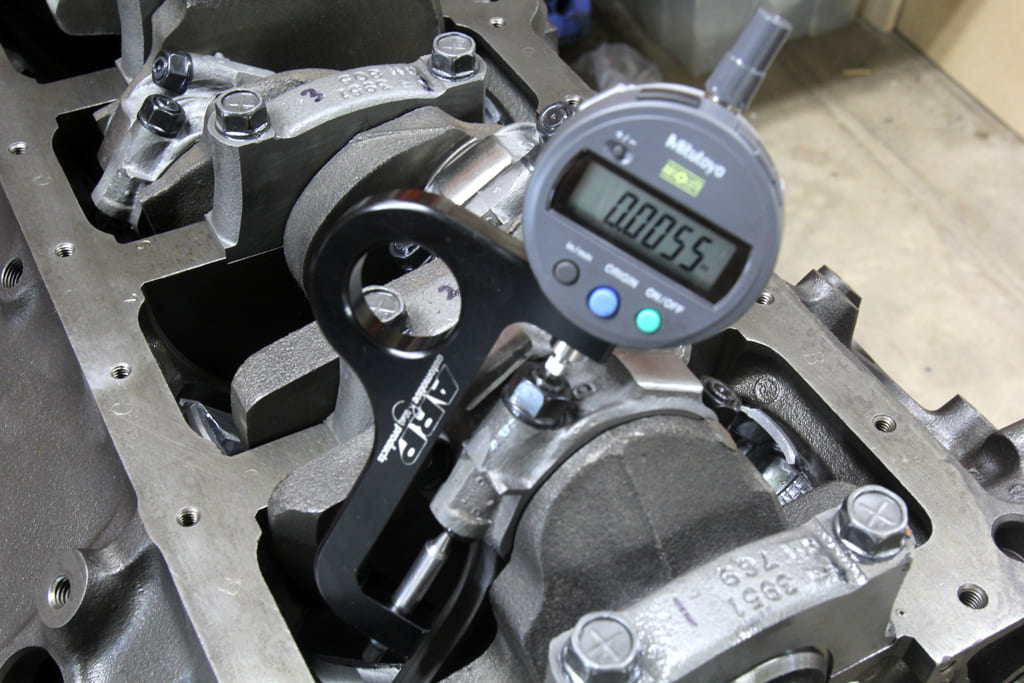
With the stretch gauge, you read directly how much the bolt stretches during tightening: the dial gauge sits on both ends of the fitted bolt, and tightening stops when the stretch reaches the value in the table. Friction no longer comes into play, hence a more consistent preload on a heavily stressed engine.
All the torque and stretch values on this page assume ARP assembly grease on the bolt threads and on the bearing face of the nuts; engine oil does not replace it.
Founded in the early 1970s by Gary Holzapfel, who came from the aerospace sector, ARP (Automotive Racing Products) was born to put an end to fastener-related engine failures in racing. Its thousands of part numbers, designed and manufactured in California for the cylinder head, the main bearings and the connecting rods, come in several materials depending on the application and are recognised for the consistency of their manufacture.
| Brand | Model (chassis) | Engine code | Power | Years |
|---|---|---|---|---|
| Triumph | TR7 I Coupé 2.0 | CG2 | 106 hp | 1975-1981 |
| Triumph | TR7 I Coupé 2.0 | 90 hp | 1975-1981 | |
| Triumph | TR7 I Coupé 2.0 | 129 hp | 1975-1979 | |
| Triumph | TR7 II 2.0 | CG2 | 106 hp | 1979-1981 |
| Triumph | TR7 II 2.0 | 92 hp | 1979 | |
| Triumph | TR7 II 2.0 | 129 hp | 1979-1981 | |
| Triumph | TR7 II 2.0 | 89 hp | 1979-1982 |
A TR7 that is revved higher subjects its rod bolts to harsher inertia loads on every revolution, and the failure of a single one destroys the rod, the piston and the block. An ARP 8740 set weighs little against rebuilding the bottom end.