Product successfully added to your shopping cart
Quantity
Total
There are 0 items in your cart. There is 1 item in your cart.
Total products
Total shipping To be determined
Total

Small Block
Manufacturers
Small Block
Warning: Last items in stock!
New product
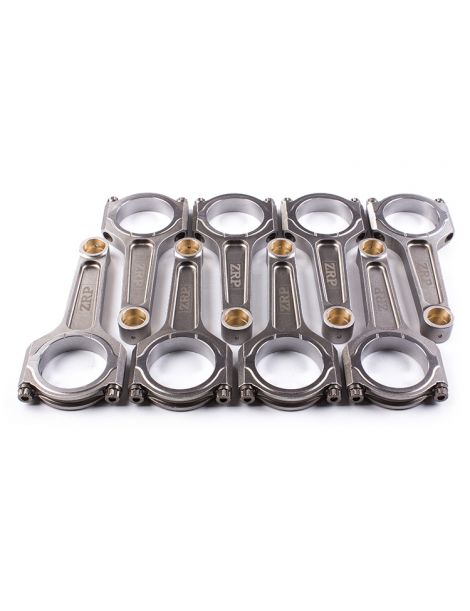
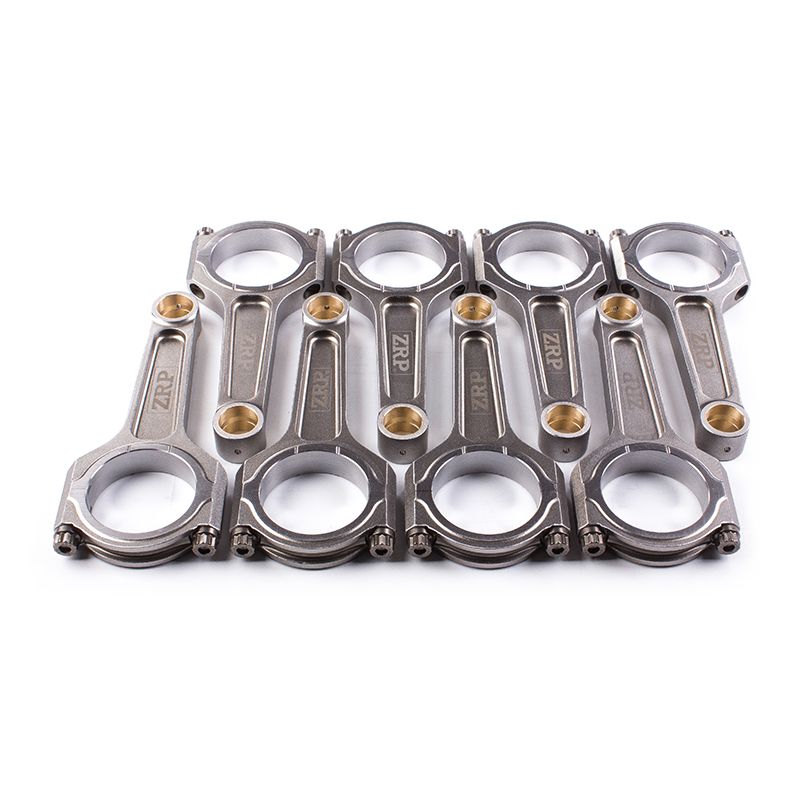
Set of 8 forged connecting rods in 4340 steel for Chevrolet Small Block V8.
Launched in late 1954 for the 1955 model year, the Chevrolet Small Block was General Motors’ first overhead-valve V8, introduced on the Corvette and the Bel Air under the "Turbo-Fire" name. With an initial displacement of 265 ci (4.3 L), this 90° cast-iron block runs on five main bearings, uses a pushrod-operated OHV valvetrain with two valves per cylinder and pairs a 3.75" bore with a 3.00" stroke, good for up to 195 hp in four-barrel form. Light, compact and cheap to build, it permanently established the V8 layout at Chevrolet.
Over the years displacement grew from 265 to 400 ci (6.6 L), passing through 283 ci (4.6 L), 327 ci (5.4 L), 305 ci (5.0 L) and above all the 350 ci (5.7 L), launched in 1967 and now the brand’s benchmark. It powered everything from the Corvette to the Camaro, Chevelle, Nova and C/K pickups, and was adopted by nearly every GM division. Built in more than 90 million units, from carburettor to fuel injection, this first-generation Small Block stayed in service until the early 2000s before giving way to the LT and then LS families.
These rods are forged from high-strength 4340 steel, then machined to the original 144.78 mm centre-to-centre length: they replace the standard Small Block rod directly, without changing the geometry of the bottom end. Replacement becomes necessary as soon as forged pistons are fitted, as soon as the maximum rpm rises, as soon as boost pressure increases or displacement grows, situations in which the standard part has no reserve left.
Intended for built V8s, whether highly tuned naturally aspirated, turbocharged or supercharged, they serve every discipline: rally, drift, drag racing, circuit and track use, hillclimb, time attack. They support Stage 2, Stage 3 and Stage 4+ builds up to a fully rebuilt competition engine; at 570 g per rod in I profile, they keep a controlled mass across the eight cylinders.
| Reference | Brand | Profile | Bolts | Pin diameter OEM 23,55 mm | Small-end width | Big-end diameter OEM 56,52 mm | Big-end width | Center-to-center | Weight per rod |
|---|---|---|---|---|---|---|---|---|---|
| R-SBC-002-I | ZRP | I | ARP 8740 (7/16") | 23.55 mm | 56.52 mm | 23.88 mm | 144.78 mm | 570 g |
| Rod | Bolts | Torque | Recommended stretch |
|---|---|---|---|
| ZRP (R-SBC-002-I) | ARP 8740 (7/16") | 88,1 N·m | 0,127–0,140 mm |
Common practice on this 144,78 mm centre-to-centre version is a dry run off the engine before final assembly: the rod is clamped on the bench, the cap tightened with nothing in it, and you watch how the bolt responds on the gauge. That way, before the crank goes in, you know at what torque level the expected stretch actually appears for this particular batch of bolts. The table gives the values specified by the bolt manufacturer, ARP 8740; they must be followed scrupulously, stretch read on the gauge remaining the only reference method for validating the final tightening.
| 4340 is a low-alloy nickel-chromium-molybdenum steel, as common in aerospace as in motorsport. Forged then heat-treated by quenching and tempering, it combines high tensile strength, excellent fatigue life and real ductility. Compared with a factory rod, usually sintered and sized for production cost, a forged 4340 rod gains around +19% in yield strength, +8% in tensile strength and, above all, +19 to +37% in fatigue strength, i.e. a service life under cyclic load several times higher. This is exactly why forged 4340 becomes essential as soon as rpm and boost climb. |
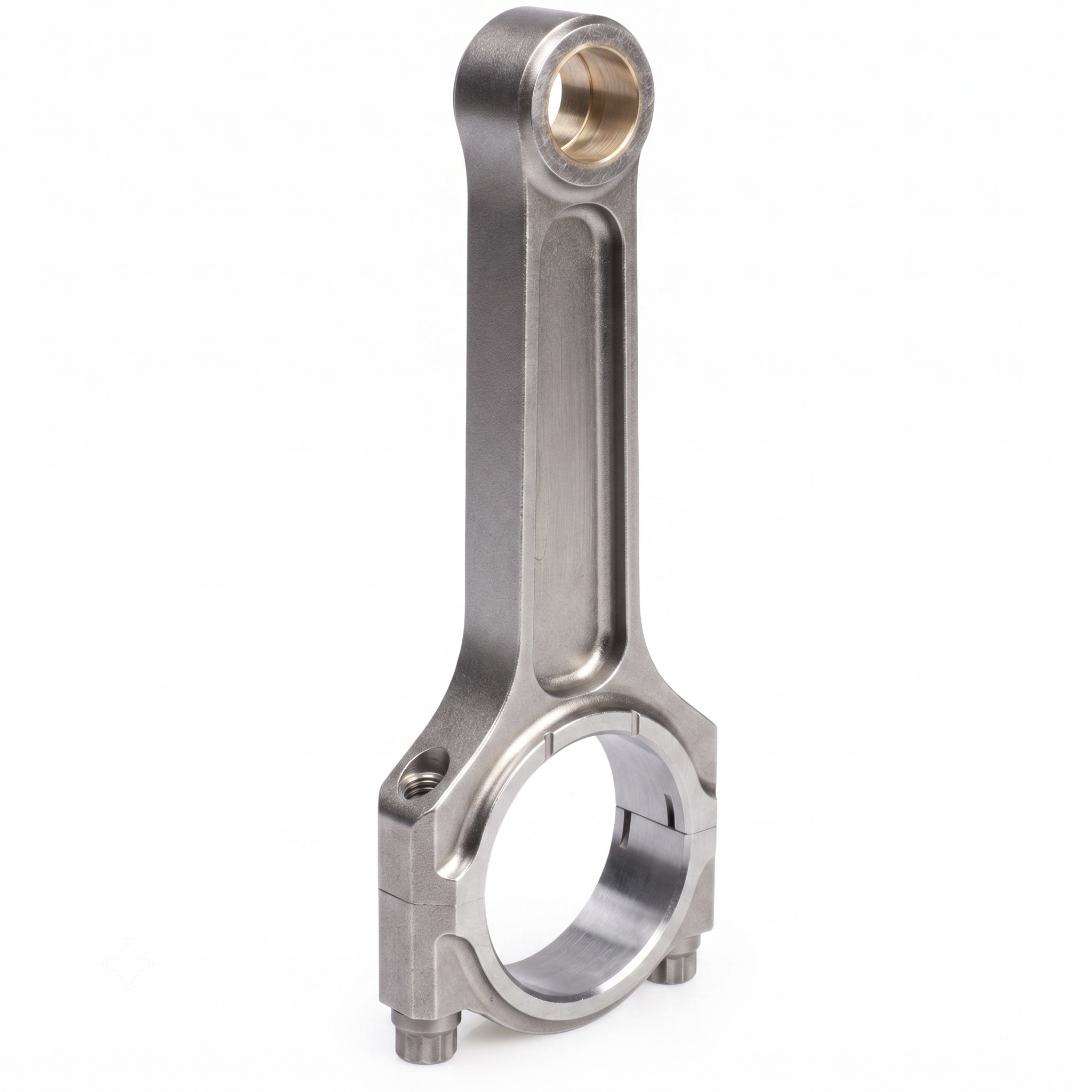 | I-beam profile. Its slimmed central section cuts mass: less inertia, sharper rpm pick-up and lower stress on the bolts. It is the preferred profile on heavily worked V8s such as the built Small Block, where a light assembly is wanted without giving up strength. |
On a Small Block the rod bolt is the first mechanical stop of the bottom end: it decides the rpm that can be held and the acceptable cylinder pressure. The grade is therefore reasoned by use: low-rpm torque in rally or hillclimb, high rpm held for long minutes in circuit and track use, short repeated peaks in drag racing. Target power per cylinder completes the choice. This reference is fitted with the ARP 8740 bolt in 7/16", respecting the torque and stretch of the table, without exception.
| ARP 8740 (7/16") is the grade fitted on this Small Block reference. Torque and recommended stretch are set by the bolt manufacturer and given in the table above; that is the only reference to follow. |
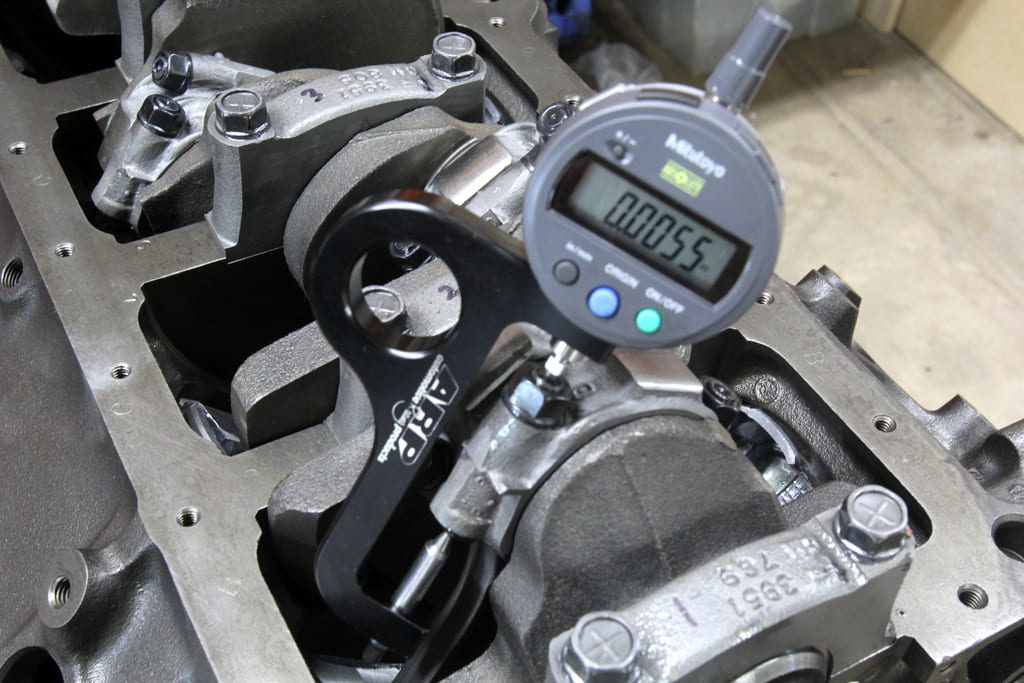
| Beyond torque tightening, measuring rod-bolt stretch is the most reliable check for reaching the target preload. It is done with the bolt fitted: place the dial gauge on both ends of the bolt and read the actual stretch, which must match the specified value (see the torque and stretch table above). By removing the friction variations inherent to torque tightening, this method secures the assembly of heavily loaded engines. |
 | ZRP is a Greek brand of high-performance forged connecting rods founded by Alex Drakos in Athens. Each rod is forged from 4340 steel, precision-machined and balanced to ±1 g to stay reliable at high rpm. Offered here in I-beam profile with ARP 8740 (7/16") bolts, they are designed and inspected in Greece, then proven in rally, on track and in drift. |
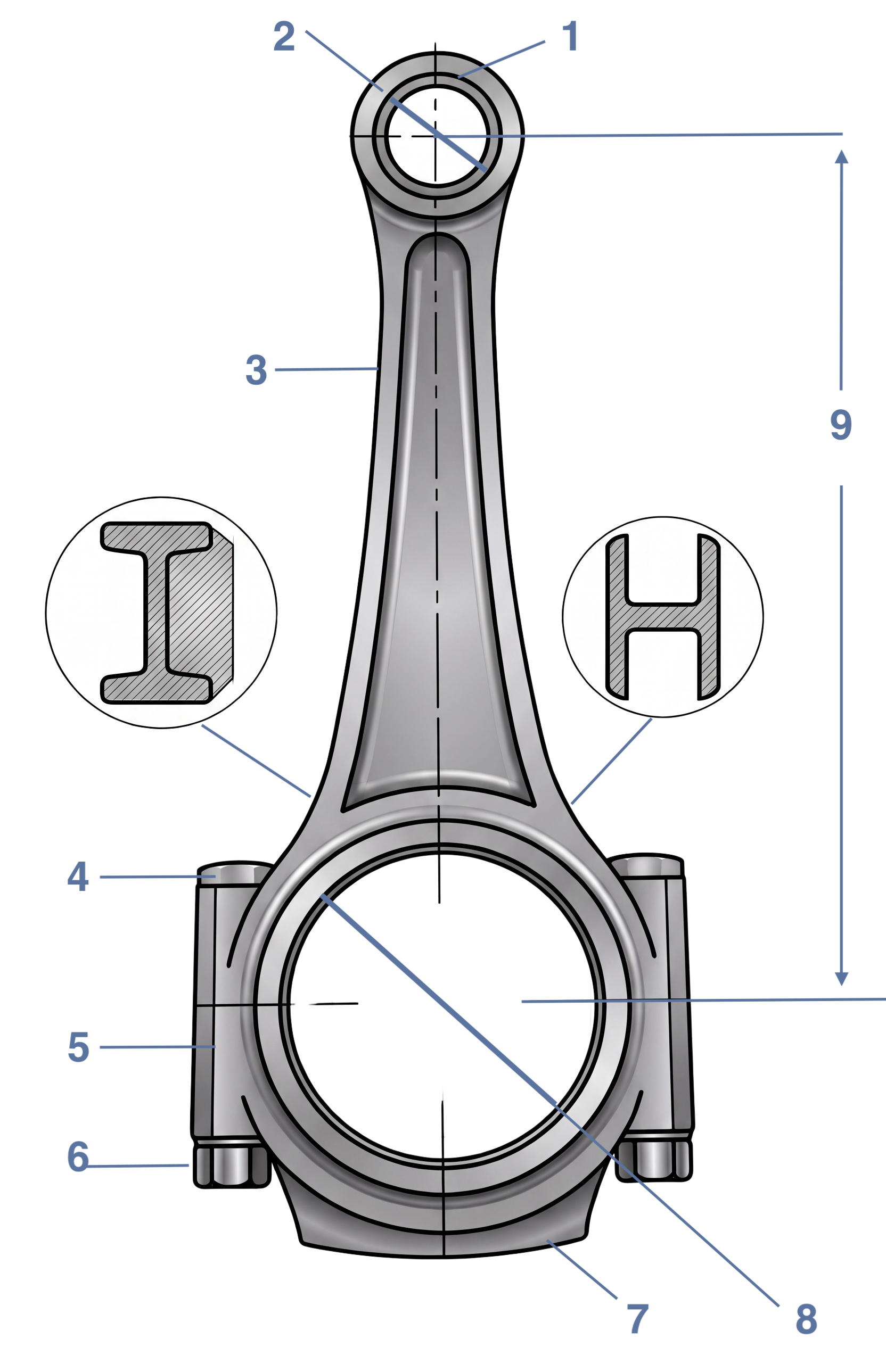 | 1) Small end 2) Small-end diameter 3) Rod beam 4) Rod bolt 5) Big end 6) Rod nut / bolt 7) Rod cap 8) Big-end diameter 9) Center-to-center |
These forged rods, at the original 144.78 mm centre-to-centre length, cover the whole family of first-generation Chevrolet Small Block V8 engines, from the 265 to the 400 ci:
| Brand | Model (chassis) | Engine code | Power | Years |
|---|---|---|---|---|
| Chevrolet | Corvette, Bel Air | 265 cu in (4.3 L) | 1955–1957 | |
| Chevrolet | Impala, Bel Air, Corvette | 283 cu in (4.6 L) | 1957–1967 | |
| Chevrolet | Corvette, Chevelle, Nova | 327 cu in (5.4 L) | 1962–1969 | |
| Chevrolet | Camaro, Corvette, C/K | 350 cu in (5.7 L) | from 1967 | |
| Chevrolet | Caprice, Monte Carlo, C/K | 400 cu in (6.6 L) | 1970–1980 | |
| Chevrolet | Camaro, Monte Carlo, C/K | 305 cu in (5.0 L) | from 1976 |
OEM reference:
On this V8, a broken standard rod is not settled with a single part: the matching piston nearly always has to be replaced, and both block and crankshaft must be checked. Rebuilding the engine with original parts therefore means buying rods and pistons, a substantial outlay for an engine that will simply find its starting limits again.
For an equivalent, often lower budget, forged 4340 rods combined with forged pistons change the level of reliability and the safety margin of the bottom end, while opening real room to increase power. European engine builders have relied on this reasoning for more than 15 years, on V8s as well as on boosted four-cylinders.
For the same money: more reliability, more potential, more service life.