Product successfully added to your shopping cart
Quantity
Total
There are 0 items in your cart. There is 1 item in your cart.
Total products
Total shipping To be determined
Total

FORD Escort IV 1983-1994
Manufacturers
FORD Escort IV 1983-1994
 View larger
Warning: Last items in stock!
New product
ARP 8740 steel rod bolt kit for the OEM rods of the Ford CVH 1.6 engine (Escort, Fiesta, Orion, Sierra).
The CVH 1.6 is Ford's 1.6-litre four-cylinder (1,597 cc) with two valves per cylinder; the NGK catalogue lists it under codes LP1, LPA, LR1, LRA, LUA, LUAE, LNA, L4B, LUC, LNB, LJF and others, on the Escort from 1980 to 1993, the Fiesta from 1984 to 1994, the Orion from 1983 to 1992 and the Sierra from 1987 to 1993, from the naturally aspirated engine to the turbo version.
For this engine, whose original rod bolts are not published, ARP offers a set of rod cap screws without washer, in M8 x 1.0 and 43 mm under the head, that takes the place of the stock bolts.
Few parts of the bottom end work as hard as the rod bolt: at every revolution, it is what stops the cap from pulling away under the inertia loads of the rod and piston assembly. The original bolt is designed for stock power and is single-use.
This 8740 set replaces the bolts of the standard rods. ARP recommends checking the stretch, 0.140 to 0.152 mm; without a gauge, its instruction sheet specifies 33.9 Nm. Material: 8740, a chrome-moly steel heat treated by ARP to 180,000 psi tensile strength, with threads rolled after heat treatment. Factory-fitted fasteners usually fall into classes 10.9 and 12.9, between 150,800 and 176,900 psi minimum. In 8740, these bolts are rated for 8,750 rpm at most (calculated estimate).
| Part number | Brand | Grade / material | Head | Thread | Under-head length |
|---|---|---|---|---|---|
| ARP-151-6004 | ARP | 8740 steel | Not published | M8 x 1.0 | 43 mm |
The ARP instruction sheet asks you to make sure, before fitting, that the cap bolt hole is chamfered enough to clear the fillet under the head.
| Reference | Tightening torque | Stretch |
|---|---|---|
| ARP-151-6004 | 33.9 Nm | 0.140 - 0.152 mm |
For this part, ARP favours tightening to a measured stretch, the key to an exact preload; torque is given only when no gauge is available. The figures in the table assume ARP lubricant.
Source of the torque and stretch figures: ARP 151-6004 instruction sheet, in the revision applicable at publication. The manufacturer's instruction sheet prevails in the event of any difference. Read the ARP 151-6004 instruction sheet
The ARP instruction sheet does not require a thread locker for this kit; only ARP Ultra-Torque grease is applied, on the threads as well as under the bolt head.
The ARP instructions for this kit require the big ends to be checked and resized once the fasteners are fitted: this job belongs to an equipped machine shop.
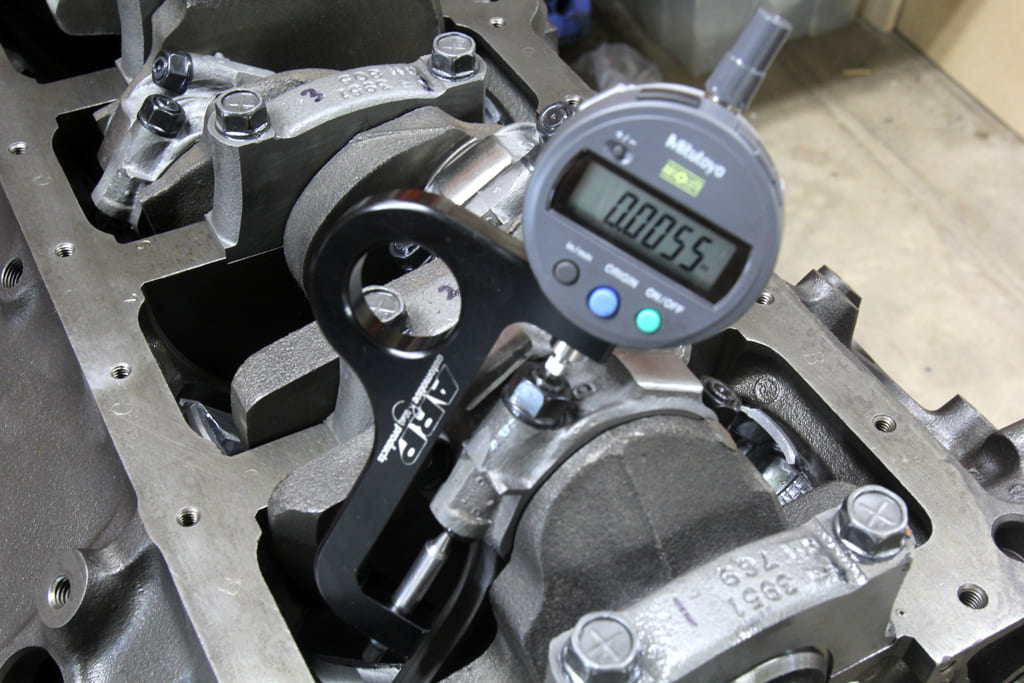
With the stretch gauge, you read directly how much the bolt stretches during tightening: the dial gauge sits on both ends of the fitted bolt, and tightening stops when the stretch reaches the value in the table. Friction no longer comes into play, hence a more consistent preload on a heavily stressed engine.
All the torque and stretch values on this page assume ARP assembly grease on the threads and under the bolt head; engine oil does not replace it.
An engineer with an aerospace background, Gary Holzapfel launched ARP (Automotive Racing Products) in the early 1970s with one goal: to eliminate engine failures caused by weak fasteners in racing. ARP designs and manufactures thousands of part numbers in California, cylinder head, main and rod bolts, in several materials depending on the use, and has become known for the consistency of its manufacturing.
| Brand | Model (chassis) | Engine code | Power | Years |
|---|---|---|---|---|
| Ford | Escort III 1.6 | LP1, LPA | 79 hp | 1980-1985 |
| Ford | Escort III 1.6 | LUA | 97 hp | 1980-1982 |
| Ford | Escort III 1.6 XR3i | LR1, LRA | 105 hp | 1982-1985 |
| Ford | Escort III RS 1600i | LUAE | 115 hp | 1982-1985 |
| Ford | Escort III 1.6 RS Turbo | LNA | 132 hp | 1984-1985 |
| Ford | Escort III 1.6 i | L4B | 90 hp | 1985 |
| Ford | Escort IV 1.6 i | L4B, LUC | 90 hp | 1986-1990 |
| Ford | Escort IV 1.6 XR3i | LR2, LRB | 105 hp | 1986-1990 |
| Ford | Escort IV 1.6 Turbo RS | LNB | 132 hp | 1986-1990 |
| Ford | Escort IV 1.6 | LP2 | 79 hp | 1986-1990 |
| Ford | Escort IV 1.6 i | LJB | 102 hp | 1989-1990 |
| Ford | Escort IV 1.6 | LUG | 88 hp | 1989-1990 |
| Ford | Escort V 1.6 | LJF | 105 hp | 1990-1993 |
| Ford | Escort V 1.6 | LUJ, LUK | 90 hp | 1990-1992 |
| Ford | Fiesta II 1.6 XR2 | LUD | 95 hp | 1984-1989 |
| Ford | Fiesta II 1.6 XR2 | LUB | 97 hp | 1984-1989 |
| Ford | Fiesta II 1.6 | LP3 | 79 hp | 1985-1989 |
| Ford | Fiesta III 1.6 XR2i | LJD | 103 hp | 1989-1993 |
| Ford | Fiesta III 1.6 XR2i | LJC | 110 hp | 1989-1994 |
| Ford | Fiesta III 1.6 | LUH | 88 hp | 1989-1994 |
| Ford | Fiesta III 1.6 | LUH | 90 hp | 1989-1992 |
| Ford | Fiesta III 1.6 Turbo | LHA | 131 hp | 1990-1992 |
| Ford | Orion I 1.6 | LP1, LPA | 79 hp | 1983-1986 |
| Ford | Orion I 1.6 i | LR1, LRA | 105 hp | 1983-1986 |
| Ford | Orion II 1.6 | LUC | 90 hp | 1985-1990 |
| Ford | Orion II 1.6 i Cat | L4B | 90 hp | 1986-1990 |
| Ford | Orion II 1.6 i | LRB | 105 hp | 1986-1990 |
| Ford | Orion II 1.6 i | LJB | 102 hp | 1986-1990 |
| Ford | Orion II 1.6 | LUG | 88 hp | 1986-1990 |
| Ford | Orion III 1.6 i | LJF | 105 hp | 1990-1992 |
| Ford | Orion III 1.6 | LUJ, LUK | 90 hp | 1990-1992 |
| Ford | Sierra II 1.6 | LSE | 75 hp | 1987-1993 |
| Ford | Sierra II 1.6 | LSF | 72 hp | 1988-1993 |
| Ford | Sierra II 1.6 i | L6B | 80 hp | 1989-1993 |
A single original bolt letting go is enough to destroy the bottom end of a tuned CVH 1.6, whereas ARP 8740 bolts cost far less than a complete rebuild.