Product successfully added to your shopping cart
Quantity
Total
There are 0 items in your cart. There is 1 item in your cart.
Total products
Total shipping To be determined
Total

BY REFERENCE COMETIC - Reinforced cylinder head gaskets
Manufacturers
BY REFERENCE COMETIC - Reinforced cylinder head gaskets
Warning: Last items in stock!
New product
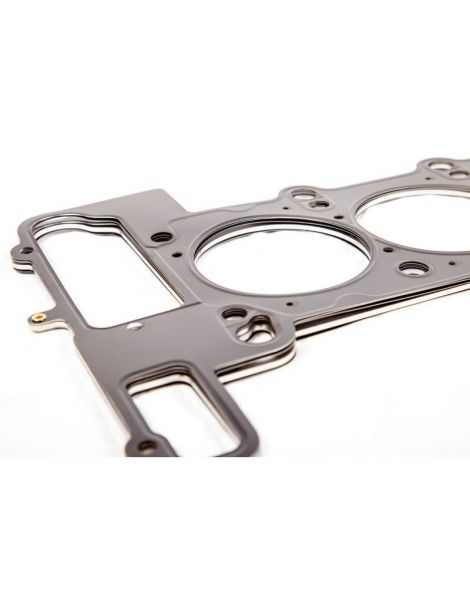
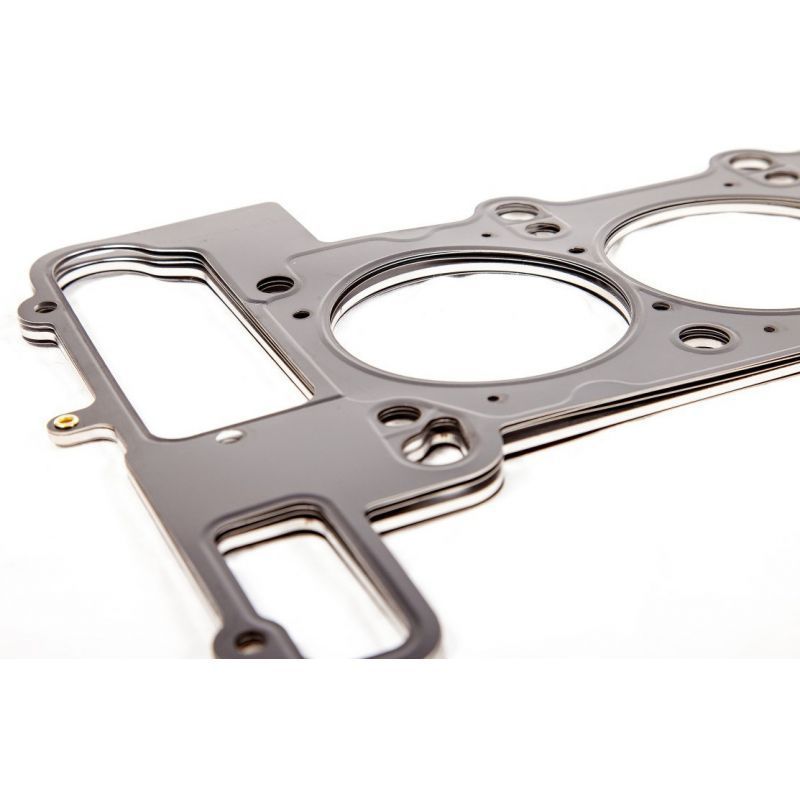
Reinforced Cometic head gasket in multilayer MLS and in CFM-20 for Ford Essex V6 engines of 3.0 litres.
The Ford Essex V6 of 3.0 litres, identified by the codes HYF, HY, EV30H, TV30HYU and TV30LY, powers the Capri, Granada, Consul and Sierra II models detailed below.
The original gasket of these engines carries the part number 1482291. Ford publishes neither its bore, nor its thickness, nor its construction. It is sized for standard pressure: when that rises, clamping eases off, the cylinder head lifts and coolant reaches a cylinder.
The head gasket does not seal on its own: the fasteners that clamp the head to the block count as much as it does. Beyond 100 N/mm², a composite gasket settles for good; the 301 stainless steel of MLS gaskets withstands 517 N/mm², 5 times more, and regains its shape at every combustion.
This page gathers the part numbers of Cometic, an American maker of competition gaskets, in two constructions: the multi-layer steel MLS and the CFM-20, with a steel core covered by an asbestos-free compound. The bores are 95.5, 96.5 and 97 mm and the thicknesses run from 0.69 to 3.56 mm, enough to adjust the compression ratio without touching the pistons or the cylinder head. As a rule, the gasket bore chosen is at least 0.5 mm larger than the actual cylinder bore. Each part number is sold individually and for one cylinder bank only: one is needed on the right and one on the left.
| Gasket bore | Thickness | Gasket volume | Gasket type OEM not specified | Brand | Part number OEM 1482291 |
| 95.5 mm | 0.69 mm | 4.94 | MLS | Cometic | C4971-027 |
| 95.5 mm | 0.76 mm | 5.44 | MLS | Cometic | C4971-030 |
| 95.5 mm | 0.91 mm | 6.52 | MLS | Cometic | C4971-036 |
| 95.5 mm | 1.02 mm | 7.31 | MLS | Cometic | C4971-040 |
| 95.5 mm | 1.14 mm | 8.17 | MLS | Cometic | C4971-045 |
| 95.5 mm | 1.30 mm | 9.31 | MLS | Cometic | C4971-051 |
| 95.5 mm | 1.42 mm | 10.17 | MLS | Cometic | C4971-056 |
| 95.5 mm | 1.50 mm | 10.74 | CFM-20 | Cometic | C14053-059 |
| 95.5 mm | 1.50 mm | 10.74 | CFM-20 | Cometic | H1196059F |
| 95.5 mm | 1.52 mm | 10.89 | MLS | Cometic | C4971-060 |
| 95.5 mm | 1.68 mm | 12.03 | MLS | Cometic | C4971-066 |
| 95.5 mm | 1.78 mm | 12.75 | MLS | Cometic | C4971-070 |
| 95.5 mm | 1.91 mm | 13.68 | MLS | Cometic | C4971-075 |
| 95.5 mm | 2.03 mm | 14.54 | MLS | Cometic | C4971-080 |
| 95.5 mm | 2.18 mm | 15.62 | MLS | Cometic | C4971-086 |
| 95.5 mm | 2.34 mm | 16.76 | MLS | Cometic | C4971-092 |
| 95.5 mm | 2.49 mm | 17.84 | MLS | Cometic | C4971-098 |
| 95.5 mm | 3.05 mm | 21.85 | MLS | Cometic | C4971-120 |
| 95.5 mm | 3.56 mm | 25.50 | MLS | Cometic | C4971-140 |
| 96.5 mm | 1.42 mm | 10.39 | MLS | Cometic | H4387SP2056S |
| 97 mm | 1.50 mm | 11.08 | CFM-20 | Cometic | C14081-059 |
| 97 mm | 1.50 mm | 11.08 | CFM-20 | Cometic | H1196SP1059F |
| 97 mm | 1.52 mm | 11.23 | MLS | Cometic | H4387SP3060S |
The volume of a gasket is the hollow it leaves above each cylinder. That hollow adds to the combustion chamber and lowers the compression ratio, the more so as it is wide. Compare these values only between gaskets of the same bore.
| Fasteners | Engines | Tightening torque |
| Original cylinder head bolts | HYF, HY, EV30H, TV30HYU, TV30LY | not published by the manufacturer |
Before fitting, run a straightedge across the head and block faces to check they are flat, and have them resurfaced if needed. Add no sealing paste: Cometic gaskets arrive already coated.
| CFM-20 Cometic A galvanized steel core covered on both faces with a soft asbestos-free compound. This laminated construction, part metal and part fibre, combines the strength of steel with the softness of the compound. It is offered here in two bores, 95.5 and 97 mm, and in one thickness of 1.5 mm. | |
 | MLS Cometic Stainless steel sheets, stamped and then joined by rivets. The outer sheets carry active beads around each cylinder and each fluid passage. Moderate tightening is enough to seal, and the bore hardly distorts. This versatile construction suits everything from the tuned naturally aspirated engine to moderate boost. |
Gasket bore. Cometic MLS is offered in 95.5 mm (C4971), in 96.5 mm (H4387SP2056S) and in 97 mm (H4387SP3060S); the CFM-20 in 95.5 mm (H1196059F, C14053-059) and in 97 mm (H1196SP1059F, C14081-059).
Thickness. Ford publishes no thickness for the original gasket of these engines. A thicker gasket enlarges the combustion chamber and lowers the compression ratio; a thinner one reduces it and raises the ratio.
| Your goal | Thickness to choose |
| Keep the original compression ratio | Original thickness not published by Ford: measure the removed gasket and pick the nearest value offered |
| Skimmed cylinder head, make up the lost height | The offered value nearest to the figure measured on the removed gasket, plus the thickness taken off when resurfacing |
| Forced induction build, lower the ratio | A thickness above the one measured on the removed gasket |
| Naturally aspirated build, raise the ratio | A thickness below that of the removed gasket, down to 0.69 mm, the thinnest in the range |
If you choose a thickness below the original, first measure with a dial gauge how far the pistons stand above the block deck: that figure sets the clearance left between piston and head.
 | Cometic Gasket, Inc. is an American company, founded in 1989 in Concord, Ohio, that designs engine gaskets and sealing solutions. It became known for the made-to-measure gasket, cut to the bore and thickness wanted. All of its manufacturing stays in the United States, with American materials. |
| Criterion | Original gaskets 1482291 | Reinforced gaskets |
| Construction | Construction not stated by the manufacturer | Multi-layer stainless steel (MLS) |
| Gasket bore | not published | 95.5, 96.5 and 97 mm |
| Thicknesses available | thickness not published by the manufacturer | 0.69 to 3.56 mm, 18 values |
| Compression ratio adjustment | None | Through the thickness chosen |
| Resistance to overpressure | Limited to standard output | Designed for forced induction |
| Brand | Model | Engine code | Power | Years |
| Ford | CAPRI II (GECP) 3.0 | HYF | 138 hp | 1974-1977 |
| Ford | CAPRI III (GECP) 3.0 | HYF | 138 hp | 1978-1981 |
| Ford | CAPRI I (ECJ) 3000 | HY | 140 hp | 1972-1974 |
| Ford | CAPRI I (ECJ) 3000 | HY | 140 hp | 1973-1973 |
| Ford | GRANADA (GGTL, GGFL) 3.0 | EV30H | 138 hp | 1972-1976 |
| Ford | GRANADA I Coupé (GGCL) 3.0 | EV30H | 138 hp | 1972-1976 |
| Ford | GRANADA Turnier (GGNL) 3.0 | EV30H | 138 hp | 1972-1976 |
| Ford | CONSUL (GGFL) 3000 | EV30H | 138 hp | 1972-1974 |
| Ford | CONSUL Coupé (GGCL) 3000 | EV30H | 138 hp | 1972-1974 |
| Ford | CONSUL Turnier (GGNL) 3000 | EV30H | 138 hp | 1972-1975 |
| Ford | SIERRA II (GBG, GB4) 3.0 ESSEX V6 | EV30H | 152 hp | 1989-1993 |
| Ford | SIERRA II (GBG, GB4) 3.0 i | EV30H | 159 hp | 1990-1993 |
| Ford | CAPRI I (ECJ) 3000 | TV30HYU | 138 hp | 1972-1972 |
| Ford Australia | CAPRI Coupé 3.0 RS3000 | TV30HYU | 138 hp | 1972-1974 |
| Ford Australia | CAPRI Coupé 3.0 GT | TV30HYU | 140 hp | 1973-1974 |
| Ford | CAPRI I (ECJ) 3000 | TV30LY | 128 hp | 1970-1971 |
| Ford Australia | CAPRI Coupé 3.0 | TV30LY | 128 hp | 1970-1974 |
OEM part number: 1482291.
Important: the part numbers on this page match the Ford Essex V6 engines of 3.0 litres listed above: note your vehicle's engine code, then check the bore, before ordering.
When the original gasket reaches its limit, the reinforced gasket takes over: under higher combustion pressure it holds its shape and does not sag.
A turbo, a supercharger or a raised compression ratio put the head under greater strain, and the gasket becomes the hardest-worked part of the top end. A reinforced gasket avoids the gas or coolant leak, and the head removal that follows, with the vehicle off the road.