Product successfully added to your shopping cart
Quantity
Total
There are 0 items in your cart. There is 1 item in your cart.
Total products
Total shipping To be determined
Total

BY REFERENCE COMETIC - Reinforced cylinder head gaskets
Manufacturers
BY REFERENCE COMETIC - Reinforced cylinder head gaskets
Warning: Last items in stock!
New product
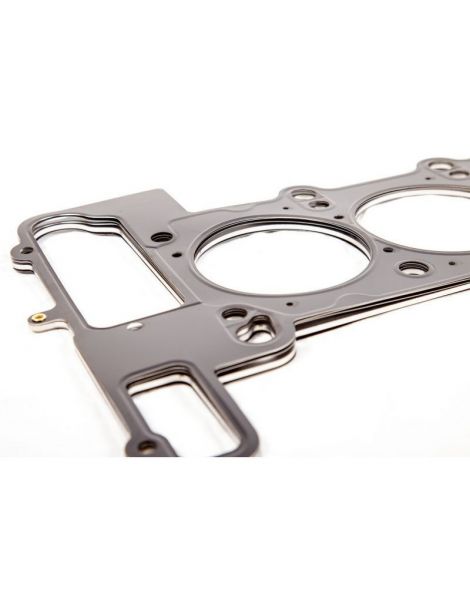
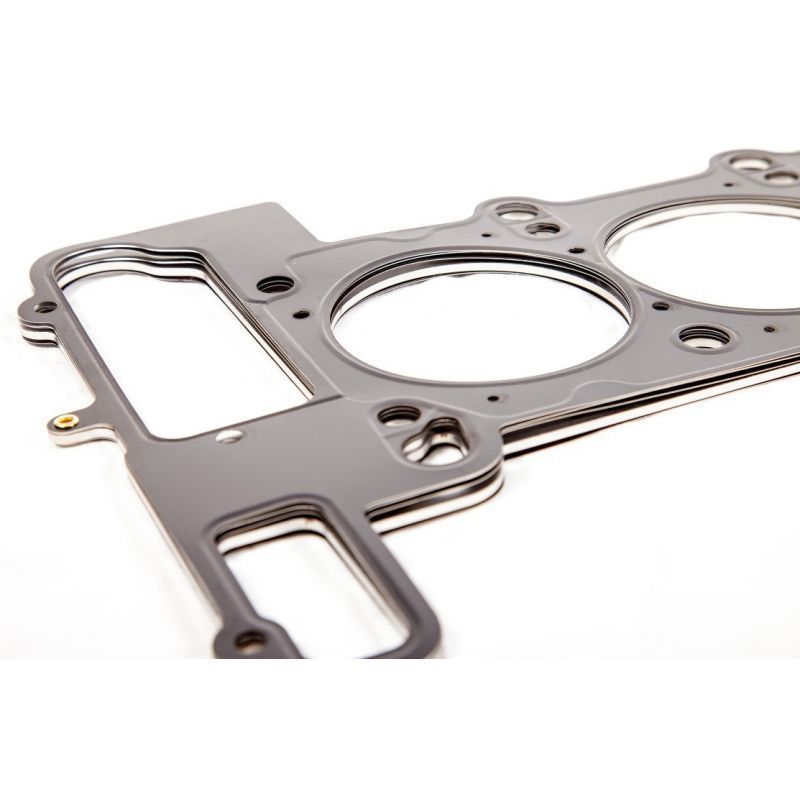
Reinforced Cometic head gasket, in CFM-20, for the Jaguar V12 of the XJ, XJ Coupé, XJSC Convertible and E-Type Series 3. One gasket per bank.
The Jaguar V12 of 5.3 litres, identified by the codes 7P, 7P1, 7S1, 8B, 8C, 8E and 8S, powers the Jaguar XJ, XJ Coupé, XJSC Convertible and E-Type Series 3 detailed below; the 8C also exists in 6.0 litres.
The original gasket of the Jaguar V12 carries the part numbers C33135 (right) and C33136 (left); the manufacturer publishes neither its bore nor its thickness. It is metal, fibre, metal, two sheets around a fibre core, and sized for standard combustion pressure: when that pressure rises, the head loses clamping force, lifts and lets coolant reach a cylinder.
The gasket does not guarantee the seal on its own: the fasteners that clamp the head onto the block weigh just as much. CFM-20 combines a galvanized steel core with a soft asbestos-free compound that makes up for small irregularities in the gasket faces. On this V12, torquing in several passes keeps the pressure even.
This page offers the part numbers from the American maker Cometic, a specialist in racing gaskets, in a single construction: CFM-20. Their bore is 93 mm or 97 mm and their thickness 1.09 mm or 1.50 mm, for the left bank and for the right bank. Each part number is sold individually.
| Gasket bore | Thickness | Gasket volume | Gasket type OEM not specified | Brand | Part number OEM C33135 (droite) et C33136 (gauche) |
| 93 mm | 1.09 mm | 7.40 | CFM-20 left bank | Cometic | C4330-043 |
| 93 mm | 1.09 mm | 7.40 | CFM-20 right bank | Cometic | C4331-043 |
| 93 mm | 1.50 mm | 10.19 | CFM-20 left bank | Cometic | C4330-059 |
| 93 mm | 1.50 mm | 10.19 | CFM-20 right bank | Cometic | C4331-059 |
| 97 mm | 1.09 mm | 8.05 | CFM-20 left bank | Cometic | C4221-043 |
| 97 mm | 1.09 mm | 8.05 | CFM-20 right bank | Cometic | C4222-043 |
| 97 mm | 1.50 mm | 11.08 | CFM-20 left bank | Cometic | C4221-059 |
| 97 mm | 1.50 mm | 11.08 | CFM-20 right bank | Cometic | C4222-059 |
A gasket's volume is the space it leaves free above each cylinder. That space adds to the combustion chamber and lowers the compression ratio; only gaskets of the same bore are comparable. Here, the gaskets come in two bores, 93 mm and 97 mm.
| Fasteners | Engines | Tightening torque |
| Original cylinder head bolts | 7P, 7P1, 7S1, 8B, 8C, 8E, 8S | not published by the manufacturer |
Before fitting, run a straight edge over the head and the block to check their flatness, and have either one resurfaced if necessary. Cometic checks the flatness of each of its CFM-20 gaskets. This check holds for the Jaguar V12 as for any other engine.
| CFM-20 Cometic A galvanized steel core, lined on each face with a soft asbestos-free compound blending aramid fibres, mineral fillers and elastomer binders. This layered structure, between metal and fibre, joins the stiffness of steel to the give of the compound. It is offered here as eight part numbers: bores of 93 mm and 97 mm, thicknesses of 1.09 mm and 1.50 mm, for the left bank and for the right bank. |
Gasket bore. The Cometic CFM-20 gasket is offered in 93 mm (C4330 on the left, C4331 on the right) and in 97 mm (C4221 on the left, C4222 on the right), each in 043 (1.09 mm) and in 059 (1.50 mm).
Thickness. For the original gasket, the manufacturer gives no thickness. A thicker gasket enlarges the combustion chamber and lowers the compression ratio; a thinner one reduces it and raises the ratio.
| Your goal | Thickness to choose |
| Keep the original compression ratio | Original thickness not published: measure the removed gasket of each bank and compare its size with the two thicknesses offered, 1.09 mm and 1.50 mm |
| Skimmed cylinder head, make up the lost height | Two thicknesses are listed, 1.09 mm and 1.50 mm: choose the one closest to the removed gasket, plus the material taken off when the heads are resurfaced |
| Forced induction build, lower the ratio | 1.09 mm, if the thickness measured on the original gasket at removal is lower |
| Naturally aspirated build, raise the ratio | 1.50 mm, if the thickness measured on the original gasket at removal is higher |
With no published original thickness, read with a dial gauge how far the pistons stand above the block's gasket face, bank by bank, above all if the removed gasket is thinner than 1.09 mm: this value gives the clearance left between piston and head.
 | Cometic Gasket, Inc. is an American manufacturer of gaskets and sealing solutions for engines, founded in 1989 in Concord, Ohio. Its reputation rests on the made-to-measure gasket, cut to the bore and thickness requested; all production takes place in the United States, from American raw materials. The part numbers C4330, C4331, C4221 and C4222 are its own. |
| Criterion | Original gasket C33135 (right) and C33136 (left) | Reinforced gaskets |
| Construction | Metal, fibre, metal (two sheets and a fibre core) | Galvanized steel core and asbestos-free compound (CFM-20) |
| Gasket bore | not published by the manufacturer | 93 / 97 mm |
| Thicknesses available | thickness not published by the manufacturer | 1.09 to 1.50 mm |
| Compression ratio adjustment | None | Through the thickness chosen |
| Resistance to overpressure | Limited to standard output | Designed for forced induction |
| Model | Engine code | Power | Years |
| Jaguar XJ 12 5.3 | 7P | 269 hp | 1972-1973 |
| Jaguar XJ 12 5.3 | 7P | 253 hp | 1973-1976 |
| Jaguar XJ 12 5.3 | 7P | 254 hp | 1986-1989 |
| Jaguar XJ 12 H.E. | 7P / 8S | 295 hp | 1981-1992 |
| Jaguar XJ Sovereign V12 | 7P | 264 hp | 1986-1992 |
| Jaguar XJ Sovereign V12 | 7P | 268 hp | 1985-1992 |
| Jaguar XJ 5.3 | 7P | 265 hp | 1981-1987 |
| Jaguar XJ 5.3 | 7P1 | 247 hp | 1974-1992 |
| Jaguar XJ Coupé 5.3 | 8B | 290 hp | 1975-1981 |
| Jaguar XJ Coupé 5.3 H.E. | 8S | not published | 1985-1992 |
| Jaguar XJ Coupé 5.3 | 8C | not published | 1988-1992 |
| Jaguar XJ Coupé 5.3 | 8S | not published | 1991-1993 |
| Jaguar XJ Coupé 6.0 | 8C | not published | 1989-1993 |
| Jaguar XJ 6.0 | 8C | not published | 1993-1994 |
| Jaguar XJSC Convertible 5.3 | 7P | 254 hp | 1986-1988 |
| Jaguar XJSC Convertible 5.3 | 8E | 287 hp | 1988-1992 |
| Jaguar XJSC Convertible 5.3 H.E. | 8S | not published | 1985-1992 |
| Jaguar XJSC Convertible 5.3 | 8C | not published | 1988-1991 |
| Jaguar XJSC Convertible 5.3 | 8S | not published | 1991-1993 |
| Jaguar E-Type 2+2 V12 5.3 Série 3 | 7S1 | 276 hp | 1971-1975 |
| Jaguar E-Type Convertible V12 5.3 Série 3 | 7S1 | 276 hp | 1971-1975 |
OEM part number: C33135 (right) and C33136 (left).
Important: the part numbers on this page suit the Jaguar V12 7P, 7P1, 7S1, 8B, 8C, 8E and 8S: a V12 has two banks and each takes its own gasket, so order one left and one right part number, and check your engine's bore, 93 mm or 97 mm.
When the original gasket reaches its limits, this CFM-20 gasket takes over: the steel core keeps its shape under combustion pressure, while the soft compound on both faces follows the small flaws of the head and block. The Jaguar V12 finds here eight part numbers, in two bores and two thicknesses, for each bank.
On an engine driven to its limit, the head gasket is the first part to fail, the weak point of the top end. A reinforced gasket prevents the leak, whereas the head removal that follows, a long and delicate job, costs much more than the gasket. This holds for the Jaguar V12 as for any hard-driven engine.