Product successfully added to your shopping cart
Quantity
Total
There are 0 items in your cart. There is 1 item in your cart.
Total products
Total shipping To be determined
Total

BY REFERENCE COMETIC - Reinforced cylinder head gaskets
Manufacturers
BY REFERENCE COMETIC - Reinforced cylinder head gaskets
Warning: Last items in stock!
New product
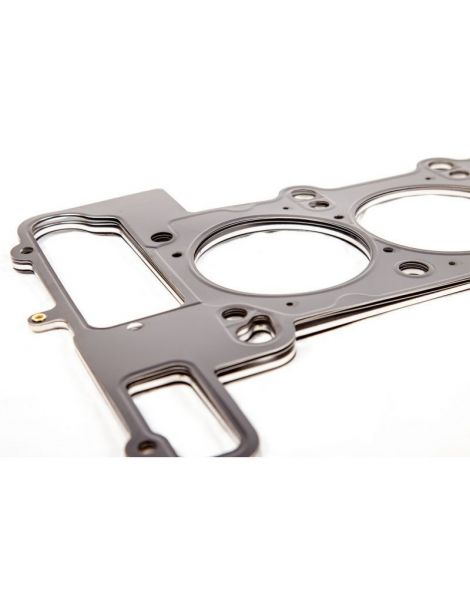
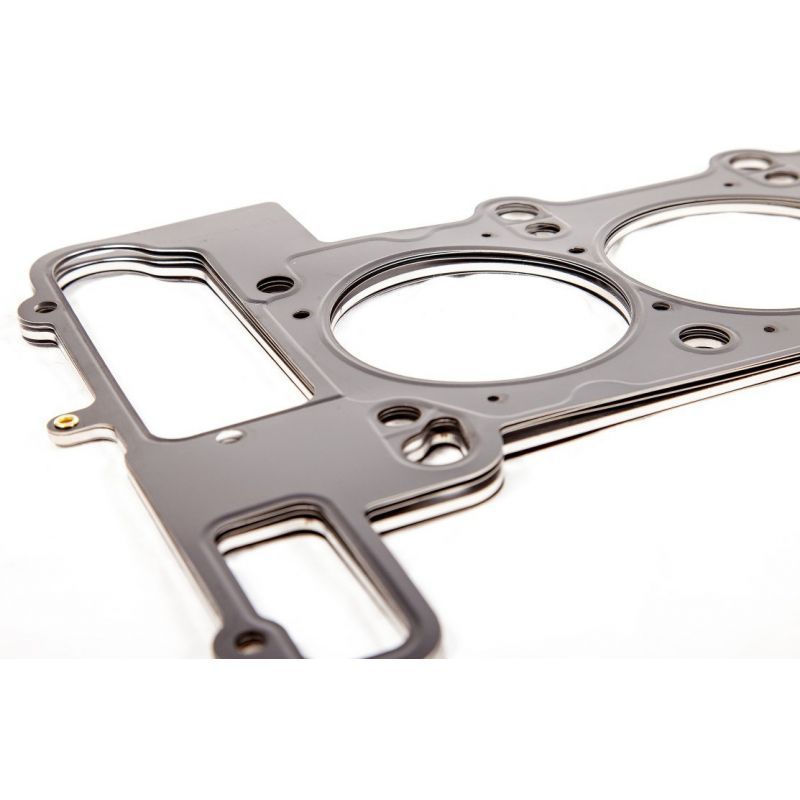
Cometic MLS reinforced head gaskets, sold individually: one gasket per cylinder bank, so two per engine.
The Toyota NASCAR V8 racing engine takes two cylinder head gaskets, one per cylinder bank. It powers no production vehicle: it is intended for competition cars.
The manufacturer publishes nothing on the original gasket: no part number, no bore, no construction and no thickness. Designed for the standard combustion pressure, it falls short as soon as that pressure increases: the clamping load relaxes, the head opens slightly and coolant enters a cylinder.
Sealing does not rest on the gasket alone: the bolts or studs that hold the head down on the block play an equal part. The stainless steel of an MLS gasket keeps its load at high pressure, where a conventional gasket settles.
This page offers two part numbers from the American maker Cometic, a specialist in racing gaskets, in one construction only: MLS, a three-layer stainless steel multilayer. Their bore is 106.68 mm and their thickness 1.02 mm. The V8 takes one gasket per cylinder bank: order both part numbers, C4291-040 for the left bank and C4290-040 for the right bank.
| Gasket bore | Thickness | Gasket volume | Gasket type OEM not specified | Brand | Part number |
| 106.7 mm | 1.02 mm | 9.12 | MLS right bank | Cometic | C4290-040 |
| 106.7 mm | 1.02 mm | 9.12 | MLS left bank | Cometic | C4291-040 |
The gasket volume is the space left open above each cylinder: it adds to the combustion chamber and lowers the compression ratio. Only gaskets of the same bore can therefore be compared.
| Fasteners | Engines | Tightening torque |
| Original cylinder head bolts | NASCAR V8 | not published by the manufacturer |
Use a straightedge to check the flatness of the head and the block before fitting, and have any distorted surface machined. Every Cometic MLS gasket is inspected before it leaves the factory; coat it with no sealing paste.
 | Cometic MLS Three stainless steel sheets, stamped and riveted together in a stack. The outer sheets show active beads around each cylinder and each fluid passage. It seals with a moderate clamping load and alters the bore very little. It is used from the prepared naturally aspirated engine up to moderate boost. |
Gasket bore. The Cometic MLS gaskets exist in 106.68 mm (C4291-040 and C4290-040), with no other bore.
Thickness. The manufacturer gives no thickness for the original gasket: only the dimension of the removed gasket serves as a reference. A thicker gasket enlarges the combustion chamber and lowers the compression ratio; a thinner one reduces it and raises the ratio.
| Your goal | Thickness to choose |
| Keep the original compression ratio | Original thickness not published: measure that of the removed gasket and compare it with the only gasket offered, 1.02 mm |
| Skimmed cylinder head, make up the lost height | Only one thickness exists, 1.02 mm: set it against that of the removed gasket, plus the material taken off when resurfacing |
| Forced induction build, lower the ratio | 1.02 mm, when the thickness measured on the removed gasket is lower |
| Naturally aspirated build, raise the ratio | 1.02 mm, when the thickness measured on the removed gasket is higher |
With no known original thickness, use a dial gauge to read how far the pistons protrude above the block face, above all if the removed gasket is thicker than 1.02 mm: this figure gives the clearance left between piston and head.
 | Cometic Gasket, Inc. is a company from the United States, set up in 1989 in Concord, Ohio, that designs gaskets and sealing parts for engines. It earned its reputation with made-to-measure gaskets, cut to the required bore and thickness and produced on site from American raw materials. |
| Criterion | Original gasket, part number not published | Reinforced gaskets |
| Construction | Construction not stated by the manufacturer | Multilayer stainless steel (MLS), three layers |
| Gasket bore | not published by the manufacturer | 106,68 mm |
| Thicknesses available | thickness not published by the manufacturer | 1.02 mm |
| Compression ratio adjustment | None | Through the thickness chosen |
| Resistance to overpressure | Limited to standard output | Designed for forced induction |
| Model | Engine code | Power | Years |
| Toyota NASCAR V8 | NASCAR V8 | not published | - |
OEM part number: not published by the manufacturer.
Important: The V8 takes one gasket per cylinder bank: C4291-040 for the left bank, C4290-040 for the right bank. Order both part numbers for a complete engine.
When the original gasket no longer holds, the reinforced gasket steps in: at higher combustion pressure it keeps its shape instead of flattening.
On an engine under strain, with a turbo, a supercharger or a raised compression ratio, the head gasket often gives up before any other part. The reinforced gasket prevents the leak, and the head removal that a leak would force costs far more than the gasket.