Product successfully added to your shopping cart
Quantity
Total
There are 0 items in your cart. There is 1 item in your cart.
Total products
Total shipping To be determined
Total

BMC A Series
Manufacturers
BMC A Series
 View larger
Warning: Last items in stock!
New product
ARP 8740 rod bolts and nuts for BMC A-Series OEM connecting rods (three kits: 206-6001, 206-6021 and 206-6002).
The A-Series is the BMC engine family that the ARP catalogue lists as « BMC A-Series »; ARP covers it with two bolt sizes, 3/8 in and 11/32 in, and its 11/32 in part number also targets the B-Series.
This ARP kit replaces the original rod bolt of these engines with 8740 bolts that the instruction sheet describes as pressed into the rods and tightened with nuts lubricated with Ultra-Torque.
At every revolution, the rod bolt takes the pull of the rod and piston assembly, which tries to force the cap away through inertia. As original equipment, it is sized for stock power.
These 8740 ARP part numbers (206-6001 and 206-6021 in 3/8 in, 206-6002 in 11/32 in) go on in two steps, pressing the bolts into the rods and then tightening the nuts, preferably by measuring a stretch of 0.165 to 0.178 mm; without a gauge, the instruction sheet gives 74.6 Nm for the 3/8 in and 47.5 Nm for the 11/32 in. These bolts are made from 8740, a chrome-moly steel brought to 180,000 psi tensile strength by ARP's heat treatment; the threads are rolled afterwards. For comparison, classes 10.9 and 12.9 of original fasteners have a minimum of 150,800 to 176,900 psi. The 8740 bolts hold up to 8,750 rpm (calculated estimate).
| Part number | Brand | Grade / material | Nut | Thread | Under-head length |
|---|---|---|---|---|---|
| ARP-206-6001 | ARP | 8740 steel | Not published | 3/8 in | Not published |
| ARP-206-6021 | ARP | 8740 steel | Not published | 3/8 in | Not published |
| ARP-206-6002 | ARP | 8740 steel | Not published | 11/32 in | Not published |
ARP's instruction sheet asks you to check, before pressing the bolts in, that every rod bore has a wide enough chamfer at the top to clear the radius under the bolt head.
| Reference | Tightening torque | Stretch |
|---|---|---|
| ARP-206-6001 | 74.6 Nm | 0.165 - 0.178 mm |
| ARP-206-6021 | 74.6 Nm | 0.165 - 0.178 mm |
| ARP-206-6002 | 47.5 Nm | 0.165 - 0.178 mm |
ARP recommends tightening to a measured stretch, which gives a more accurate preload than torque alone, given as a fallback. Torque and stretch figures assume ARP lubricant.
The values above come from the ARP 206-6001 and 206-6002 instruction sheets applicable at the date of publication; they are authoritative in the event of any difference. Read the ARP 206-6001 instruction sheet; Read the ARP 206-6002 instruction sheet
The ARP instruction sheet does not require a thread locker for this kit; only ARP Ultra-Torque grease is applied, on the bolt threads as well as on the bearing face of the nuts.
The ARP instructions for this kit require the big ends to be checked and resized once the fasteners are fitted: this job belongs to an equipped machine shop.
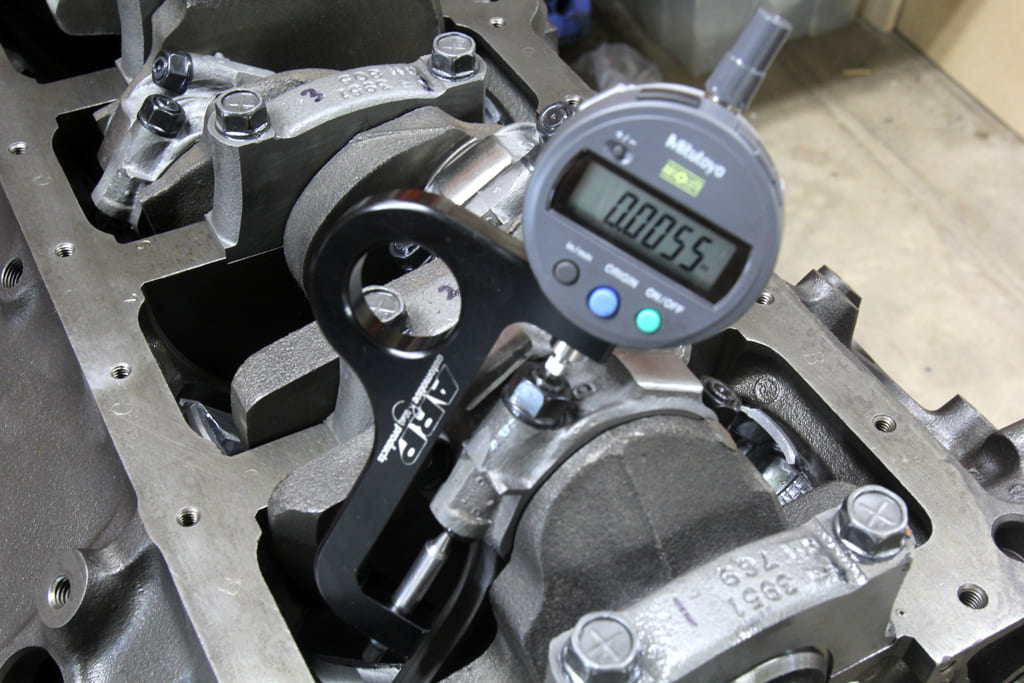
Stretch measurement supplements torque tightening and gives the most accurate preload. It is done with the bolt in place: the gauge, fitted with a dial indicator, bears on both ends of the bolt and shows the stretch achieved, to be brought to the value in the table above. This avoids the variations caused by friction, which matters on a highly stressed engine.
Tightening is done with ARP assembly grease, on the bolt threads and on the bearing face of the nuts: the torque and stretch figures in the table were established with it.
An engineer with an aerospace background, Gary Holzapfel launched ARP (Automotive Racing Products) in the early 1970s with one goal: to eliminate engine failures caused by weak fasteners in racing. ARP designs and manufactures thousands of part numbers in California, cylinder head, main and rod bolts, in several materials depending on the use, and has become known for the consistency of its manufacturing.
| Brand | Model (chassis) | Engine code | Power | Years |
|---|---|---|---|---|
| BMC | A-Series engines, 3/8 in bolts (206-6001 and 206-6021) | |||
| BMC | A-Series and B-Series engines, 11/32 in bolts (206-6002) |
On a tuned BMC engine, every rod bolt takes the piston's inertia load on each revolution. If a single one breaks, the rod, the block and often the crankshaft are lost, whereas ARP 8740 hardware is a small outlay next to a full engine rebuild.