Product successfully added to your shopping cart
Quantity
Total
There are 0 items in your cart. There is 1 item in your cart.
Total products
Total shipping To be determined
Total

2.5L 24v - M50B25TU (with VANOS)
Manufacturers
2.5L 24v - M50B25TU (with VANOS)
Warning: Last items in stock!
New product
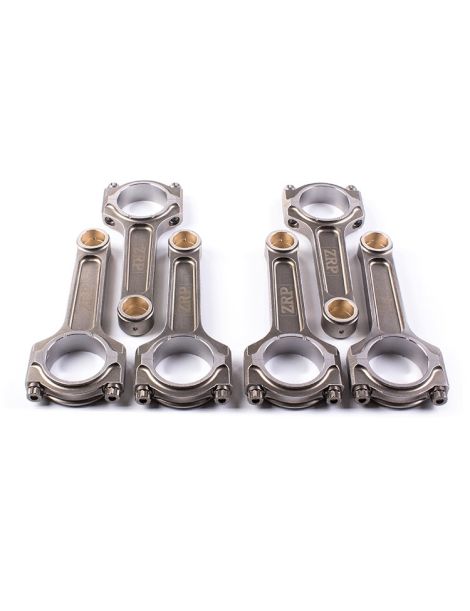
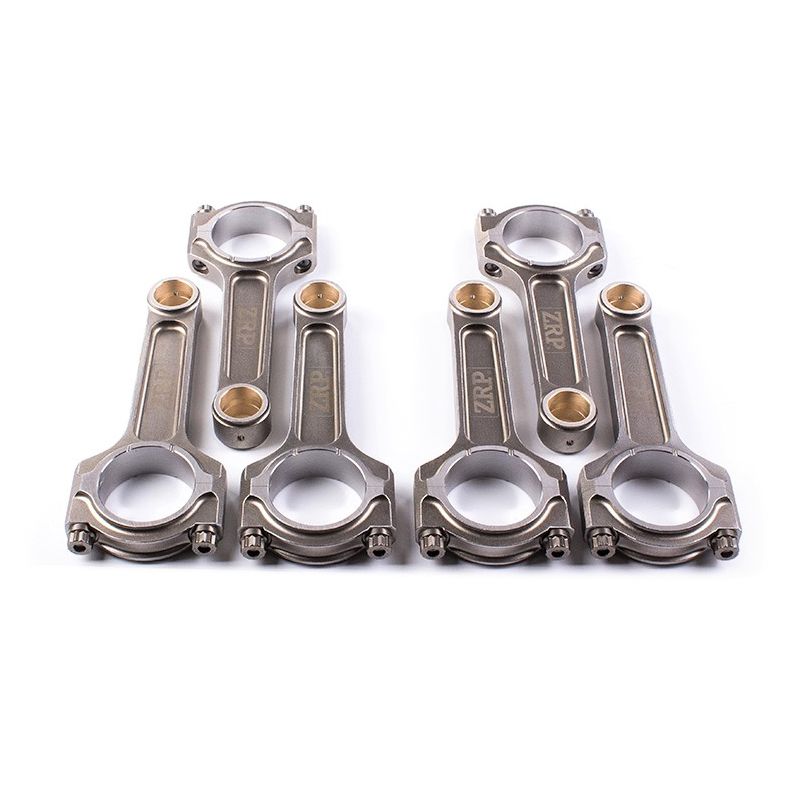
Set of 6 forged 4340-steel connecting rods for BMW 6-cylinder 24V, 140 mm c-to-c.
Launched in 1990, the 2.5L M50B25 straight-six introduced BMW's DOHC 24-valve engine generation: double overhead camshafts, four valves per cylinder and a forged crankshaft. With a displacement of 2,494 cc (84 mm bore, 75 mm stroke), it produces 192 hp. From 1992, BMW added intake variable valve timing (the so-called 'single VANOS' configuration), which improves low-end torque and flexibility without changing the bottom-end architecture.
In 1995, the M52B25 took over with a lighter block and kept single VANOS, for 170 hp in the 323i and 523i. On these engines pushed in tuning, torque and cylinder pressure climb well beyond the original figures: it is the rotating assembly, and first of all the connecting rods, that becomes the critical point to reinforce.
A forged connecting rod is shaped by hot die-forging the steel: the material is compressed and its grain follows the part's geometry, giving it far greater strength and endurance than a production sintered-metal rod. Machined and balanced, it withstands the high cylinder pressures, high rpm and torque peaks of tuned engines. It's the assurance of a bottom end that lasts when the original power is exceeded.
| Reference | Brand | Profile | Hardware | Pin diameter OEM 22 mm | Small-end width | Big-end diameter OEM 48 mm | Big-end width | Center-to-center OEM 135 / 140 mm | Weight per rod |
|---|---|---|---|---|---|---|---|---|---|
| R-BMW-002-I | ZRP | I | ARP 2000-3/8"-38mm | 22 mm | 48 mm | 21.9 mm | 140 mm | 498 g | |
| R-BMW-002-I-L19 | ZRP | I | ARP L19-3/8"-38mm | 22 mm | 48 mm | 21.9 mm | 140 mm | 498 g |
| Rod | Hardware | Tightening torque | Recommended stretch |
|---|---|---|---|
| ZRP (R-BMW-002-I) | ARP 2000 | 61 N·m | 0.140 – 0.152 mm |
| ZRP (R-BMW-002-I-L19) | ARP L19 | 67,8 N·m | 0.152 – 0.165 mm |
Tightening by torque alone leaves a scatter that nothing announces: the engine starts, runs, and the deviation only shows up under sustained use, when the least firmly held rod starts working its joint face. On M50B25 and M52B25 units used for power increases or on track, that uncertainty has no place. This is the whole point of the values in the table above: issued by the bolt manufacturer, separate for ARP 2000 and for ARP L19, they apply exactly as published. And it is also why measuring stretch with a dial gauge is presented as the reference method: it turns an estimate into a verification, on each of the twelve bolts. Clean threads, an even film of ARP assembly lubricant, load raised in alternating stages. The kit instruction sheet remains the document that counts.
| All these ZRP rods are forged from 4340 nickel-chromium-molybdenum alloy steel, the motorsport standard. Compared with the original sintered metal, it offers roughly 19% higher yield strength, around 8% more tensile strength and 19 to 37% better fatigue endurance. This mechanical margin is exactly what's needed to handle forced induction, high rpm and the high torque of a build. |
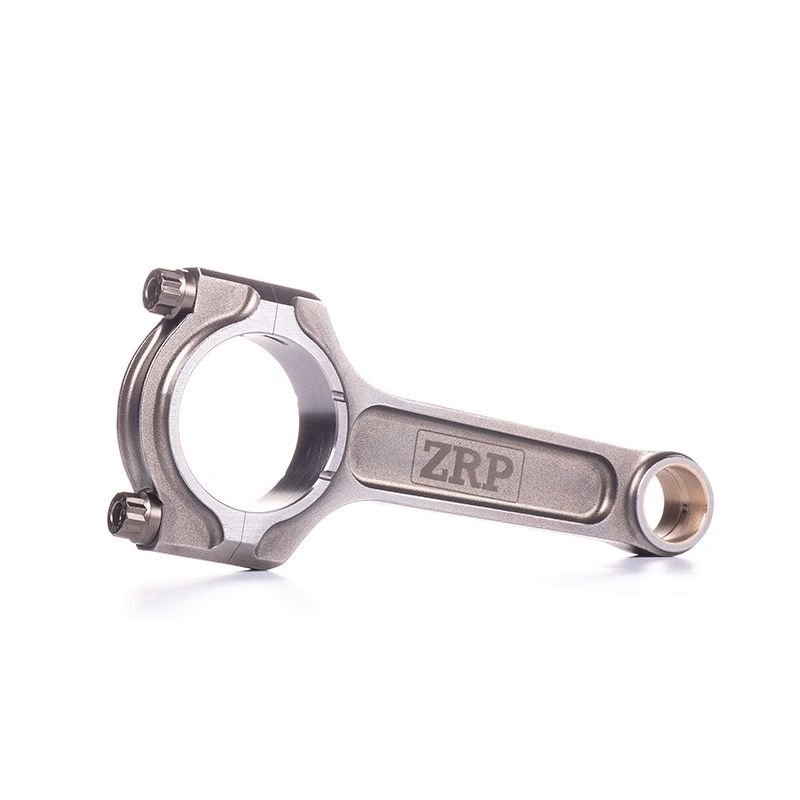
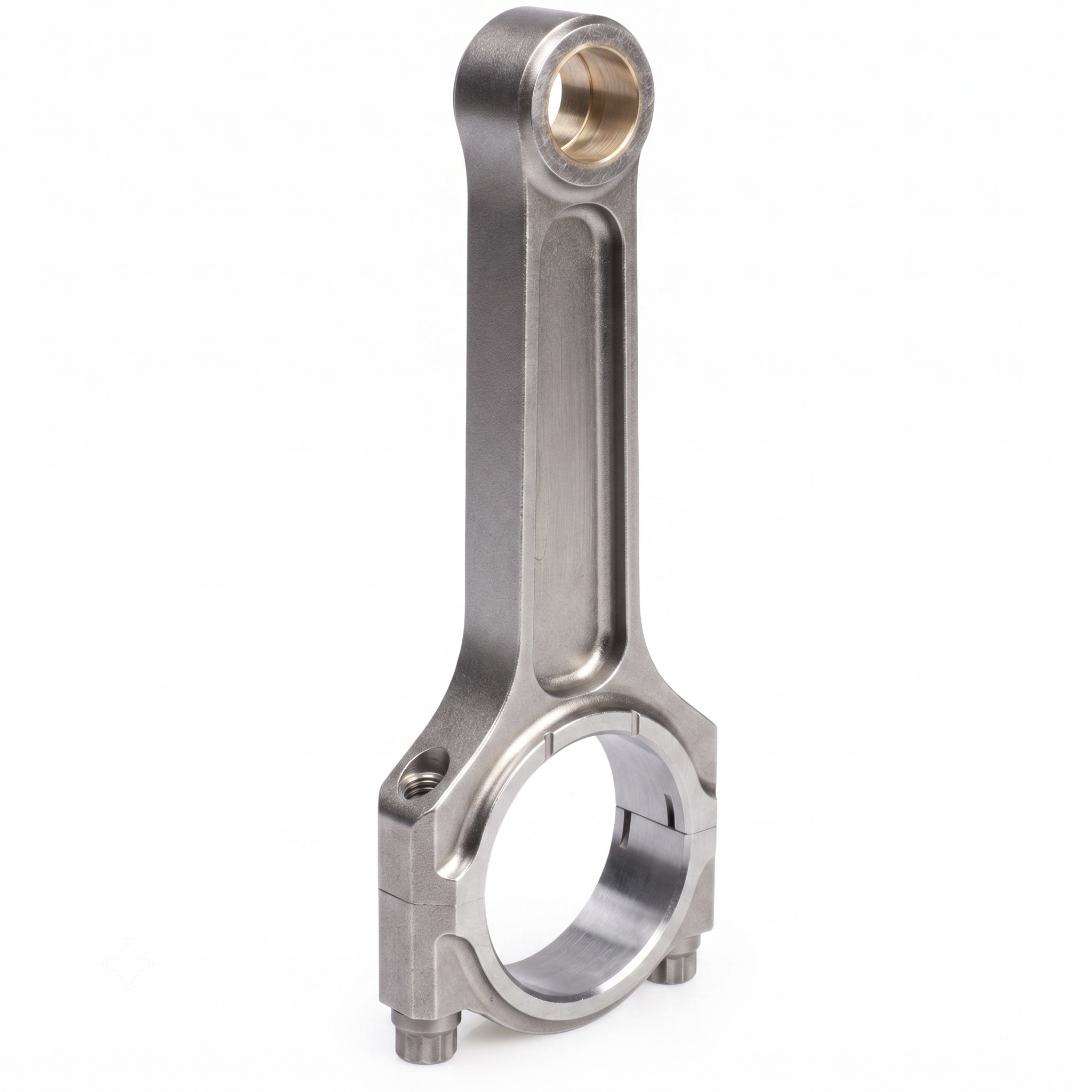 | I-Beam profile. It's the profile chosen here. Light and rigid, it limits reciprocating mass and suits tuned M50 and M52 straight-sixes perfectly, where high-rpm response is sought without adding weight to the rotating assembly. |
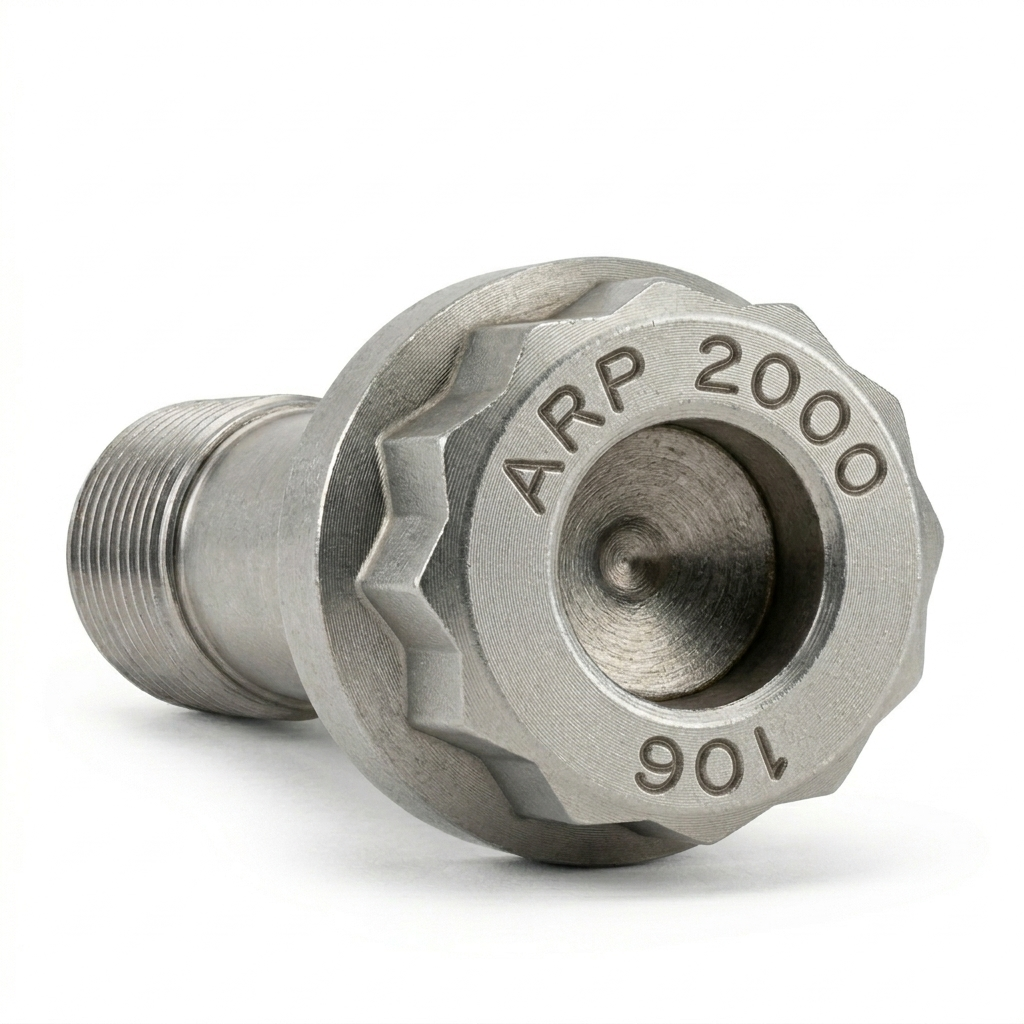 | ARP 2000. Versatile high-performance bolt with no storage constraints. In 3/8" diameter, it covers up to around 200 hp per cylinder and 8,500 rpm: more than enough to reinforce an M50 or M52 2.5L on track, trackday, drift, rally, drag or hillclimb. |
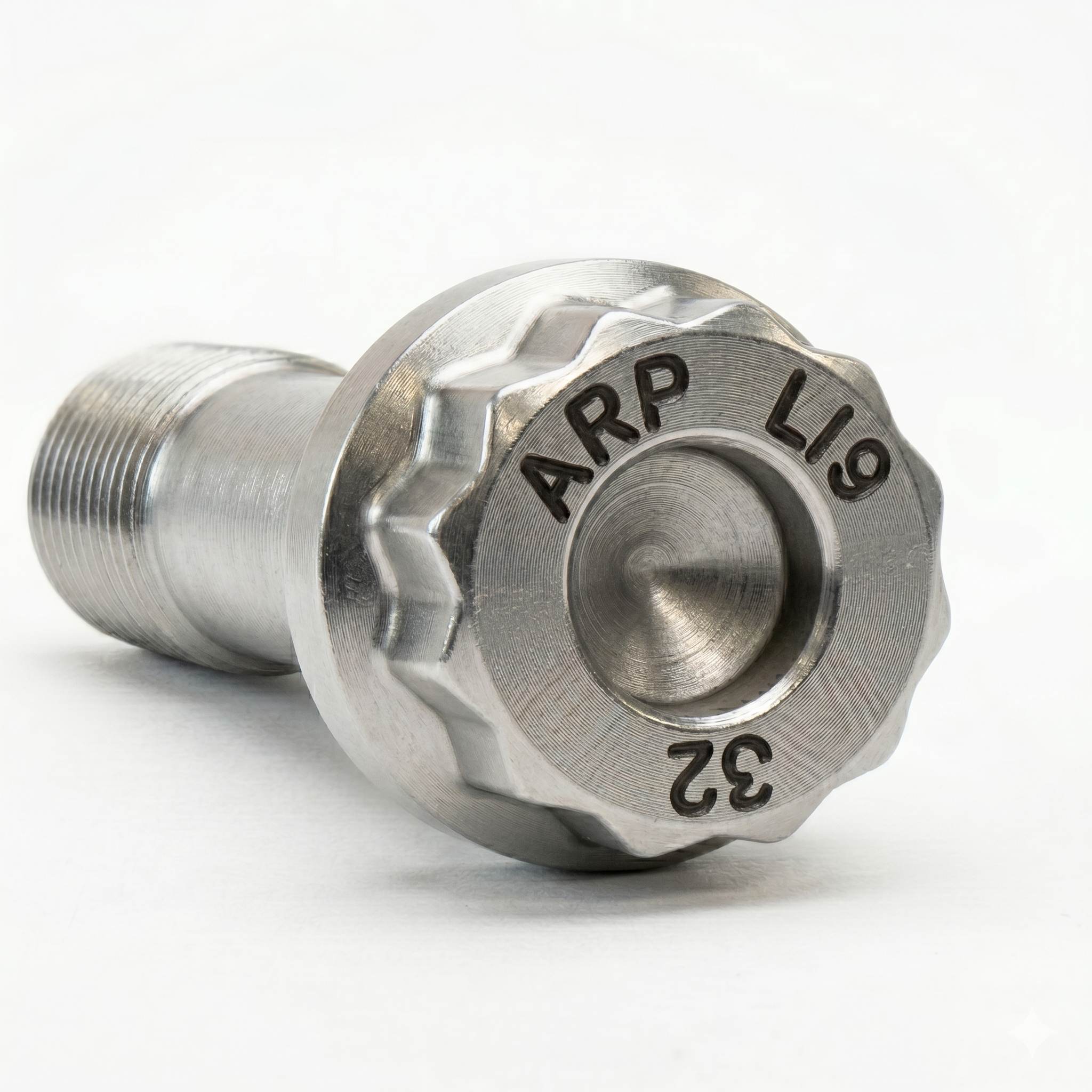 | ARP L19 (tensile strength of approximately 260,000 psi, or ~1,793 MPa). Designed for engines pushed to the extreme, when cylinder pressure and sustained rpm exceed the ARP 2000's range. In 3/8", it targets around 250 hp per cylinder and 10,000 rpm, for big-power builds in drag, drift, rally and track. Sensitive to corrosion and hydrogen embrittlement, it must be stored and fitted oiled. |
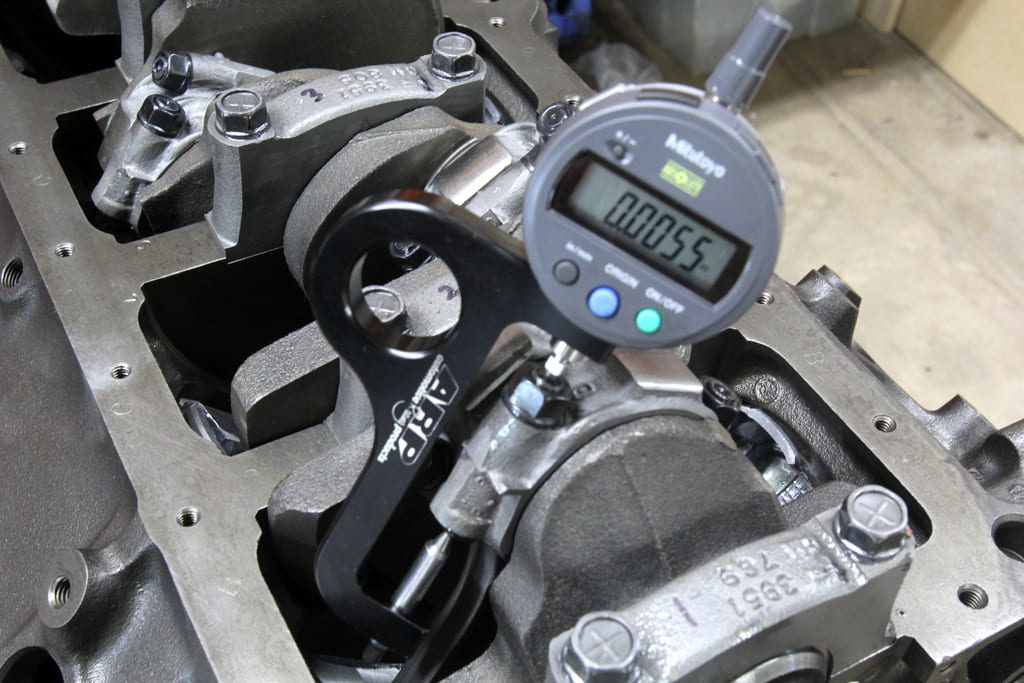
| On high-performance bolts, the reference tightening is done by checking stretch with a gauge (stretch gauge), more precise than torque alone: you measure the actual elongation of the fitted bolt. Always follow the values in the instructions supplied with the kit. |
 | ZRP, a Greek brand of high-performance forged connecting rods, designed by Alex Drakos in Athens. Each rod is forged from 4340 steel, precision-machined and balanced to ±1 g to stay reliable at high rpm. Offered here in I-beam profile with ARP 2000 or L19 bolts, they are designed and inspected in Greece, and proven in rally, on circuit and in drift. |
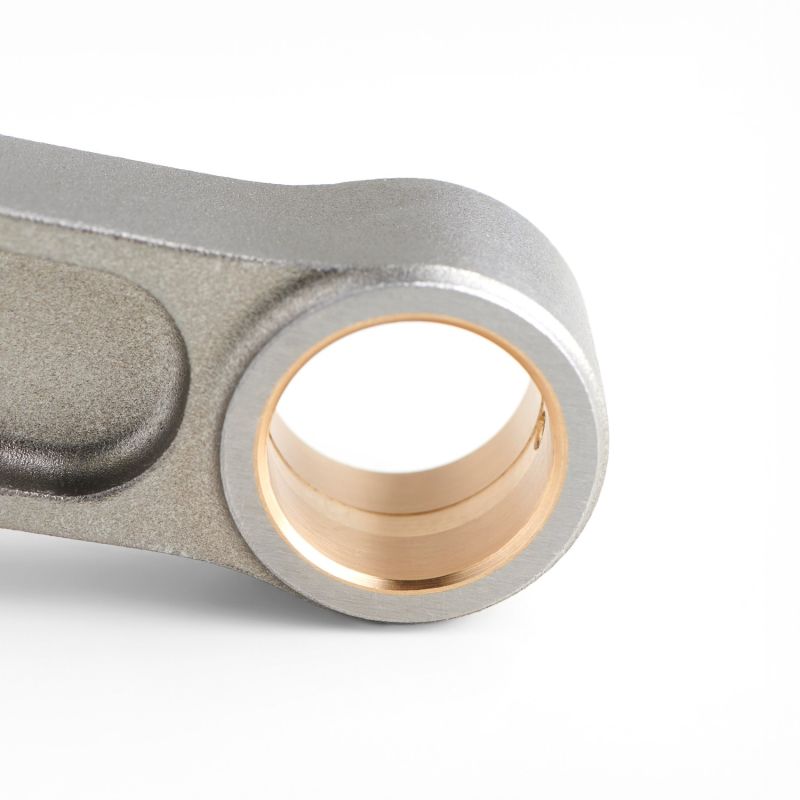
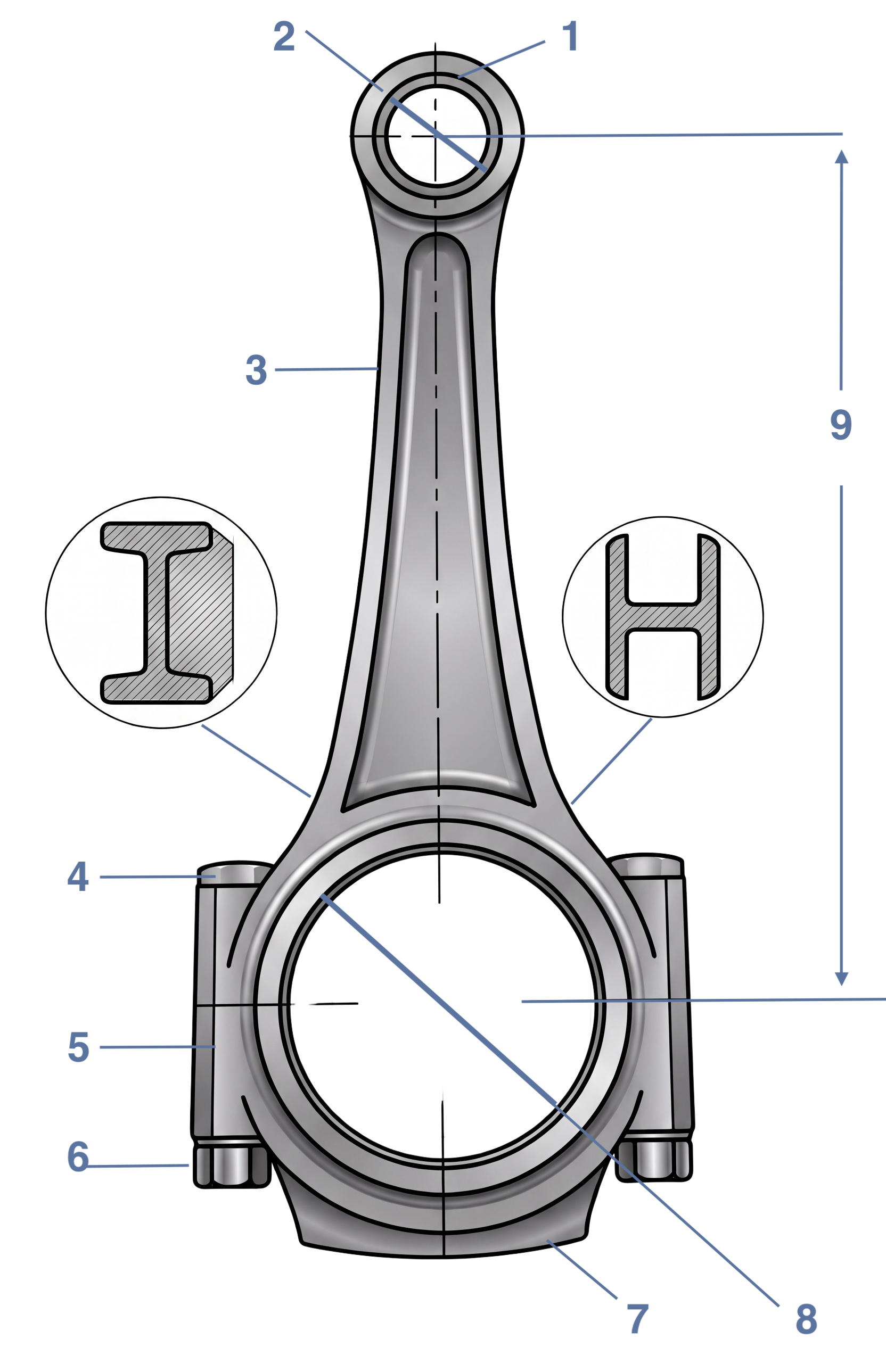 | 1) Small end 2) Small-end diameter 3) Rod beam 4) Rod bolt 5) Big end 6) Rod nut / bolt 7) Rod cap 8) Big-end diameter 9) Center-to-center |
The following summary covers the vehicles fitted with the BMW 6 cylindres 24V 140 mm rod length M50B20 M50B25TU M52B25 M54B25 engine. A check of the piston pin diameter and of the rod length is required before ordering.
| Brand | Model (chassis) | Engine code | Power | Years |
|---|---|---|---|---|
| BMW | 325i / 325is (E36) | M50B25 | 192 hp | 1990–1995 |
| BMW | 325i Cabriolet (E36) | M50B25 | 192 hp | 1993–1995 |
| BMW | 525i / 525iX (E34) | M50B25 | 192 hp | 1990–1995 |
| BMW | 525i / 525iX Touring (E34) | M50B25 | 192 hp | 1991–1996 |
| BMW | 323i (E36) | M52B25 | 170 hp | 1995–1999 |
| BMW | 323ti Compact (E36) | M52B25 | 163–170 hp | 1997–2000 |
| BMW | 323i Coupé / Cabriolet (E36) | M52B25 | 170 hp | 1995–1999 |
| BMW | 323i Touring (E36) | M52B25 | 170 hp | 1995–1999 |
| BMW | 523i / 523i Touring (E39) | M52B25 | 170 hp | 1995–2000 |
OEM reference: M50B25 11 24 1 730 420; M52B25 11 24 1 739 725 (replaced by 11 24 1 437 211).
On a tuned M50 or M52, a failing production rod often takes the block and crankshaft with it: the bill then far exceeds the price of a set of forged rods. Investing at build time in ZRP 4340-steel rods and ARP hardware secures the bottom end for the long term and saves a full rebuild. A complete kit, designed for the displacement, remains the most cost-effective spend for driving with confidence.