Product successfully added to your shopping cart
Quantity
Total
There are 0 items in your cart. There is 1 item in your cart.
Total products
Total shipping To be determined
Total

1.5 16v - L15A
Manufacturers
1.5 16v - L15A
Warning: Last items in stock!
New product
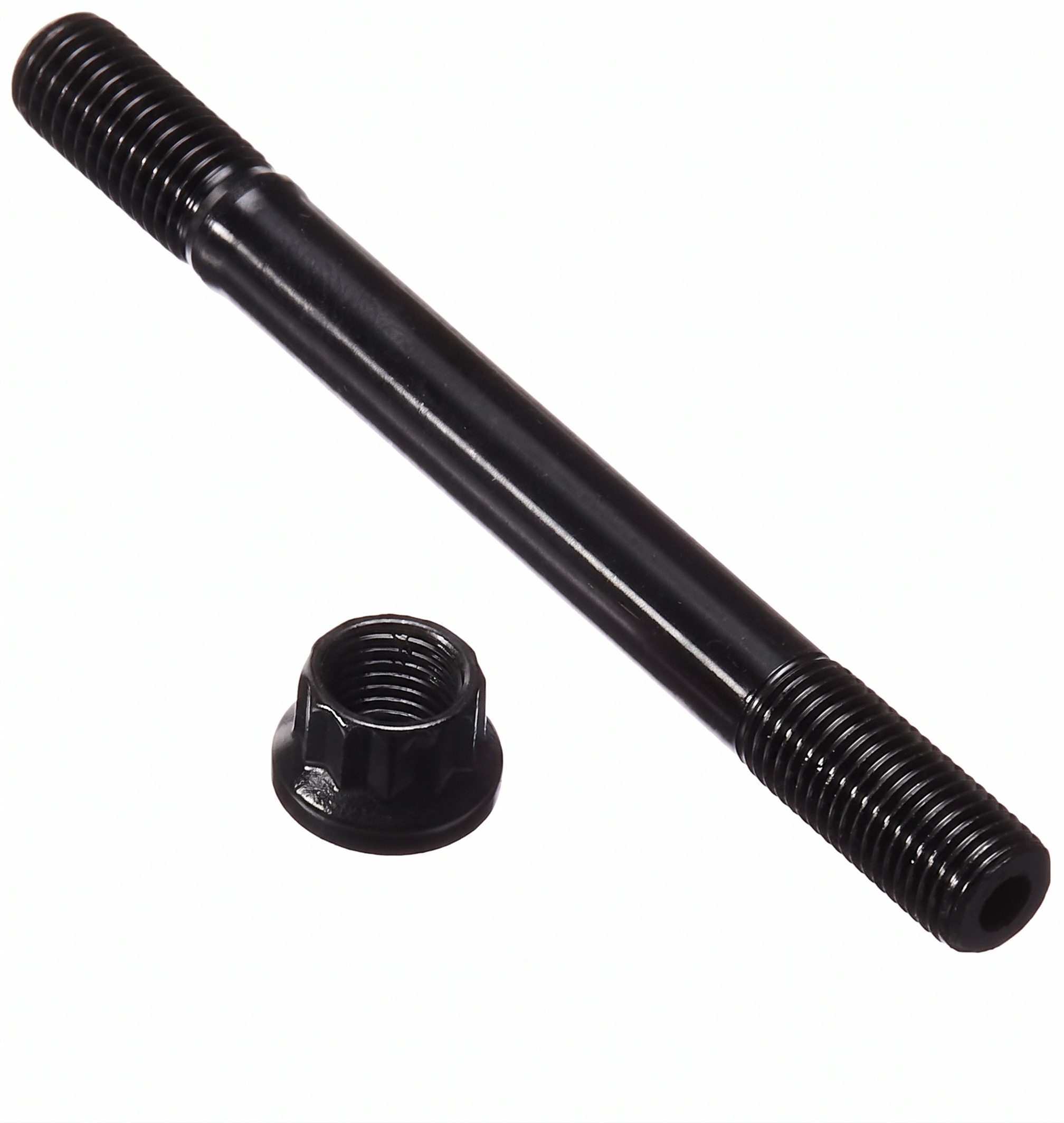
Kit of ARP 8740 cylinder head studs for the Honda L15A four-cylinder (Jazz, Fit, City, Civic VIII).
ARP intends this kit for the 1.5-litre single overhead cam inline four-cylinder Honda L15A, fitted notably to the Honda Jazz, Fit, City, Freed and Mobilio.
As built, the L15A cylinder head is secured by standard head bolts; ARP kit 208-4308 replaces them with studs.
Every combustion cycle pushes the cylinder head upwards. The head fasteners resist it by keeping a constant clamping pressure on the gasket; if that pressure drops, the seal is no longer guaranteed.
ARP reference 208-4308 is the stud kit designed for this engine: 8740, 12-point nuts. The instruction sheet runs as follows: studs go into the block by hand, the head is fitted, then threads, nuts and the underside of the washers take the ARP Ultra-Torque supplied; tightening is done in three equal passes, following the manufacturer's sequence. 8740 is a chrome-molybdenum steel, rated by ARP at 190,000 psi tensile strength. As a reference point, an engine's standard fasteners mostly belong to property classes 10.9 and 12.9, with a minimum tensile strength between 150,800 and 176,900 psi. No calculated strength figure specific to this kit is published, as its thread is not known. As an estimate only, equivalent 8740 fasteners of M10 diameter sit around 500 hp on a four-cylinder engine.
| Part number | Brand | Grade / material | Nuts | Thread |
| ARP-208-4308 | ARP | 8740 | 12-point |
| Part number | Stage 1 | Stage 2 | Stage 3 |
| ARP-208-4308 | 23 Nm | 45 Nm | 68 Nm |
The studs are fitted into the block by hand, without a torque wrench. For a permanent installation, the instruction sheet accepts thread locker, with tightening to be completed before it sets.
Before fitting, the instruction sheet asks for the block threads to be cleaned and, if needed, run through with a cleaning tap.
If a stud opens into the water jacket, the instruction sheet has the part that screws into the block coated with ARP thread sealer.
Follow the tightening sequence recommended by the manufacturer and bring to torque in three stages; the stated values assume ARP lubricant on the threads and under the nuts.
According to the instruction sheet, ARP lubricant is also applied to the washers, as on the threads.
Values taken from ARP instruction sheet 208-4308, in the revision current on the date of publication. In the event of any discrepancy, the official instruction sheet prevails; it also details the full procedure and the tightening sequence. Read the ARP 208-4308 instruction sheet
The stated tightening torques only make sense with ARP assembly grease, applied to the threads and under the nuts.
| Buy the ARP assembly grease → |
 | Founded in the early 1970s by Gary Holzapfel, who came from the aerospace industry, ARP (Automotive Racing Products) set itself the mission of eliminating engine failures caused by inadequate fasteners in competition. Its thousands of parts are designed and produced in California, in several material grades depending on the application. |
| Criterion | Original head bolts | Reinforced ARP studs |
 |  | |
| Block threads | Stressed at every tightening | Preserved: studs fitted by hand |
On an engine left standard, the original fasteners do their job. Switching to reinforced fasteners becomes worthwhile as soon as:
| Model | Engine code | Power | Years |
| Honda Jazz II (GD, GE) 1.5 | L15A, L15A1, L15A2, L15A4 | 90 to 110 hp | 2002-2008 |
| Honda Jazz III (GE) 1.5 | L15A7 | 116 to 120 hp | 2007-2014 |
| Honda Jazz IV (GK) 1.5 | L15A | 120 hp | since 2014 |
| Honda Jazz Shuttle (GG) 1.5 | L15A | 120 hp | 2011-2014 |
| Honda Fit (GD) 1.5 | L15A1 | 106 hp | 2004-2008 |
| Honda Fit (GE) 1.5 | L15A7 | 120 hp | 2008-2014 |
| Honda City IV (GD, GE) 1.5 | L15A1, L15A2, L15AV | 78 to 110 hp | 2002-2009 |
| Honda City V (GM) 1.5 | L15A7 | 102 to 120 hp | 2008-2015 |
| Honda City VI (GM) 1.5 | L15A7 | 116 to 119 hp | 2014-2021 |
| Honda Freed (GB) 1.5 | L15A, L15A7 | 99 to 118 hp | 2008-2016 |
| Honda Freed Spike (GB) 1.5 | L15A | 118 hp | 2010-2015 |
| Honda Mobilio (GB) 1.5 | L15A | 90 to 110 hp | 2001-2008 |
| Honda Mobilio Spike (GK) 1.5 | L15A | 110 hp | 2002-2008 |
| Honda Airwave (GJ) 1.5 VTEC | L15A | 110 hp | since 2004 |
| Honda Partner (GJ) 1.5 i-DSI | L15A2 | 90 hp | 2006-2010 |
| Everus S1 1.5 | L15A1 | 105 hp | since 2011 |
| Honda Civic VIII (FD, FA) 1.5 i-VTEC | L15A7 | 120 hp | 2005-2013 |
The original head bolts of the L15A follow stock output: as it rises, they are the first to limit gasket retention. A kit of ARP 8740 studs offers a higher clamp load, for a cost out of all proportion to reworking a cylinder head, gasket and labour included.