Product successfully added to your shopping cart
Quantity
Total
There are 0 items in your cart. There is 1 item in your cart.
Total products
Total shipping To be determined
Total

3.0L 24v - 7M-GTE
Manufacturers
3.0L 24v - 7M-GTE
Warning: Last items in stock!
New product
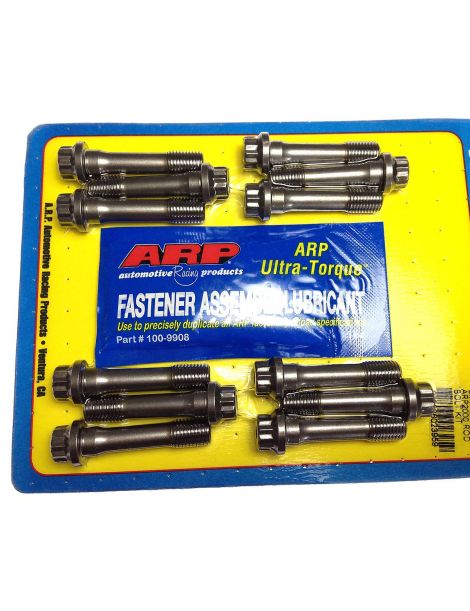
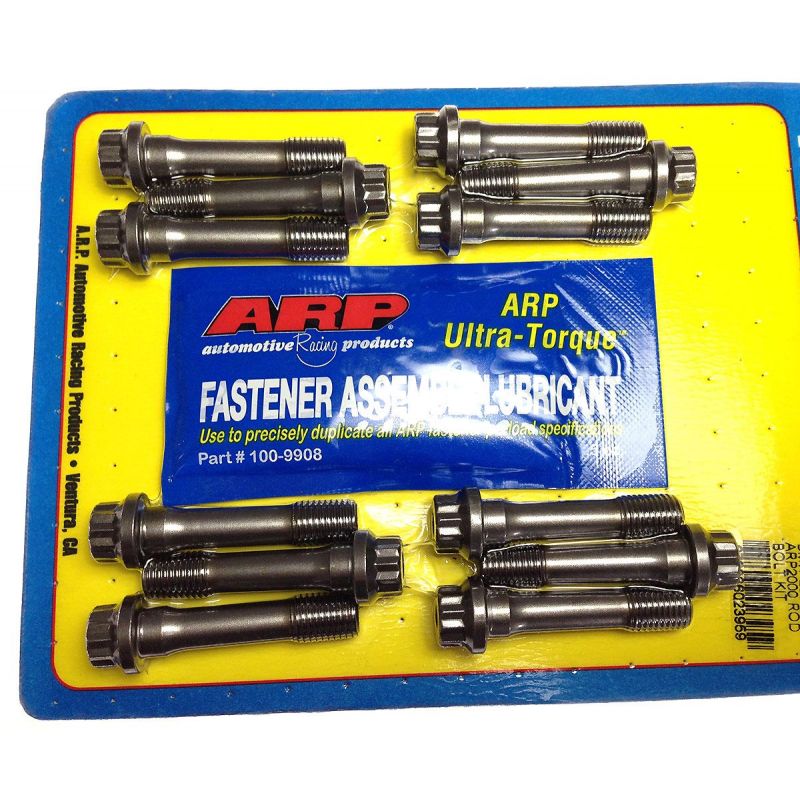
ARP 8740 connecting rod bolt and nut kit replacing the original bolts on OEM rods of the Toyota 7M-GE and 7M-GTE engines.
This kit is for the Toyota 7M-GE and 7M-GTE inline six-cylinder engines of 3.0 litres, with 24 valves, naturally aspirated or turbocharged, fitted to the Supra as well as the Cressida, Chaser, Cresta and Crown.
The ARP 8740 bolt takes the place of the original rod bolt, which is also tightened by a nut; it is pressed into the connecting rod.
At every engine revolution, the rod and piston assembly pulls on the rod cap, and only its bolts hold it against these inertia loads. The original ones are intended for stock power.
The kit contains 8740 connecting rod bolts to be pressed into the rod; the nut is preferably tightened by stretch measured with a gauge, the ARP instruction sheet giving a torque when no gauge is available. Material: 8740, a chrome-moly steel heat treated by ARP to 180,000 psi tensile strength, with threads rolled after heat treatment. Factory-fitted fasteners usually fall into classes 10.9 and 12.9, between 150,800 and 176,900 psi minimum.
| Part number | Brand | Grade / material | Nut | Thread | Under-head length |
|---|---|---|---|---|---|
| ARP-203-6004 | ARP | 8740 steel | Not published | Not published |
Before the bolts are pressed in, the ARP instruction sheet asks you to make sure the top of the rod bore has enough of a chamfer to clear the radius under the head.
| Reference | Tightening torque | Stretch |
|---|---|---|
| ARP-203-6004 | 67.8 Nm | 0.152 - 0.165 mm |
For this part, ARP favours tightening to a measured stretch, the key to an exact preload; torque is given only when no gauge is available. The figures in the table assume ARP lubricant.
The values above come from the ARP 203-6004 instruction sheet applicable at the date of publication; it is authoritative in the event of any difference. Read the ARP 203-6004 instruction sheet
Assembly is done without thread locker, as the ARP instruction sheet calls for none: ARP Ultra-Torque grease is applied to the threads of each bolt and to the bearing face of its nut.
Once the fasteners are fitted, the ARP instructions call for the big ends to be checked and resized by a machine shop.
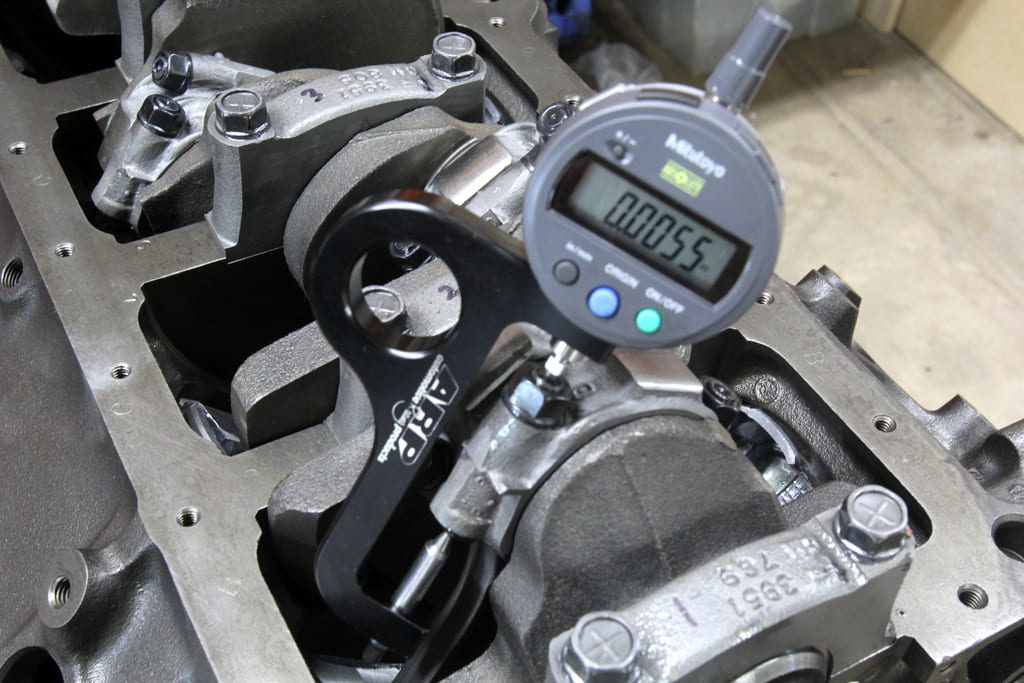
Tightening to stretch means setting the preload on how much the bolt actually stretches, rather than on a torque affected by friction. With the bolt fitted, the dial gauge is placed on both its ends and the bolt is tightened until the stretch given in the table is read. It is the safest method on a highly tuned engine.
Tightening is done with ARP assembly grease, on the bolt threads and on the bearing face of the nuts: the torque and stretch figures in the table were established with it.

Founded in the early 1970s by Gary Holzapfel, who came from the aerospace sector, ARP (Automotive Racing Products) was born to put an end to fastener-related engine failures in racing. Its thousands of part numbers, designed and manufactured in California for the cylinder head, the main bearings and the connecting rods, come in several materials depending on the application and are recognised for the consistency of their manufacture.
| Brand | Model (chassis) | Engine code | Power | Years |
|---|---|---|---|---|
| Toyota | Chaser (MX83) | 7M-GE | 200 hp | 1989-1992 |
| Toyota | Cresta III (MX83) | 7M-GE | 200-204 hp | 1988-1992 |
| Toyota | Cressida (X6 / X8 / MX83) | 7M-GE | 193-200 hp | 1988-1993 |
| Toyota | Crown (MS135) | 7M-GE | 190 hp | 1987-1991 |
| Toyota | Supra (MA70) | 7M-GE, 7M-GTE | 190-238 hp | 1986-1993 |
The turbocharged 7M-GTE, and a 7M-GE that is revved higher, pull on the rod bolts on every revolution, and the failure of a single bolt destroys the rod, the piston and the block. For far less than the cost of restoring a bottom end, ARP 8740 bolts rule out that risk.