Product successfully added to your shopping cart
Quantity
Total
There are 0 items in your cart. There is 1 item in your cart.
Total products
Total shipping To be determined
Total

2.3L 16v - B235
Manufacturers
2.3L 16v - B235
Warning: Last items in stock!
New product
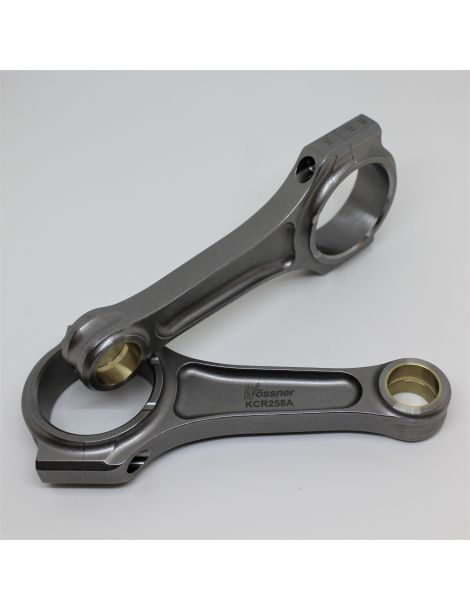
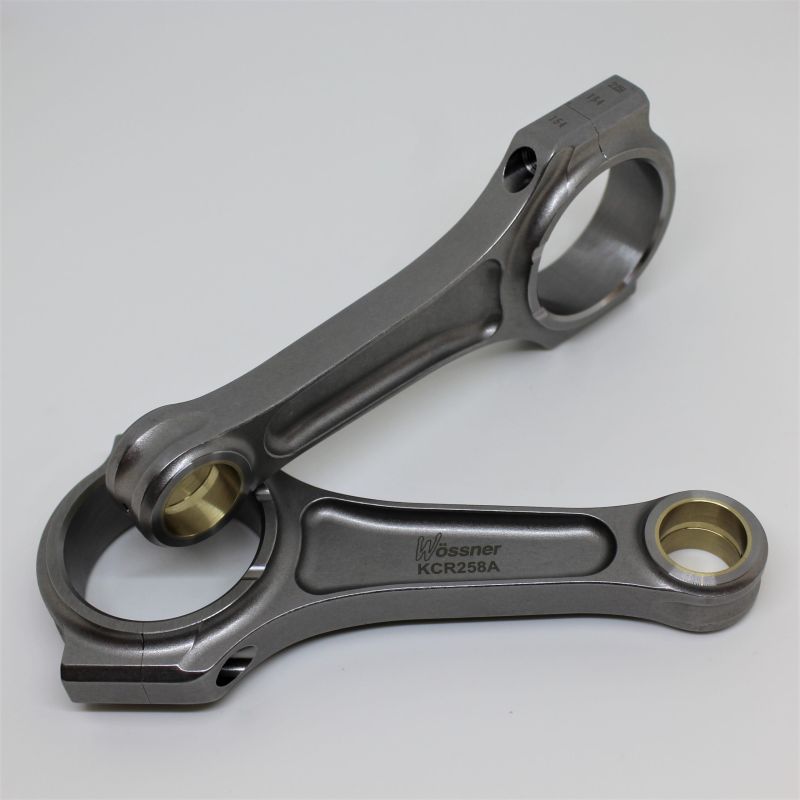
Set of 4 forged 4340 steel connecting rods for SAAB 2.3L 16V Turbo B235.
The SAAB B235 is a 2.3-litre inline four-cylinder with 16 valves and a turbocharger, derived from the "H engine" family developed by Saab. Introduced in 1997 in the 9-5 (YS3E), it powered the Swedish saloon and estate until 2009 and also went into the first-generation 9-3 (YS3D) in its sporting versions. Cast-iron block, aluminium DOHC cylinder head: the architecture is that of an engine designed around forced induction, with a reserve of material that explains its reputation for longevity.
The whole range shares the same mechanical base in several power levels: the B235E of around 185 hp with a low-pressure Garrett turbo, the 220 hp B235L and the B235R Aero at 230 to 260 hp with a Mitsubishi TD04. It is exactly that margin which made the B235 a favourite of engine builders: a remap and a rise in boost pressure are enough to push cylinder pressure well beyond the original specification. The standard connecting rod then becomes the part that limits the build, and forged 4340 rods lift that restriction before moving on to forged pistons.
Machined from high-strength 4340 steel, these forged rods give the B235 bottom end the mechanical reserve it lacks as soon as power rises. They become essential when moving to forged pistons, raising the rev limit, increasing boost pressure or gaining displacement: all situations where the production rod, designed for volume manufacturing, reaches its limits. The Wössner I profile, 690.74 g for a 153 mm centre-to-centre and a 24 mm pin, answers that with a solid section and continuous grain flow.
Built to absorb the loads of modified engines, whether turbocharged or supercharged, they cover every discipline: rally, drift, drag, circuit and trackdays, hillclimb, time attack. They support Stage 2, Stage 3 and Stage 4+ builds, right up to the fully redesigned competition block. Whatever the discipline, the real safety margin comes from the material of the rod and from the grade of its bolts.
| Reference | Brand | Profile | Bolts | Pin diameter OEM 24 mm | Small-end width | Big-end diameter OEM n.p. | Big-end width | Center-to-center OEM 153 mm | Weight per rod |
|---|---|---|---|---|---|---|---|---|---|
| KCR052A | Wössner | I | ARP 2000-3/8"-38mm | 24 mm | 22 mm | 56 mm | 26.4 mm | 153 mm | 690.74 g |
| Rod | Bolts | Torque | Recommended stretch |
|---|---|---|---|
| Wössner (KCR052A) | ARP 2000 | 74.6 N·m | 0.1397 – 0.1524 mm |
Only one combination is offered here, the Wössner rod with its ARP 2000 fasteners in 3/8": there is therefore a single range to respect, and no reason to depart from it. Below it, the bolt does not install the tension needed to keep the cap clamped when the piston is pulled back at the top of its stroke: the rod to cap joint opens cyclically, the shell is hammered then indented, it loses its thickness before its position, and the bearing runs hot. Above it, the bolt passes its elastic domain: elongation becomes permanent, preload falls away, while the overload closes and distorts the bearing bore, makes the big end oval and removes any even bearing contact. On a tuned B235 turbo, both drifts are paid for at the same price. The values in the table below are those of the fastener manufacturer and assume ARP assembly lubricant, since lubrication strongly changes the torque reading. Stretch checking with a dial gauge remains the reference method, and the instructions supplied with the kit prevail in case of any discrepancy.
| 4340 steel is a nickel-chromium-molybdenum alloy steel used in aerospace and motorsport alike. Forged then heat-treated (quench and temper), it offers excellent tensile strength, high fatigue resistance and real ductility. Compared with an original rod (often sintered/powder metal, optimised for series-production cost), a 4340 forged rod shows roughly +19% higher yield strength, +8% higher tensile strength and above all +19% to +37% higher fatigue strength, i.e. a fatigue life under cyclic loading several times longer. This is what makes forged 4340 the reference material as soon as boost and rpm climb. |
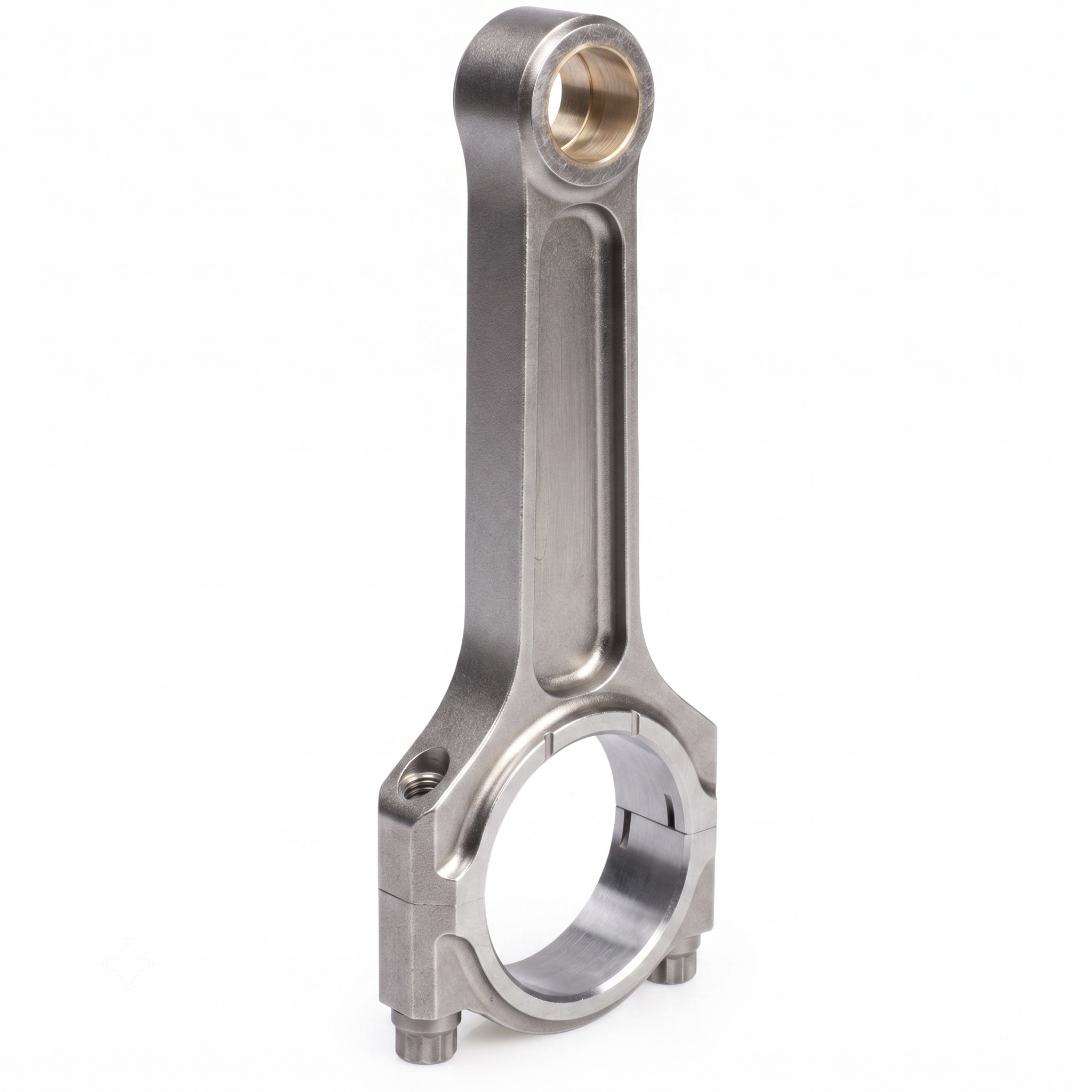 | I-beam profile. With its thinner central section, the I-beam rod is lighter: less inertia and freer rev pick-up. It is the preferred profile on modern turbo engines. Its I-HD (Heavy Duty) version is a reinforced variant, designed for higher loads. |
A rod bolt is judged first on its metallurgy: alloy grade, cleanliness of the steel, heat treatment carried through the section, then rolling of the threads once the part is treated, which work-hardens the thread root and moves the fatigue initiation away. Add corrosion resistance and dimensional consistency, without which preload varies from one bolt to the next. This Wössner rod for the B235 is supplied with ARP 2000 hardware in 3/8"-38 mm: refer to the table above for torque and stretch, and always favour the measured stretch check.
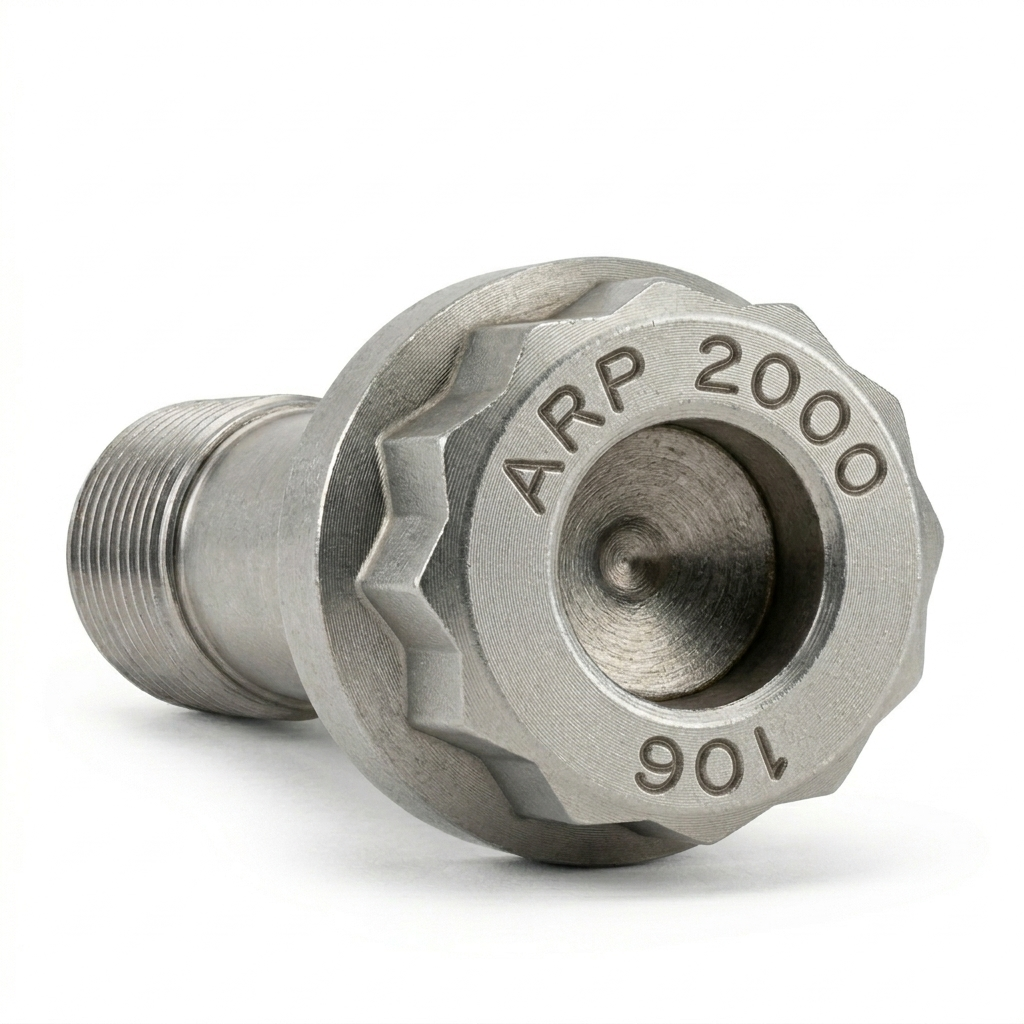 | ARP 2000 is a wrought, through-hardened steel with tensile strength around 220,000 psi, i.e. ~1,517 MPa. Threads rolled after heat treatment, excellent cyclic fatigue endurance, good stability against ambient corrosion and no particular storage constraint. The grade is rated up to 200 hp per cylinder in 3/8" and up to 8,500 rpm, which makes it the most common in circuit racing, trackdays, drift, rally, drag and hillclimb. This is the hardware supplied with the Wössner I-profile rod of this B235, in 3/8"-38 mm. |
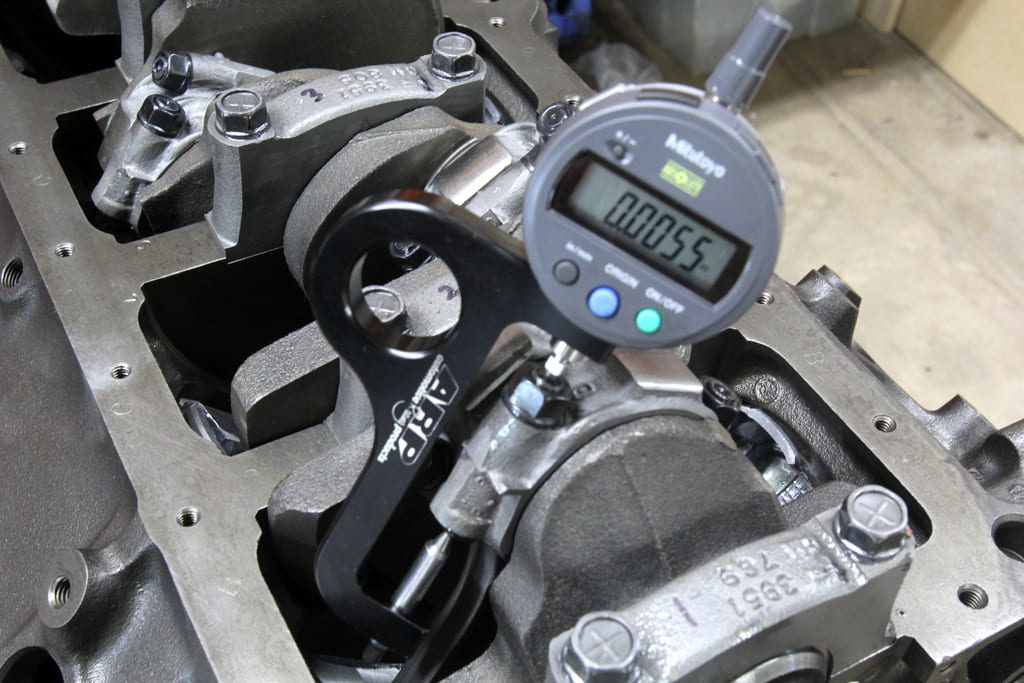
In addition to torque tightening, measuring rod-bolt stretch is the most reliable check for optimal preload. The check is done with the bolt fitted: place the gauge (dial indicator) on the two ends of the bolt and read its actual stretch, which must match the recommended value (see the torque & stretch table above). This method removes the friction variations inherent in torque tightening and secures the assembly on heavily stressed engines. |
 | Wössner is a German manufacturer known for its high-end forged pistons and connecting rods. Its rods are machined from 4340 steel to tight tolerances, balanced and delivered ready to fit, a level of finish appreciated in rallying as much as on the track. For the SAAB B235 the set is offered in the I profile with ARP 2000 bolts, a combination that favours light weight and free revving while keeping a comfortable reserve of strength. |
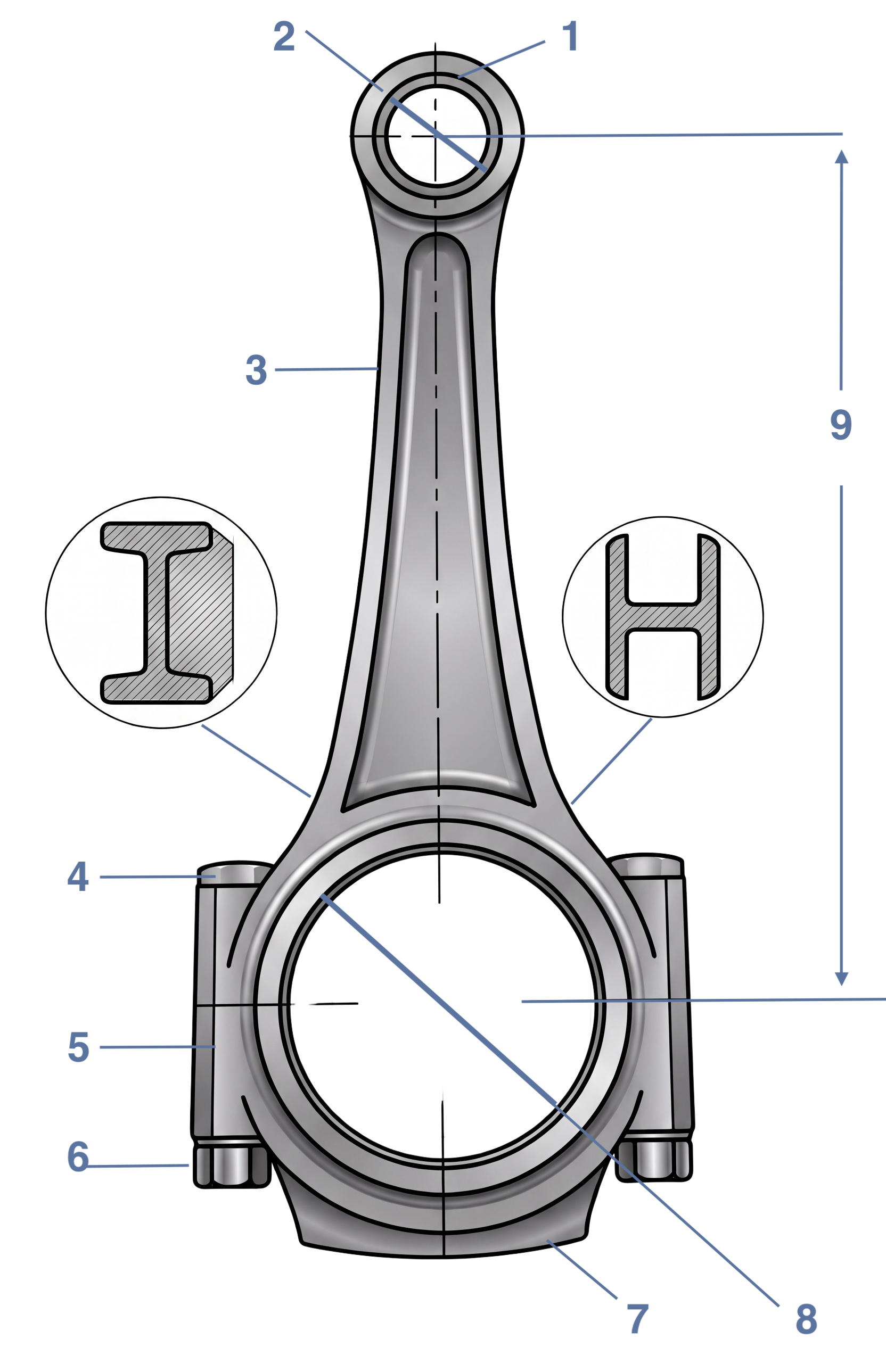 | 1) Small end 2) Small-end diameter 3) Rod beam 4) Rod bolt 5) Big end 6) Rod nut / bolt 7) Rod cap 8) Big-end diameter 9) Center-to-center |
These forged connecting rods are compatible with all vehicles fitted with the SAAB B235 engine (3.0L 24V twin-turbo):
| Brand | Model (chassis) | Engine code | Power | Years |
|---|---|---|---|---|
| SAAB | 9-5 (YS3E) | B235E | 185 hp | 1997–2009 |
| SAAB | 9-5 Aero (YS3E) | B235R | 230–260 hp | 1999–2009 |
| SAAB | 9-3 Viggen (YS3D) | B235R | 225–230 hp | 1999–2002 |
| SAAB | 9-3 Aero (YS3D) | B235R | 230 hp | 2002–2003 |
OEM reference: 30589313 (replaces 9199233), set of 4 connecting rods.
When a standard bottom end breaks a rod, the repair does not stop there: the rods AND the pistons, almost always damaged at the same time, sometimes the crankshaft too, have to be replaced. The bill for a simple return to factory condition then becomes very high.
For an equivalent or even lower budget, a set of 4340 forged rods combined with forged pistons brings reliability and a safety margin of another order, with real room to raise power on this 2.3-litre turbo. This has been the choice of European engine builders for more than fifteen years.
For the same budget: more reliability, more potential and more longevity for the rotating assembly.