Product successfully added to your shopping cart
Quantity
Total
There are 0 items in your cart. There is 1 item in your cart.
Total products
Total shipping To be determined
Total

2.0L 16v - A20NHT/NFT
Manufacturers
2.0L 16v - A20NHT/NFT
Warning: Last items in stock!
New product
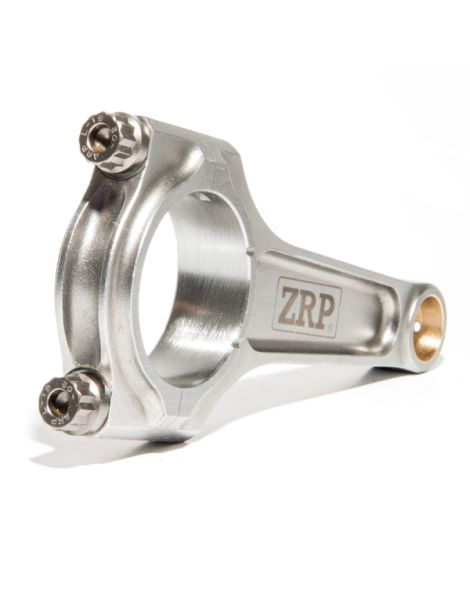
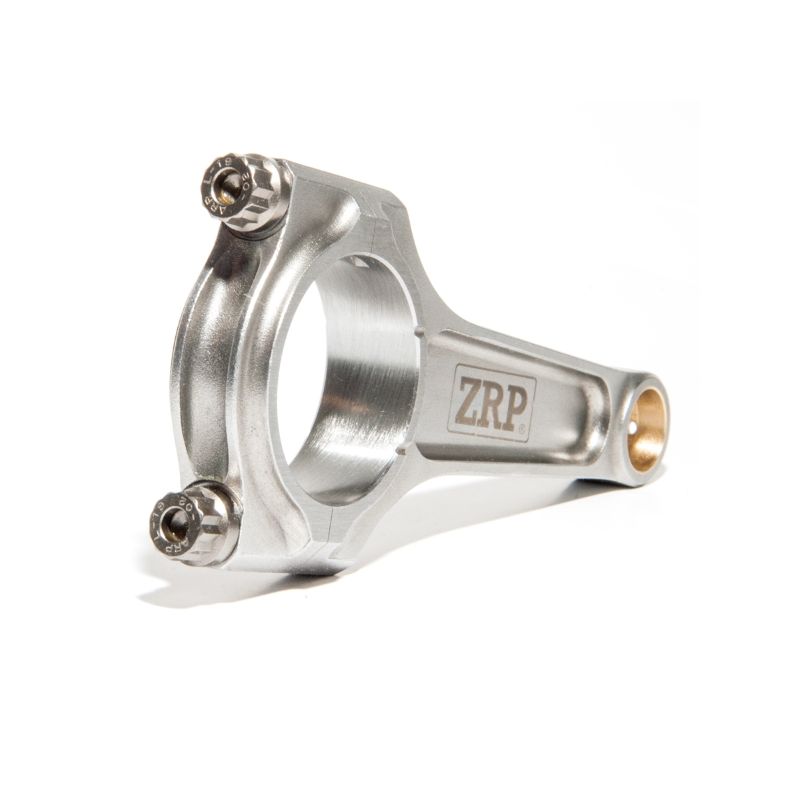
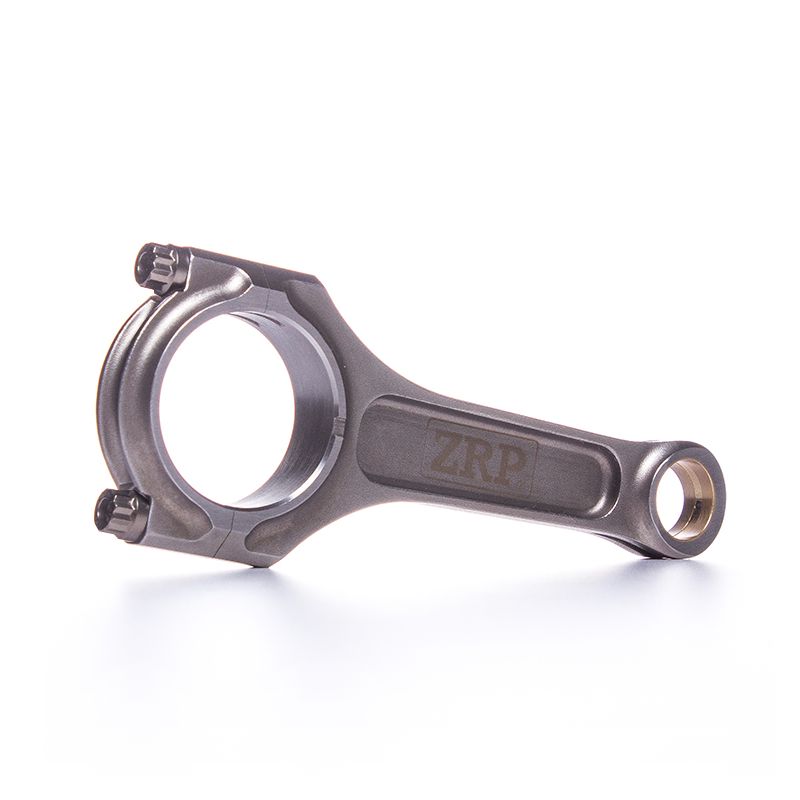
Set of 4 forged connecting rods in 4340 steel for the Opel 2.0L 16V Turbo LNF / A20NFT.
The 2.0 16v Turbo (Ecotec "LNF" then A20NHT / A20NFT families) is a direct-injection inline-four petrol engine developed by General Motors. Displacing 1,998 cc (86 mm bore × 86 mm stroke), it pairs a 16-valve DOHC head with a turbocharger, twin-scroll on the most powerful versions, and reinforced piston cooling. Introduced in 2007 (Pontiac Solstice GXP, Saturn Sky Redline, Chevrolet Cobalt SS and HHR SS, code LNF, around 264 HP), it later powered the Opel / Vauxhall Insignia 2.0 Turbo (A20NHT / A20NFT, around 220 HP) and, in its most accomplished form (A20NFT "LDK", around 280 HP and 400 Nm), the Opel Astra J VXR / GTC OPC built from 2012 to 2018. Robust by design, this Ecotec turbo block readily accepts higher boost pressure; beyond the original torque, the stock rods and pistons become the weak link.
Forged from high-strength 4340 steel, these reinforced connecting rods secure the bottom end as soon as power climbs. They become essential when switching to forged pistons, raising the rev limit, increasing boost pressure or gaining displacement, situations where the stock rod reaches its limits. Designed to withstand the heavy loads of built engines (turbo or high-output naturally aspirated), they cover every discipline (rally, drift, drag, circuit and track days, hillclimb, time attack) and support Stage 2, Stage 3 and Stage 4+ builds, up to full competition engines.
| Reference | Brand | Profile | Bolts | Pin diameter OEM 23 mm | Small-end width | Big-end diameter | Big-end width | Center-to-center OEM 145,45 mm | Weight per rod |
|---|---|---|---|---|---|---|---|---|---|
| R-OPE-009I | ZRP | I | ARP 2000-3/8"-38mm | 23 mm | 52,13 mm | 23,95 mm | 145,45 mm | 547 g | |
| R-OPE-009I-L19 | ZRP | I | ARP L19-3/8"-38mm | 23 mm | 52,13 mm | 23,95 mm | 145,45 mm | 547 g |
| Rod | Bolts | Torque | Recommended stretch |
|---|---|---|---|
| ZRP (R-OPE-009I) | ARP 2000-3/8"-38mm | 61 N·m | 0,140 – 0,152 mm |
| ZRP (R-OPE-009I-L19) | ARP L19-3/8"-38mm | 67,8 N·m | 0,152 – 0,165 mm |
Assembly lubricant is no minor detail on this turbocharged four-cylinder: it sets the friction coefficient, and therefore how much of the applied torque actually becomes preload. Tightened dry, a bolt will reach the right torque reading while remaining underloaded; drowned in engine oil, it can be overloaded. The figures in the table above, issued by the bolt manufacturer, assume clean threads and a thin film of ARP lubricant spread over the threads and under the head; they must be followed to the letter, for ARP 2000 as well as for ARP L19 bolts. Since torque remains an indirect measurement, checking stretch with a dial gauge is the dependable method: it verifies the elongation actually obtained on each of the eight bolts. Tighten progressively, in stages, alternating sides of the cap. The instruction sheet supplied with the kit overrides any workshop habit.
| 4340 is a nickel-chromium-molybdenum alloy steel used both in aerospace and motorsport. Forged then heat-treated (quench and temper), it combines excellent tensile strength, very good fatigue resistance and marked ductility. Compared with a stock rod (often sintered metal, optimised for mass-production cost), a forged 4340 rod offers about +19% yield strength, +8% tensile strength and above all +19 to +37% fatigue resistance, i.e. a service life under cyclic loading several times longer. That is what makes forged 4340 the benchmark material as soon as boost and rpm rise. |
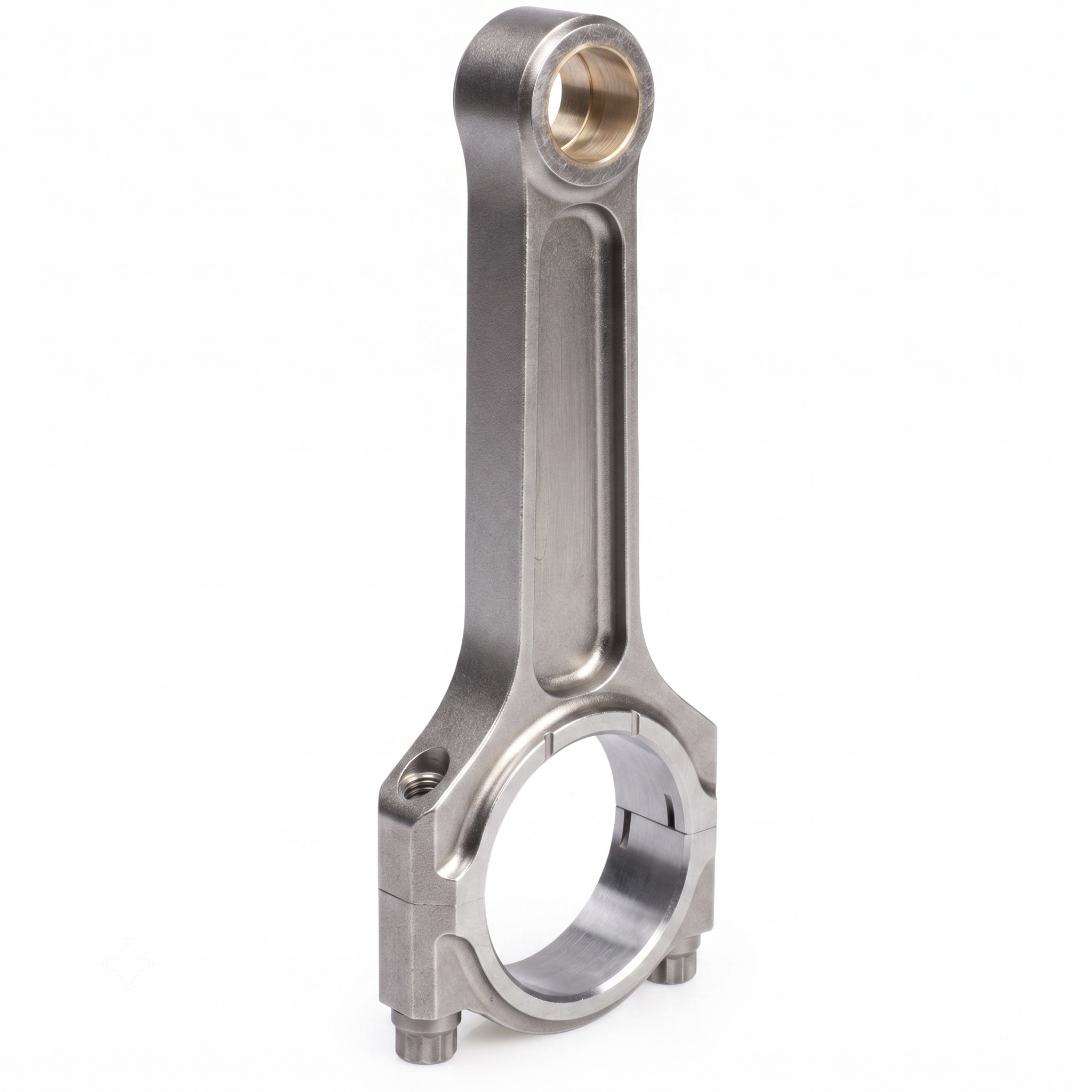 | I-beam. Its slimmer central section makes the rod lighter: less reciprocating inertia and freer rev pick-up. It is the favoured profile on modern turbo engines such as the 2.0 Ecotec. Its I-HD (Heavy Duty) variant is a reinforced version for the highest loads. |
The rod bolt is one of the most heavily stressed parts of the engine. The key is to match the ARP grade to the real use of the build, then to follow the assembly torque and stretch rigorously.
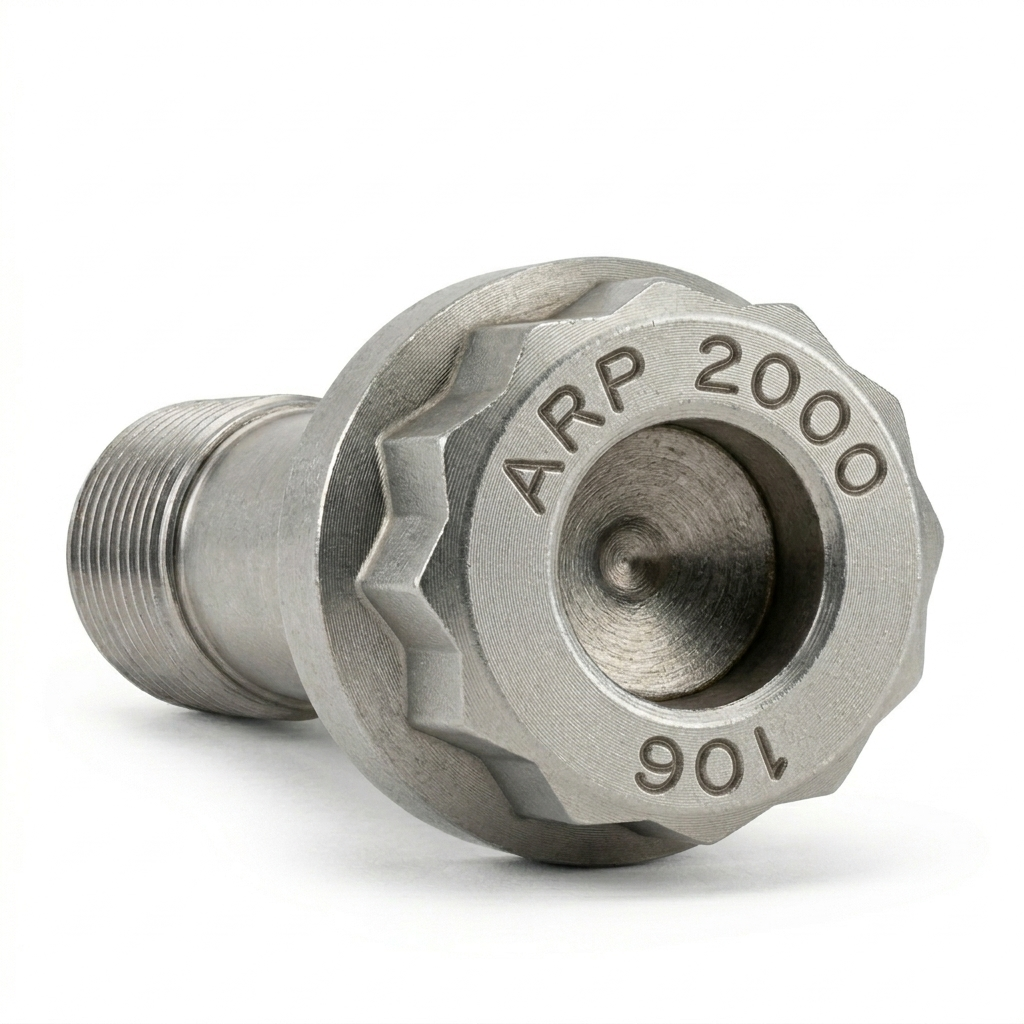 | ARP 2000 (tensile strength around 220,000 psi, i.e. ~1,517 MPa) is the high-performance standard. Suited to builds up to 200 hp per cylinder in 3/8", and up to 8,500 rpm, it is the most common bolt in circuit racing, track days, drift, rally, drag and hillclimb, valued for its strength, reliability and versatility, with no particular storage constraint. |
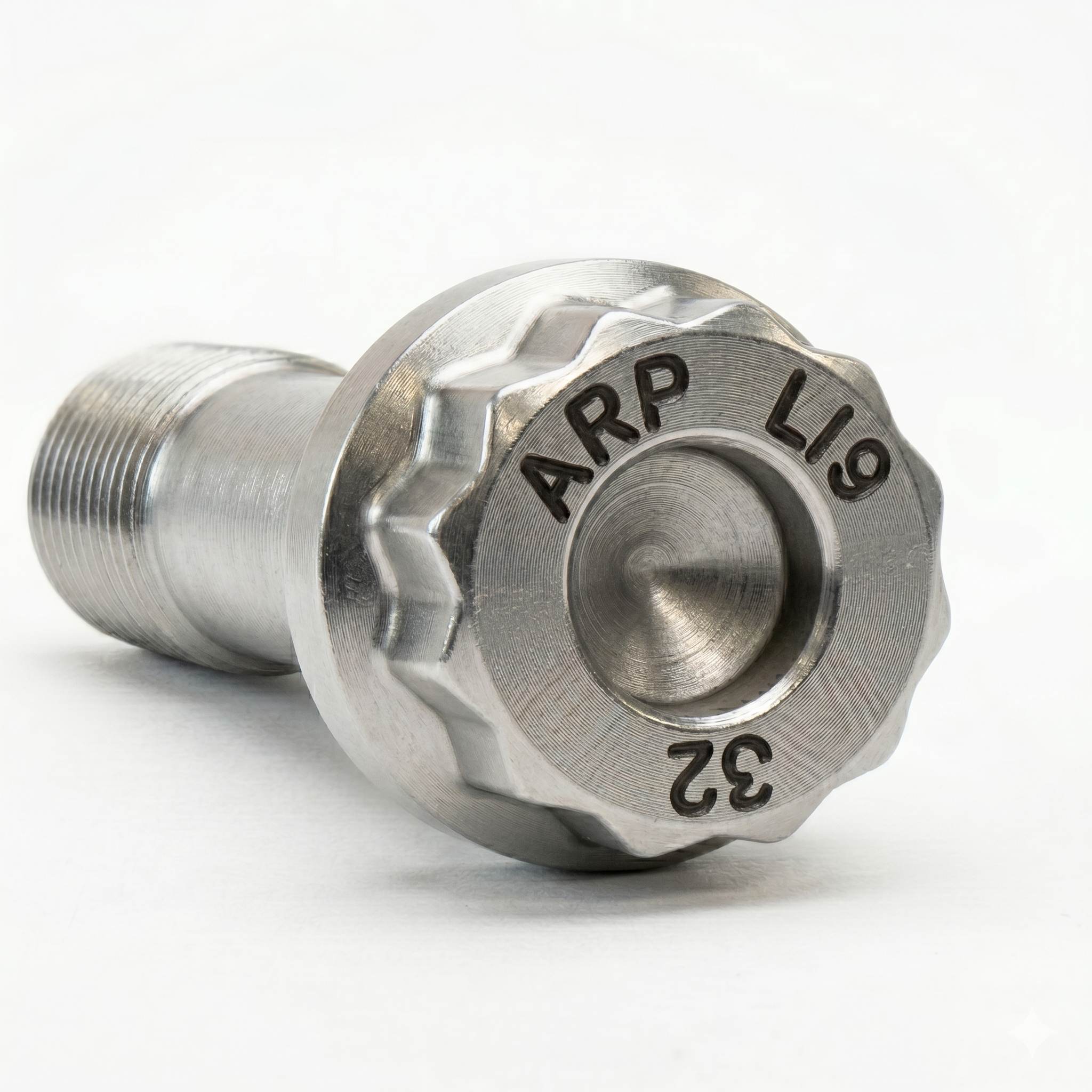 | L19 (tensile strength around 260,000 psi, i.e. ~1,793 MPa) targets engines pushed to the extreme, up to 250 hp per cylinder in 3/8", and up to 10,000 rpm: very high boost pressure, sustained high rpm and elevated cylinder pressure. It is the choice for big-power builds and drag racing. The L19 alloy is sensitive to oxidation and requires careful (oiled) storage. |
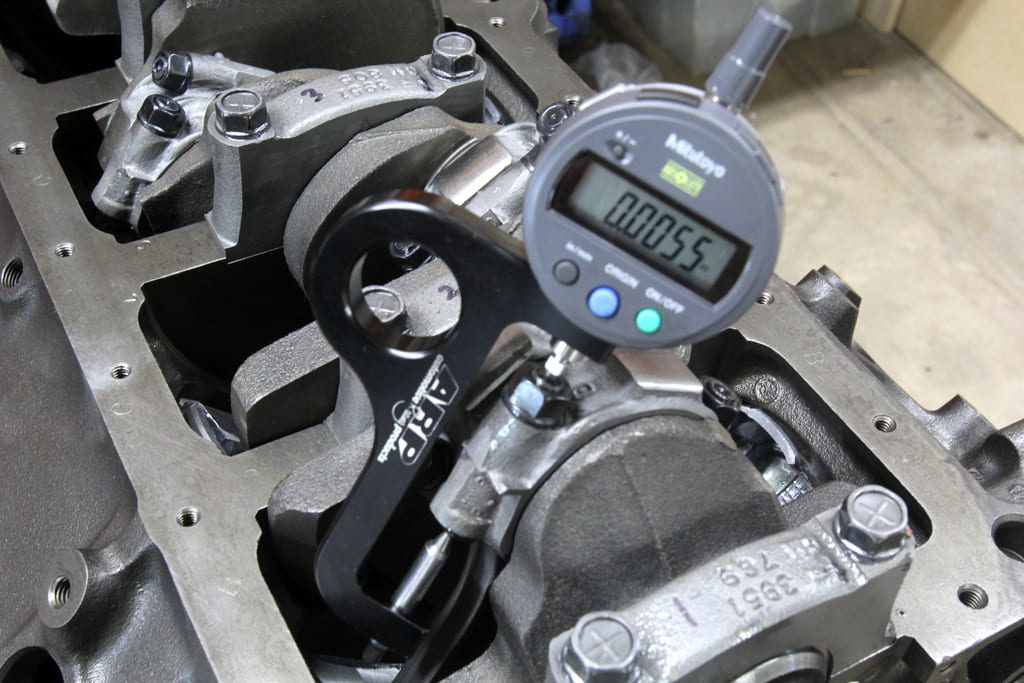
| In addition to torque tightening, measuring rod-bolt stretch remains the most reliable check to reach optimal preload. With the bolt fitted, the gauge (dial indicator) is placed on both ends of the bolt and the actual stretch is read, which must match the recommended value (see the torque and stretch table above). This method eliminates the friction variations inherent to torque tightening and secures the assembly on heavily stressed engines. |
 | ZRP is a Greek brand of high-performance forged connecting rods, designed by Alex Drakos in Athens. Each rod is forged from 4340 steel, precision-machined and balanced to ±1 g to stay reliable at high rpm. Offered here in I-beam profile with ARP 2000 or L19 bolts, they are developed and inspected in Greece and proven in rally, circuit racing and drift. |
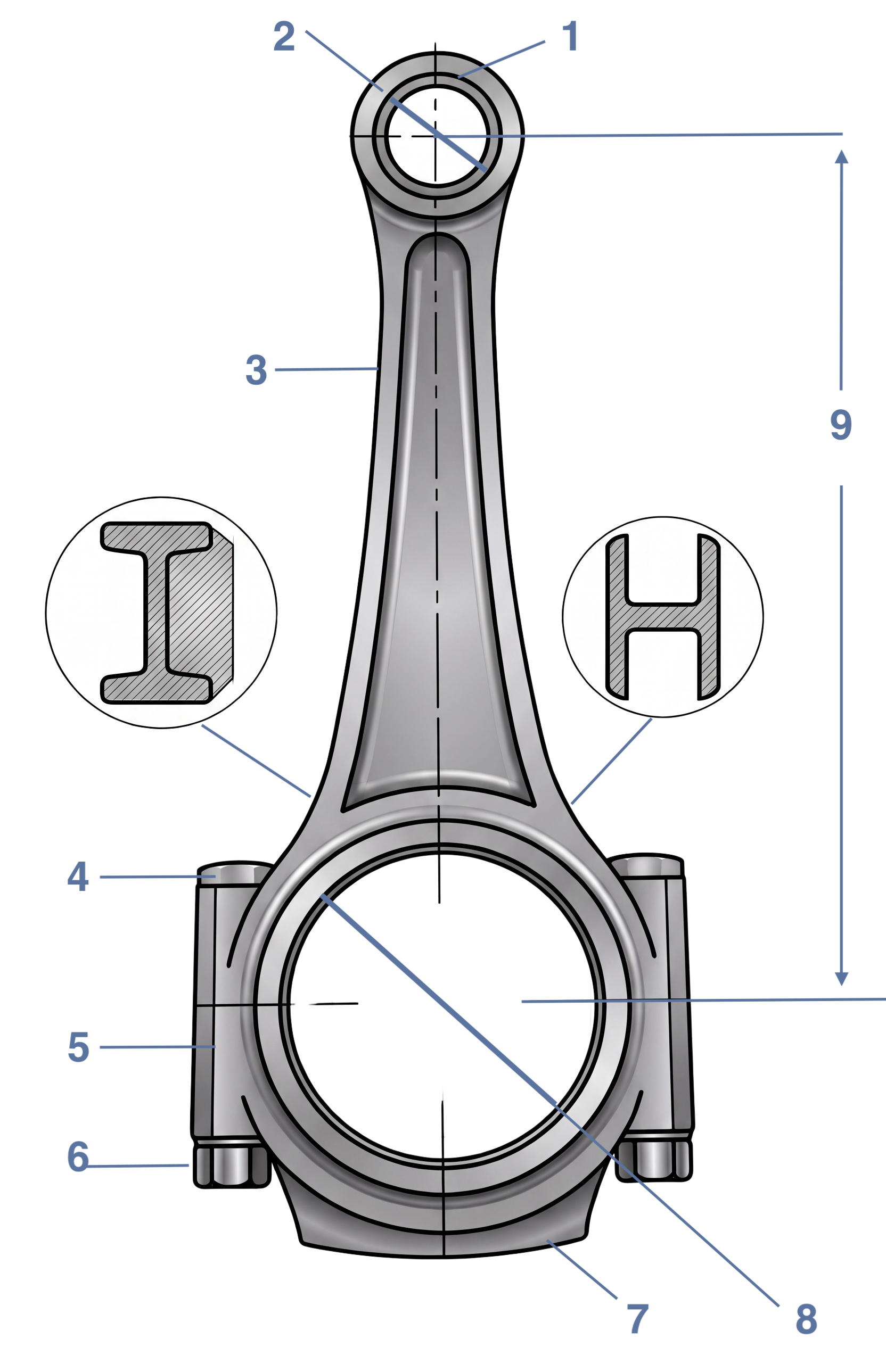 | 1) Small end 2) Small-end diameter 3) Rod beam 4) Rod bolt 5) Big end 6) Rod nut / bolt 7) Rod cap 8) Big-end diameter 9) Center-to-center |
These forged connecting rods fit every 2.0 Ecotec turbo engine sharing the same rod (centre-to-centre 145.45 mm, 23 mm piston pin):
| Brand | Model (chassis) | Engine code | Power | Years |
|---|---|---|---|---|
| Opel / Vauxhall | Insignia A (G09) 2.0 Turbo / Turbo 4x4 | A20NHT / A20NFT | 220 HP (162 kW) | 2008–2017 |
| Opel / Vauxhall | Astra J VXR / GTC OPC 2.0 Turbo | A20NFT | 280 HP (206 kW) | 2012–2018 |
| Saab | 9-3 (YS3F) 2.0t | A20NFT | 220 HP (162 kW) | 2008–2015 |
| Saab | 9-5 (YS3G) 2.0 Turbo | A20NHT | 220 HP (162 kW) | 2010–2012 |
| Chevrolet | Cobalt SS / HHR SS 2.0 Turbo | LNF | 264 HP (194 kW) | 2007–2010 |
| Pontiac | Solstice GXP 2.0 | LNF | 264 HP (194 kW) | 2006–2009 |
| Saturn | Sky Redline 2.0 | LNF | 264 HP (194 kW) | 2006–2010 |
| Cadillac | SLS 2.0T | LNF | 262 HP (193 kW) | 2010–2013 |
OEM reference: 12638832 (set of 4 rods).
When a stock bottom end lets go (a broken, bent or scored rod), simply returning to the factory configuration means replacing the rods AND the pistons, often damaged at the same time: the bill rises fast for a like-for-like repair with no gain. For an equivalent or even lower budget, forged 4340 connecting rods combined with forged pistons bring far greater reliability and safety margin, plus real headroom to increase power. It is the solution European engine builders have chosen for over fifteen years: for the same budget, more reliability, more potential, more longevity.