- In stock


ACL trimetal connecting rod bearings Honda F23A F23Z K20A3
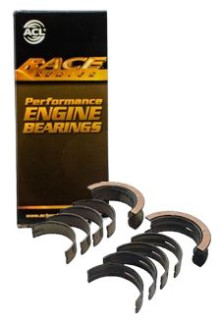
ACL Race trimetal connecting rod bearings for the Honda F23A, F23Z and K20A3.
The Honda F23A, F23Z and K20A3 four-cylinder engines
The F23A and F23Z are the 2.3 litre 16-valve four-cylinder engines of Honda's F family; they power the Accord, Accord Aerodeck, Odyssey and Shuttle. The K20A3 is the 2.0 litre four-cylinder engine of Honda's K family; it powers the Civic, Integra and Acura RSX. ACL lists a single bearing set for these engines: same crankpin diameter, a single set covers the family.
From the factory, this engine is fitted with standard production connecting rod bearings, sized for the loads of the original engine: as soon as power, engine speed or boost pressure increase, they reach their limits.
Trimetal connecting rod bearings
Three layers make up a trimetal bearing: the steel back for stiffness, the copper-lead intermediate layer for load capacity, then the anti-friction running layer that protects the crankpin. This set includes 8 half shells, that is 4 pairs.
Where an aluminium bi-metal bearing, designed for low to medium loads, withstands about 8,000 psi, a performance trimetal bearing goes up to 12,000 psi: 50% extra margin. That is what keeps it durable on an engine boosted by a turbo or supercharger, or pushed to high rpm.
Technical specifications
| ACL bearings Crankpin Ø 44.976 / 45.000 mm Housing bore Ø 48.000 / 48.024 mm Width 15.5 mm |
| Reference | Brand and treatment | Size | Wall thickness (mm) |
|---|---|---|---|
| 4B1906H-STD | ACL Race - Untreated | Standard | 1.502 |
| 4B1906HX-STD | ACL Race - Untreated | Std, increased clearance (HX) | 1.489 |
| 4B1906H-.025 | ACL Race - Untreated | +0.025 | 1.515 |
| 4B1906H-.25 | ACL Race - Untreated | +0.25 | 1.627 |
| 4B1906H-.50 | ACL Race - Untreated | +0.50 | 1.752 |
Running clearance
Between the crankpin and the bearing there is a small gap, the running clearance, in which the oil film circulates.
In operation there is no metal-to-metal contact: the crankpin turns on this oil film, which supports the whole load. The clearance determines its thickness. A clearance that is too tight hinders oil flow, heats the assembly and promotes seizure; one that is too wide lets oil leak away, weakens the film and makes oil pressure drop. The correct clearance balances oil flow and film strength.
| Size / grade | When to choose it | ACL Race Series |
|---|---|---|
| Standard (STD) | Standard journal, not reground | 0.049 to 0.058 mm |
| Increased clearance (HX) | Wider clearance: high oil flow, high rpm | 0.074 to 0.083 mm |
| +0.025 mm | Polished journal | 0.049 to 0.058 mm |
| +0.25 mm | Journal reground to 0.25 mm | 0.049 to 0.058 mm |
| +0.50 mm | Journal reground to 0.50 mm | 0.049 to 0.058 mm |
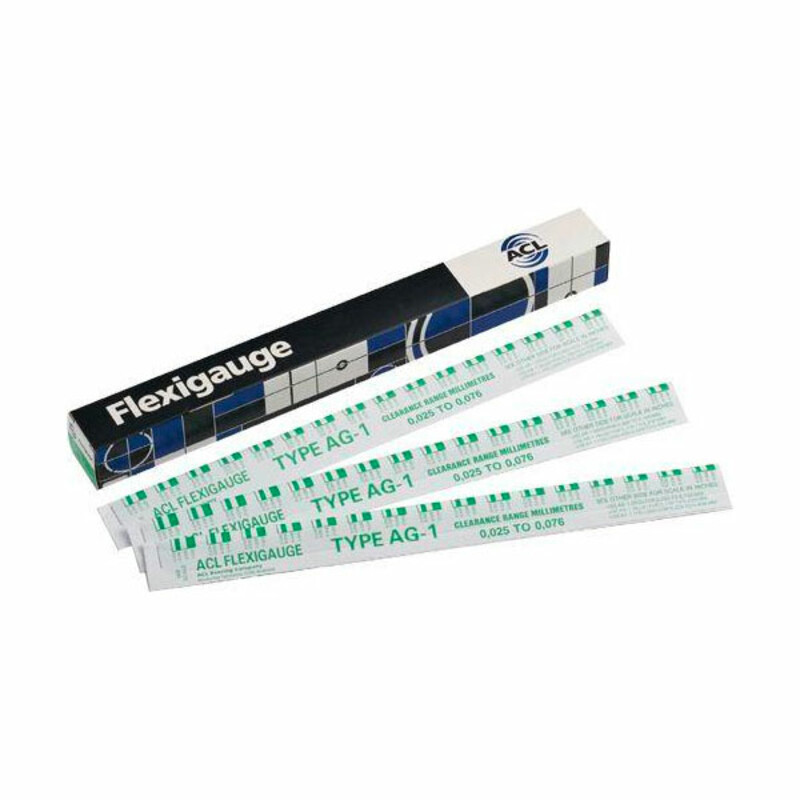
Checking on assembly: lay a calibrated strip (Plastigauge) on the journal, torque the rod cap to spec, then compare the crushed strip against the gauge to read the clearance.
Technical guide
Designed for engine building and motorsport, these ACL trimetal connecting rod bearings carry much more load than an original bearing, whether the engine gains power, revs higher or receives a turbo or supercharger. They are available in several sizes: the standard size, a +0.025 mm size for a crankpin that has only been polished, +0.25 and +0.50 mm regrind sizes and the HX version with increased clearance for high-revving engines or engines needing a high oil flow. That makes it possible to put a reground crankshaft back into service without changing range and to set the clearance for the oil and use.
The brand
 |
ACL Bearing Company has been making high-performance engine bearings in Australia since 1949. Its Race Series offers precise trimetal bearings, available in many sizes and proven in tuned and racing engines worldwide. |
Vehicle compatibility
This connecting rod bearing set fits the F23A, F23Z and K20A3 four-cylinder engines of the following Honda and Acura models:
| Brand | Model (chassis) | Engine code | Power | Years |
|---|---|---|---|---|
| HONDA | ACCORD VI (CK, CG, CH, CF, CL) 2.3 / 2.3 (CF8) / 2.3 (CG5, CF9, CF0, CF1, CF2) / 2.3 (CL3, S86) | F23A1, F23A5, F23Z5 | 137–154 hp | 1997–2003 |
| HONDA | ACCORD VI Coupe (CG) 2.3 | F23A1 | 152 hp | 1997–2002 |
| HONDA | ACCORD VI Hatchback (CH, CL) 2.3 (CL4) | F23Z5 | 154 hp | 2000–2002 |
| HONDA | ACCORD VI Aerodeck (CF) 2.3 16 V (CF6) | F23A7 | 160 hp | 1998–2002 |
| HONDA | ODYSSEY (RA_) 2.3 (RA3, RA6) | F23A7 | 150 hp | 1997–1999 |
| HONDA | SHUTTLE (RA) 2.3 16V (RA3, RA5) | F23A7 | 150 hp | 1997–2004 |
| HONDA | ACCORD V (CE, CF_, CD) 2.3 i VTEC (CG5) | F23A1 | 150 hp | 1997–1998 |
| HONDA | CIVIC VII Hatchback (EU, EP, EV) 2.0 i Sport (EV1) / 2.0 (EV1) | K20A3 | 160–162 hp | 2001–2005 |
| HONDA | CIVIC VII Berline tricorps (ES, ET) 2.0 (ET1) / 2.0 iVtec (ET1) | K20A3 | 155–160 hp | 2003–2006 |
| HONDA | CIVIC VIII Berline tricorps (FD, FA) 2.0 (FD2) | K20A3 | 155 hp | 2006–2012 |
| HONDA | INTEGRA Coupé (DC5) 2.0 (DC5) | K20A3 | 160 hp | 2002–2008 |
| ACURA | RSX Coupé (DC_) 2.0 / 2.0 Sport | K20A3 | 158–162 hp | 2001–2006 |
Why replace the bearings
When a connecting rod bearing gives way, the damage quickly spreads beyond the part itself: a scored crankpin, debris carried through the whole oil circuit, a crankshaft to regrind at the very least, sometimes a rod and block lost. A bearing set costs far less than a regrind and is nothing compared with a complete engine rebuild. It is the cheapest part of the rotating assembly, yet the one whose failure is most expensive.
-
Brand
-
Reference4B1906H-STD
-
In stock19 Items