Product successfully added to your shopping cart
Quantity
Total
There are 0 items in your cart. There is 1 item in your cart.
Total products
Total shipping To be determined
Total

2.0 16v - F20C
Manufacturers
2.0 16v - F20C
Warning: Last items in stock!
New product
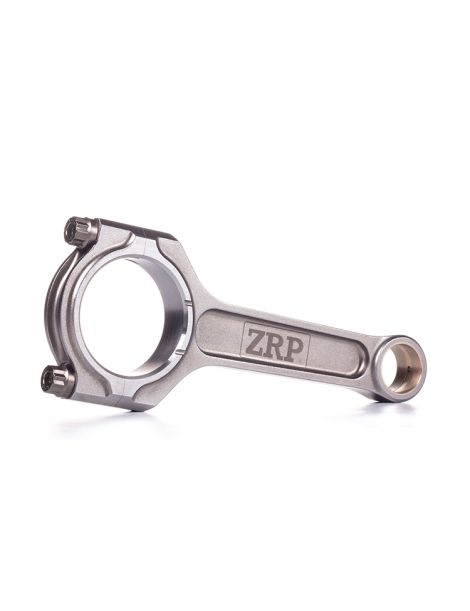
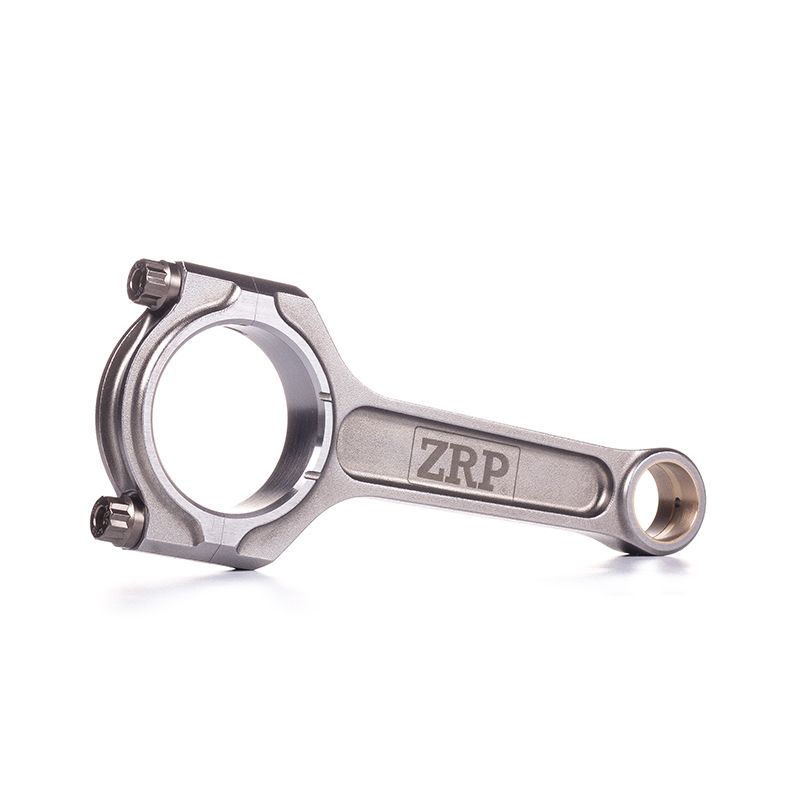
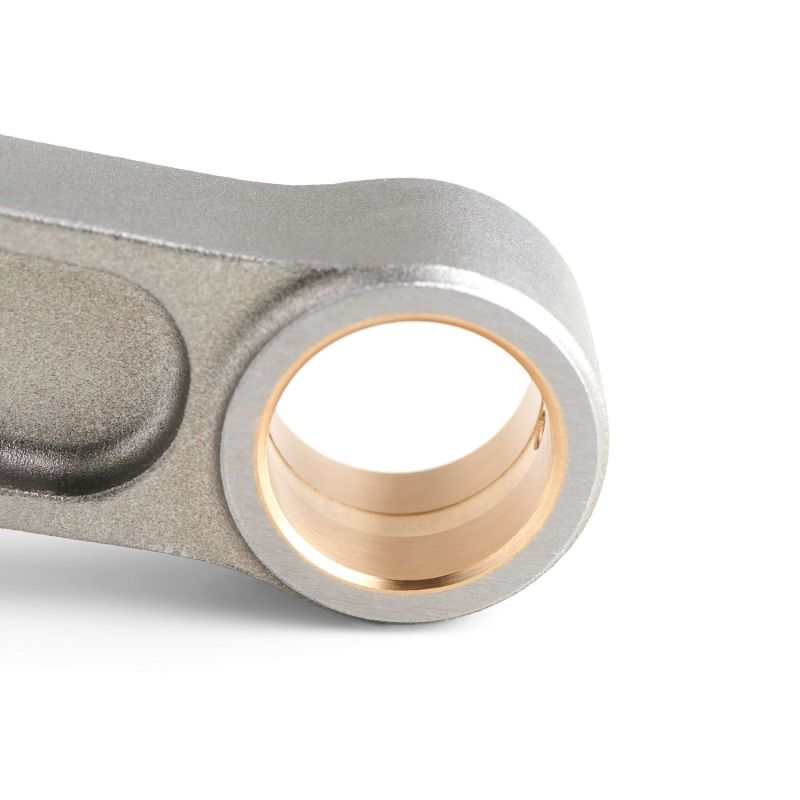
Set of 4 forged connecting rods in 4340 steel for the Honda 2.4 stroker F24 build (F20C base), 23 mm pin.
"F24" is not a factory Honda engine but the tuner's name for an F20C stroked to about 2.4 L. The original F20C is the 2.0 L 16-valve DOHC VTEC four-cylinder of the Honda S2000 (AP1), famous for its 240 to 250 hp naturally aspirated and one of the highest redlines ever fitted to a production engine, around 9,000 rpm. Converting it to F24 means fitting a longer-stroke crankshaft for more displacement: the forged rods offered here, with a shortened 145.5 mm center-to-center length and a 23 mm piston pin, keep the deck height correct despite that added stroke. The result is a build with markedly higher torque, whether it stays high-compression naturally aspirated or gains a turbocharger. At those stress levels the factory rods become the weak link: replacing them with forged rods is the first safeguard of a reliable, lasting stroker.
Drop-forged and precision-machined, these rods withstand bending, compression and fatigue loads far beyond those the factory sintered rods tolerate. They suit every sporting use of a prepared F-series engine: circuit, time attack, drift, drag, rally and hillclimb. Depending on the build, they support a Stage 2 as readily as a Stage 3 or a Stage 4 pushed in compression, rpm and, where fitted, boost. Supplied as a complete set of 4, weight-matched, they preserve the balance of the rotating assembly and the high-rpm resistance typical of the F block. All adopt the 145.5 mm center-to-center length and the 23 mm piston pin specific to the F24 stroker.
| Reference | Brand | Profile | Bolts | Pin Ø (mm) OEM 23 mm | Small-end width (mm) | Big-end Ø (mm) | Big-end width (mm) | Center-to-center (mm) OEM 145,5 mm | Weight (g) |
|---|---|---|---|---|---|---|---|---|---|
| R-HON-016-I | ZRP | I-HD | ARP 2000-3/8"-38mm | 23 | 51 | 19,83 | 145,5 | 510 | |
| R-HON-016-I-L19 | ZRP | I-HD | ARP L19-3/8"-38mm | 23 | 51 | 19,83 | 145,5 | 510 |
ZRP: Recommended for forced induction engines.
On these rods, tightening is controlled by bolt stretch, measured with a gauge, rather than by torque alone. The stretch values below are indicative: always follow the bolt manufacturer's instructions.
| Rod | Bolts | Torque | Recommended stretch |
|---|---|---|---|
| ZRP I-HD (R-HON-016-I) | ARP 2000 | 61 N·m | 0,140 – 0,152 mm |
| ZRP I-HD (R-HON-016-I-L19) | ARP L19 | 67.8 N·m | 0,152 – 0,165 mm |
| These rods are forged from 4340 low-alloy nickel-chromium-molybdenum steel, the benchmark for high-performance rods. Forged, then quenched and tempered, it keeps a continuous grain flow that gives high tensile strength and excellent fatigue life, two decisive qualities on a torque-increased stroker. Compared with a cost-optimised sintered factory rod, a forged 4340 rod gains about +19% yield strength, +8% tensile strength and +19 to +37% in fatigue endurance. It is this margin that lets a stroked F20C absorb over-revs and torque increases without breakage. |
The range is offered in the reinforced I-HD profile, an I-beam by ZRP. It is the best all-round choice for an F24: stiff, lightened and proven on heavily stressed engines. The specification table gives the center-to-center length, big-end diameter, big-end width and weight of each reference.
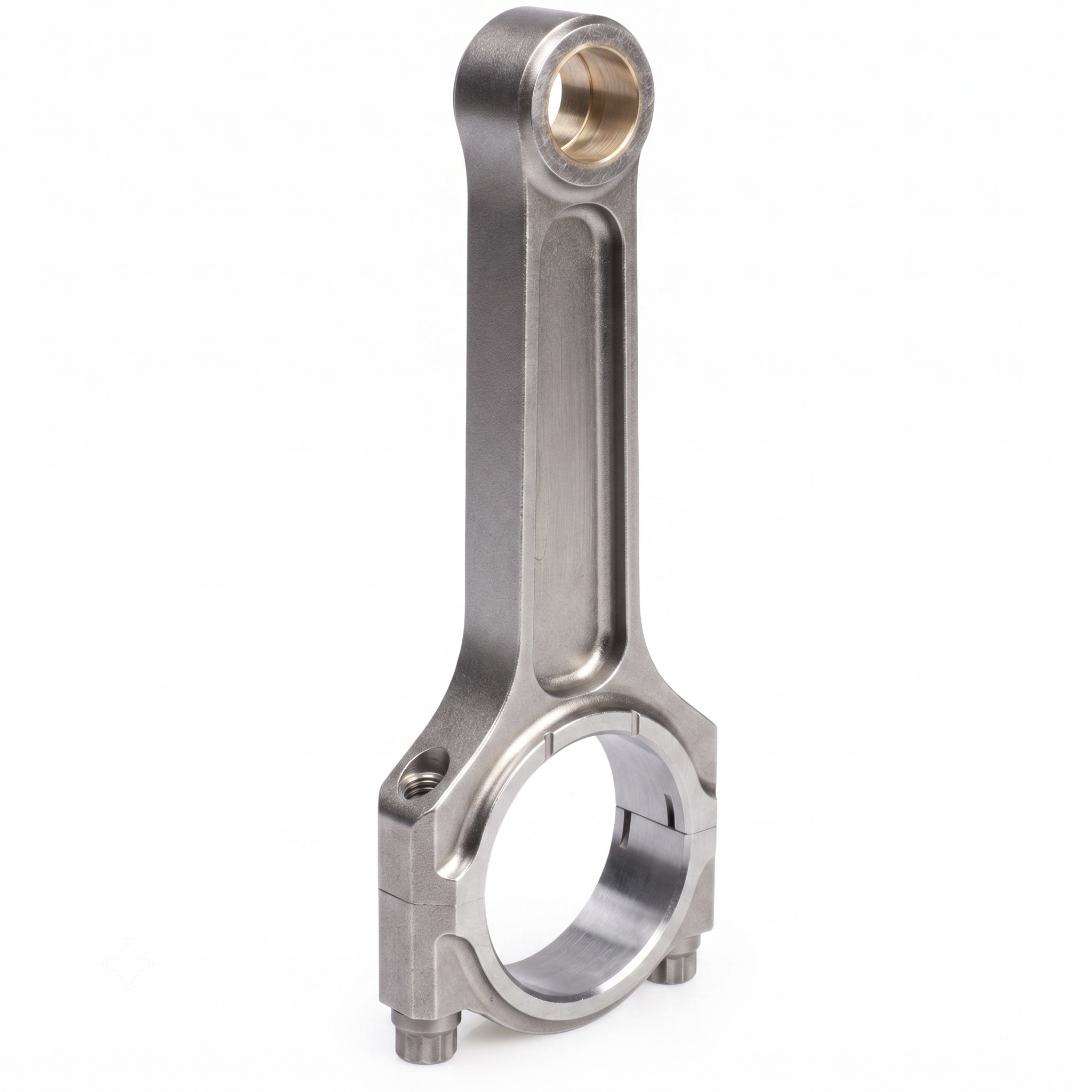 | I-HD profile: reinforced Heavy Duty I-beam from the ZRP Pro Series range, designed for the best weight / stiffness compromise on demanding builds; its optimised section resists buckling under the heavy loads of a turbo or high-compression naturally aspirated stroker. |
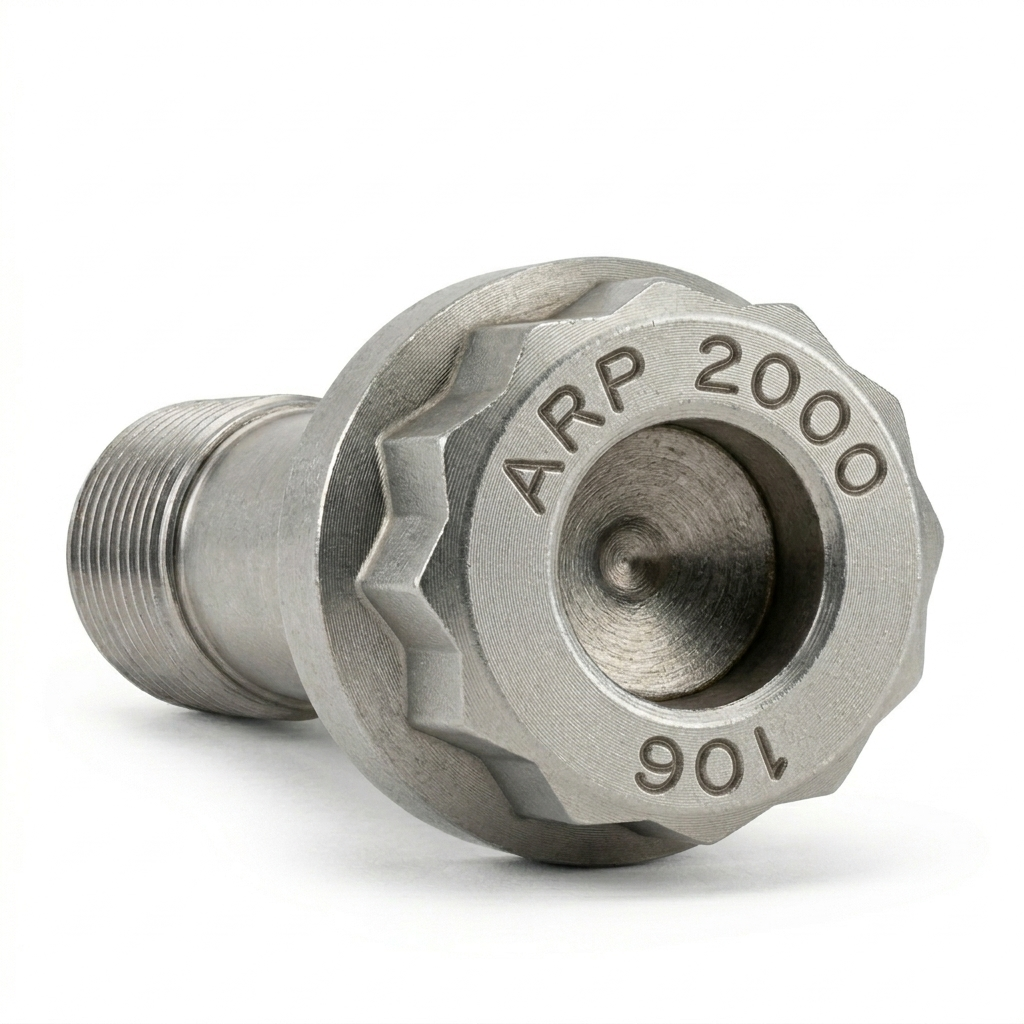 | ARP 2000: the versatile benchmark alloy, with a tensile strength of about 220,000 psi (1,517 MPa). Offered here in 3/8" diameter, it covers the vast majority of builds, up to about 200 hp per cylinder, at speeds reaching 8,500 rpm. It is the default choice for a reliability-focused F24 stroker. |
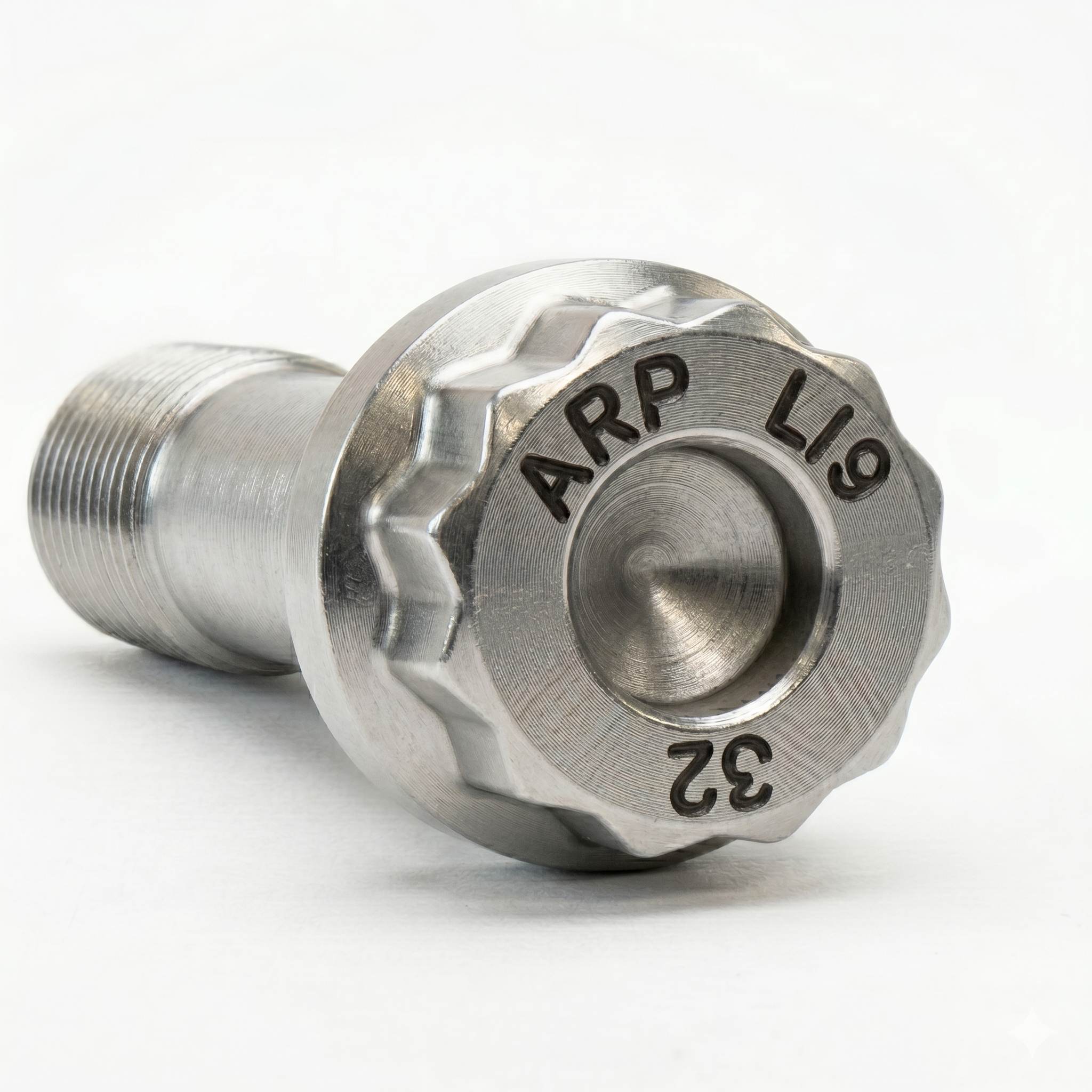 | ARP L19: a higher-grade alloy (≈ 260,000 psi / 1,793 MPa) for the most heavily stressed engines in torque and rpm, up to about 250 hp per cylinder and rpm up to 10,000, in 3/8". More sensitive to corrosion and hydrogen embrittlement, it must be oiled and stored with care. |
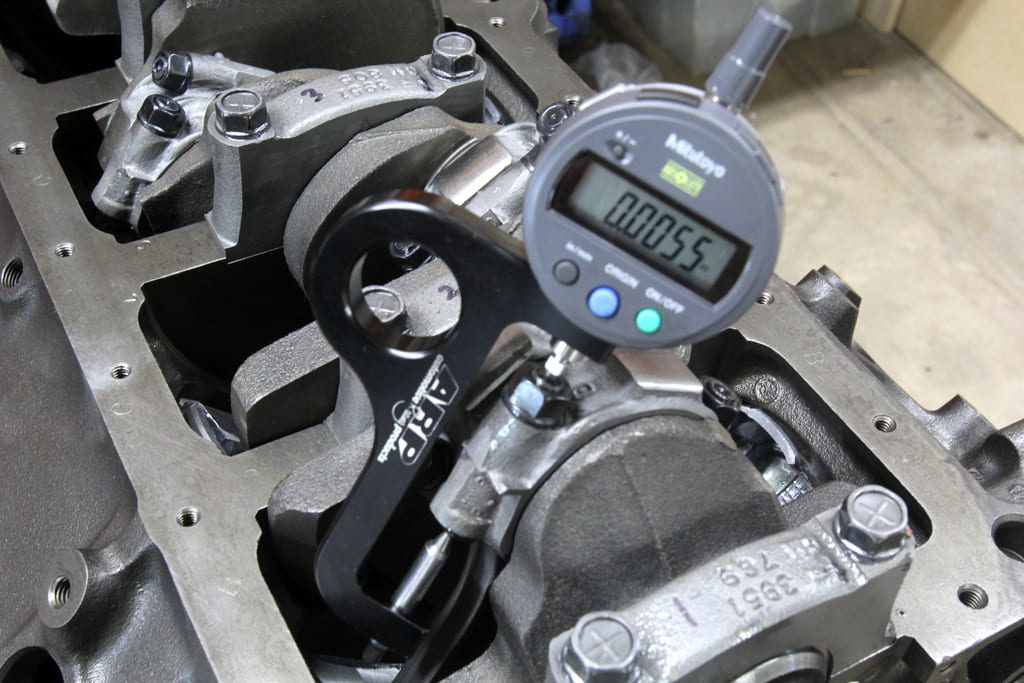
| On a forged rod, the correct bolt preload is checked by its stretch, measured with a dial gauge, rather than by torque alone: lubrication and run-in distort the torque reading. Always refer to the stretch values specified by the bolt manufacturer, recalled in the table above. |
Discover the ARP stretch gauge
This F24 range is made by ZRP, a maker of precision-machined forged competition rods, weight-matched to ± 1 g. The Pro Series I-HD line is recognised for its robustness on heavily prepared engines. Each reference is supplied as a complete set of 4, with its dedicated ARP bolts.
 | ZRP is a Greek house based in Athens, where Alex Drakos oversees both engineering and production. For this 2.4 build derived from the F20C, the rod is die-forged in 4340 steel and then fully reworked, with the set matched to ±1 g: on an engine that spins this high, equal masses are part of reliability. The chosen profile is the I-HD, with ARP 2000 or ARP L19 bolts. Final checks in Greece, with field experience in rallying, on track and in drift. |
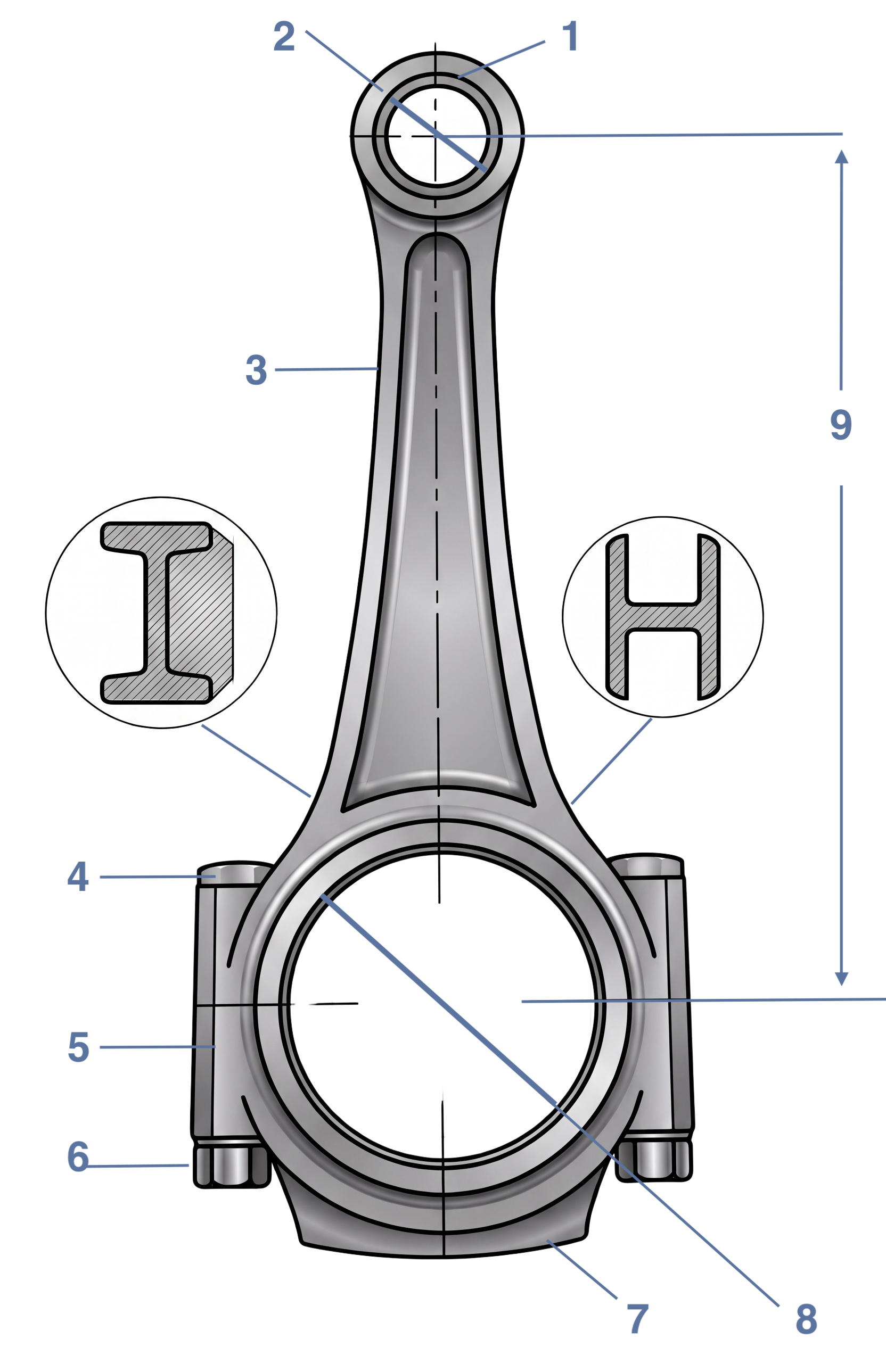 | 1) Small end 2) Small-end diameter 3) Rod beam 4) Rod bolt 5) Big end 6) Rod nut / bolt 7) Rod cap 8) Big-end diameter 9) Center-to-center |
These rods equip "F24" builds, a Honda F20C stroked to about 2.4 L. The donor base is the F20C of the Honda S2000 (AP1):
| Brand | Model (chassis) | Engine code | Power | Years |
|---|---|---|---|---|
| Honda | S2000 (AP1) | F20C | 176–184 kW (240–250 ch) | 1999–2009 |
A set of forged rods costs far less than an engine failure: on a stroked F24 pushed in torque and rpm, an original rod that lets go takes out the block, the crankshaft and very often the cylinder head. By fitting weight-matched forged rods from the start, you make your build reliable for the long term and avoid a full rebuild, for a negligible extra cost compared with the price of a new engine.