Product successfully added to your shopping cart
Quantity
Total
There are 0 items in your cart. There is 1 item in your cart.
Total products
Total shipping To be determined
Total

3.6L 24v - M96 Turbo
Manufacturers
3.6L 24v - M96 Turbo
 View larger
Warning: Last items in stock!
New product
Reinforced Cometic head gasket in MLX. Sold individually, two gaskets for the flat-six.
The M96.70, M96.70S and M96.70SL engines are the turbocharged 3.6 litre, 24-valve flat-six of the Porsche 911 Turbo (type 996), detailed in the table below. The gasket is sold individually and the engine needs two, one per cylinder bank.
Porsche lists part number 997 104 170 71 for the M96.70 and 996 104 170 72 for the M96.70S and M96.70SL, the latter two per engine, but publishes neither the bore, nor the thickness, nor the construction. Sized for the standard combustion pressure, the original gasket gives way as soon as it is exceeded: the head lifts slightly, the clamping load drops and coolant reaches the cylinder.
Sealing does not rely on the gasket alone: the fasteners that clamp the head to the block provide the other half. A composite gasket is crushed for good beyond 100 N/mm², whereas the 301 stainless steel of the MLX withstands 517 N/mm², five times more, and recovers its shape at every combustion cycle.
This page covers one part number from Cometic, the American maker of competition gaskets, in a single construction: MLX. Its bore is 103.5 mm and its thickness 1.02 mm. It is sold individually: allow two gaskets for the flat-six, one per cylinder bank.
| Gasket bore | Thickness | Gasket volume | Gasket type OEM not specified | Brand | Part number OEM 997 104 170 71 | 996 104 170 72 |
| 103.5 mm | 1.02 mm | 8.58 | MLX | Cometic | C14141-040 |
A gasket's volume is the void it leaves above each cylinder. That void enlarges the combustion chamber and so lowers the compression ratio. Two gaskets can only be compared at an equal bore.
| Fasteners | Engines | Tightening torque |
| Original cylinder head bolts | M96.70, M96.70S, M96.70SL | not published by the manufacturer |
Before fitting, check the head and block sealing faces for flatness with a straightedge and have them resurfaced if needed. The Cometic gasket arrives coated: do not add any sealing paste.
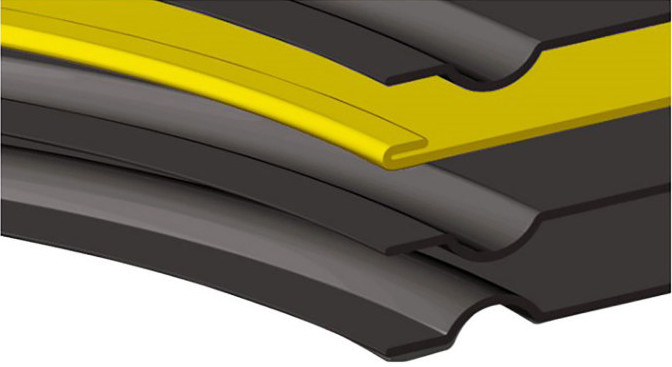 | Cometic MLX A stack of stamped, riveted stainless steel sheets whose centre sheet is folded to form a stopper around the combustion chamber, with a high-temperature coating. Clamping force rises at that point without any extra bore distortion. It is the strongest all-steel construction, recommended for heavy boost, here in 103.5 mm. |
Gasket bore. The Cometic MLX comes in 103.5 mm (C14141-040), with no other bore.
Thickness. Porsche publishes no thickness for the original gasket: only the figure measured on the removed gasket applies. A thicker gasket enlarges the combustion chamber and lowers the compression ratio; a thinner one reduces it and raises the ratio.
| Your goal | Thickness to choose |
| Keep the original compression ratio | Original thickness not published: measure that of the removed gasket and set it against the only gasket offered, 1.02 mm |
| Skimmed cylinder head, make up the lost height | Only one thickness is offered, 1.02 mm: compare it with that of the removed gasket, plus the metal taken off when resurfacing |
| Forced induction build, lower the ratio | 1.02 mm, when the thickness measured on the removed gasket is lower |
| Naturally aspirated build, raise the ratio | 1.02 mm, when the thickness measured on the removed gasket is higher |
With no original thickness published, use a dial gauge to read how far the pistons stand above the block face, above all if the removed gasket is thicker than 1.02 mm: this figure gives the clearance left between piston and head.
 | Cometic Gasket, Inc. is an American company set up in 1989 and based in Concord, Ohio. It designs gaskets and sealing solutions for engines, its strength being the made-to-order gasket, machined to the bore and thickness required, entirely in the United States from American raw materials. |
| Criterion | Original gaskets 997 104 170 71 and 996 104 170 72 | Reinforced gaskets |
| Construction | Not specified by the manufacturer | Multilayer stainless steel (MLX) |
| Gasket bore | not published by the manufacturer | 103.5 mm |
| Thicknesses available | Not published by the manufacturer | 1.02 mm |
| Compression ratio adjustment | None | Through the thickness chosen |
| Resistance to overpressure | Limited to standard output | Designed for forced induction |
| Model | Engine code | Power | Years |
| 911 (996) 3.6 Turbo 4 | M96.70 | 420 hp | 2000-2005 |
| 911 (996) 3.6 GT2 | M96.70 | 462 and 483 hp | 2001-2005 |
| 911 (996) 3.6 Turbo 4S | M96.70 | 450 hp | 2003-2005 |
| 911 Décapotable (996) 3.6 Turbo 4 | M96.70 | 420 hp | 2003-2005 |
| 911 Décapotable (996) 3.6 Turbo 4S | M96.70 | 450 hp | 2003-2005 |
| 911 Décapotable (996) 3.6 S | M96.70 | 450 hp | 2004-2005 |
| 911 (996) 3.6 S | M96.70 | 450 hp | 2004-2005 |
OEM part number: 997 104 170 71 for the M96.70, 996 104 170 72 for the M96.70S and M96.70SL (two per engine).
Important: C14141-040 suits the M96.70, M96.70S and M96.70SL engines of the 911 Turbo (996) listed on this page: each engine needs two gaskets, one per cylinder bank. The M96.76 and M96.79 engines of the 911 GT3 are not covered by this page.
Once the original gasket reaches its limit, the reinforced gasket takes over: under heavy combustion pressure it keeps its shape and does not crush.
As soon as boost goes up, a larger turbo is fitted or the compression ratio is raised, the head gasket often becomes the weak point of the engine's upper end. A reinforced gasket prevents the leak and the head removal, far costlier than the part.