Product successfully added to your shopping cart
Quantity
Total
There are 0 items in your cart. There is 1 item in your cart.
Total products
Total shipping To be determined
Total

2.5L 24v - 1JZ-GTE
Manufacturers
2.5L 24v - 1JZ-GTE
Warning: Last items in stock!
New product
Set of 6 forged 4340 steel connecting rods for the Toyota 1JZ-GTE 2.5L 24V Turbo.
The Toyota 1JZ-GTE is a turbocharged 2.5-litre (2,492 cc) inline six-cylinder engine with double overhead camshafts and 24 valves. Introduced in 1990, it first used a twin-turbo layout before switching, from 1996, to a single turbocharger combined with VVT-i variable valve timing. Built around an exceptionally sturdy cast-iron block, with an 86 mm bore and a short 71.5 mm stroke, it delivers a quoted output of around 280 hp and generous torque while keeping a wide reliability margin.
A true icon of Japanese tuning, the 1JZ-GTE powers the Toyota Supra 2.5 (JZA70), the Chaser, Cresta and Mark II saloons and coupés (JZX81, JZX90, JZX100, JZX110), the Soarer (JZZ30), the Crown (JZS171) and the Verossa, built between 1990 and 2007. Popular in drift, drag and racing, it accepts very high power figures provided the bottom end is reinforced: that is exactly what forged connecting rods are for.
These rods are forged from high-strength 4340 steel, then machined and inspected one by one: it is that material, not merely a shape, that gives the 1JZ-GTE bottom end the reserve it needs when power rises. Fitting forged pistons, raising the rev limit, running higher boost pressure or gaining displacement all push the production rod outside its operating range. The Wössner I profile, 660.87 g per rod for a 125.2 mm centre-to-centre and a 22 mm pin, takes that load on all six cylinders.
Designed for modified engines, turbocharged or supercharged, they suit every discipline: rally, drift, drag, circuit and trackdays, hillclimb, time attack. They follow Stage 2, Stage 3 and Stage 4+ builds, right up to the fully reworked competition block, where this inline six can take very high power levels.
| Reference | Brand | Profile | Bolts | Pin diameter OEM 22 mm | Small-end width | Big-end diameter | Big-end width | Center-to-center OEM 125,2 mm | Weight per rod |
|---|---|---|---|---|---|---|---|---|---|
| KCR366A | Wössner | I | ARP 2000-3/8"-38mm | 22 mm | 25,9 mm | 55 mm | 25,9 mm | 125,2 mm | 660,87 g |
| Connecting rod | Bolts | Tightening torque | Recommended stretch |
| Wössner (KCR366A) | ARP 2000 | 74,6 N·m | 0,1397 – 0,1524 mm |
The whole difficulty of tightening comes from the fact that the wrong quantity is being measured: a torque wrench reads torque, whereas the bearing depends only on the tension actually installed in the bolt. On a built 1JZ-GTE, a torque figure reached too early because of a dry or dirty thread leaves the bolt effectively under-tensioned; preload is missing, the cap lifts intermittently, the shell is hammered at its edges, clearance opens and oil pressure collapses under sustained use. Conversely, torque carried beyond the range stretches the bolt into its plastic domain: measured elongation then exceeds the target value, a sign that the bolt has lost its elastic reserve, while the bearing bore distorts and the big end goes oval. That is why the table below gives both the torque and the stretch specified by the fastener manufacturer for the Wössner rod and its 3/8" ARP 2000 fasteners: the first is used to approach the value, the second to validate it. Assemble with ARP lubricant, the kit instructions taking priority.
| 4340 steel is a nickel-chromium-molybdenum alloy steel used in aerospace and motorsport alike. Forged then heat-treated (quench and temper), it offers excellent tensile strength, high fatigue resistance and real ductility. Compared with an original rod (often sintered/powder metal, optimised for series-production cost), a 4340 forged rod shows roughly +19% higher yield strength, +8% higher tensile strength and above all +19% to +37% higher fatigue strength, i.e. a fatigue life under cyclic loading several times longer. This is what makes forged 4340 the reference material as soon as boost and rpm climb. |
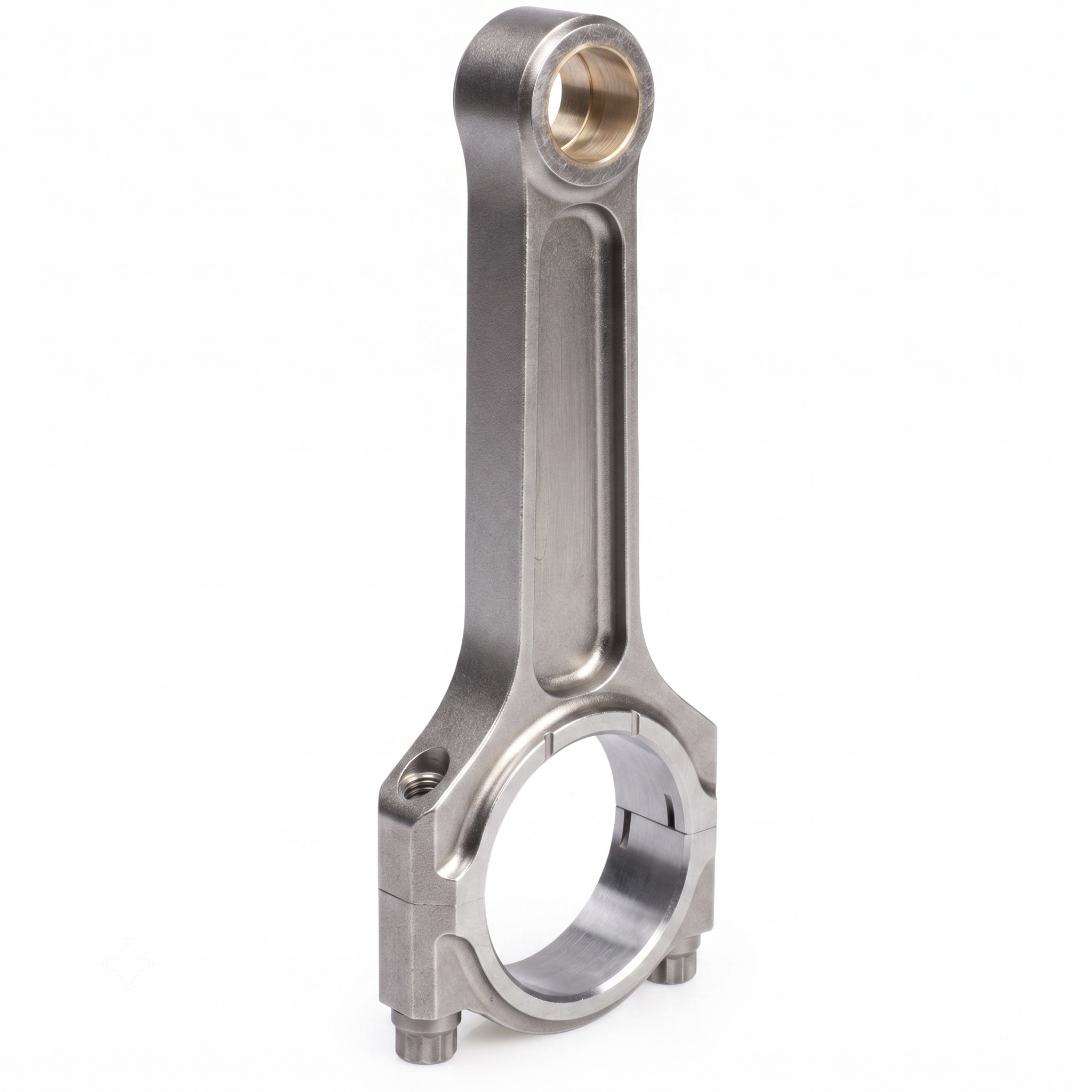 | I-beam profile. With its thinner central section, the I-beam rod is lighter: less inertia and freer rev pick-up. It is the preferred profile on modern turbo engines like the 1JZ-GTE. Its I-HD (Heavy Duty) version is a reinforced variant, designed for higher loads. |
A rod bolt is not chosen on its size but on its metallurgy. The alloy grade sets the yield strength and the tensile strength; the heat treatment decides how uniform the section is; the rolling of the threads, carried out after that treatment, work-hardens the thread root and pushes back the fatigue crack initiation, exactly where most failures occur. Manufacturing consistency does the rest: it alone allows identical preload on each bolt. This 1JZ-GTE is supplied with ARP 2000 hardware in 3/8"-38 mm; torque and stretch are listed in the table, and stretch is what counts.
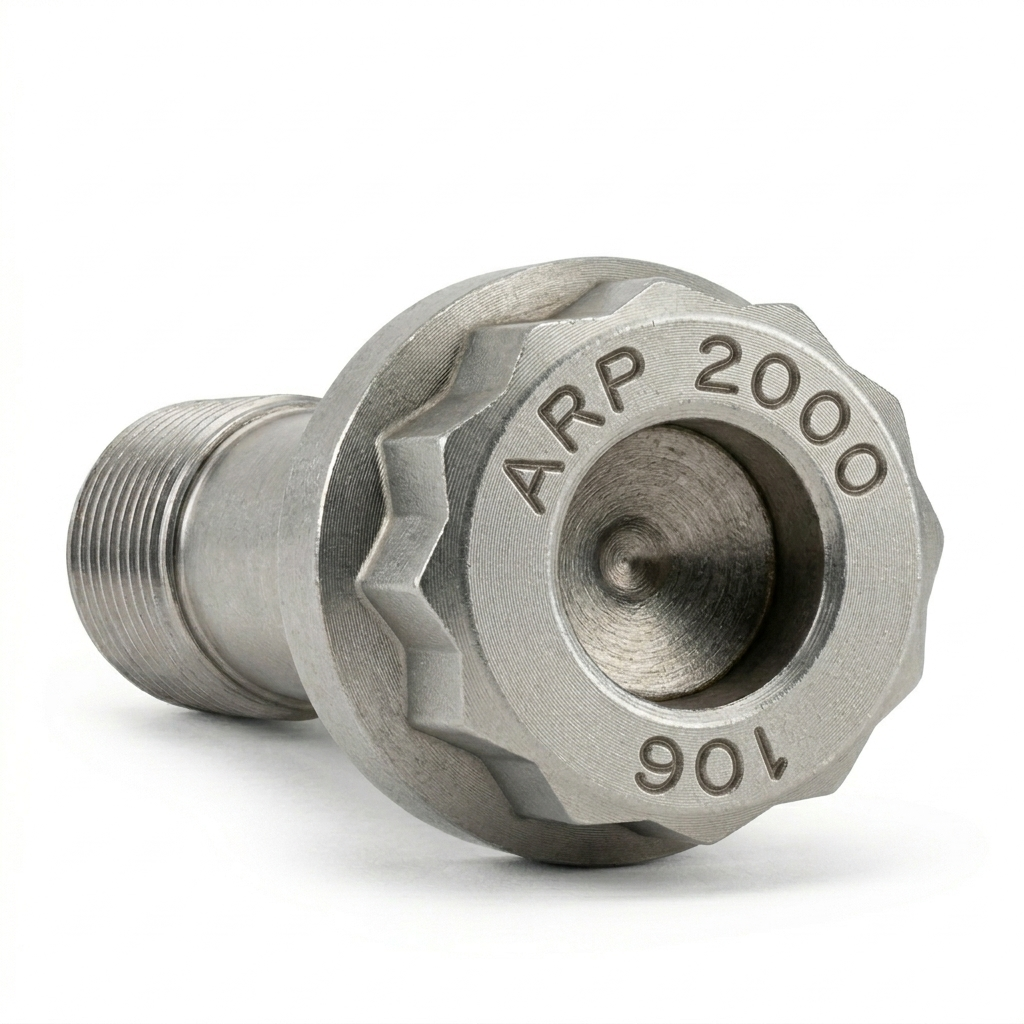 | ARP 2000 is a wrought steel quenched and tempered through the section, with tensile strength settling around 220,000 psi, i.e. ~1,517 MPa. Its threads are rolled after heat treatment, hence excellent cyclic fatigue life, and its composition gives good stability against corrosion: no special storage is required. The grade is rated up to 200 hp per cylinder in 3/8" and up to 8,500 rpm, which makes it the most widespread in circuit racing, trackdays, drift, rally, drag and hillclimb. It is the hardware of the Wössner I-profile rod on this 1JZ-GTE, in 3/8"-38 mm. |
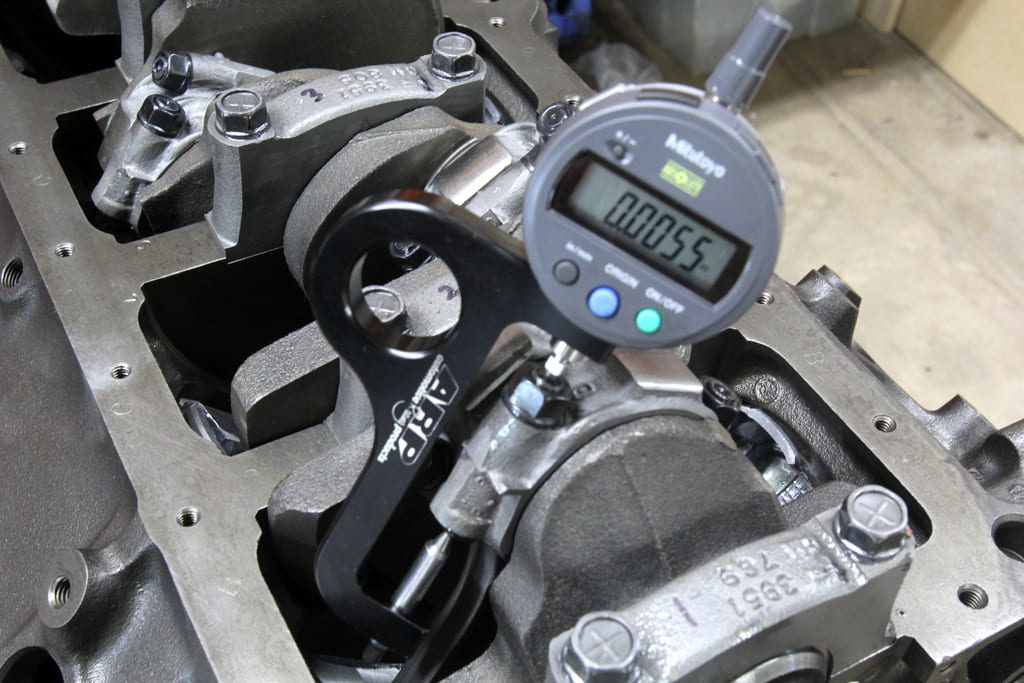
In addition to torque tightening, measuring rod-bolt stretch is the most reliable check for optimal preload. The check is done with the bolt fitted: place the gauge (dial indicator) on the two ends of the bolt and read its actual stretch, which must match the recommended value (see the torque & stretch table above). This method removes the friction variations inherent in torque tightening and secures the assembly on heavily stressed engines. |
 | Wössner is a renowned German manufacturer specialising in high-performance forged pistons and connecting rods. Its rods are machined from forged 4340 steel, heat-treated for high fatigue strength. Wössner calls its optimised profile “A-Beam”, an enhanced I-beam design combining light weight, stiffness and reliability for heavily built engines, both turbocharged and naturally aspirated. |
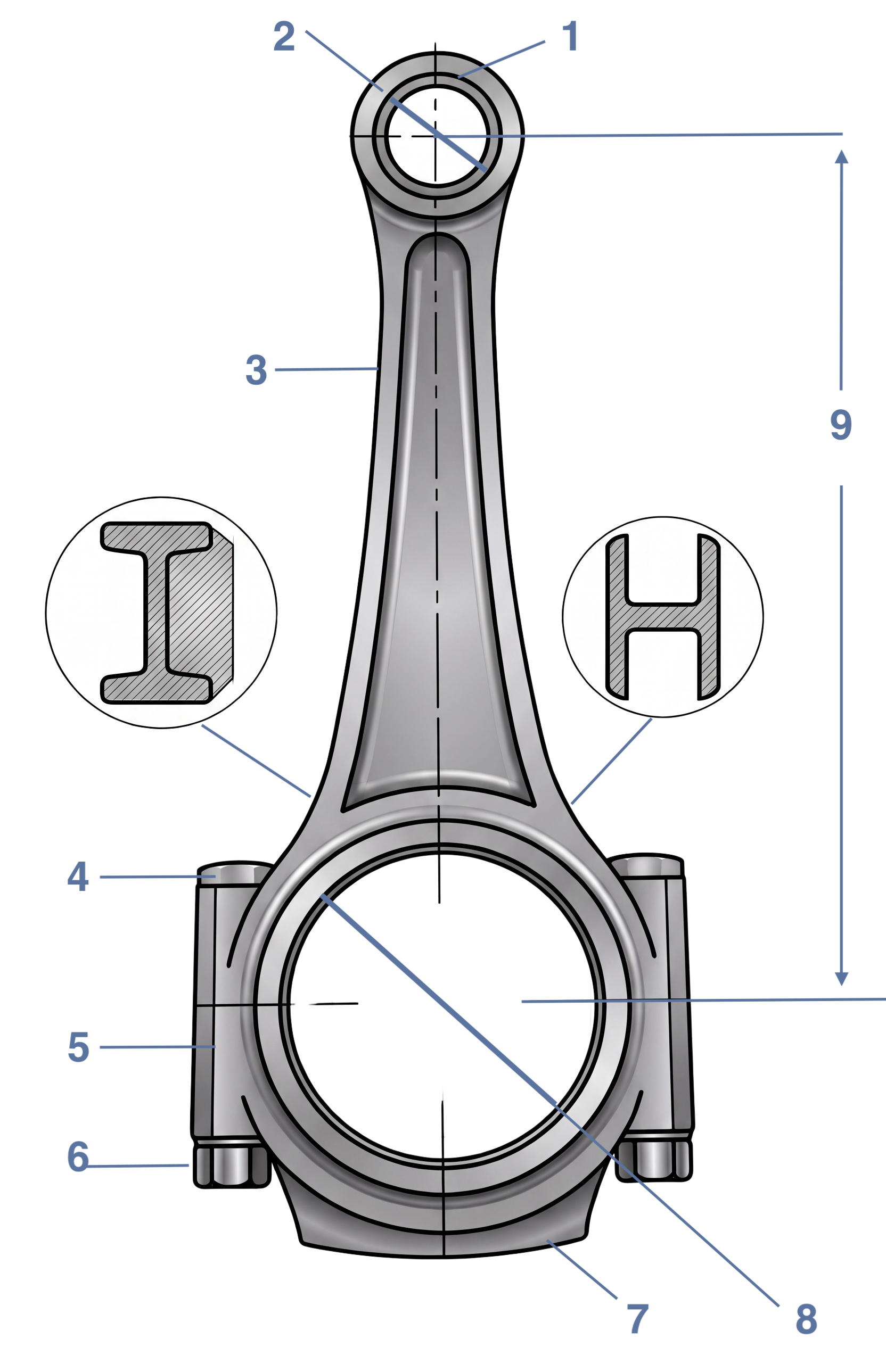 | 1) Small end 2) Small-end diameter 3) Rod beam 4) Rod bolt 5) Big end 6) Rod nut / bolt 7) Rod cap 8) Big-end diameter 9) Center-to-center |
These forged connecting rods are compatible with all vehicles fitted with the Toyota 1JZ-GTE engine (3.0L 24V twin-turbo):
| Make | Model (chassis) | Engine code | Power | Years |
| Toyota | Chaser (JZX81) | 1JZ-GTE | 280 hp (206 kW) | 1990–1992 |
| Toyota | Chaser (JZX90) | 1JZ-GTE | 280 hp (206 kW) | 1992–1996 |
| Toyota | Chaser (JZX100) | 1JZ-GTE | 280 hp (206 kW) | 1996–2001 |
| Toyota | Cresta (JZX81) | 1JZ-GTE | 280 hp (206 kW) | 1990–1992 |
| Toyota | Cresta (JZX90) | 1JZ-GTE | 280 hp (206 kW) | 1992–1996 |
| Toyota | Cresta (JZX100) | 1JZ-GTE | 280 hp (206 kW) | 1996–2001 |
| Toyota | Crown (JZS171) | 1JZ-GTE | 280 hp (206 kW) | 1999–2003 |
| Toyota | Crown Break (JZS171) | 1JZ-GTE | 280 hp (206 kW) | 1999–2003 |
| Toyota | Mark II (JZX90) | 1JZ-GTE | 280 hp (206 kW) | 1992–1996 |
| Toyota | Mark II (JZX100) | 1JZ-GTE | 280 hp (206 kW) | 1996–2001 |
| Toyota | Mark II (JZX110) | 1JZ-GTE | 280 hp (206 kW) | 2000–2004 |
| Toyota | Mark II Break (JZX110) | 1JZ-GTE | 280 hp (206 kW) | 2002–2007 |
| Toyota | Soarer (JZZ30) | 1JZ-GTE | 280 hp (206 kW) | 1990–2000 |
| Toyota | Supra (JZA70) | 1JZ-GTE | 280 hp (206 kW) | 1990–1993 |
| Toyota | Verossa (JZX110) | 1JZ-GTE | 280 hp (206 kW) | 2000–2003 |
OEM reference: 13201-46030 (set of 6 rods).
A broken standard rod is never solved by replacing the faulty part alone: the rods AND the pistons, almost always marked by the incident, go together, and the crankshaft and bearings often have to be reworked. The bill for a simple return to the factory configuration then becomes hard to justify.
For an equivalent, sometimes lower budget, a set of 4340 forged rods fitted with forged pistons offers reliability and a safety margin of a completely different level, and leaves real room to raise power on this boosted inline six. This has been the choice of European engine builders for more than fifteen years.
For the same budget: more reliability, more potential, more longevity for the 1JZ-GTE bottom end.