Product successfully added to your shopping cart
Quantity
Total
There are 0 items in your cart. There is 1 item in your cart.
Total products
Total shipping To be determined
Total

2.0L 16v - C20XE
Manufacturers
2.0L 16v - C20XE
Warning: Last items in stock!
New product
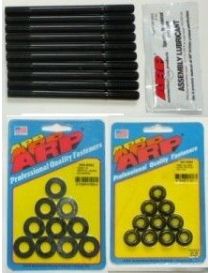
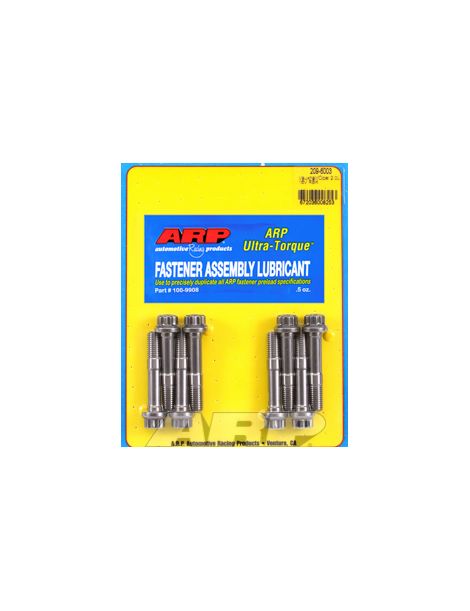
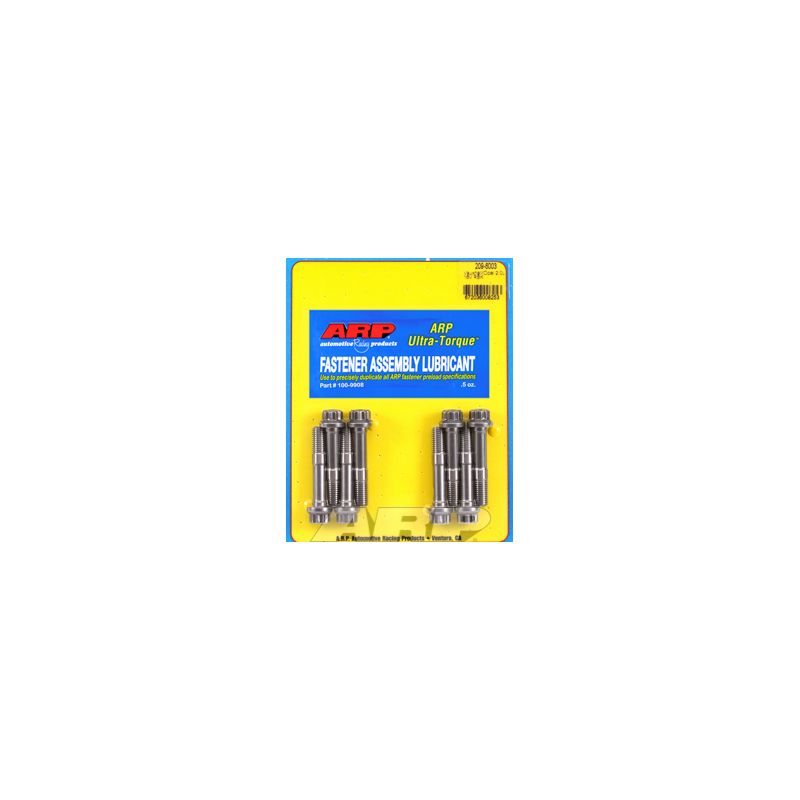
ARP 8740 and ARP2000 rod bolt kits for OEM Opel and Vauxhall 2.0 16V rods (Kadett, Astra, Calibra, Vectra, Zafira, VX220).
Built from 1988 to 2014, the 2.0-litre 16-valve four-cylinder from Opel and Vauxhall comes in naturally aspirated and turbocharged form. The C20XE (150 hp) powers the Kadett E GSi, Astra F GSi, Calibra and Vectra A; the C20LET (204 hp), the Calibra and Vectra A Turbo 4x4; the Z20LET (190 to 200 hp), the Astra G and Zafira A OPC as well as the Speedster / VX220; the Z20LEH (240 hp), the Astra H OPC / VXR and Zafira B OPC.
The original rod bolt of these engines is an M9 bolt: on a tuned engine, it is the part that has to carry the inertia loads at high rpm, hence its replacement by the ARP bolts of the kits.
At every revolution, the rod bolt takes the pull of the rod and piston assembly, which tries to force the cap away through inertia. As original equipment, it is sized for stock power and is replaced at every strip-down.
The 8740 kit replaces the original rod bolts with M9 x 1.25 bolts tightened by measuring stretch, the method ARP recommends for this part, or failing that by torque. The ARP2000 kit replaces the same bolts with stronger M9 x 1.25 bolts, tightened the same way, preferably by stretch. In 8740, these bolts are rated for 9,500 rpm at most (calculated estimate). The engine speed allowed by the ARP2000 bolts goes up to 10,250 rpm (calculated estimate).
| Part number | Brand | Grade / material | Head | Thread | Under-head length |
|---|---|---|---|---|---|
| ARP-109-6001 | ARP | 8740 steel | 12-point | M9 x 1.25 | Not published |
| ARP-209-6003 | ARP | ARP2000 | 12-point | M9 x 1.25 | Not published |
| Reference | Tightening torque | Stretch |
|---|---|---|
| ARP-109-6001 | 43.4 Nm | 0.140 - 0.152 mm |
| ARP-209-6003 | 51.5 Nm | 0.165 - 0.178 mm |
For this part, ARP favours stretch measurement in addition to torque, the key to an exact preload. The figures in the table assume ARP lubricant.
Figures taken from the ARP 109-6001 and 209-6003 instruction sheets, revisions in force on the day of publication. Should any difference appear, the official instruction sheets take precedence. Read the ARP 109-6001 instruction sheet ; Read the ARP 209-6003 instruction sheet
No thread locker is called for by the ARP instruction sheet for this kit: the bolts are fitted with ARP Ultra-Torque grease, on the threads and under the head.
According to the ARP instructions, the big ends must be checked and resized with the fasteners in place; plan a visit to a machine shop.
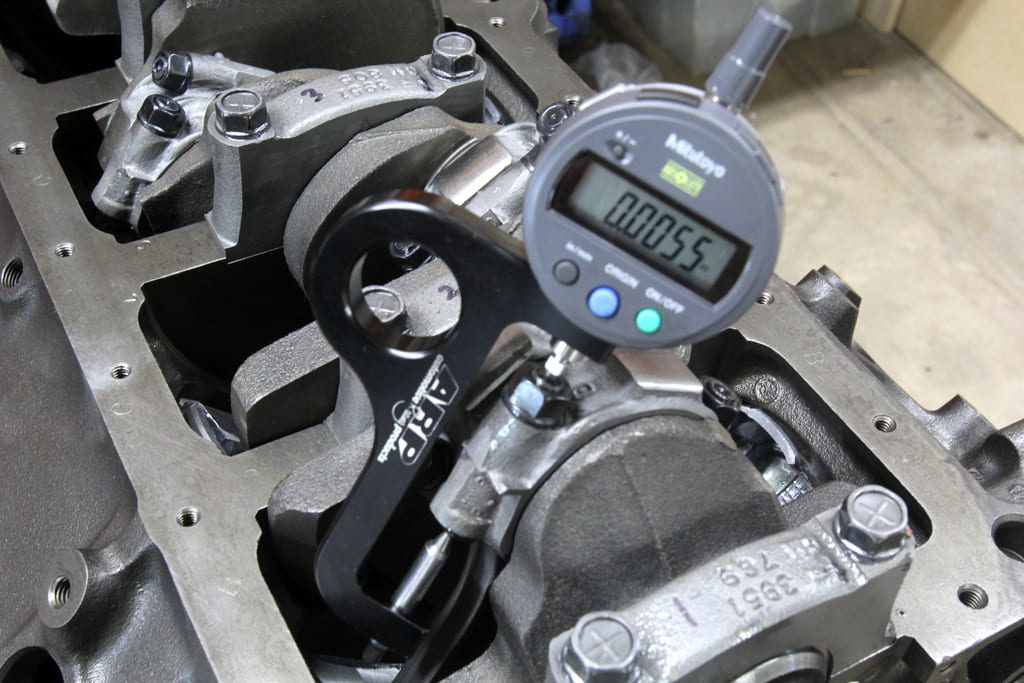
Tightening to stretch means setting the preload on how much the bolt actually stretches, rather than on a torque affected by friction. With the bolt fitted, the dial gauge is placed on both its ends and the bolt is tightened until the stretch given in the table is read. It is the safest method on a highly tuned engine.
Tightening is done with ARP assembly grease, on the threads and under the head: the torque and stretch figures in the table were established with it.
| Grade | Material | Tensile strength | Strengths |
|---|---|---|---|
| 8740 | Chrome-moly steel | 180,000 | Widely used grade, threads rolled after heat treatment |
| ARP2000 | ARP alloy steel | 220,000 psi | Stronger than 8740, a common step up in racing |
ARP (Automotive Racing Products) came into being in the early 1970s, when Gary Holzapfel, who came from the aerospace industry, decided to tackle the engine failures caused in motorsport by inadequate fasteners. Today the brand produces thousands of part numbers in California for the cylinder head, the main bearings and the connecting rods, in materials suited to each application, with manufacturing known for its consistency.
| Brand | Model (chassis) | Engine code | Power | Years |
|---|---|---|---|---|
| Opel / Vauxhall | Astra F GSi (T92) | C20XE | 150 hp | 1991-1998 |
| Opel / Vauxhall | Kadett E GSi (T85) | C20XE | 150 hp | 1988-1991 |
| Opel / Vauxhall | Calibra (C89) | C20XE | 150 hp | 1990-1994 |
| Opel / Vauxhall | Vectra A (J89) | C20XE | 150 hp | 1990-1995 |
| Opel / Vauxhall | Calibra Turbo 4x4 (C89) | C20LET | 204 hp | 1992-1997 |
| Opel / Vauxhall | Vectra A Turbo 4x4 (J89) | C20LET | 204 hp | 1994-1995 |
| Opel / Vauxhall | Astra G OPC (T98) | Z20LET | 190-200 hp | 2000-2005 |
| Opel / Vauxhall | Zafira A OPC (T98) | Z20LET | 192-200 hp | 2001-2005 |
| Opel / Vauxhall | Speedster / VX220 (E01) | Z20LET | 200 hp | 2002-2006 |
| Opel / Vauxhall | Astra H OPC / VXR (A04) | Z20LEH | 240 hp | 2005-2010 |
| Opel / Vauxhall | Zafira B OPC (A05) | Z20LEH | 240 hp | 2006-2012 |
| Opel / Vauxhall | Astra H / Zafira B (A04/A05) | Z20LER | 200 hp | 2004-2014 |
On a tuned 2.0 16V, a rod bolt that lets go can destroy the rod, the piston and the block. Reinforced, and therefore stronger, ARP bolts withstand higher engine speeds and inertia loads than the original bolts: the risk of breakage caused by the fasteners goes down, at a cost far below that of rebuilding the bottom end.
Removing the connecting rods is the right time to replace their bearings: here are the ones that fit this engine.
| Connecting rod bearings Opel C20LET → |
A forged connecting rod starts as a steel billet, usually 4340, shaped hot under very high pressure: its material is denser and more homogeneous than that of a stock rod. Compared with an original rod, often made of sintered metal and designed for cost, a 4340 forged rod offers about +19% yield strength, +8% tensile strength and +19 to +37% fatigue strength. It is the foundation of a reliable high-power build. For your engine:
| Forged rods Opel 2.0 16V C20XE / C20LET / Z20LET → |