Product successfully added to your shopping cart
Quantity
Total
There are 0 items in your cart. There is 1 item in your cart.
Total products
Total shipping To be determined
Total

2.0 24V - RB20DE/DET
Manufacturers
2.0 24V - RB20DE/DET
Warning: Last items in stock!
New product
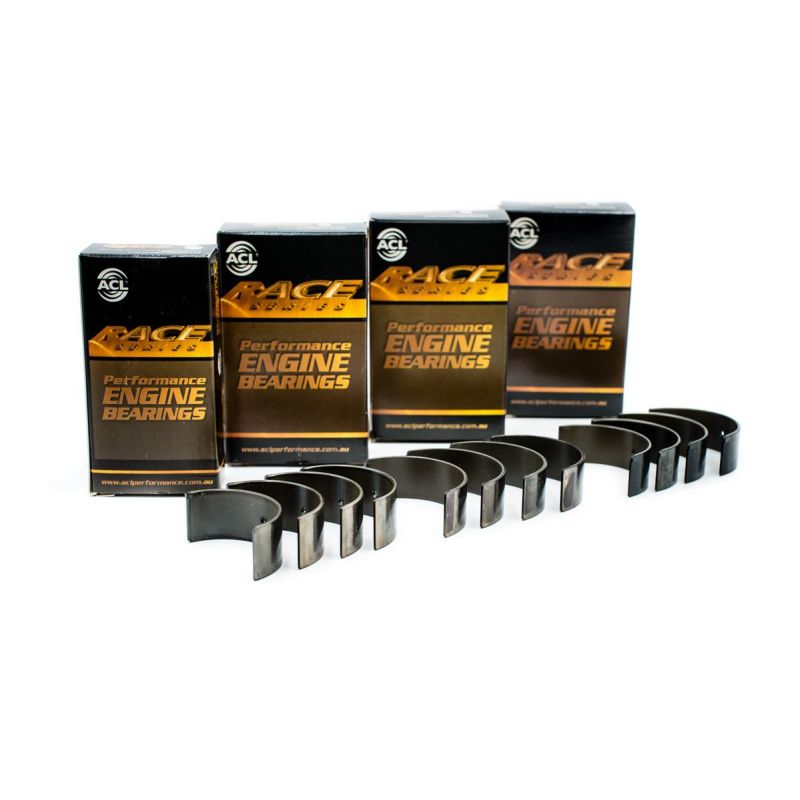
Set of 12 trimetal connecting rod half-bearings for Nissan inline six RB20DE and RB20DET.
The RB20DE is Nissan's 2-litre inline six with double overhead camshafts and 24 valves; the RB20DET is its turbocharged version. They are found in the Skyline R31, R32 and R34, the Laurel and the Cefiro, among others. ACL lists the same bearing set for both engines: a single set covers the family.
From the factory, this engine is fitted with standard production connecting rod bearings, sized for the loads of the original engine: as soon as power, engine speed or boost pressure increase, they reach their limits.
For these connecting rod bearings, the Nissan workshop manual specifies a running clearance of 0.020 to 0.045 mm.
A trimetal bearing combines three layers with complementary roles: a steel back that provides structural strength, a copper-lead intermediate layer that takes the heavy loads and an anti-friction running layer that protects the crankpin. The complete set contains 12 half shells, i.e. 6 pairs.
An aluminium bi-metal bearing, intended for low to medium loads, tops out at around 8,000 psi; a performance trimetal bearing holds up to 12,000 psi, 50% more load capacity. It therefore gains strength and service life on turbocharged, supercharged or high-revving engines.
| ACL bearings Crankpin Ø 44.956 / 44.974 mm Housing bore Ø 48.000 / 48.013 mm Width 17 mm |
| Reference | Brand and treatment | Size | Wall thickness (mm) |
|---|---|---|---|
| 6B2630H-STD | ACL Race - Untreated | Standard | 1.502 |
| 6B2630HX-STD | ACL Race - Untreated | Std, increased clearance (HX) | 1.489 |
| 6B2630H-.025 | ACL Race - Untreated | +0.025 | 1.515 |
| 6B2630H-.25 | ACL Race - Untreated | +0.25 | 1.627 |
Running clearance is the space left between the bearing and the crankpin, permanently filled by the oil film.
With the engine running, the crankpin does not touch the bearing: it rides on this oil film, which takes the load. The clearance sets the film thickness. Too small, it restricts oil flow, raises the temperature and invites seizure; too large, it lets the oil escape, the film loses its load capacity and oil pressure falls. The right clearance combines sufficient lubrication with an oil film that keeps carrying the load.
| Size / grade | When to choose it | ACL Race Series |
|---|---|---|
| Standard (STD) | Standard journal, not reground | 0.049 to 0.058 mm |
| Increased clearance (HX) | Wider clearance: high oil flow, high rpm | 0.074 to 0.083 mm |
| +0.025 mm | Polished journal | 0.049 to 0.058 mm |
| +0.25 mm | Journal reground to 0.25 mm | 0.049 to 0.058 mm |
Checking on assembly: lay a calibrated strip (Plastigauge) on the journal, torque the rod cap to spec, then compare the crushed strip against the gauge to read the clearance.
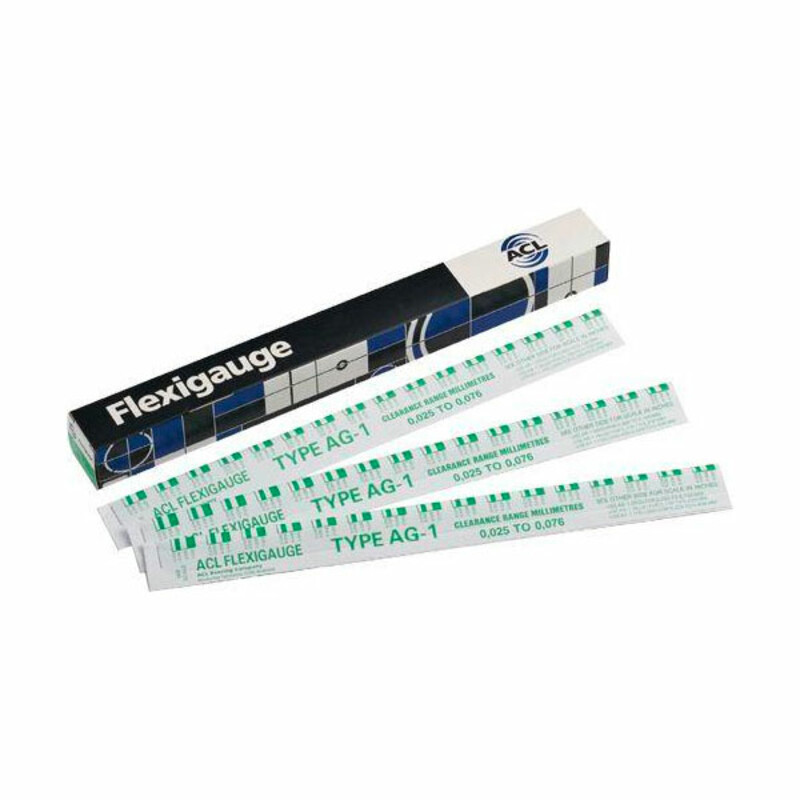
The ACL connecting rod bearings shown here are trimetal bearings built for engine tuning and racing. They withstand far higher loads than a standard bearing and come in several sizes: the standard size, a +0.025 mm size for a crankpin that has only been polished, a +0.25 mm regrind size and the HX version with increased clearance for high-revving engines or engines needing a high oil flow. This range lets you refit a reground crankshaft without changing product line and match the clearance to the oil and use chosen.
 | Founded in Australia in 1949, ACL Bearing Company designs high-performance engine bearings. Its Race Series brings together precision trimetal bearings, offered in a wide choice of sizes and fitted to built engines around the world. |
This connecting rod bearing set fits the RB20DE and RB20DET six-cylinder engines of the following Nissan models:
| Brand | Model (chassis) | Engine code | Power | Years |
|---|---|---|---|---|
| NISSAN | CEFIRO I Saloon (A31) 2.0 (A31) | RB20DE | 155 hp | 1988–1994 |
| NISSAN | CEFIRO I Saloon (A31) 2.0 (LA31, LCA31) / 2.0 Autech (CA31) | RB20DET | 205–224 hp | 1988–1994 |
| NISSAN | LAUREL (C34) 2.0 | RB20DE | 155 hp | 1990–1993 |
| NISSAN | LAUREL (C34) 2.0 Turbo | RB20DET | 205 hp | 1990–1993 |
| NISSAN | LAUREL (C35) 2.0 i (HC35) | RB20DE | 156 hp | 1997–2001 |
| NISSAN | SKYLINE Coupé (R31) 2.0 | RB20DE | 158 hp | 1985–1990 |
| NISSAN | SKYLINE Coupé (R31) 2.0 Turbo | RB20DET | 218 hp | 1985–1990 |
| NISSAN | SKYLINE (R31) 2.0 | RB20DET | 208 hp | 1987–1990 |
| NISSAN | SKYLINE (R32) 2.0 (HR32) / 2.0 4x4 | RB20DE | 155 hp | 1989–1993 |
| NISSAN | SKYLINE (R32) 2.0 Turbo (HCR32) / 2.0 Turbo 4x4 (HNR32) / 2.0 | RB20DET | 215–218 hp | 1989–1993 |
| NISSAN | SKYLINE Coupé (R32) 2.0 (HCR32) / 2.0 4x4 | RB20DE | 155–158 hp | 1989–1993 |
| NISSAN | SKYLINE Coupé (R32) 2.0 Turbo (HCR32) / 2.0 Turbo 4x4 (HNR32) / 2.0 (HCR32) / 2.0 AWD (HNR32) | RB20DET | 208–218 hp | 1989–1993 |
| NISSAN | SKYLINE (R34) 2.0 (HR34) | RB20DE | 155 hp | 1998–2000 |
| NISSAN | SKYLINE Coupé (R34) 2.0 (HR34) | RB20DE | 155 hp | 1998–2000 |
A failing connecting rod bearing does not fail alone: it scores the crankpin, sends debris through the oil circuit and calls at least for a crankshaft regrind, when it does not also take out the rod and the block. On a built engine, a bearing set costs only a fraction of a regrind, and even less of a full rebuild: it is the cheapest part of the rotating assembly and the one whose failure costs the most.