
Product successfully added to your shopping cart
Quantity
Total
There are 0 items in your cart. There is 1 item in your cart.
Total products
Total shipping To be determined
Total

2.2L 10v - KZ
Manufacturers
2.2L 10v - KZ
 View larger
 Warning: Last items in stock!
New product
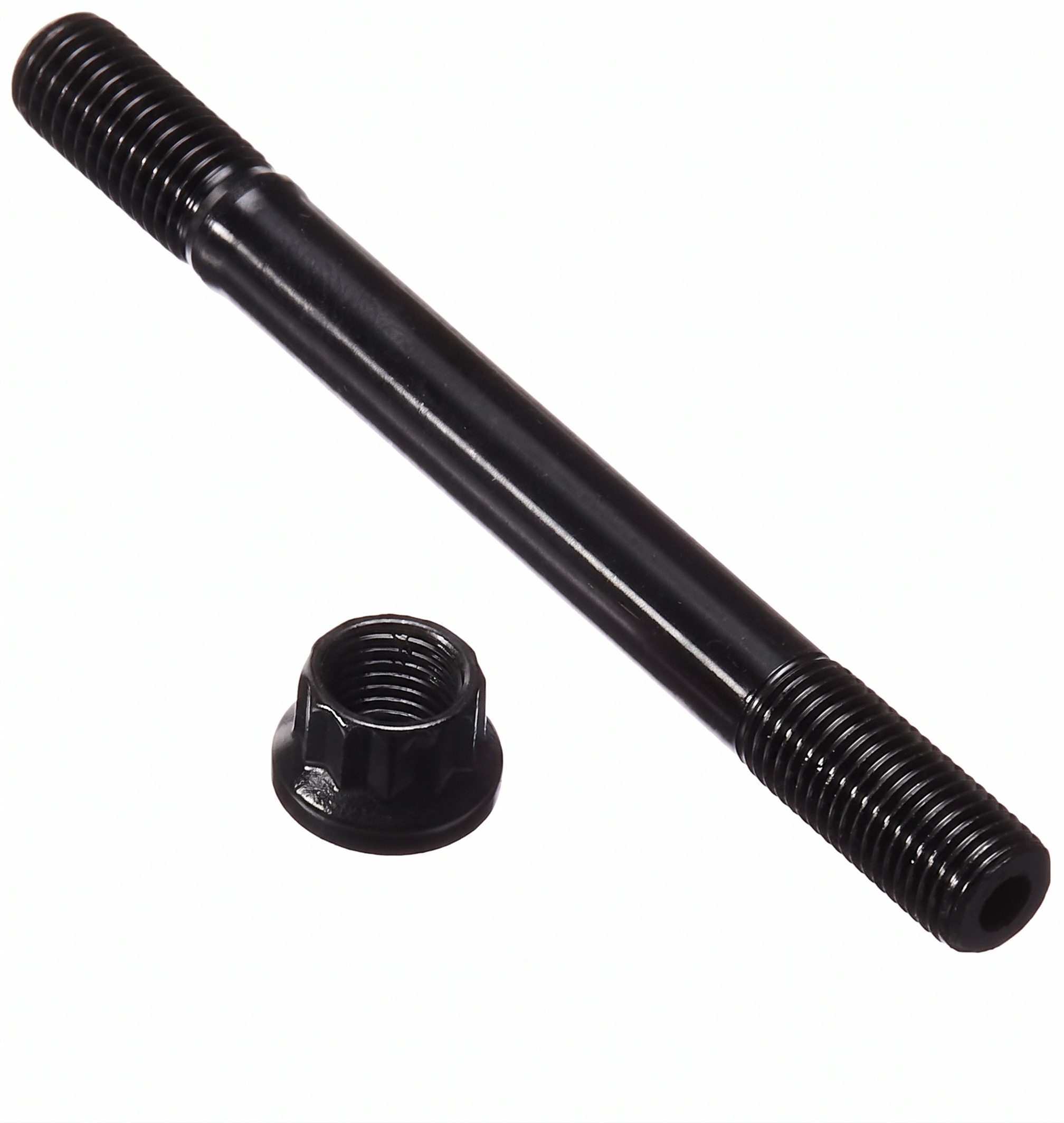
Kits of ARP 8740 cylinder head studs for the Audi 100 and 200 with the ten-valve five-cylinder KZ or NF.
Audi's naturally aspirated inline five-cylinder with ten valves and a single overhead camshaft comes in two capacities: the 2.2-litre KZ (2,226 cm³, 81 mm bore) and the 2.3-litre NF (2,309 cm³, 82.5 mm bore). It powers the Audi 100 C3, with the KZ and then the NF, and the Audi 200 C3, with the NF.
As standard, the head of the KZ and NF is held by 11 mm internal multi-spline bolts, M11 x 1.5 and 96 mm long (part number 049 103 384 B), tightened to 40 Nm, then 60 Nm, then half a turn, two 90° passes being permitted; these bolts are new at every assembly. ARP replaces them with two kits of 7/16 in studs in 8740 steel.
Cylinder head fasteners work constantly: they hold the head tight against the block, crush the gasket to the right value and hold back the push of the gases at every combustion. If they lose even a little tension, the gasket starts to leak.
Two ARP references are offered: the 204-4205 and the 204-4703, the latter in "undercut" form according to the 2026 ARP list. Both instruction sheets describe the same method: studs screwed into the block by hand before the head goes on, washers and nuts lubricated, then three equal stages up to 80 ft-lb. 8740 is a chrome-molybdenum steel, rated by ARP at 200,000 psi tensile strength. As a reference point, an engine's standard fasteners mostly belong to property classes 10.9 and 12.9, with a minimum tensile strength between 150,800 and 176,900 psi. In 7/16 in, the 8740 studs hold up to 700 hp on this five-cylinder engine (calculated estimate).
| Part number | Brand | Grade / material | Nuts | Thread |
| ARP-204-4205 | ARP | 8740 | 12-point | 7/16 in |
| ARP-204-4703 | ARP | 8740 - Undercut | 12-point | 7/16 in |
| Part number | Stage 1 | Stage 2 | Stage 3 |
| ARP-204-4205 | 36 Nm | 72 Nm | 108 Nm |
| ARP-204-4703 | 36 Nm | 72 Nm | 108 Nm |
For both kits: no torque is applied to the studs as they go into the block: they are screwed in by hand. The instruction sheet leaves the option of thread locker to mount them permanently, provided tightening is done before the product hardens.
A stud that opens into the block's water jacket gets the ARP thread sealer on its block-side threads, as both instruction sheets specify.
Tightening to torque is done in three steps, in the order set by the engine manufacturer, with ARP lubricant applied to the threads and under the nuts, a condition for the table values to apply.
The washers also receive ARP lubricant, as stated in the instruction sheet.
These values come from ARP instruction sheets 204-4205 and 204-4703; if they differ, the official instruction sheet prevails, with the full procedure and the manufacturer's tightening sequence. Read the ARP 204-4205 instruction sheet; Read the ARP 204-4703 instruction sheet
All torque values on this page are given with ARP assembly grease on the threads and under the nuts; another lubricant would make them wrong.
| Buy the ARP assembly grease → |
The undercut version is recognisable by its reduced shank between the threads. According to ARP, this profile equalises stretch from one stud to the next and makes the clamping more consistent, while compensating for head gasket compression during installation: engine sealing benefits.
 | Founded in the early 1970s by Gary Holzapfel, who came from the aerospace industry, ARP (Automotive Racing Products) set itself the mission of eliminating engine failures caused by inadequate fasteners in competition. Its thousands of parts are designed and produced in California, in several material grades depending on the application. |
| Criterion | Original head bolts | Reinforced ARP studs |
 |  | |
| Tightening method | Torque then angle (40 Nm, 60 Nm, then 2 x 90°) | Torque only, in 3 stages |
| Block threads | Stressed at every tightening | Preserved (studs fitted hand tight) |
On an engine left standard, the original fasteners do their job. Switching to reinforced fasteners becomes worthwhile as soon as:
| Model | Engine code | Power | Years |
| Audi 100 C3 2.2 (Saloon, Avant) | KZ | 112-115 hp | 1984-1987 |
| Audi 100 C3 2.3 / 2.3 E (Saloon, Avant) | NF | 132-136 hp | 1986-1991 |
| Audi 100 C3 2.3 quattro / 2.3 E quattro (Saloon, Avant) | NF | 132-136 hp | 1986-1990 |
| Audi 200 C3 2.3 (Saloon, Avant) | NF | 136 hp | 1986-1991 |
OEM reference: 049 103 384 B
On a tuned KZ or NF, the extra load works the head gasket harder than in stock form. ARP studs in 8740 screwed in by hand clamp the head more evenly: less risk of a leaking gasket, and of a rebuild costing far more than the kit.