Product successfully added to your shopping cart
Quantity
Total
There are 0 items in your cart. There is 1 item in your cart.
Total products
Total shipping To be determined
Total

1.5L 16v - EA211
Manufacturers
1.5L 16v - EA211
 View larger
 Warning: Last items in stock!
New product
Kit of 4 forged 4340-steel connecting rods for the Audi/Volkswagen 1.5 TSI EA211.
The 1.5 TSI from the EA211 family is an inline four-cylinder petrol engine with direct injection and turbocharging, displacing 1,498 cc. Introduced to expand the EA211 range, this unit powers a large share of the Volkswagen Group’s recent models (Volkswagen, Audi, SEAT and Škoda), with outputs from 130 to 150 hp depending on the version, several featuring cylinder deactivation (ACT) to cut fuel use. Efficient and compact, it is aimed above all at everyday economy.
That very focus on economy is what shows its limits in tuning: as soon as boost pressure, load or engine speed is raised, the stock rods become the most likely failure point of the reciprocating assembly. Fitting forged rods is then the structural step to make a 1.5 TSI reliable when you want to unlock more of its potential, without fearing failure at the first excess.
Our forged rods for the 1.5 TSI EA211 are machined from wrought 4340 steel, the benchmark for demanding engine builds. They suit the widest range of uses , circuit and trackday, drift, rally, drag, time attack, hillclimb , and work equally well on a heavily tuned fast-road 1.5 TSI and on a full competition engine. Whether the target is Stage 2, a high-power Stage 3 or Stage 4 and beyond, they support the rise in performance with no compromise on durability. Each kit gathers 4 rods weight-matched to ±1 g and faithfully keeps the factory 19 mm piston pin and 136.8 mm center-to-center length.
Where the factory rod is calibrated for high-volume production cost, the forged 4340 rod brings a far wider mechanical margin: around +19% yield strength, +8% tensile strength and +19 to +37% fatigue endurance. That reserve lets the boosted 1.5 TSI absorb cylinder-pressure peaks and inertia loads without cracking. The whole range shown here shares this same forged 4340 steel.
| Reference | Brand | Profile | Rod bolts | Pin bore (mm) | Small-end width (mm) | Big-end bore (mm) | Big-end width (mm) | Center-to-center (mm) | Weight (g) |
|---|---|---|---|---|---|---|---|---|---|
| R-VW-006-I | ZRP | I | ARP 2000-5/16"-38mm | 19 | 50,6 | 20 | 136,8 | 395 | |
| R-VW-006-I-L19 | ZRP | I | ARP L19-5/16"-38mm | 19 | 50,6 | 20 | 136,8 | 395 |
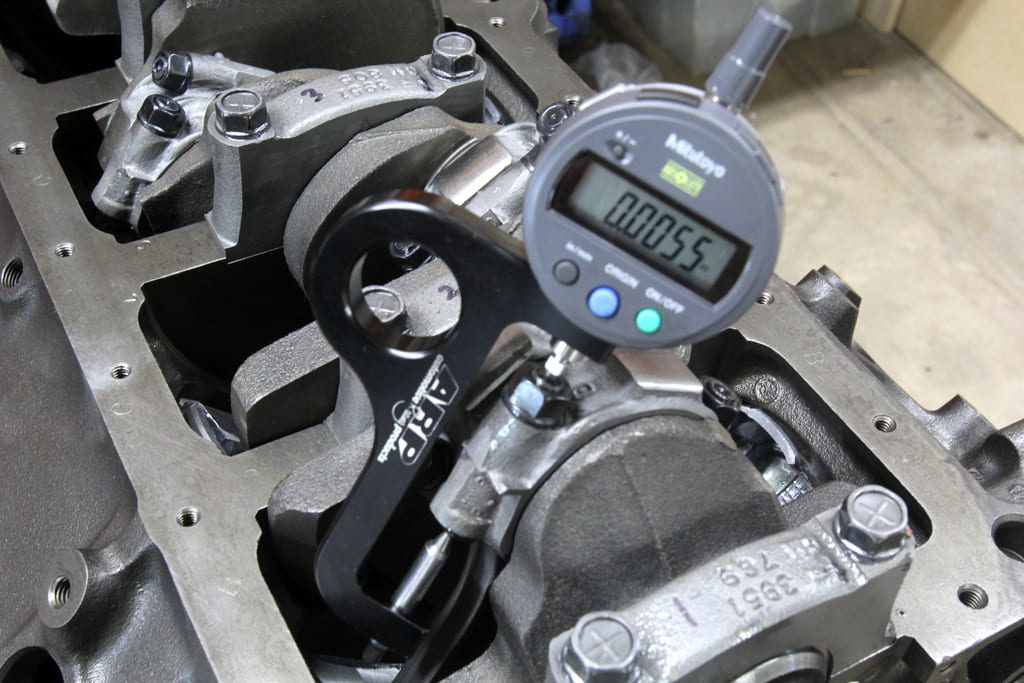
Handling mistakes weigh more than the accuracy of the wrench: no universal joint, no flexible extension and no impact gun to run the 1.5 TSI bolts down, and a square grip on the bolt head. The movement must be slow and continuous up to the click, with no jerk, then the gauge is read again to confirm the stretch obtained falls inside the range given, with no attempt to exceed it. The table values, for ARP 2000 as for ARP L19 in 5/16" 38 mm, are those specified by the bolt manufacturer and must be followed scrupulously, the stretch measurement remaining the reference against plain torque.
| Reference | Brand | Rod bolts | Torque | Recommended stretch |
|---|---|---|---|---|
| R-VW-006-I | ZRP | ARP 2000-5/16"-38mm | 40.7 N·m | 0.140 to 0.152 mm |
| R-VW-006-I-L19 | ZRP | ARP L19-5/16"-38mm | 54.2 N·m | 0.127 to 0.140 mm |
| 4340 is a low-alloy steel with nickel, chromium and molybdenum. Forging aligns the metal grain with the load paths, closes foundry micro-porosity and delivers mechanical strength on another level from a cast or sintered production rod. The aim is a tensile strength of around 930 to 1,080 MPa together with excellent fatigue endurance , exactly what is needed as soon as the engine gains torque, revs or boost. This is the material that makes up our entire EA211 range. |
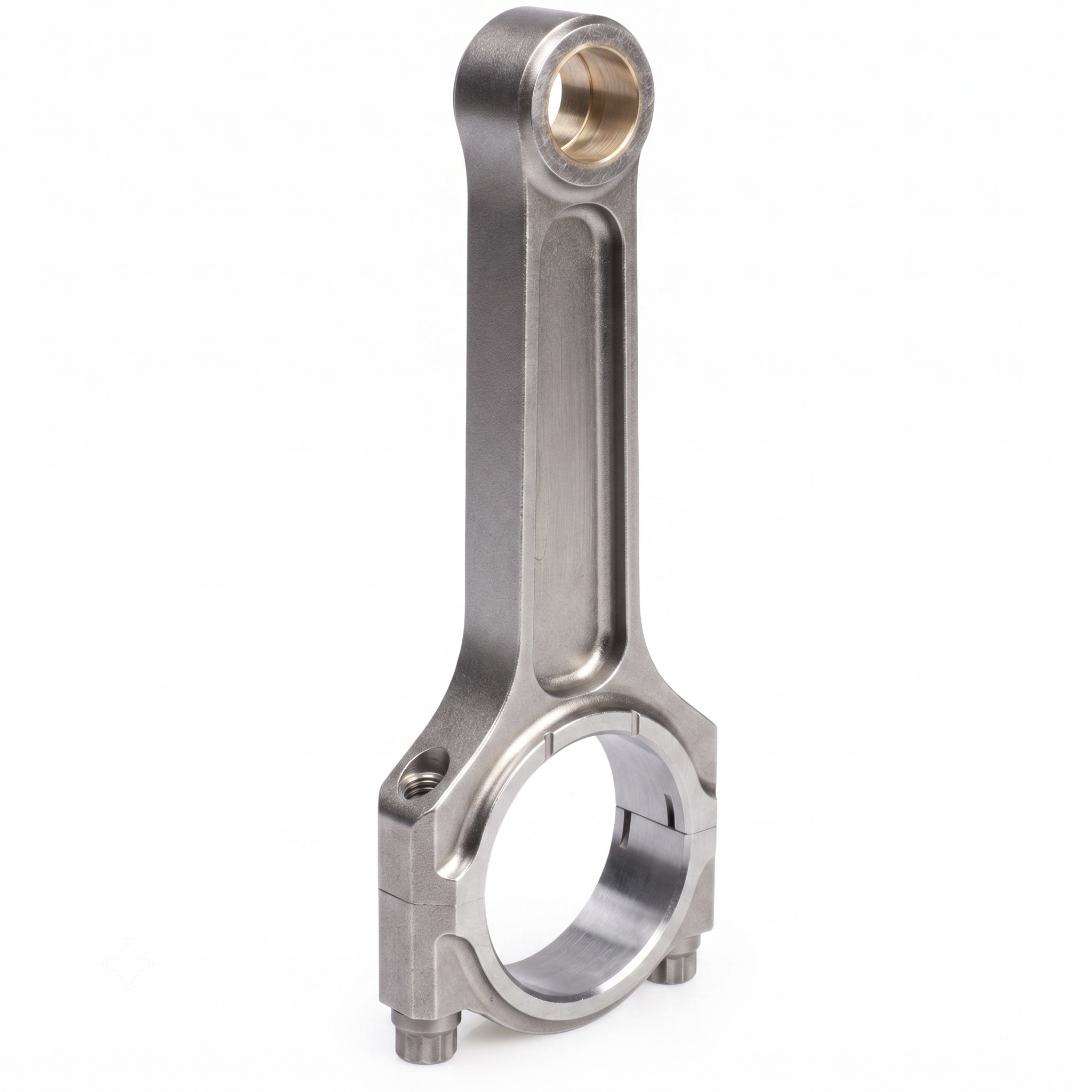 | The I profile (ZRP), light (395 g), gathers material where the compression loads act. Machined from forged 4340 steel, it relies on a lighter reciprocating assembly to help the 1.5 TSI pick up revs while keeping high reliability. It is available with either ARP 2000 or ARP L19 bolts, in 5/16" diameter. |
Two grades of ARP bolts are offered, both in the 5/16" diameter suited to the EA211 center-to-center:
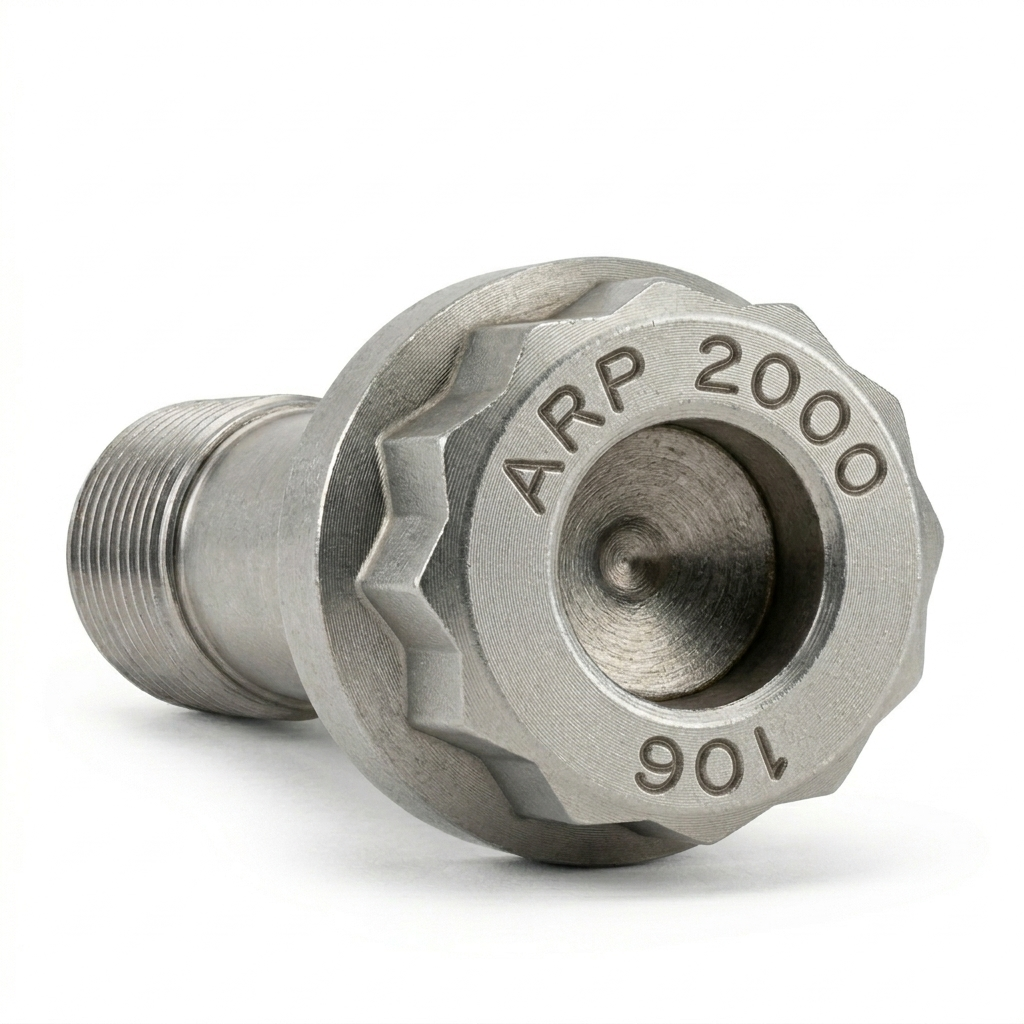 | ARP 2000: the all-round benchmark alloy, with a tensile strength of about 220,000 psi (1,517 MPa). It is the default choice: it covers the vast majority of builds, from simply raised boost to high power, and makes the bottom end reliable for good. It secures power of around 150 hp per cylinder and rpm up to 8,500. |
 | ARP L19: a higher-strength alloy, around 260,000 psi (1,793 MPa), intended for heavily tuned engines run at high rpm and high cylinder pressure. More sensitive to corrosion and hydrogen, it is reserved for the most extreme builds. It targets serious turbo builds, up to nearly 200 hp per cylinder. |
| The most reliable way to guarantee preload is not to aim for a torque figure but to measure bolt stretch with a dial gauge. Tighten in steps until the recommended stretch is reached , 0.140 to 0.152 mm for ARP 2000, 0.127 to 0.140 mm for ARP L19 , ensuring an even, repeatable clamp load, cylinder after cylinder. |
 | This EA211 range is made by ZRP, a specialist in race forged rods. It is offered in the I profile, machined from 4340 steel and supplied with either ARP 2000 or ARP L19 bolts in 5/16". Each reference ships as a complete weight-matched set of 4, with its dedicated ARP bolts. |
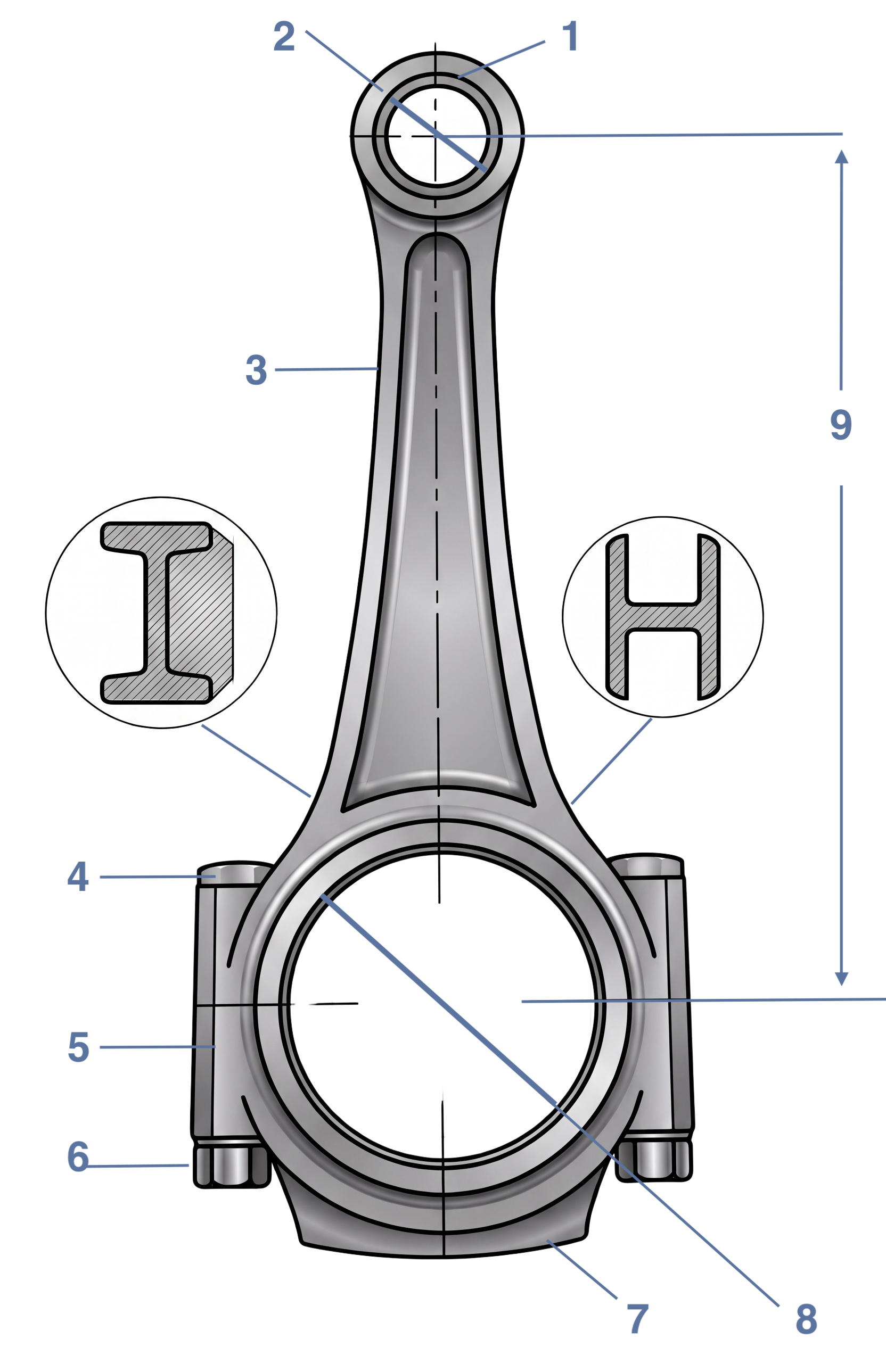 | 1) Small end 2) Small-end diameter 3) Rod beam 4) Rod bolt 5) Big end 6) Rod nut / bolt 7) Rod cap 8) Big-end diameter 9) Center-to-center |
This table gathers the vehicles powered by the Audi Volkswagen 1.5L 16V TSI EA211. Measure the piston pin diameter and the rod length before ordering to rule out any fitting error.
| Make | Model (chassis) | Engine code | Power | Years |
|---|---|---|---|---|
| Audi | A1 Sportback (GBA) 35 TFSI | DADA, DPCA, DXDB | 150 hp | 2018– |
| Audi | A3 (8V) / Sportback / Limousine / Cabriolet | DADA, DPCA | 150 hp | 2017–2020 |
| Audi | Q2 (GAB, GAG) 35 TFSI | DADA, DPCA, DXDB | 150 hp | 2018– |
| Audi | Q3 (F3B) 35 TFSI | DADA, DPCA, DXDB | 150 hp | 2018– |
| SEAT | Arona (KJ7, KJP) | DADA, DPCA, DXDB | 150 hp | 2017– |
| SEAT | Ateca (KH7, KHP) + 4Drive | DADA, DPCA, DXDB | 150 hp | 2018– |
| SEAT | Ibiza V (KJ1, KJG) | DADA, DPCA, DXDB | 150 hp | 2017– |
| SEAT | Leon (5F1) / ST (5F8) | DACA, DPBA, DADA, DPCA | 130–150 hp | 2018–2020 |
| SEAT | Leon (KL1, KLG) / Sportstourer (KL8, KLD) | DPBA | 131 hp | 2019– |
| SEAT | Tarraco (KN2) ACT | DADA, DPCA, DXDB | 150 hp | 2018–2024 |
| Škoda | Kamiq (NW4) | DADA, DPCA, DXDB | 150 hp | 2019– |
| Škoda | Karoq (NU7, ND7) + 4x4 | DADA, DPCA, DXDB | 150 hp | 2017– |
| Škoda | Kodiaq I (NS6, NS7, NV7) + 4x4 | DADA, DPCA | 150 hp | 2018– |
| Škoda | Octavia III (5E) / Combi | DADA, DPCA | 150 hp | 2017–2020 |
| Škoda | Scala (NW1) | DADA, DPCA, DXDB | 150 hp | 2019– |
| Škoda | Superb III (3V) / Break | DADA, DPCA | 150 hp | 2017–2024 |
| Volkswagen | Arteon (3H7, 3H8) | DADA, DPCA | 150 hp | 2017– |
| Volkswagen | Golf VII (5G, BQ, BE) / Variant / Sportsvan | DACA, DPBA, DADA, DPCA | 130–150 hp | 2017–2020 |
| Volkswagen | Golf VIII (CD1, DA1) / Variant (CG5, DB5) | DPBA | 131 hp | 2019– |
| Volkswagen | Passat B8 (3G, CB) / Variant | DADA, DPCA | 150 hp | 2018–2024 |
| Volkswagen | Polo VI (AW1, BZ1, AE1) | DADA, DPCA | 150 hp | 2018–2021 |
| Volkswagen | T-Cross (C11, D31) | DADA, DPCA, DXDB | 150 hp | 2020– |
| Volkswagen | T-Roc (A11, D11) + 4motion | DADA, DPCA, DXDB | 150 hp | 2017– |
| Volkswagen | Tiguan (AD1, AX1) + Allspace | DADA, DPCA, DXDB | 150 hp | 2018– |
| Volkswagen | Touran (5T1) | DADA, DPCA, DXDB | 150 hp | 2018– |
On a tuned 1.5 TSI, a stock rod that lets go usually takes the block, crankshaft and pistons with it. Investing in a forged rod set from the outset costs far less than a full rebuild after a failure. You permanently strengthen the bottom end, preserve the value of your build and drive with peace of mind, in intensive use as much as day to day.