Product successfully added to your shopping cart
Quantity
Total
There are 0 items in your cart. There is 1 item in your cart.
Total products
Total shipping To be determined
Total

1.5L 12v - 3E-E
Manufacturers
1.5L 12v - 3E-E
Warning: Last items in stock!
New product
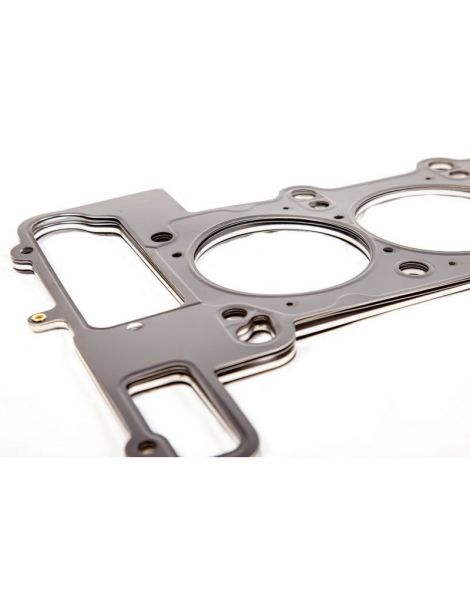
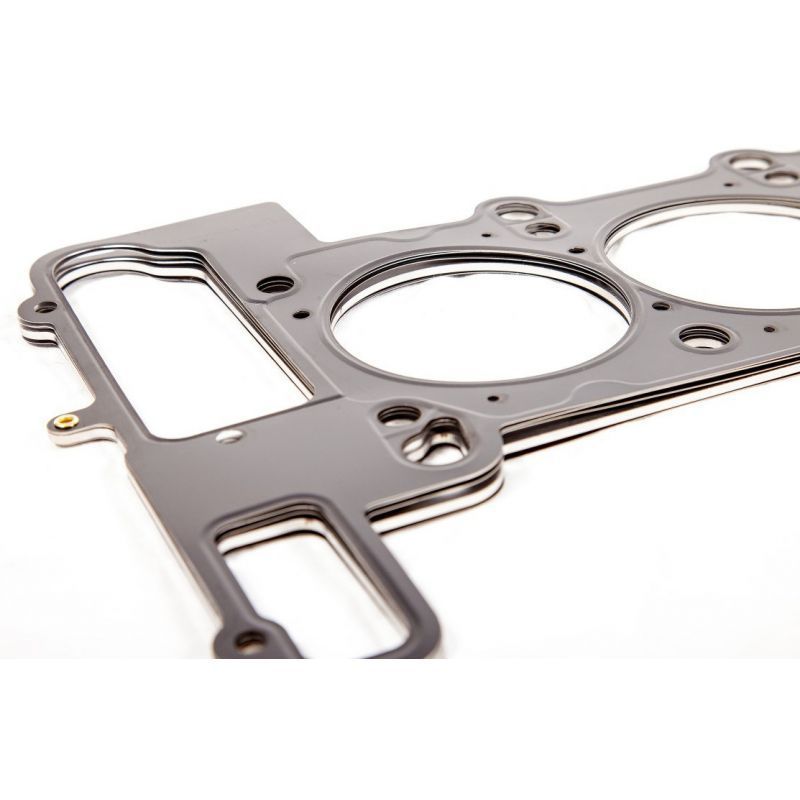
Reinforced Cometic head gasket, in copper. Sold individually, one gasket per engine.
The 3E-E petrol engine of 1.5 litres powers the Toyota Corolla II, Corolla Liftback, Corsa and Tercel, detailed below.
The original gasket carries part numbers 11115-11010 and 11115-11060. Toyota publishes neither its bore, nor its thickness, nor its construction. Sized for the original combustion pressure, it is no longer adequate once that pressure rises: the clamping force falls, the cylinder head lifts slightly off the block and coolant passes into a cylinder.
Sealing does not depend on the gasket alone: it also rests on the fasteners that clamp the cylinder head to the block. Pure copper at 99.9% resists corrosion, deforms without breaking and carries heat away well, without becoming fragile at high temperature.
This page presents the three part numbers of the American maker Cometic, a specialist in competition gaskets, in a single construction: copper. All have a 74 mm bore; the thickness is 1.27 mm, 2.03 mm or 2.39 mm. The gasket is drawn slightly wider than the cylinder, by at least 0.5 mm on the bore. Each part number is sold individually, one gasket per engine.
| Gasket bore | Thickness | Gasket volume | Gasket type OEM not specified | Brand | Part number OEM 11115-11010 |
| 74 mm | 1.27 mm | 5.46 | Copper | Cometic | C4109-050 |
| 74 mm | 2.03 mm | 8.73 | Copper | Cometic | C4109-080 |
| 74 mm | 2.39 mm | 10.28 | Copper | Cometic | C4109-094 |
A gasket's volume is the free space it leaves above each cylinder. This volume adds to the combustion chamber and lowers the compression ratio; only gaskets of the same bore are comparable.
| Fasteners | Engines | Tightening torque |
| Original cylinder head bolts | 3E-E | not published by the manufacturer |
Before fitting, check with a straight edge that the cylinder head and block are flat, and have them machined if needed. Cometic checks the flatness of every copper gasket it produces.
| Cometic copper A plate of pure oxygen-free copper, grade C110 (99.9% copper). This metal does not fear corrosion, crushes without cracking, carries heat away well and keeps its suppleness at high temperature. Cometic checks the flatness of every gasket and advises, for the best result, fitting it with a crimped sealing ring. |
Gasket bore. The Cometic copper gaskets exist in 74 mm (C4109-050, C4109-080 and C4109-094), with no other bore.
Thickness. Toyota gives no thickness for the original gasket. A thicker gasket enlarges the combustion chamber and lowers the compression ratio; a thinner one reduces it and raises the ratio.
| Your goal | Thickness to choose |
| Keep the original compression ratio | Original thickness not published by the manufacturer: measure the removed gasket and choose among 1.27 mm, 2.03 mm and 2.39 mm |
| Skimmed cylinder head, make up the lost height | Three thicknesses are offered, 1.27 mm, 2.03 mm and 2.39 mm: compare them with that of the removed gasket, plus the metal taken off when resurfacing |
| Forced induction build, lower the ratio | 1.27 mm, when the figure measured on the removed gasket is low |
| Naturally aspirated build, raise the ratio | 2.03 mm or 2.39 mm, when the figure measured on the removed gasket is high |
With no published original thickness, use a dial gauge to measure how far the pistons stand proud of the block face, especially to aim for 1.27 mm: this figure reveals the clearance left between piston and cylinder head.
 | Founded in 1989 in Concord, Ohio, Cometic Gasket, Inc. designs gaskets and sealing parts for engines. Its reputation comes from the made-to-measure gasket, cut to the bore and thickness requested, entirely manufactured in the United States from American raw materials. |
| Criterion | Original gasket 11115-11010 and 11115-11060 | Reinforced gaskets |
| Construction | Construction not specified by the manufacturer | Pure copper, 99.9% (grade C110) |
| Gasket bore | not published by the manufacturer | 74 mm |
| Thicknesses available | thickness not published by the manufacturer | 1.27 to 2.39 mm |
| Compression ratio adjustment | None | Through the thickness chosen |
| Resistance to overpressure | Limited to standard output | Designed for forced induction |
| Model | Engine code | Power | Years |
| Toyota Corolla II Berline à hayon (_L3_) 1.5 (EL31) | 3E-E | 71 hp | 1987-1989 |
| Toyota Corolla Liftback (_E9_) 1.5 | 3E-E | 71 hp | 1987-1989 |
| Toyota Corsa Berline à hayon (_L3_) 1.5 (EL31) | 3E-E | 79 hp | 1989-1990 |
| Toyota Corsa Coupé (_L3_) 1.5 (EL31) | 3E-E | 79 hp | 1989-1990 |
| Toyota Tercel Berline tricorps 1.5 (EL42) | 3E-E | 83 hp | 1989-1994 |
OEM part number: 11115-11010 and 11115-11060.
Important: the part numbers on this page suit the 3E-E engine: check your vehicle's engine code before ordering.
When the original gasket reaches its limit, this copper gasket takes over: pure copper keeps its ductility when hot without turning brittle, and the seal between head and block is preserved.
As soon as you add a turbo, a supercharger or raise the compression ratio, the head gasket is the first part of the top end to give way. A reinforced gasket avoids the leak, then the cylinder head removal it forces, a job far more expensive than the part.